A short thread on the evolution of British battleship armour.
Detail is in the images!
(1/10)
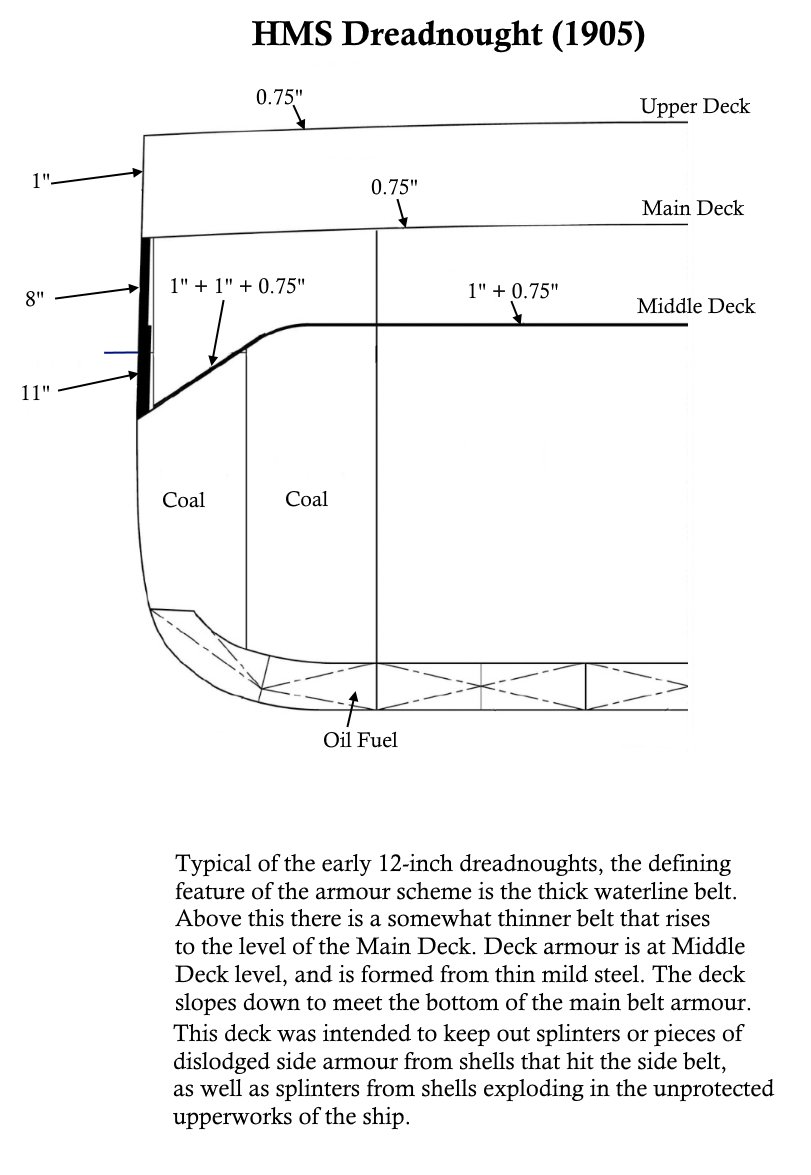
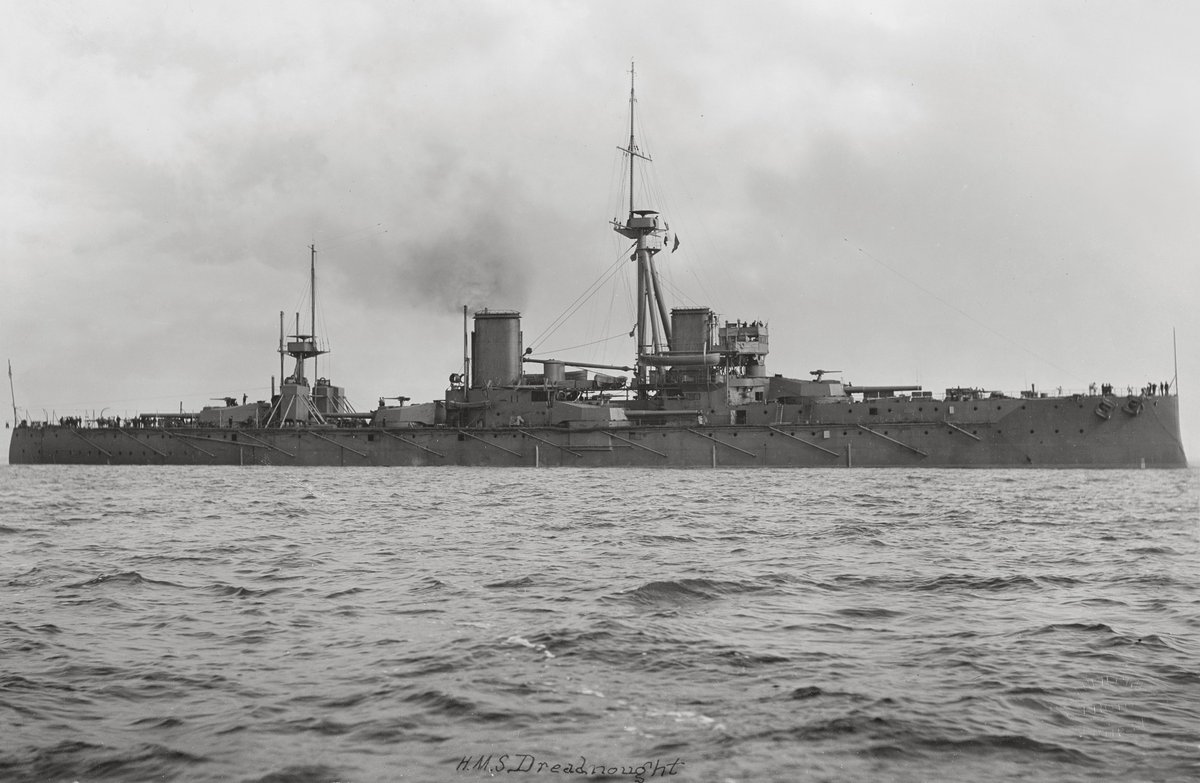
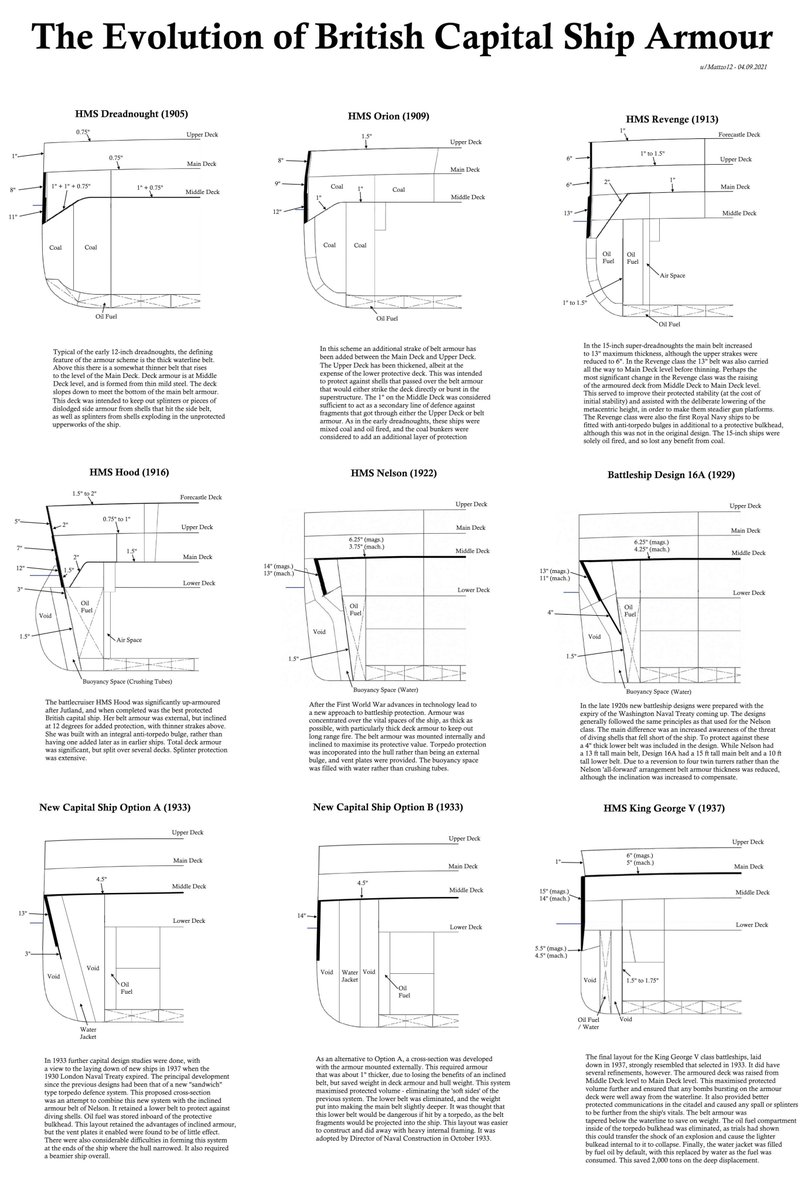
HMS Dreadnought, laid down 1905. This layout was typical of the early British 12-inch armed battleships, although of course there are some detail differences.
(2/10)
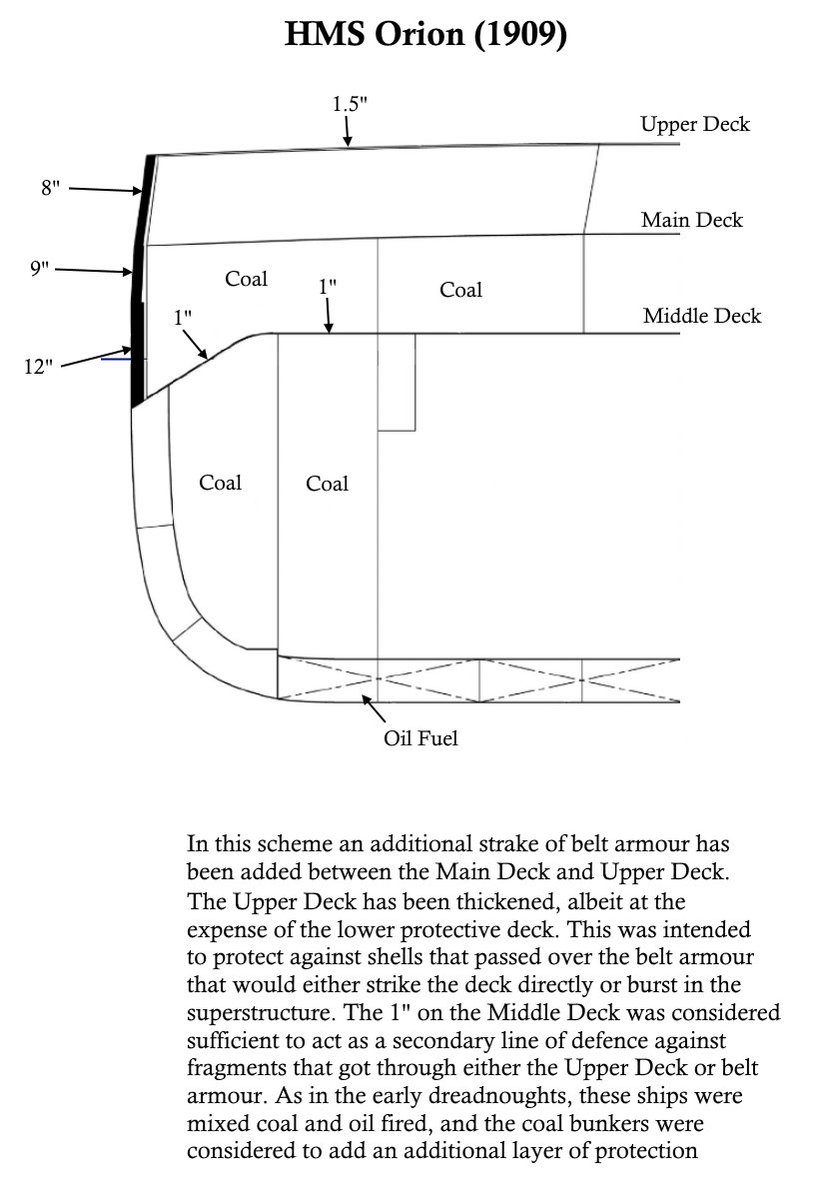
HMS Orion, laid down 1909. This layout is typical of the 13.5-inch armed 'super-dreadnoughts', although there are some improvements in later classes.
(3/10)
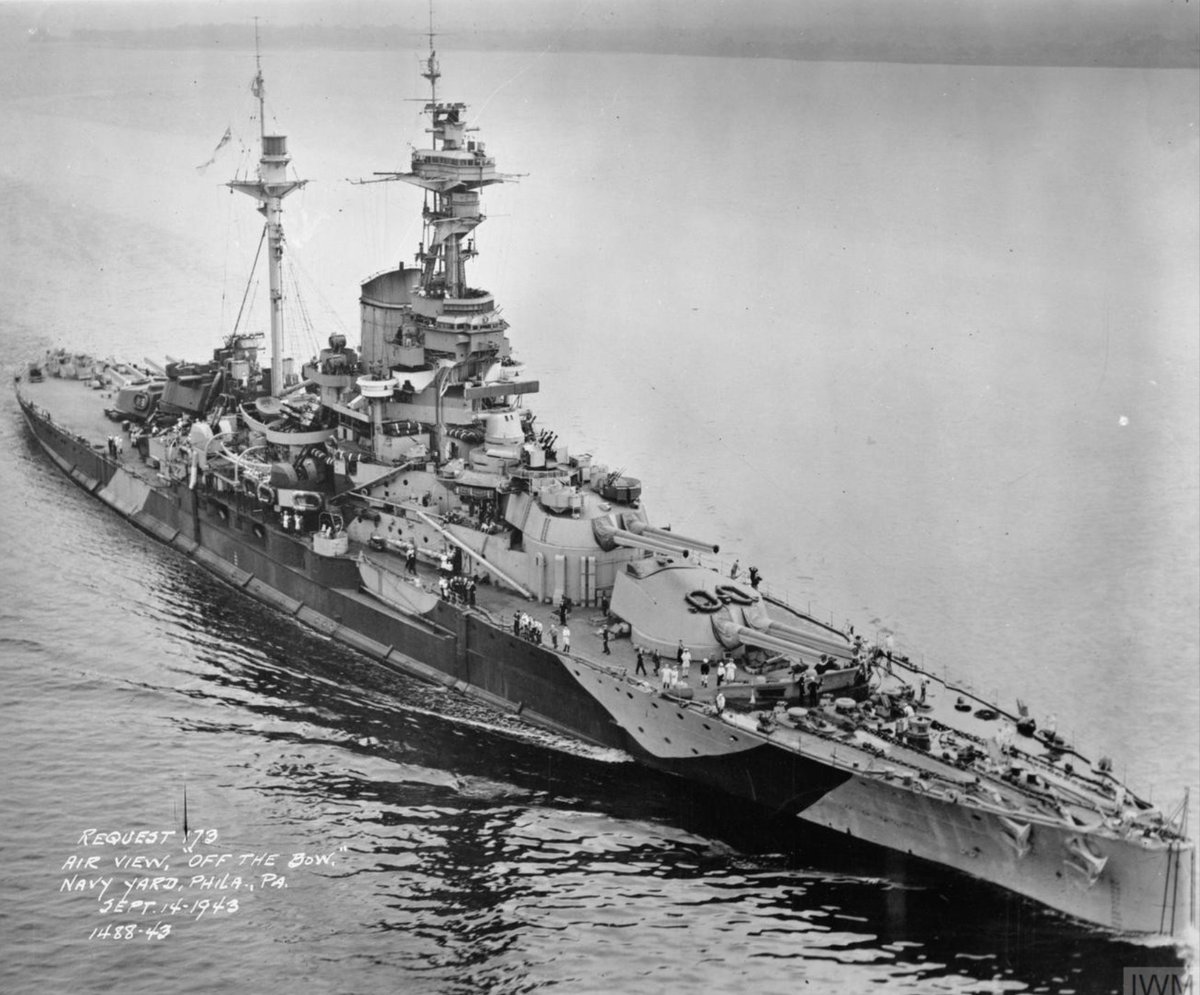
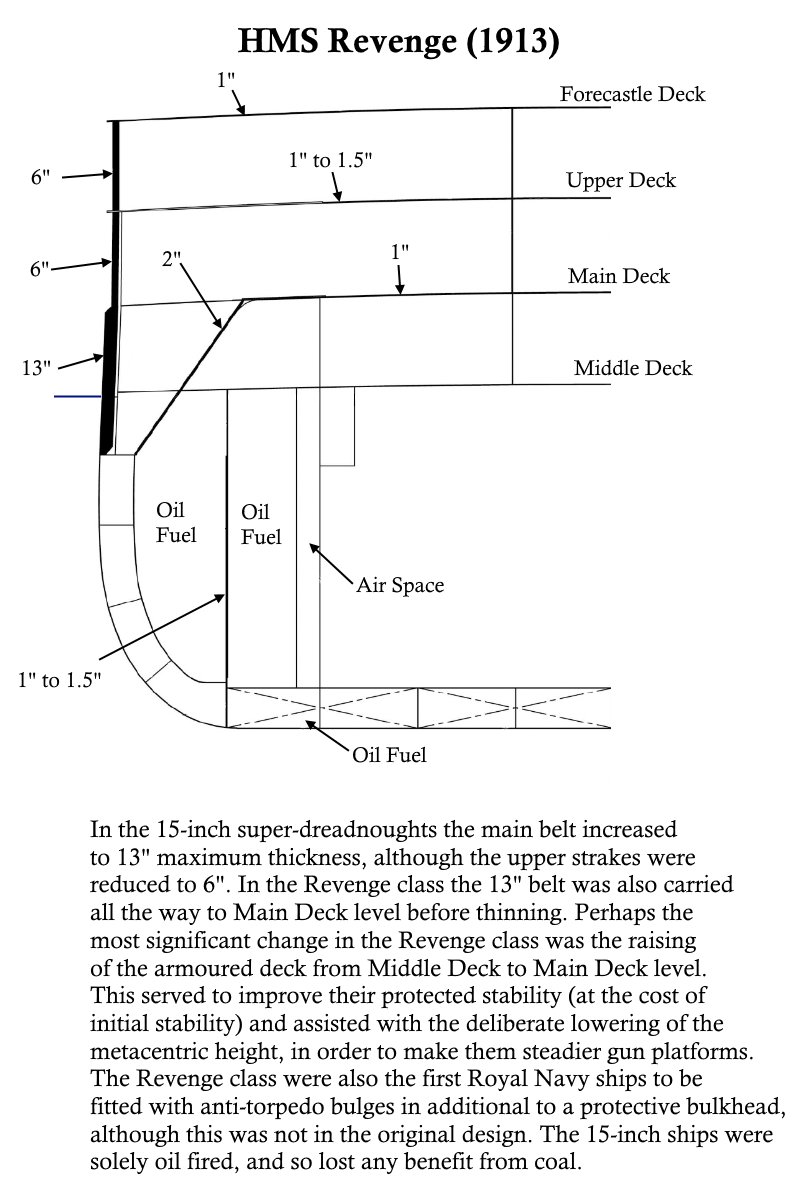
HMS Revenge, laid down 1913. Chose the R class over the Queen Elizabeths as they are more noteworthy in terms of armour scheme development.
(The Queen Elizabeths are a bit of a cross between this and the 13.5-inch design!)
(4/10)
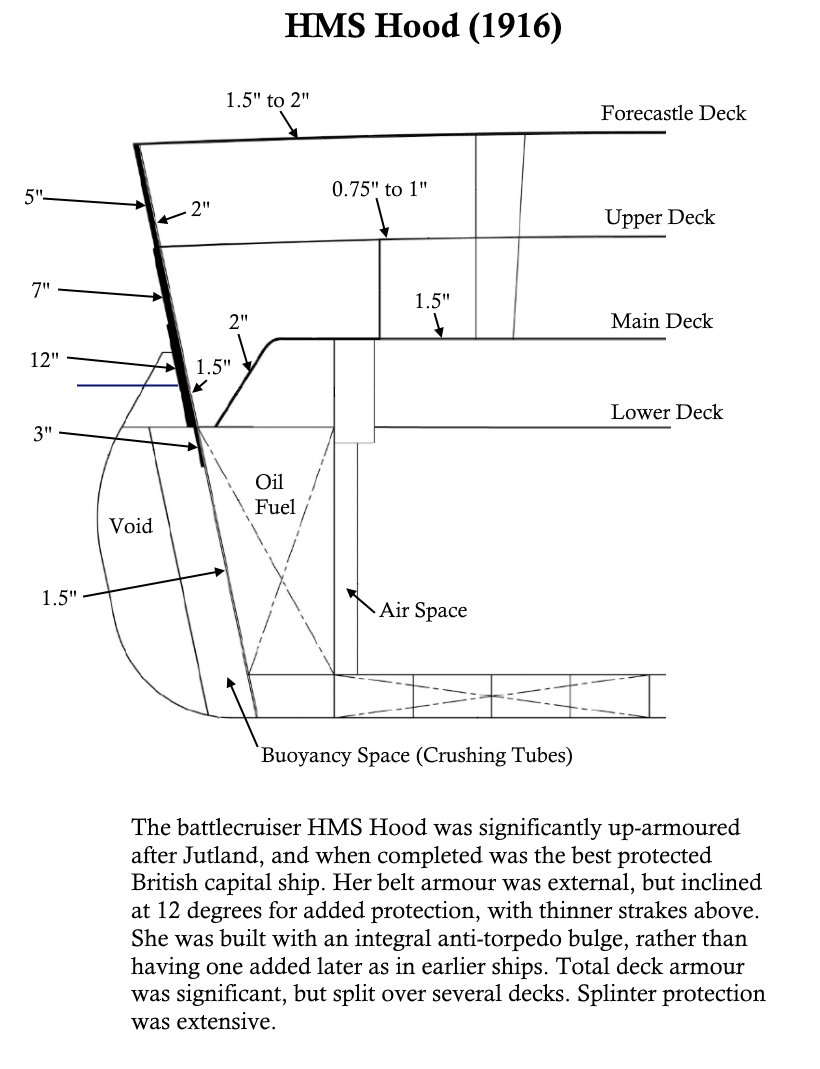
HMS Hood. Despite her unfortunate end, she was the best protected British capital ship yet built when she completed. Perhaps the ultimate example of an incremental armour scheme in Royal Navy service.
(5/10)
HMS Nelson, laid down in 1922. Somewhat of a revolution in armour scheme, with the full scale adoption of an 'All or Nothing' scheme after the advances of the First World War.
(6/10)
Battleship 1929. Never built, as the 1930 London Naval Treaty extended the battleship building holiday. But an importance piece of the puzzle.
(7/10)
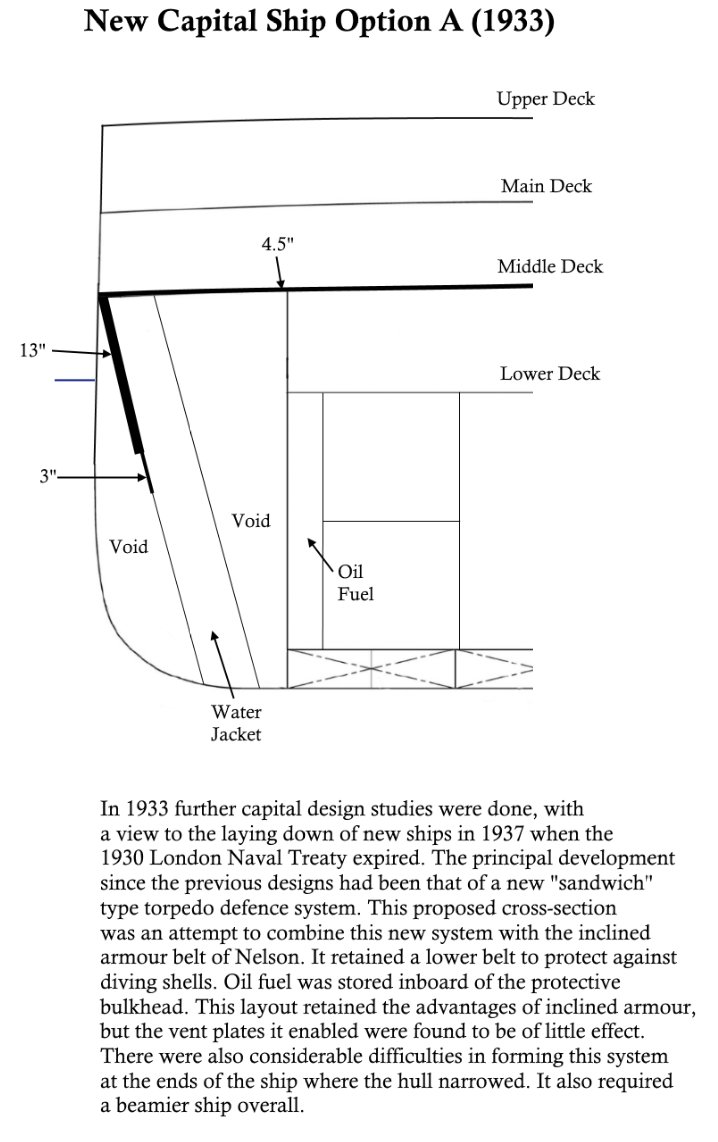
Option A of a new design presented in 1933. A design study rather than a final design, this attempts to combine a new torpedo defence system with the inclined belt.
(8/10)
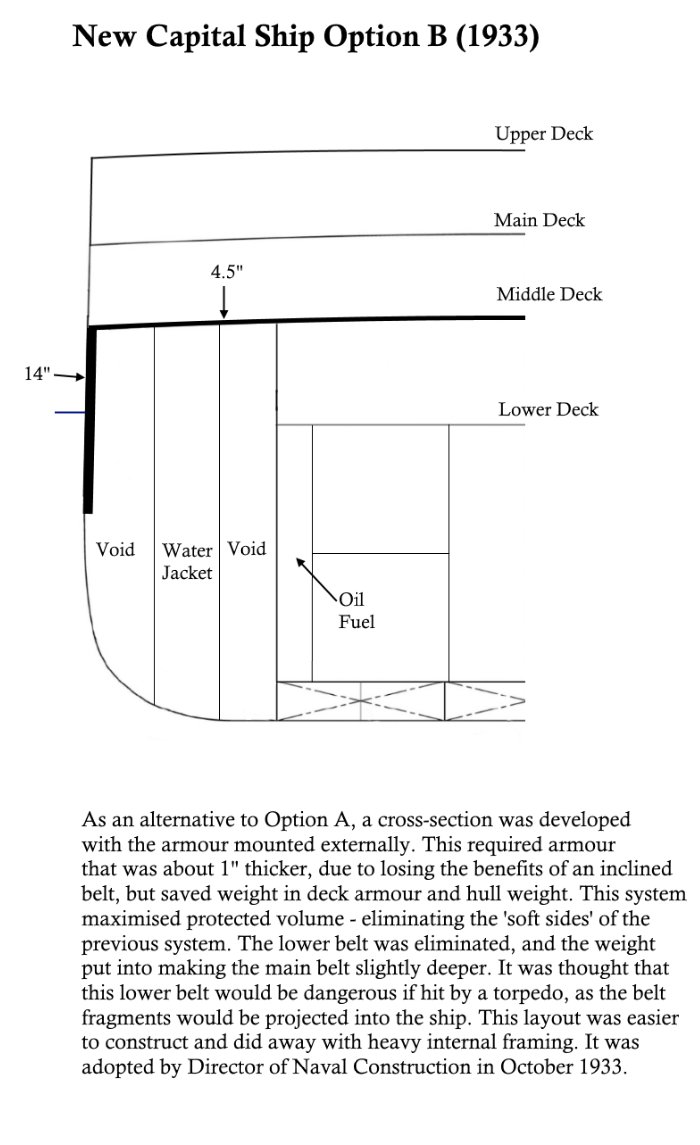
Option B of the 1933 design study. This works the armour externally. This was the option chosen.
(9/10)
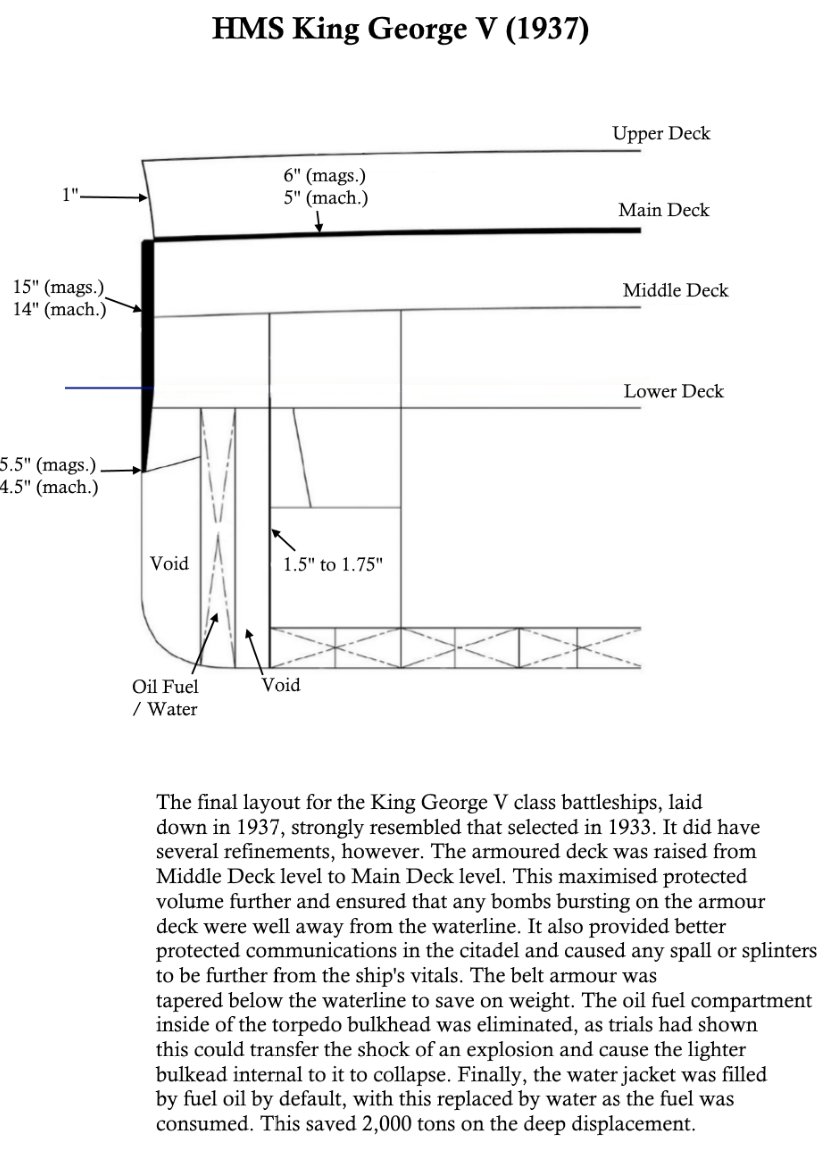
HMS King George V, laid down 1937. This is Option B above, but further developed and refined. This would be the template for the Royal Navy's last generation of battleship.
(10/10)
All 9 cross-sections in the same image.
• • •
Missing some Tweet in this thread? You can try to
force a refresh

Between 1928 and 1930 thirteen 10,000 ton cruisers of the Kent, London and Norfolk classes were commissioned in the Royal Navy and the Royal Australian Navy.
These were large ships, with 8in guns, designed for trade protection.
1/
The ships were as follows:
Kent class: 5 British + 2 Australian ships
London class: 4 ships
Norfolk class: 2 ships
2/
However, these ships had been built to strict Treaty imposed weight limits. One of the compromises had been the absense of an armour belt over the machinery - protection being focused in 'boxes' around the magazines.
A rapid tour through the 59 'big gun' battleships (and battle cruisers) of the Royal Navy - from Dreadnought in 1906 to Vanguard in 1946.
1/26
Dreadnought.
The first all big gun battleship in the world. Several navies had been moving in this direction, but Dreadnought was the first. 10 x 12in guns and capable of 21 knots, she marked a new era of battleship design. She rammed and sunk a U-Boat in 1915.
2/26
Bellerophon, Temeraire, Superb.
The first British follow-on designs to Dreadnought, they largely retained the same layout with minor improvements. All three served at Jutland.
Why did the Royal Navy only reconstruct 3 ships in the 1930s out of the 10 Queen Elizabeths and Revenges? Why did only Royal Oak of the R class get improved deck armour? Did they plan to reconstruct Barham and Malaya?
The answers involve a dive into RN "large repairs".
1/
Up until 1930 the scrapping schedule was set by the 1922 Washington Naval Treaty.
1935 - 3 x Queen Elizabeths
1936 - 1 x Queen Elizabeth, 1 x Revenge
1937 - 2 x Revenges
1938 - 1 x Revenge
1939 - 1 x Queen Elizabeth
1941 - 1 x Revenge
2/
Under this plan, and given the financial situation of the 1920s and the benign international situation, it wasn't worth giving any of these ships a major modernisation beyond the fitting of anti-torpedo bulges. Nor, to be honest, did the technology exist to do so.
At a glance, the four twin turrets and tower like superstructure narrow it down to one of the three fully reconstructed Queen Elizabeths. (Vanguard, commissioned 1946, does share these features but she is very distinct!)
2/
To tell Warspite apart from her sisters Queen Elizabeth and Valiant there are a couple of useful tells.
The easiest is the secondary armament. Warspite had a mixed battery - 4 x 6in guns in casemates (red box) and 4 x 4in guns in twin mounts (blue box) on each beam.
I am going to take the liberty of extensively quoting from the end of Friedman's book 'British Carrier Aviation', because I think it makes some important points about aircraft carriers and seapower relevant to today.
1/
"This long story would seem to have several morals. The first and most important is that carriers are valuable because they enhance the flexibility - the crucial element - of seapower. Navies are effective because they can present a great variety of enemies with a wide range
2/
of threats, so that a potential enemy must provide against so wide a range of contingencies as to reduce his capability in any one of them. This is a natural consequence of the mobility of navies as compared to ground (and associated air) forces.
3/
Was looking through a copy of Janes Fighting Ships 2009-10 this week. Comparing the fleet then and the theoretical or anticipated replacement plans to what actually happened is depressing.
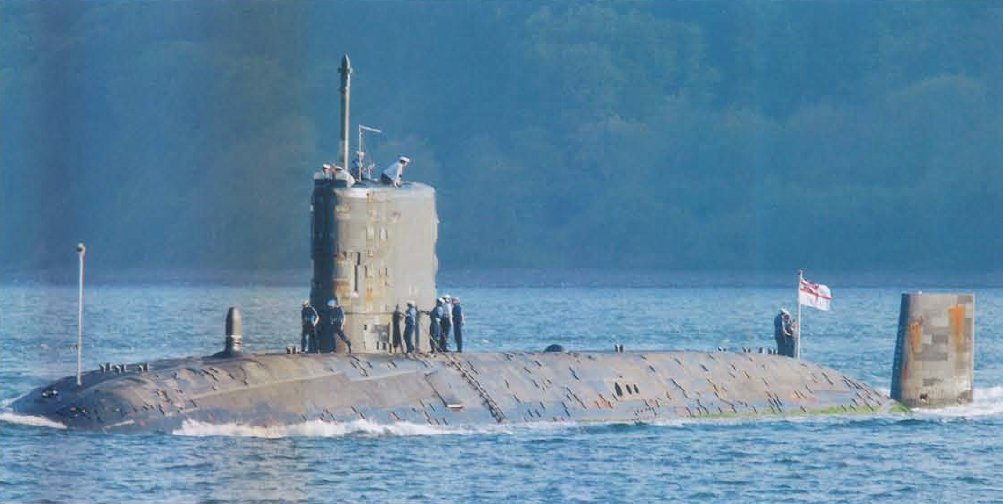
In 2009 there were 8 in service (1 Swiftsure, 7 Trafalgars). Sceptre was to decommission in 2010 with Astutes replacing the Trafalgars on a 1-to-1 basis between 2009 and 2022. Astute boat 5 was due to commission in 2017.
2/18
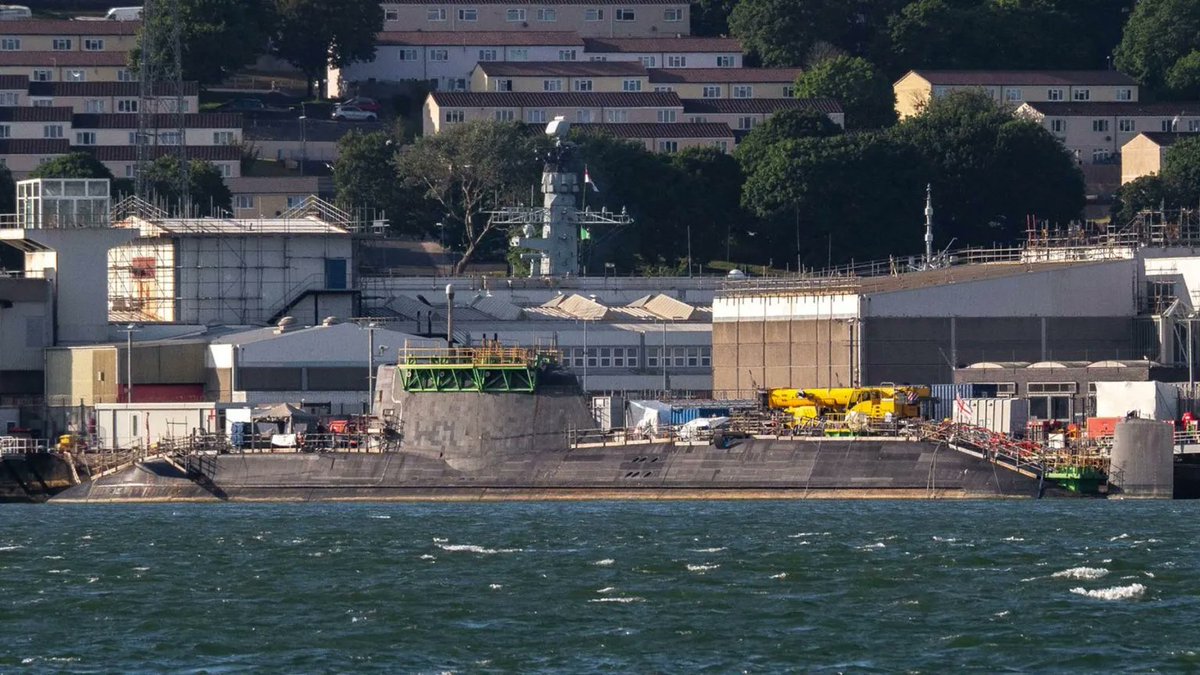
Today we have 6 in service - theoretically (1 Trafalgar, 5 Astutes). Triumph is life extended to 2025. Astute boat 5 commissioned in 2022, 5 years late. Astute boats 2 and 3 haven't been to sea for years.