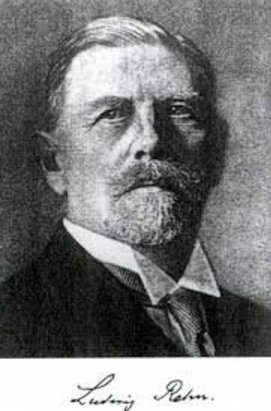
Cardiac surgery is 125 years old today! On September 9 1896, the German surgeon Ludwig Rehn performed the first successful operation on the human heart.
Born in Allendorf, Germany, in 1849, Rehn had an unusually varied career. While working as a GP near Frankfurt he noticed that workers at a local chemical works were prone to bladder cancer - deducing that the cause was a chemical they worked with, aniline.
But he's better known for this famous paper, published in 1897. It begins: "In a desperate case of a stab wound of the right ventricle, I was forced to operate because of persistent bleeding." A sentence that heralded the era of cardiac surgery.
The patient was Willhelm Justus, a gardener aged 22. On Sept 7th 1896 Justus was stabbed in an apparently unprovoked attack. When the police found him he had been unconscious for three hours. They took him to the Frankfurt hospital where Rehn worked.
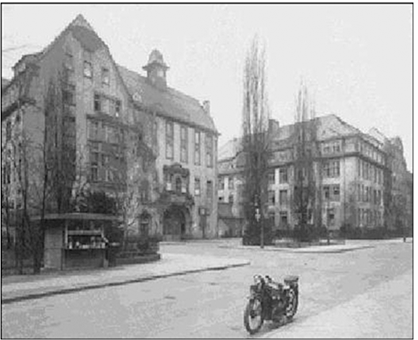
The doctors there found themselves examining a 'deathly pale' patient who 'groaned a great deal'. They assumed he would die. Rehn had been away on a trip, but when he returned two days later the patient had taken a major turn for the worse. He decided to operate.
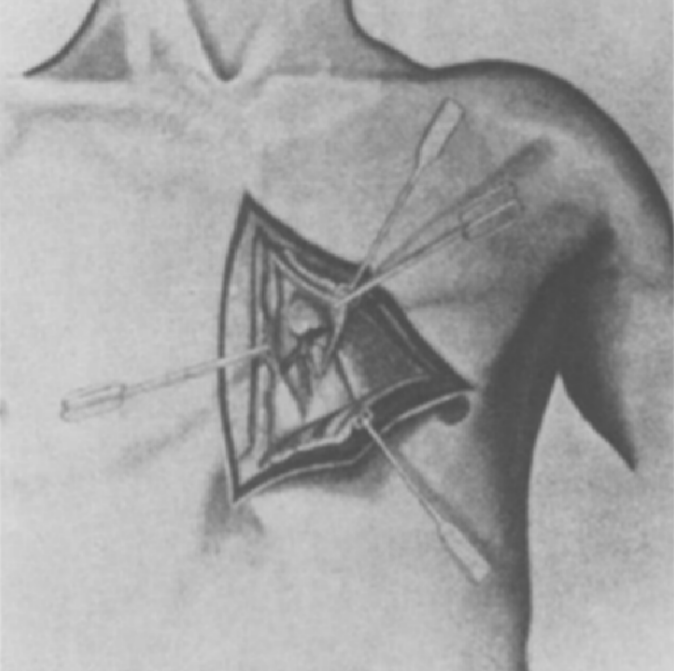
Rehn found a wound in the right ventricle, which he closed with three silk sutures - not easy, since the heart was still beating. "The heart continued to beat, and we could breathe freely," he wrote. The patient had a 'tendency to vomiting', but made a full recovery.
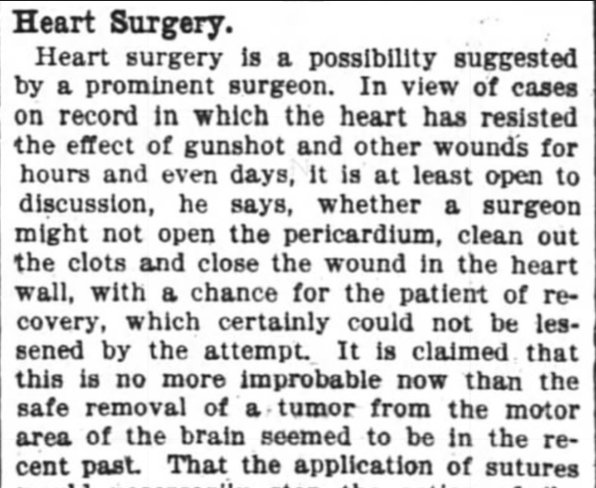
It's difficult to express just how great an advance this represented. Just a few weeks earlier, when another surgeon had suggested that heart surgery was not far from being a reality, it made front-page news.
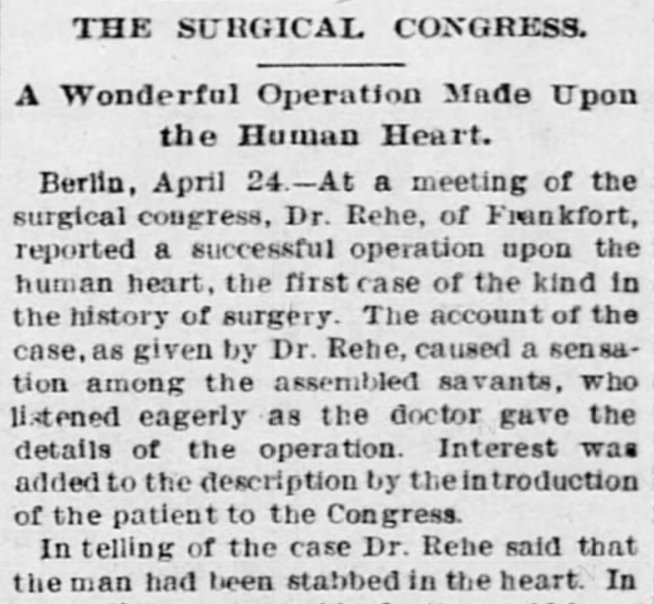
When Rehn announced the success of his operation at a conference the following April, it caused a sensation - not least because he introduced the audience to his patient Willhelm, who was fit and well.
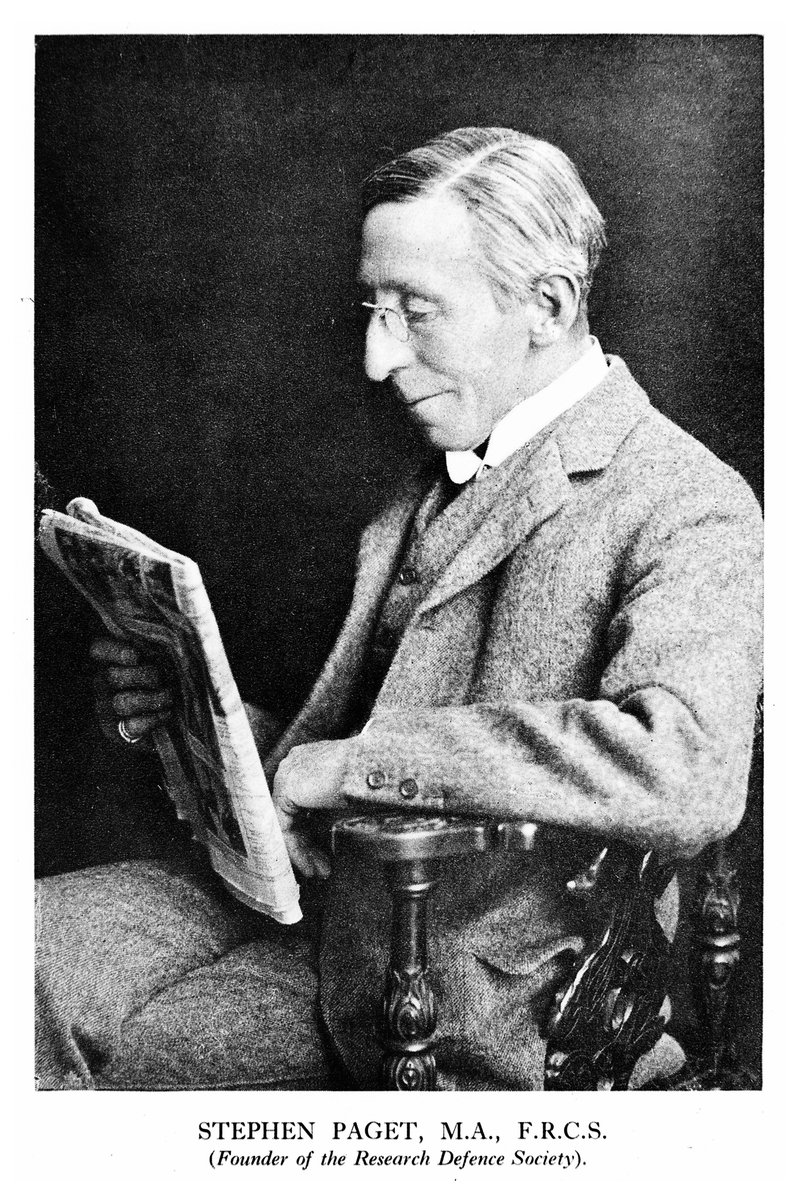
In a book published the same year as Rehn's operation, the British surgeon Stephen Paget had discussed cardiac injury, writing: "No new method, and no new discovery, can overcome the natural difficulties that attend a wound of the heart." He was happy to be proved wrong.
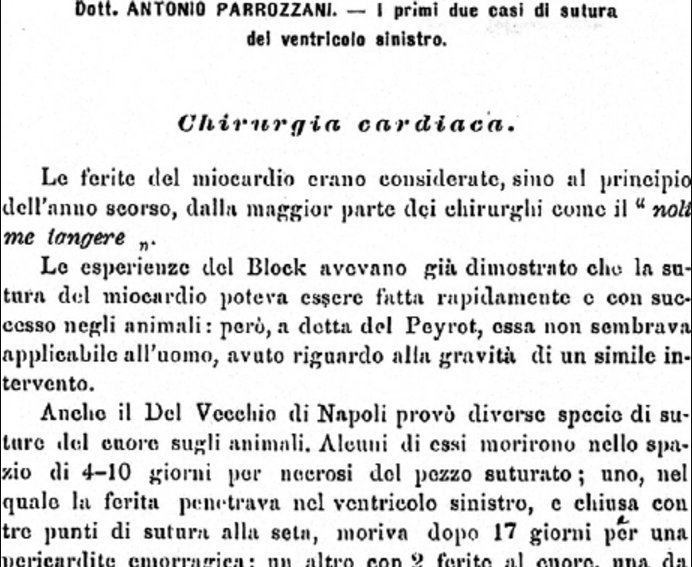
In April 1897, shortly after Rehn announced his triumph to the world, the Italian surgeon Antonio Parrozzani performed the second cardiac suture - and the first on the left ventricle. Operations in other countries followed. A new era had begun.
Rehn concluded his original case report by expressing the hope that 'this case will not remain a curiosity, but, rather, that the field of cardiac surgery will be further investigated.' He certainly got his wish!
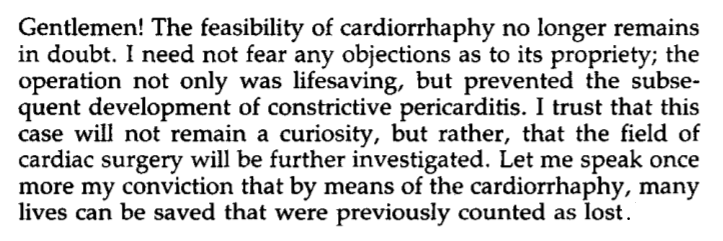
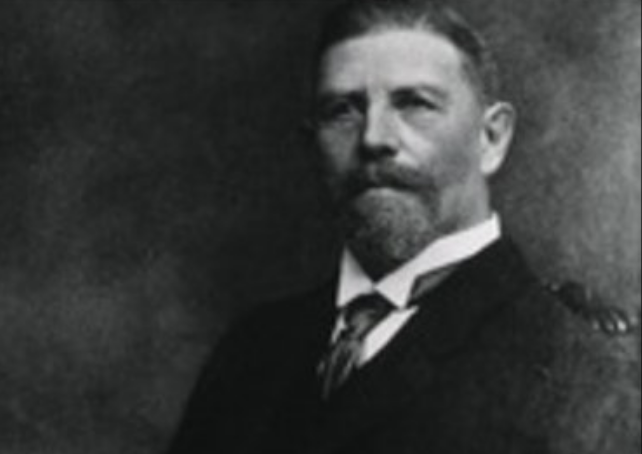
It is thanks to Ludwig Rehn that we are today celebrating a century and a quarter of cardiac surgery - exactly 125 years after his pioneering surgical success.
For much more on this subject, and how the whole field of cardiac surgery has evolved in the 125 years since Rehn's operation, my book The Matter of the Heart is a good starting place: penguin.co.uk/books/1110892/…
• • •
Missing some Tweet in this thread? You can try to
force a refresh

Today is the 150th anniversary of a historic operation performed by this surgeon - George William Callender. Few people know his name now, but Callender was once described as the first person to operate on the human heart.
Callender was born in 1830 in Bristol and won a scholarship to St Bartholomew's Hospital in London. Smart both intellectually and sartorially, he amused the other students by always insisting on changing into evening dress for dinner - even when dining alone.
On October 28 1872, Callender was on duty at @BartsHospital when a 31-year-old man arrived on the ward. He had previously been examined at the hospital and told that nothing was wrong with him - but after nine days of severe pain he decided to return. Which was just as well.
There's a lot of stuff on Twitter at the moment about Covid-related science communication, good and bad.
So this seems a good time to share a interesting example of a scientific urban myth that I've just come across. Here's a short THREAD.
On my morning walk I was listening to a 2013 edition of @BBCRadio4's reliably funny panel show The Unbelievable Truth. At one point in this programme, the presenter @RealDMitchell's script asserts that:
"In 2005, scientists at the University of Groningen revealed that men and women find it easier to achieve orgasm whilst wearing socks. The scientists believe this is because the couples were more comfortable and therefore more relaxed when they didn’t have cold feet."
How did Alexander Graham Bell and Wilhelm Roentgen contribute to a historic surgical operation that took place 125 years ago next month? Here's a THREAD about a presidential assassination, the inventor of the telephone, and the evolution of medical imaging.
The story begins on July 2 1881, when President James Garfield was shot at point-blank range while waiting for a train in Washington D.C. His attacker was immediately arrested, but the President was gravely wounded.
Over the next few weeks, President Garfield's life hung in the balance. His doctors wanted desperately to remove the assassin's bullet, but had no idea where it had ended up, and no means of finding out.
Just stumbled across some fantastic photos of the RAF Symphony Orchestra's 1944-5 tour of the USA. Including my dad, aged 24, who played the flute in the orchestra and the RAF Central Band throughout the war. @RAFMusic
Standing to the left of my dad is, I think, the celebrated horn player Dennis Brain, taking a photo of his own.
Aficionados of 20th-century British music may notice other great names here including the conductor Norman del Mar, bassoonist Cecil James, and violinists Sidney Griller and Frederick Grinke.
This historic document is the first electrocardiogram (ECG), recorded in 1887 by the British physiologist Augustus Desiré Waller.
By the 1880s, experiments had already shown that electrical activity played an important role in cardiac function. In 1878 John Burdon-Sanderson demonstrated the sequence of tissue depolarization and repolarization that accompanied the beating of a frog's heart.
In 1885, Waller (r) started to investigate electrical activity in animal hearts using a Lippmann capillary electrometer, an instrument which employed a column of mercury to detect electrical current. Tiny deflections in the height of the column were observed through a microscope.
A few years ago a 59-year-old man walked into a hospital in eastern France and asked to see a doctor. He had no symptoms, but said he had been advised to get an X-ray. This is it:
A lateral view gives a slightly clearer view of a foreign body in the lower lobe of the left lung. What could it be?
A dental drill bit! The patient explained that a little earlier his dentist had accidentally dropped it in his mouth and he had inhaled it. It had caused no immediate trouble but the dentist, aghast, told him he needed to get it extracted ASAP. 😱