
1/
🔥 Today we’re excited to launch the Auto Router in the Uniswap Interface
🧠 It delivers better execution prices for traders by splitting routes, using more data, and factoring in gas costs
uniswap.org/blog/auto-rout…
🔥 Today we’re excited to launch the Auto Router in the Uniswap Interface
🧠 It delivers better execution prices for traders by splitting routes, using more data, and factoring in gas costs
uniswap.org/blog/auto-rout…
2/
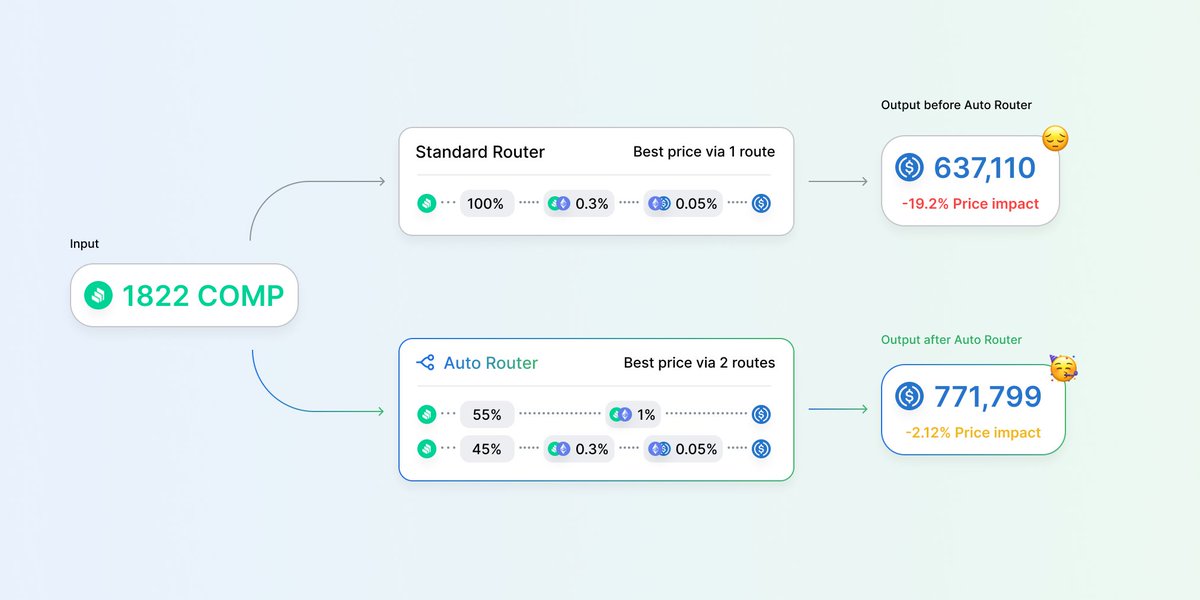
🔀 Split Routes
The Auto Router can split trades across up to seven routes to take advantage of liquidity in different pools
🔀 Split Routes
The Auto Router can split trades across up to seven routes to take advantage of liquidity in different pools
3/
💪 More powerful algorithm
The Auto Router uses a larger data set for more efficient execution, especially on large trades.
💪 More powerful algorithm
The Auto Router uses a larger data set for more efficient execution, especially on large trades.

4/
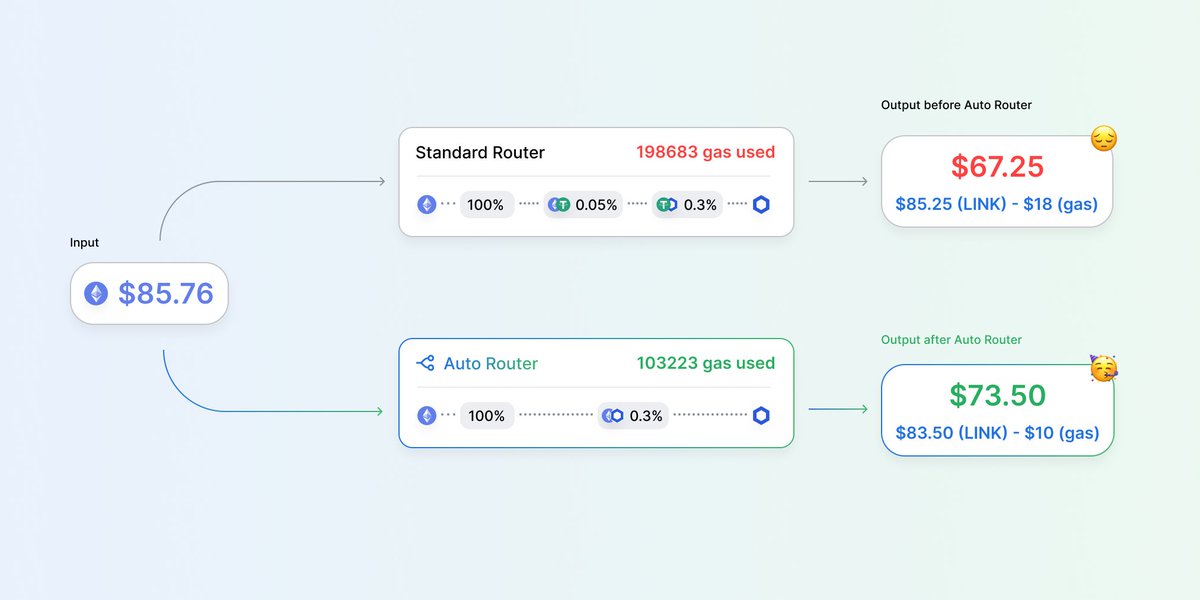
⛽️ Gas cost awareness
The Auto Router is aware of gas costs and will only take an extra hop if it yields a better effective price for you.
⛽️ Gas cost awareness
The Auto Router is aware of gas costs and will only take an extra hop if it yields a better effective price for you.
5/
📊 In our analysis of 4,429 on-chain swaps from June 1, 2021, the Auto Router improves pricing on 13.97% of all trades and 36.84% of trades between the Top 10 tokens by TVL.
📈 More than 60% of trades between $500k - $1m were improved.
📊 In our analysis of 4,429 on-chain swaps from June 1, 2021, the Auto Router improves pricing on 13.97% of all trades and 36.84% of trades between the Top 10 tokens by TVL.
📈 More than 60% of trades between $500k - $1m were improved.

6/
👋 We welcome other Uniswap community projects to use the Auto Router too.
💻 The code is fully open source on the Uniswap github. We’ll host a Twitch live stream in coming weeks to walk through the code.
github.com/Uniswap/routin…
github.com/Uniswap/smart-…
👋 We welcome other Uniswap community projects to use the Auto Router too.
💻 The code is fully open source on the Uniswap github. We’ll host a Twitch live stream in coming weeks to walk through the code.
github.com/Uniswap/routin…
github.com/Uniswap/smart-…
• • •
Missing some Tweet in this thread? You can try to
force a refresh






