Remember the story of the settler documented taking a rifle from a soldier and using it to shoot at Palestinians? Now it turns out that the IDF identified the settler, but didn't report him and are refusing to share his name. haaretz.com/israel-news/.p…
They're also refusing to say whether action was taken against the masked soldier who was seen shooting at Palestinians in May, even though one of the Palestinians ended up dead that day.
If that wasn't enough, even though soldiers have for months been documented protecting settlers while the latter attack Palestinians, the IDF's Advocate General says that no disciplinary action has been taken against these soldiers.
Apparently, the IDF Spokesperson's standard response—"the rules have been clarified"—was enough.
But what needs clarification is that it's not just a problem with settlers. The problem is the system which enables, encourages, protects them & whitewashes the truth on their behalf.
After the umpteenth time, it's hard to escape the conclusion that settler violence *is* state violence, carried out by an external contractor to make it easier to deny it. An entire system for whom a bullet in a Palestinian's head is little more than a PR accident.
Because we know exactly what need clarifying. We were there, we've spoken to countless soldiers who testify about the far-too-close relationship with settlers, the fear of arresting them, the vague rules and the settlers who give orders. It's all here: bit.ly/3BtshpQ
For example, one testifier told us: "Obviously they (the soldiers) aren’t allowed to touch Jews. That’s the whole story regarding the law as it applies in the territories. [...] The army isn’t allowed to arrest or detain [the settlers]." bit.ly/3673Wrt
Of the few politicians who commented on last week's wild attack in the Hebron Hills, fewer spoke of the soldiers at the scene. It's easier to condemn "extremists" than the system that protects them. But the settlers wouldn't be nearly as powerful w/out it.
• • •
Missing some Tweet in this thread? You can try to
force a refresh

Has your lecture been cancelled because the IDF broke into the university with live fire and stun grenades? For the third time in the course of three months, the IDF raided Birzeit. Why? Let's talk about Order 101, the IDF’s law banning freedom of speech and assembly🧵
Order 101, aka “Order Regarding Prohibition of Incitement and Hostile Propaganda”, is a military decree that the IDF issued just two months after it occupied the West Bank in 1967. This order criminalises a wide array of civic activities.
The last raid on Birzeit was notably violent, but breaking into the university is part of the IDF's routine. The IDF framed the recent attack as an operation against a “pro-terrorist gathering”, a typical justification within Order 101.
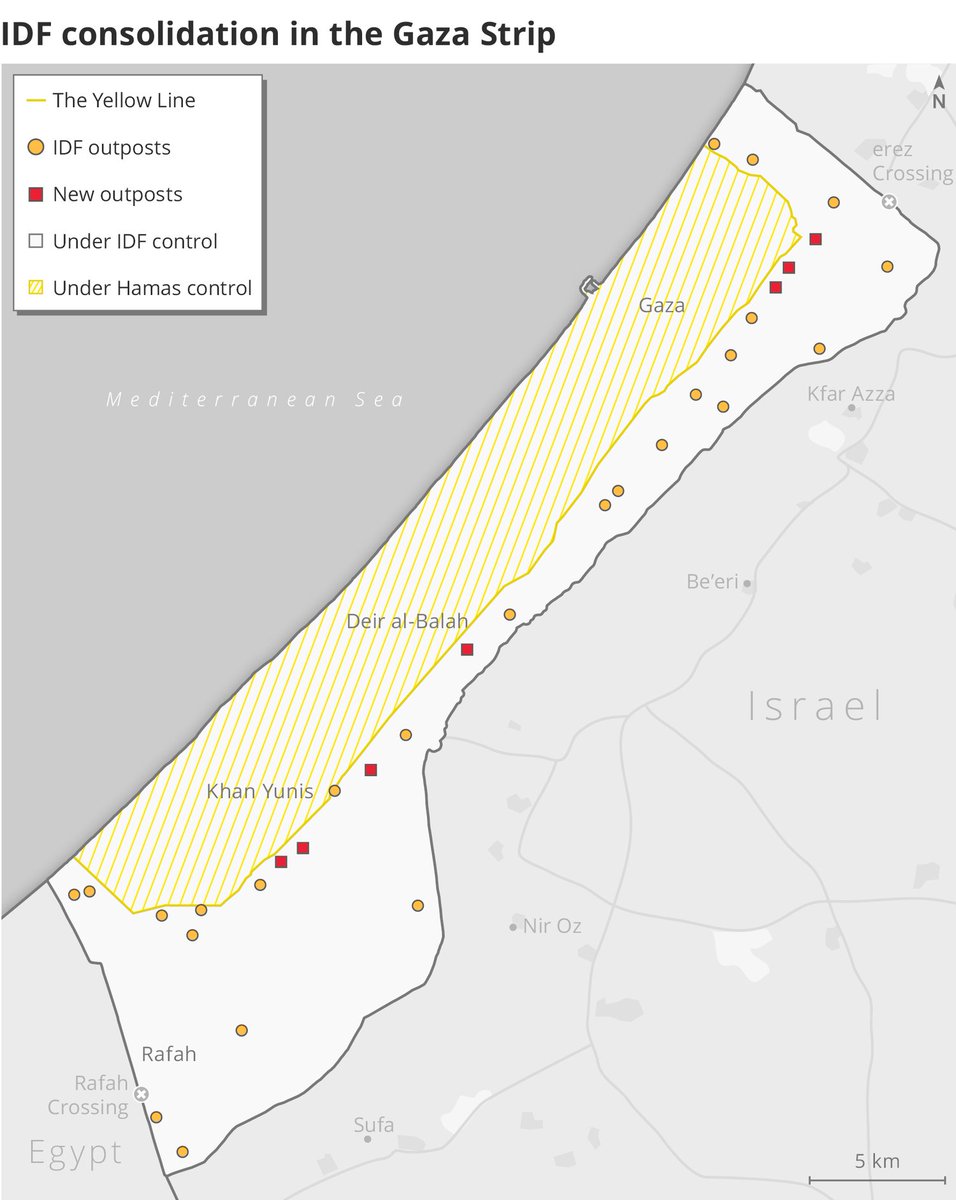
🟨IDF’s Yellow Line in Gaza.
56% of Gaza’s territory is now under Israel’s military control. The new temporary border, the Yellow Line, may become permanent. We can’t let this happen. What you must know about the Yellow Line (Fire-policy, destruction, settlements) 🧵
According to the plan, the IDF will withdraw from the Yellow Line to a more distant perimeter within the Gaza Strip and will be replaced by an International Stabilization Force. Meanwhile, Israel’s actions indicate a lack of any genuine commitment to withdrawal.
East of the Yellow Line, Israel has carried out continuous demolitions in a manner that suggests an intention to maintain a permanent military presence there. Israel has also constructed more than a dozen new military outposts along the Yellow Line.
On Friday, a horrifying terror attack took place inside Israel in which two Israelis were brutally murdered. However, it’s the aftermath of the attack that provides us with a clear example of how Israel’s security establishment operates. Here’s why:
The terrorist, who entered Israel through a hole in the separation barrier, apparently came from the city of Qabatiya in the West Bank. Immediately after the attack, security forces raided the city, using air support and mortar fire. Many were arrested, and a curfew was imposed.
The raid’s goal seemed to be less about investigating the attack itself and more about sending a message to the entire population: terror doesn’t pay. In reality, if you're a Palestinian living in the oPt, you're guilty until proven innocent anyway, regardless of your actions.
For the past two years, the IDF has systematically been using Palestinians as human shields. Here is an especially chilling testimony from a soldier who served in Gaza: “One was 16 years old [...] if there’s an IED [an explosive device], they get blown up.” >>>
“In one of my last deployments [to Gaza], a debate started after an incident referred to as the “mosquito protocol.” We were on the coastal road, and lots of people were walking towards Rafah, and then, they grabbed these two guys and used them to open up locations”
- Palestinians?
- Yes, Palestinians, one was 16 years old. Our interrogator told us they had ties [to Hamas]. By that point, you’re already second-guessing what you’re told, because, obviously, you could say about anyone in Gaza that they’re somehow connected to Hamas.
Here's the gist: the IDF is still using food as a weapon.
Today, the IDF announced daily “humanitarian pauses” and resumed airdrops of aid into Gaza. But this doesn’t mark a policy shift, just a new phase in the same twisted logic of control through aid🧵
As early as the first days of the war, the IDF has sporadically restricted food access in Gaza, deliberately limiting what goes in and when. By March 2, 2025, this escalated into a total siege. For 11 weeks, no food was allowed in.
The claim was that Hamas was stealing aid and using food to control civilians and profit. But even if it were true, that wouldn’t justify denying food to millions.
Muhammad Al-Fara, an elderly man with special needs, was killed by a targeted strike in Khan Younis earlier this year. Why? According to the IDF, “he was marked as a terrorist.”
So what qualifies someone as a terrorist according to the IDF? >>>
“You detect a threat or something — you shoot”
Soldiers who testified to Breaking the Silence described extremely lax rules of engagement, where many times suspicion alone can justify lethal force:
“At first, the commands were: We're at war. If you detect a threat or something — you shoot. At first, you could also shoot 2,000 meters [away]."
When a threat is detected?
"When a hot spot is seen (with thermal binoculars)"
Is a hot spot a human being?
"Supposedly, that's how the Armored Corps thinks. Then you fire a shell, tons of ammo.”
[Sgt. 1st class | Southern Gaza Strip | Oct-Nov 2023]