Bitter Gourd (Karela) or Bitter Melon
For Diabetes
Every Ayurveda / Naturopathy video promotes it
Should you take it?
Is it safe?
A 🧵+
For Diabetes
Every Ayurveda / Naturopathy video promotes it
Should you take it?
Is it safe?
A 🧵+

Scientific name: Momordica charantia
Used as hypoglycemic agent for lowering blood sugar in diabetes patients in traditional medicine
Evidence for bitter gourd reducing glucose levels is PREDOMINANTLY from cell and animal based studies
ncbi.nlm.nih.gov/pmc/articles/P… +
Used as hypoglycemic agent for lowering blood sugar in diabetes patients in traditional medicine
Evidence for bitter gourd reducing glucose levels is PREDOMINANTLY from cell and animal based studies
ncbi.nlm.nih.gov/pmc/articles/P… +
Validated, replicated & properly powered high quality clinical trials are lacking
meaning,
actual evidence for Karela juice/extracts is not present in medical literature
most of the videos/recommendations r based on flimsy foundational level evidence and appeal to tradition +
meaning,
actual evidence for Karela juice/extracts is not present in medical literature
most of the videos/recommendations r based on flimsy foundational level evidence and appeal to tradition +

Trials of Karela juice or extracts conducted on humans are only a handful and most are underpowered to actually identify efficacy and safety of such formulations
ncbi.nlm.nih.gov/pmc/articles/P…
Good data in animal models show bitter gourd extracts cause series of adverse events +
ncbi.nlm.nih.gov/pmc/articles/P…
Good data in animal models show bitter gourd extracts cause series of adverse events +
- α-momorcharin (a plant chemical in karela) related inflammatory reaction
- juice formulation leading to to acute poisoning symptoms such as acute convulsions, nervous disorders, jumping, and shortness of breath
- causes abortion and teratogenic side effects, damaging fetus +
- juice formulation leading to to acute poisoning symptoms such as acute convulsions, nervous disorders, jumping, and shortness of breath
- causes abortion and teratogenic side effects, damaging fetus +

- toxicity to fetus + cardiotoxicity of karela extracts in zebrafish embryos
- decrease in estrogen, progesterone hormone levels leading to dose-dependent antifertility effect
- and sperm damaging and reduction of sperm count resulting from antispermatogenic effect in male rats +
- decrease in estrogen, progesterone hormone levels leading to dose-dependent antifertility effect
- and sperm damaging and reduction of sperm count resulting from antispermatogenic effect in male rats +

Further, studies in animals have also shown that concentrated form of bitter gourd can lead to liver damage
longdom.org/proceedings/th… +
longdom.org/proceedings/th… +

A review of safety reported adverse effects including hypoglycemic coma and convulsions in children, reduced fertility in mice, a favism-like syndrome, increases in gamma-glutamyltransferase and alkaline phosphatase levels in animals, and headaches
pubmed.ncbi.nlm.nih.gov/12625217/ +
pubmed.ncbi.nlm.nih.gov/12625217/ +
Long term administration of karela extracts in animals led to kidney damage
pubmed.ncbi.nlm.nih.gov/24644542/ +
pubmed.ncbi.nlm.nih.gov/24644542/ +
A 2012 Cochrane Review found that "There was insufficient evidence on the effects of momordica charantia (bitter gourd) for type 2 diabetes mellitus."
pubmed.ncbi.nlm.nih.gov/22895968/ +
pubmed.ncbi.nlm.nih.gov/22895968/ +
A human trial of Bitter Gourd extract against the standard modern medicine for diabetes - Metformin,
showed that Bitter Gourd use was INFERIOR to Metformin.
(so much for ancient experience 🤓)
pubmed.ncbi.nlm.nih.gov/21211558/ +
showed that Bitter Gourd use was INFERIOR to Metformin.
(so much for ancient experience 🤓)
pubmed.ncbi.nlm.nih.gov/21211558/ +
Bitter gourd extracts or juice ARE NOT approved or recommended as a treatment or for prevention of diabetes
by any national or international Endocrinology or Diabetes societies
due to low level, very weak foundational evidence that it can manage blood sugar +
by any national or international Endocrinology or Diabetes societies
due to low level, very weak foundational evidence that it can manage blood sugar +

There’s no medically approved form or formulation of bitter gourd that can be consumed SAFELY and EFFECTIVELY as a treatment for diabetes currently
The available studies are flawed by small sample size, lack of control and poor study design +
The available studies are flawed by small sample size, lack of control and poor study design +
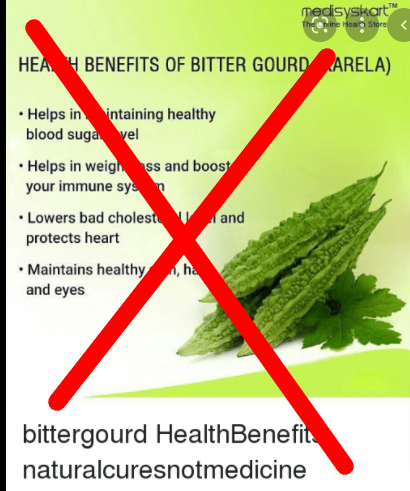
Bitter melon may be eaten as part of a healthy diet,
however,
consuming bitter melon beyond your dietary needs may lead to ill-health
You want to be a guinea pig?
Be my guest.
Maybe they'll name a new toxicity syndrome after you.
Congratulations.
End.
however,
consuming bitter melon beyond your dietary needs may lead to ill-health
You want to be a guinea pig?
Be my guest.
Maybe they'll name a new toxicity syndrome after you.
Congratulations.
End.

• • •
Missing some Tweet in this thread? You can try to
force a refresh