Fascinating! There mayyyy be some data issues. It looks like "rt" is a top contender -- while this *is* an #rstats package, as a twitter content matter expert (😂) I also know that old retweets used to be prepended with "RT" and this is probably skewing our result!
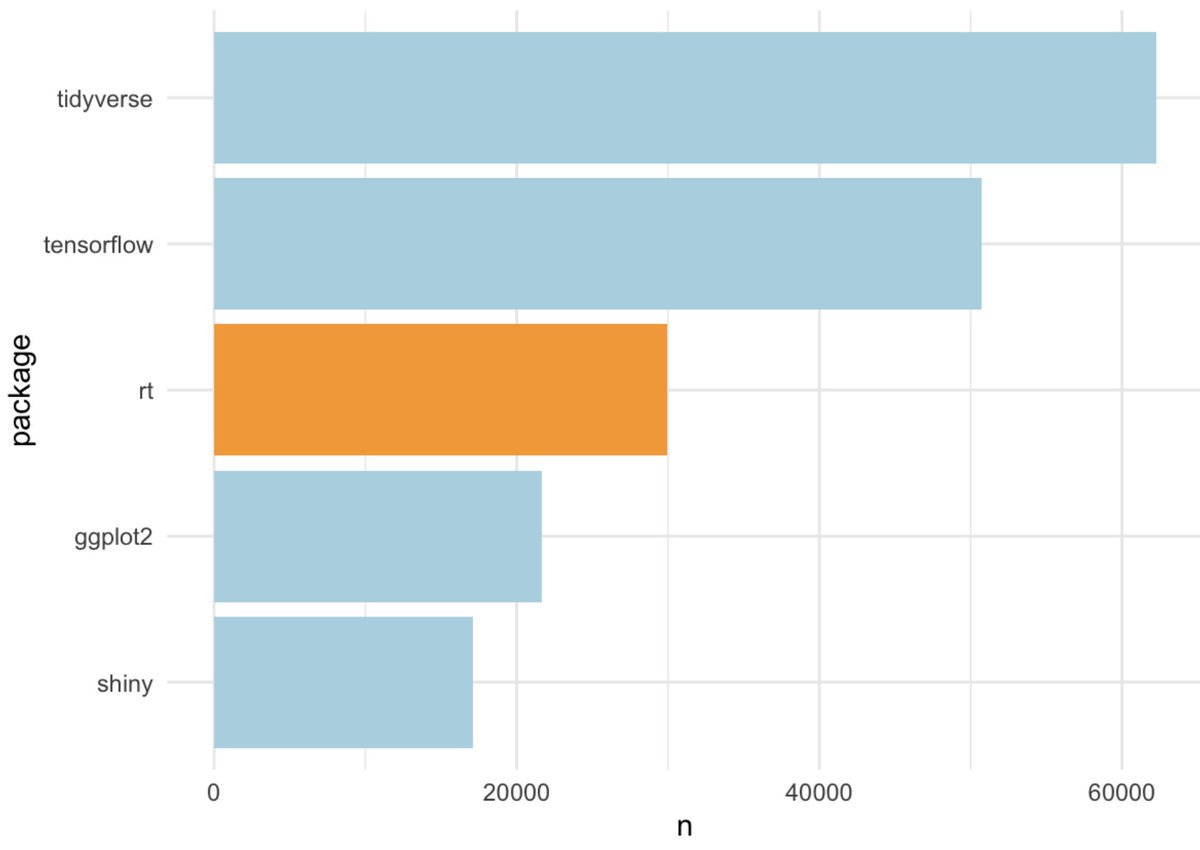
Let's filter out {rt} and see what we get!
Fun! Another data anomaly! Again, {usa} *is* an #rstats package, but a quick look at the tweets that include this shows that they are almost always referring to the country, not the package
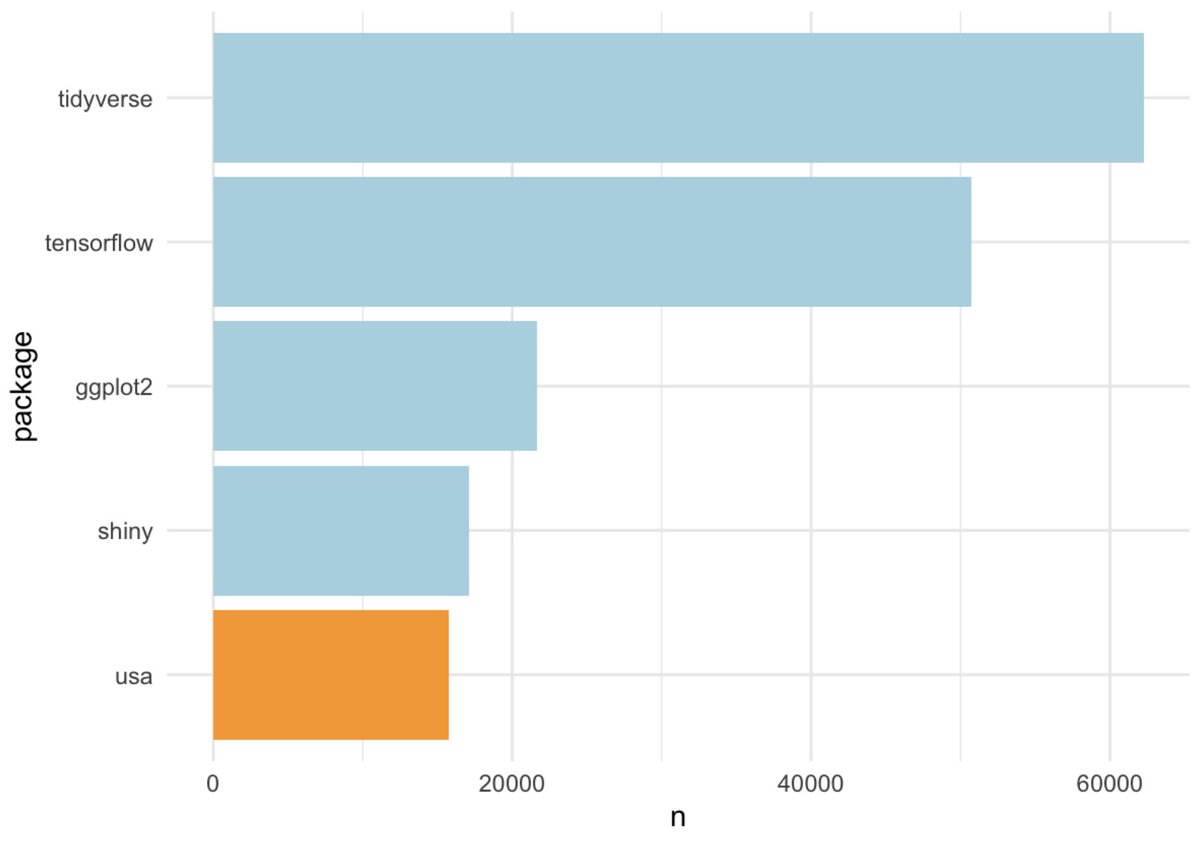
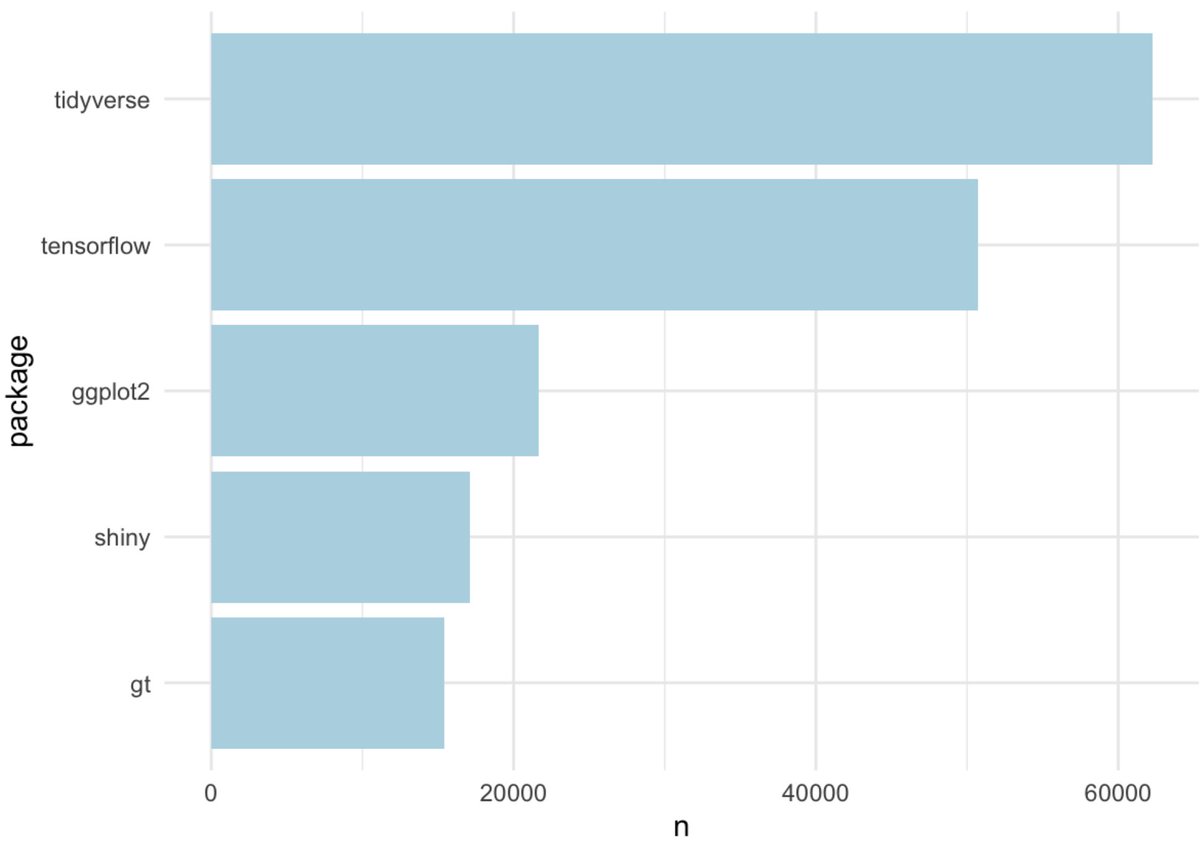
WHOA after filtering these out, we end up with the exact same 5 as we got using our sample from the past ~week with the order of the top two flipped. Sometimes sampling works!
🏆 Statistics is the real winner today!
• • •
Missing some Tweet in this thread? You can try to
force a refresh

You know how excited @daniela_witten gets about SVD? I have about the same thing with kernels. Except that I'm not sure I explain them as well as she does SVD. Still, you're getting a thread on kernels!
Maybe one way of putting it is that kernels are dot products on steroid. The dot product is already pretty cool.
1) It's easy to compute and you learn about it in high school math (at least I did, who knows what kids learn in high school now).
Take two p-dimensional vectors x = (x1, x2, ..., xp) and y = (y1, y2, ..., yp), their dot product <x|y> is simply the sum of the product of their coordinates:
<x|y> = x1 y1 + x2 y2 + ... + xp yp.
Good morning everybody! Let's talk a bit about how I came to develop statistical / machine learning tools for genomics, healthcare and drug discovery.
I trained as an engineer at @IMTAtlantique, with a specialization in computer science. I didn't really enjoy statistics and graduated in 2005, back when AI belonged to scifi and nobody knew what machine learning was.
@IMTAtlantique What really interested me was bioinformatics - the idea that my training in maths and computer science could be put to use to help solve problems from the life sciences was very appealing! So I jumped at the opportunity to intern in a lab that was doing just that.
OK, so a bit of background about me: I'm French (and tweeting from Paris), and I'm currently an associate professor at an engineering school called @MINES_ParisTech.
@MINES_ParisTech The research group I'm in (CBIO) has a partnership with @institut_curie, which is a cancer research institute. CBIO has four PIs, working on various topics related to, you've guessed it, statistics / machine learning & cancer.
@MINES_ParisTech@institut_curie My plan for the week is to talk more about my career path, my research topics, and my love of kernels. Of course I'll also talk about what we do at @WiMLDS_Paris, about open/reproducible science, and about teaching machine learning!
I have organized multiple conferences over the years.
Tips to conference organizers to support women at your meeting
1- Actively consider gender and career stage balance in speakers. 2- Women and minorities may take a longer route to success, try to avoid ageist selection.
3- Provide lactation rooms (with equipment & milk storage). Pumps are heavy and a pain to carry around a meeting. The room should be close-by not a long walk away
4.- Small babies are welcome. Check there is a changing table accessible to dads & mums.
5.- Parents of young children are often postdocs, junior faculty who need and are grateful for childcare and/or travel scholarships.
6- Go Hybrid. Live stream & record talks. Its great if one is stuck in a lactation room, or watching remotely
@Bioconductor provides genome annotation for thousands of species and its packages are used in almost every biological discipline including
Immunology
Oncology
Evolution and Phylogenetics
cheminformatics
comparative genomics
epigenetics
pharamacogenomics
systems biology
etc
The core team with the community create standard class structures for data. Developers create methods that use these, creating a connected framework were packages work together and provide entire analysis workflows
The current release @Bioconductor 3.14, consists of 2083 #RStats packages, 408 experiment data packages, 904 annotation packages, 29 workflows and 8 books.



