Kaiser Kuo Profile picture
Oct 17, 2021 16 tweets 3 min read Read on X
I can’t attest to the accuracy of this post making the rounds on Chinese social media. It purports to summarize reforms proposed by Minister of Education Huai Jinpeng, who took office in Aug. Rumors of major changes have been abroad a while but this would be quite extreme. 1/N
Huai was formerly president of Beijing University of Aeronautics and Astronautics, vice-minister of the MIIT, deputy secretary of the Tianjin Municipal Committee, and secretary of the Party Group of the Chinese Association for Science and Technology. 2/N
Right up top is a new emphasis on physical education, meant to combat “the phenomenon of feminization of boys,” (heteronormative much?) stressing major ball sports. It also calls for the construction of more sports facilities in communities. 3/N
The next one would be huge. Compulsory education would be shifted to end with two years of high school, with foreshortened elementary school (4 years from 6), and eliminating pre-kindergarten (小升初, not sure what that means). 4/N
It calls for much earlier tracking and toward one of three types of high school: specialized, general, and vocational. The aim is to create students adapted to “social survival” and work after high school. 5/N
All current technical high schools will be demoted (下放為) to vocational high schools, and the current practice of awarding senior technician certificates to students still in school will be stopped. 6/N
Another big one: university reform. Over one-third of universities will be transformed to engineering or “high-level blue-collar universities” (高级蓝领大学), focused on training of senior technical workers, to lay the foundation for the 4th Industrial Revolution. 7/N
To quickly change the current situation of college students with “grand visions but low skills, high test scores but low abilities” and to increase society’s respect for labor and workers, and “truly realize the glory of labor and equality or all.” This is really at the core. 8/N
Emphasis on correct socialist values and worldview, allowing children to enjoy learning and reducing the burden on them, having families shoulder more of the burden, and cultivating diverse talent. 9/N
Huai has pushed a concept called “有温度的教育” (an education with warmth?) which stresses “interpersonal communication, humanistic communication, human qualities, teamwork, and especially confidence in culture and understanding of society.” 10/N
The piece ends with a quote from Huai: "In today's increasingly fierce game between major powers, the technology battle is also a battle over standards, economics, and morality.” 11/N
“We need to convince people with reason and innovation and creativity. We also need to persuade people with virtue and adhere to integrity and to ethics. We need to put people first and promote human welfare." 12/N
So I read this — again, with the caveat that I don't know whether this is "official" or comes from Huai himself — as the education component of the Red New Deal. It reflects many themes we've already seen emerge. 13/N
The thrust is to restore dignity to technical education, to labor and to manufacturing. China clearly wants to avoid a hollowing out of manufacturing, to preserve process knowledge. The underlying belief is that innovation and manufacturing are inextricably linked. 14/N
It's not clear to me whether all three types of high schools will continue to be three year (10th through 12th), or whether the vocational will only be two years. I would appreciate any clarification! 15/N END (for now)
PS: Let me reiterate that this is NOT an official post. In fact on higher-visibility platforms like Sohu, the piece seems already to have been deleted. I have doubts especially about specific policy proposals, though much of this does accord with things Huai has said publicly.

• • •

Missing some Tweet in this thread? You can try to force a refresh

 

Keep Current with Kaiser Kuo

Kaiser Kuo Profile picture

Stay in touch and get notified when new unrolls are available from this author!

Read all threads

This Thread may be Removed Anytime!

PDF

Twitter may remove this content at anytime! Save it as PDF for later use!

Try unrolling a thread yourself!

how to unroll video
  1. Follow @ThreadReaderApp to mention us!

  2. From a Twitter thread mention us with a keyword "unroll"
@threadreaderapp unroll

Practice here first or read more on our help page!

More from @KaiserKuo

Oct 26, 2025
1/ I publish the weekly @triviumchina round-up via the @SinicaPodcast newsletter, usually on Saturdays. This week you'll really see why I value it. In recent months, Trivium has articulated their excellent take on Xi Jinping's vision for the Chinese economy. Thread follows. 🧵
@triviumchina @SinicaPodcast 2/ Check it out here. It's free each week — good reason to become a subscriber, as if their podcast, my podcast, and the @ChinaGSProject podcast plus the many essays and columns weren't enough! sinicapodcast.com/p/trivium-week…
@triviumchina @SinicaPodcast @ChinaGSProject 3/ So the Trivium theory on the Xi Jinping vision for the Chinese economy: With the 15th Five-Year Plan (2026–2030) taking shape, China is shifting from property- and debt-driven growth to a model powered by world-class manufacturing and advanced technology. Duh.
Read 11 tweets
Oct 9, 2025
1/ Chinese diplomats have really, really upped their game, if the PRC ambassador to Iceland, He Rong, is any indication.

I’m in Reykjavik for a couple of days where I gave the keynote yesterday at an even put on by the Iceland-China Trade Council. The ambassador joined late…
2/ …as he was busy prepping for a trip to Beijing with a major Icelandic delegation led by PM Kristrún Frostadóttir. He missed my talk and the panel that followed it, which I was on, but no matter. He came in and sat beside me, apparently knowing who I was and some bio details.
3/ He had in hand a speech script, which I couldn’t help but glance down at. It was, as you might expect, the usual bromides, pre-masticated pabulum about friendship and win-win. He’d made some notes, some edits, by hand. It stayed in his lap.
Read 9 tweets
Aug 17, 2025
Watching the Tooze lecture now. Much food for thought, and I'll share some of it with you, course by course.
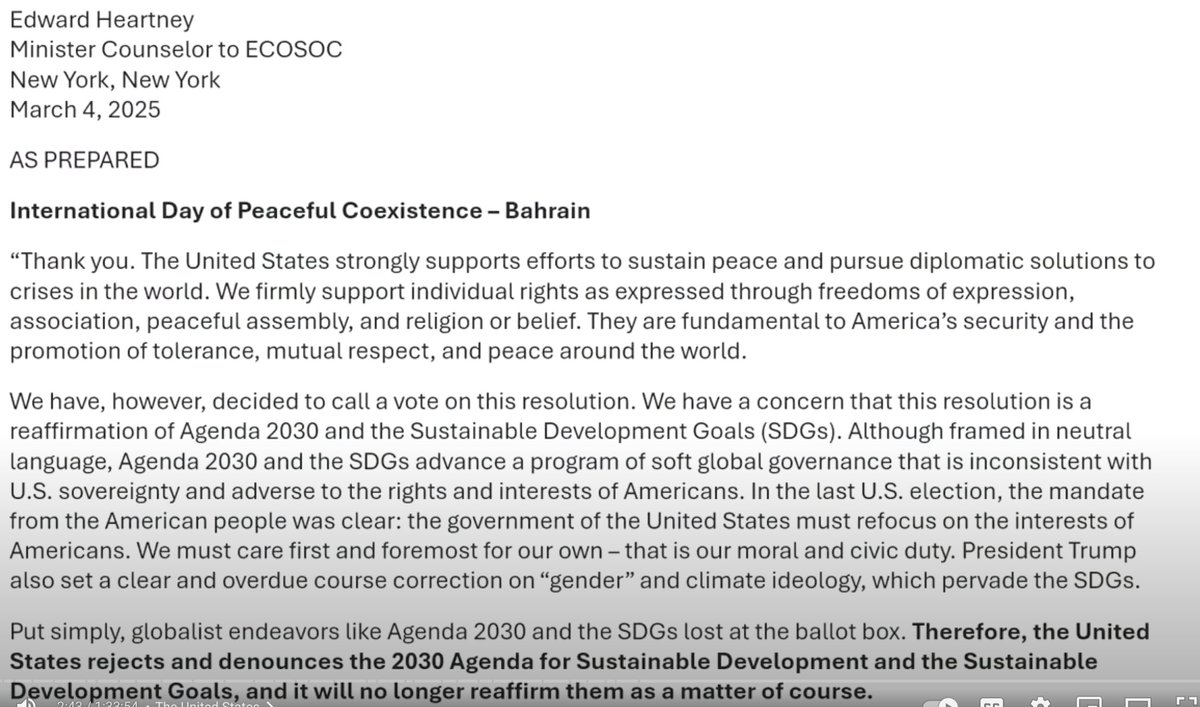
He opens with this shocker, which I somehow missed back in early March: The US was the ONLY country to vote against a UNGA Resolution on the Day of Hope and Peaceful Coexistence. Image
And here's part one of why the US voted against the resolution, part 1: It rejects and denounces the 2030 Agenda for Sustainable Development and the SDGs. Image
Read 16 tweets
Aug 15, 2025
1/ Just read a remarkable interview with Zhang Yuyan — one of China’s top "America-watchers." Even given the access Chinese analysts have to an open US media ecosystem, the sophistication of his analysis of Trump 2.0 is striking.
2/ The interview is in Contemporary American Review, a leading journal published by the Inst. of American Studies (IAS). The translation comes via the indispensable Pekingnology newsletter by Zichen Wang (@zichenwanghere), with Liu Yihang & Gao Yimeng.
pekingnology.com/p/zhang-yuyan-…
@ZichenWanghere 3/ It’s edifying to see America in this nutso moment “explained back” to us by someone whose vantage point is both far away and steeped in deep study. I was in frequent, violent agreement, but also noted where his framing diverged from mine.
Read 7 tweets
May 10, 2025
1/ Something I've been pondering of late. Most folks reach for Rome, or the rise of Bismarckian Germany, or Weimar Germany when they look for historical analogies for the U.S. today. Me? I tend to think of Spain. Hear me out. A🧵
2/ Clearly, historical analogies are blunt tools. They seduce with their patterns, but often (usually?) mislead. That said, here’s one I’ve found evocative, but with heavy caveats: the U.S. today bears some eerie resemblance to 16th–17th c. Spain during the height of its empire.
3/ Spain, flush with silver from the New World — mainly from Potosí and Zacatecas — enjoyed unprecedented purchasing power. It didn’t earn its wealth through production; it extracted it (with slave labor), then spent it… extravagantly.
Read 13 tweets
Mar 18, 2025
1/ I've been revisiting Jeffrey Ding's book *Technology and the Rise of Great Powers* ahead of a long-overdue podcast interview with him. His central argument is most persuasive: Tech diffusion and not leading-sector 0-to-1 innovation ultimately matters more in national power.
2/ He's not some blithe cheerleader for China in this book: indeed, by many of the measures he comes up with, China actually suffers a "diffusion deficit" resulting in part from its big push for breakthrough invention and, in some areas, a skills gap.
3/ Ding's book focuses on general-purpose technologies like electricity, digitization, & now AI, and notes some of the ways digitization has lagged in Chinese manufacturing and, at least at the time Ding researched/wrote his book, lagged in the right conditions for AI diffusion.
Read 15 tweets

Did Thread Reader help you today?

Support us! We are indie developers!


This site is made by just two indie developers on a laptop doing marketing, support and development! Read more about the story.

Become a Premium Member ($3/month or $30/year) and get exclusive features!

Become Premium

Don't want to be a Premium member but still want to support us?

Make a small donation by buying us coffee ($5) or help with server cost ($10)

Donate via Paypal

Or Donate anonymously using crypto!

Ethereum

0xfe58350B80634f60Fa6Dc149a72b4DFbc17D341E copy

Bitcoin

3ATGMxNzCUFzxpMCHL5sWSt4DVtS8UqXpi copy

Thank you for your support!

Follow Us!

:(