
The 'Shifta War' was an inhumane conflict fought in northern Kenya between 1963 and 1967. Short thread.
The conflict pitted Jomo Kenyatta's KANU government--which insisted on the unity of Kenya--against Somali secessionists. Here's a clip from Mandera & Wajir, Aug. 1967. 1/
The conflict pitted Jomo Kenyatta's KANU government--which insisted on the unity of Kenya--against Somali secessionists. Here's a clip from Mandera & Wajir, Aug. 1967. 1/
2/
Secessionists saw the Northern Frontier District as a part of Somalia & predicted a unitary Kenya would bring 'oppression, servitude, civil war and other evils'.
Clip: Northern Province People’s Progressive Party resolves not to participate in Kenya's elections, March 1963.
Secessionists saw the Northern Frontier District as a part of Somalia & predicted a unitary Kenya would bring 'oppression, servitude, civil war and other evils'.
Clip: Northern Province People’s Progressive Party resolves not to participate in Kenya's elections, March 1963.
3/
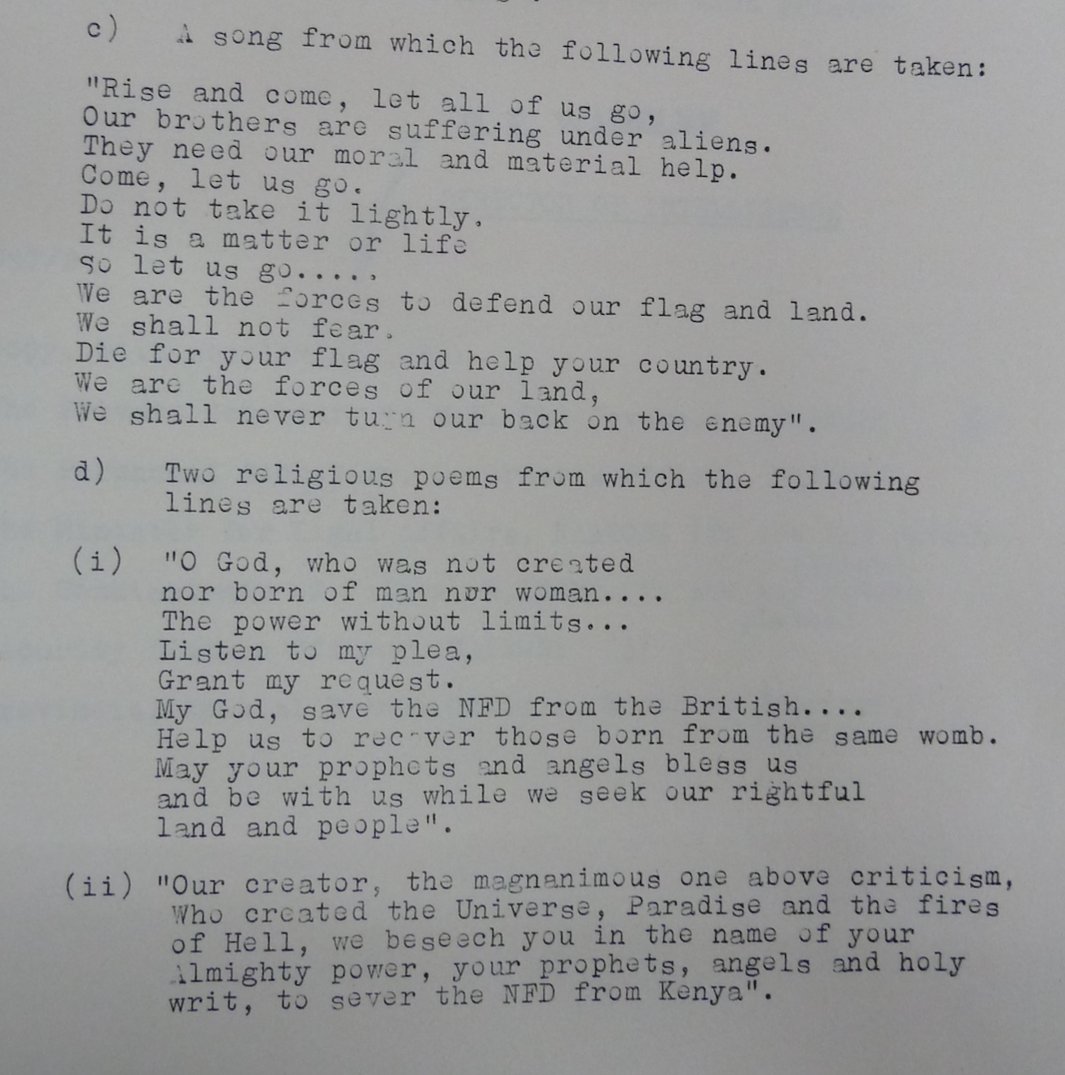
Mogadishu & Hargeisa radio broadcast poetic invocations calling on Somalis to unify, across the Kenya boundary, to seek the unity of greater Somalia.
Clips below from British intelligence.
Mogadishu & Hargeisa radio broadcast poetic invocations calling on Somalis to unify, across the Kenya boundary, to seek the unity of greater Somalia.
Clips below from British intelligence.

4/
British authorities anticipated a separate future for the NFD: according to one plan it would have remained under British administration.
But Kenyatta's new regime--pushed by protests like the one shown in this clip--insisted that Kenya's territory was inviolable.
British authorities anticipated a separate future for the NFD: according to one plan it would have remained under British administration.
But Kenyatta's new regime--pushed by protests like the one shown in this clip--insisted that Kenya's territory was inviolable.
5/
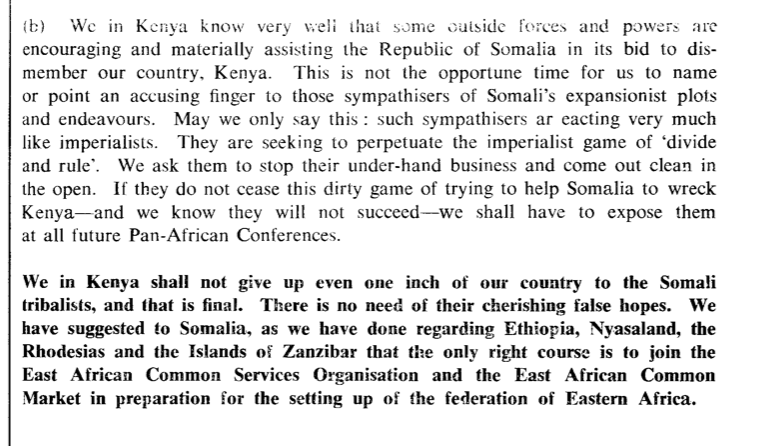
Kenyatta, in a May 1962 essay titled 'Pan African Unity and the NFD Question in Kenya':
'We in Kenya shall not give up even one inch of our country to Somali tribalists, and that is final'.
Kenyatta, in a May 1962 essay titled 'Pan African Unity and the NFD Question in Kenya':
'We in Kenya shall not give up even one inch of our country to Somali tribalists, and that is final'.
6/
There followed a massive military deployment into the NFD.
Drawing from models developed by the British during the Mau Mau war, the Kenya govt. interned pastoralists in military-run villages--a way of cutting off support for guerillas.
Clip: shiftas surrender, Aug. 1968.
There followed a massive military deployment into the NFD.
Drawing from models developed by the British during the Mau Mau war, the Kenya govt. interned pastoralists in military-run villages--a way of cutting off support for guerillas.
Clip: shiftas surrender, Aug. 1968.
7/
The 'Shifta War' ostensibly came to an end in 1967, when Zambian president Kenneth Kaunda brokered a peace deal between Kenyatta's govt. and the govt. of Somali PM Mohamed Egal.
Here's the signing ceremony in Arusha, Oct. 1967.
The 'Shifta War' ostensibly came to an end in 1967, when Zambian president Kenneth Kaunda brokered a peace deal between Kenyatta's govt. and the govt. of Somali PM Mohamed Egal.
Here's the signing ceremony in Arusha, Oct. 1967.
8/
The Somali threat, however, remained a potent resource for Kenya's government: a way to inspire militant patriotism, an excuse for demagoguery & saber-rattling.
Report below from the Nation, Feb. 1976.
The Somali threat, however, remained a potent resource for Kenya's government: a way to inspire militant patriotism, an excuse for demagoguery & saber-rattling.
Report below from the Nation, Feb. 1976.

9/
All clips from @Reuters.
I've written about secessionist projects in Kenya in the essay below.
And check out @KerenWeitzberg's lovely @OhioUnivPress book 'We Do Not Have Borders
Greater Somalia and the Predicaments of Belonging in Kenya'.
oxfordhandbooks.com/view/10.1093/o…
All clips from @Reuters.
I've written about secessionist projects in Kenya in the essay below.
And check out @KerenWeitzberg's lovely @OhioUnivPress book 'We Do Not Have Borders
Greater Somalia and the Predicaments of Belonging in Kenya'.
oxfordhandbooks.com/view/10.1093/o…
• • •
Missing some Tweet in this thread? You can try to
force a refresh






