AFRICAN & BLACK HISTORY Profile picture
Oct 23, 2021 9 tweets 3 min read Read on X
Sarah Saartjie Baartman from South Africa was cruelly exploited in Europe by being exhibited as a freak show attraction because of her protruding butt.

After her death, her body was displayed in a Paris museum for over a 100 years.

THREAD!
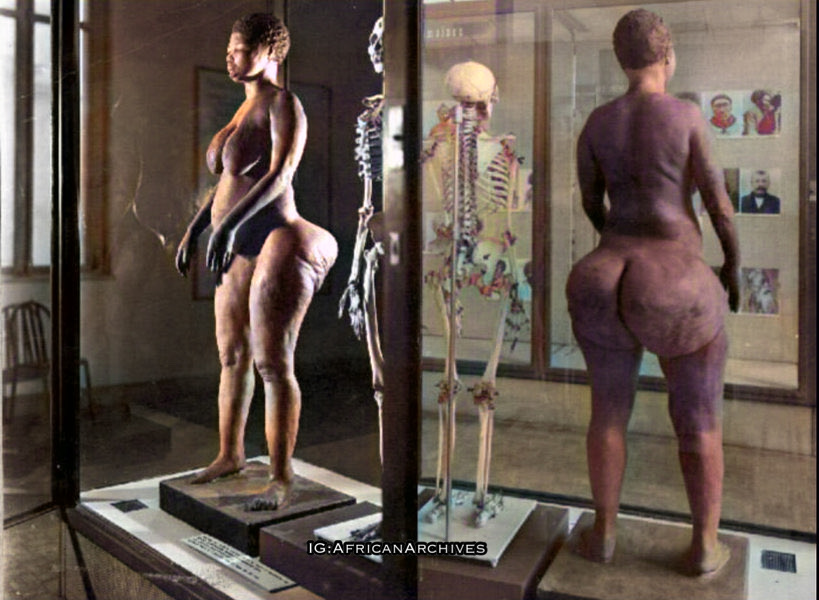
SARAH "Saarjte" Baartman of the khoikhoi people of South Africa was born in 1789 and was one of 2 women put on display as a "FREAK SHOW" act in England and then later France.
The men who promised her a life of pride in sharing her culture with the World tricked her, and though she was given pay she often was at the expense of verbal, sexual, and physical abuse.
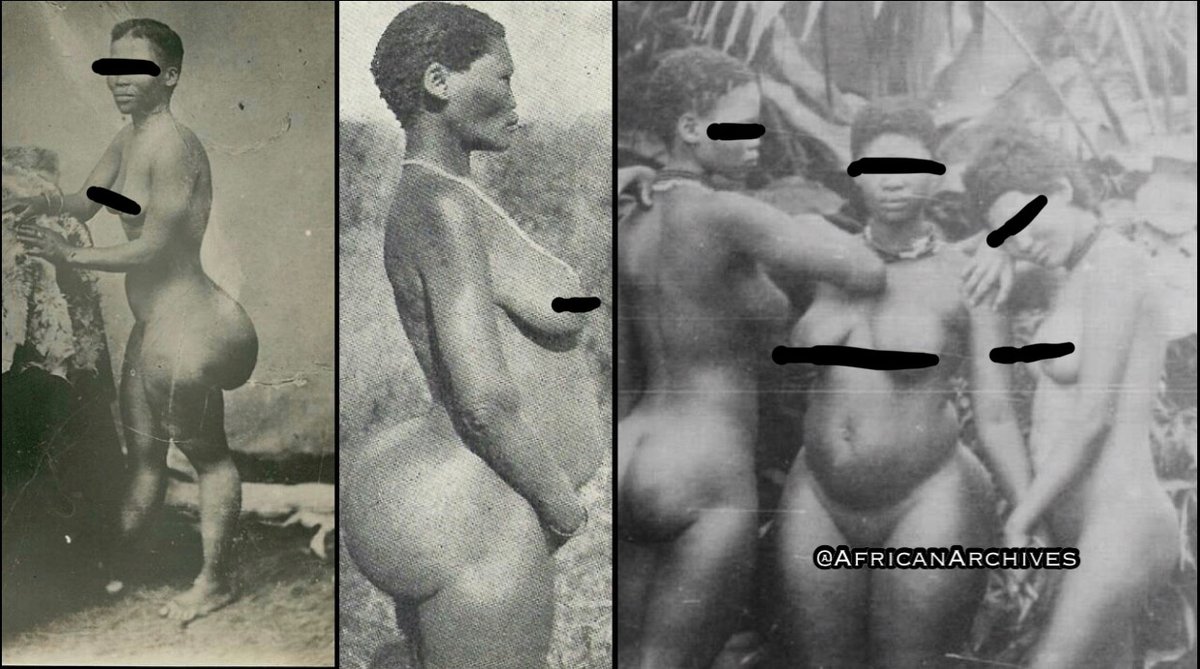
You see the HOTTENTOT VENUS (Hottentot is very derogatory) had a very distinct look, because the women of her people had extremely large buttocks, and an abnormally elongated labia.
Nude photos of khoikhoi women with steatopygia were collected by white colonialists. Steatopygia is the accumulation of large amounts of fat on the buttocks, especially as a normal condition in the Khoikhoi of Southern Africa.
She was made to wear a coloured skin tight outfit revealing what was to be a naked black woman for the paying public to inspect, view, and allegedly at times for extra coin... have a "Private Showing".
When sold to another manager, she was taken to France where she was forced to perform at private parties in homes of the most affluent and wealthy, with the final act being an invitation to the party attendees to approach, touch, feel, and inspect a laid down SARAH'S GENITALS
She was to be later handed off to medical professionals who drew the details of her body. She died penniless from diseases in Paris, as a sex slave in 1815.
Her body had a molded cast made, her brain & pelvic bone put in PRESERVING JARS with her flesh & corpse being discarded.
Her remains were finally reclaimed by South Africa, and was given a ceremonial burial in 2002 (187 years later after her death). SARAH never saw her homeland again... Only parts of her body in death.

• • •

Missing some Tweet in this thread? You can try to force a refresh

 

Keep Current with AFRICAN & BLACK HISTORY

AFRICAN & BLACK HISTORY Profile picture

Stay in touch and get notified when new unrolls are available from this author!

Read all threads

This Thread may be Removed Anytime!

PDF

Twitter may remove this content at anytime! Save it as PDF for later use!

Try unrolling a thread yourself!

how to unroll video
  1. Follow @ThreadReaderApp to mention us!

  2. From a Twitter thread mention us with a keyword "unroll"
@threadreaderapp unroll

Practice here first or read more on our help page!

More from @AfricanArchives

Apr 7
To combat the high rate of death among enslaved people, plantation owners demanded females start having children at 13.

By 20, the enslaved women would be expected to have about five children.

—THREAD— Image
An enslaved woman was a sex tool beneath the level of moral considerations.

She was an economic good, useful, in addition to her menial labor, for breeding more slaves. To attain that purpose, the master mated her promiscuously according to his breeding plans. Image
The Master ,his son(s) and other members of his family took turns with her to increase the family's fortune & to satisfy his extramarital sexual desires. Guests and neighbors were also invited to this luxury.
Read 10 tweets
Apr 1
41 years ago today, singer, songwriter and Motown legend, Marvin Gaye was shot and killed by his father, a day before his birthday.

A THREAD! Image
On April 1, 1984, Marvin was fatally shot by his father in their Los Angeles home. On the day of the murder, Marvin and Marvin Senior were arguing about a misplaced insurance policy document.
At this point, the relationship between Marvin and his father was as heated as ever- Marvin’s sister had moved out of the house just to avoid the conflict Image
Read 10 tweets
Mar 21
A sundown or sunset town was a town, city, or neighborhood in the US that excluded non-whites after dark.

The term sundown came from the signs that were posted stating that people of color had to leave the town by sundown.

A THREAD! Image
In most cases, signs were placed at the town's borders which read: “Stranger/Negro, Don't Let the Sun Set On You Here." The exclusion was official town policy or through restrictive covenants agreed to by the real estate agents of the community. Image
The policy was usually enforced through intimidation. This intimidation could occur in a number of ways, including harassment by police officers or neighbors and in some circumstances violence.
Read 6 tweets
Mar 21
Today we honour the memories of all the lives lost on this day in 1960, when white police in apartheid South Africa killed over 80 black people and wounded 186 on what is known as the Sharpville Massacre.

-Thread- Image
Image
Image
Image
The Sharpeville Massacre occurred on 21st March, 1960, in the township of Sharpeville, South Africa. It resulted in the largest number of South African deaths(up to that point) in a protest against apartheid.
Sharpeville, a black suburb outside of Vereeniging (about 50 miles south of Johannesburg), was untouched by anti-apartheid demonstrations that occurred in surrounding towns throughout the 1950s. By 1960, however, anti-apartheid activism reached the town.
Read 13 tweets
Mar 19
“fuck it, i’ll do it!” —black women

Black women are routinely erased from public memory and historical narratives of resistance.

Black women powered the civil rights movement, but rarely became its stars. #WomensHistoryMonth

A THREAD! Image
Aunt Polly Jackson, was an escaped slave who worked as an agent on the Underground Railroad helping others escape.

She was known for fighting off slave catchers with a butcher knife and a kettle of boiling water Image
Harriet Tubman, the woman who escaped slavery then fought and freed hundreds of slaves.

She reminded us that bravery and refusal to accept injustice can change history. Image
Read 23 tweets
Mar 16
35 years ago today, Latasha Harlins, 15, was fatally shot by a Korean shop owner, Soon Ja Du, over a bottle of orange juice, it became a major spark for the 1992 Los Angeles Riots.

thread Image
On March 16, 1991 Latasha Harlin’s short life came to a violent end in the midst of racial tensions in Los Angeles, California, and became a major spark for the 1992 Los Angeles Riots. Image
By the late 1980s, racial tensions were high in South Los Angeles, and especially between Korean storeowners and Black American residents of the city.
Read 10 tweets

Did Thread Reader help you today?

Support us! We are indie developers!


This site is made by just two indie developers on a laptop doing marketing, support and development! Read more about the story.

Become a Premium Member ($3/month or $30/year) and get exclusive features!

Become Premium

Don't want to be a Premium member but still want to support us?

Make a small donation by buying us coffee ($5) or help with server cost ($10)

Donate via Paypal

Or Donate anonymously using crypto!

Ethereum

0xfe58350B80634f60Fa6Dc149a72b4DFbc17D341E copy

Bitcoin

3ATGMxNzCUFzxpMCHL5sWSt4DVtS8UqXpi copy

Thank you for your support!

Follow Us!

:(