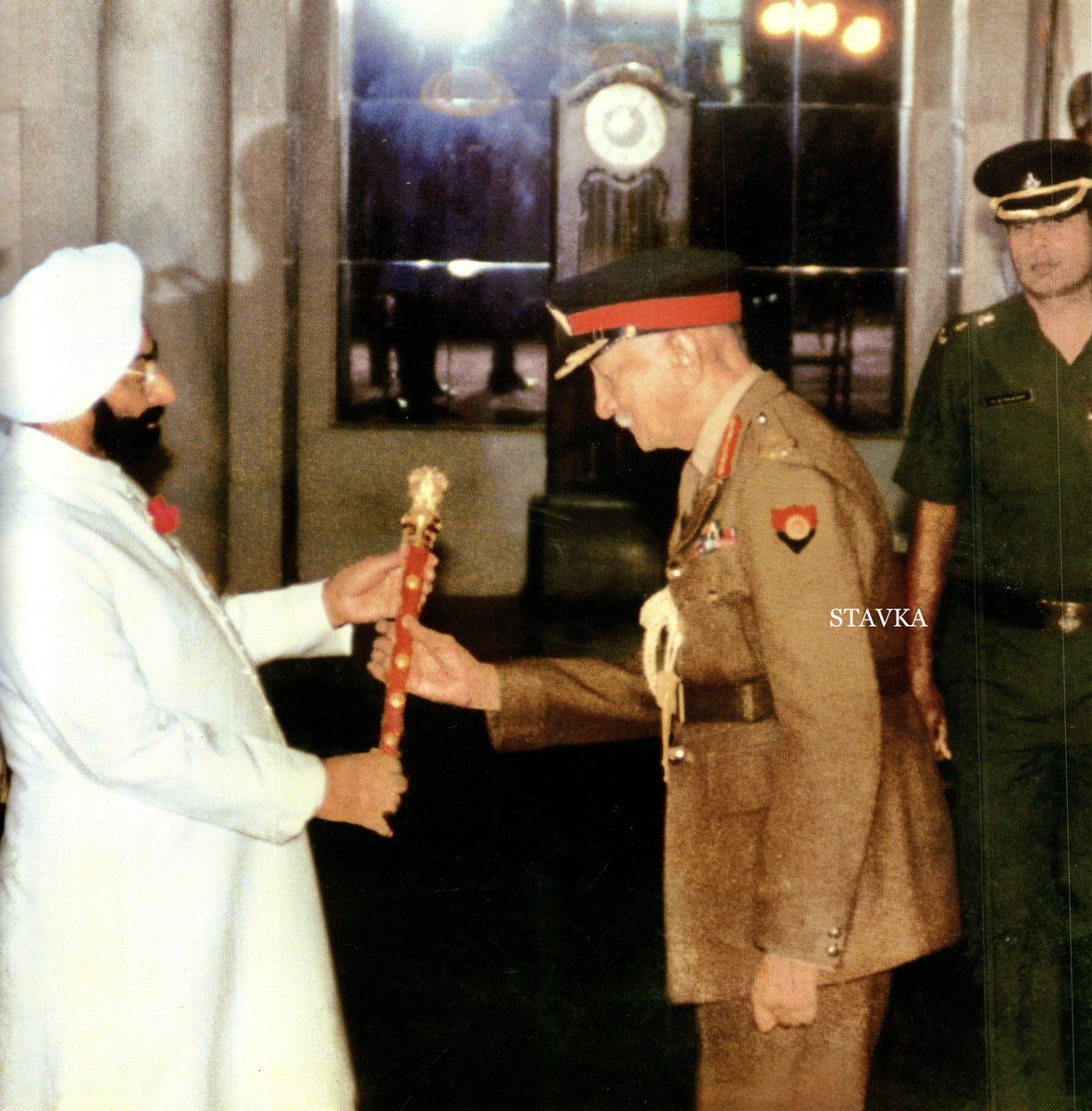
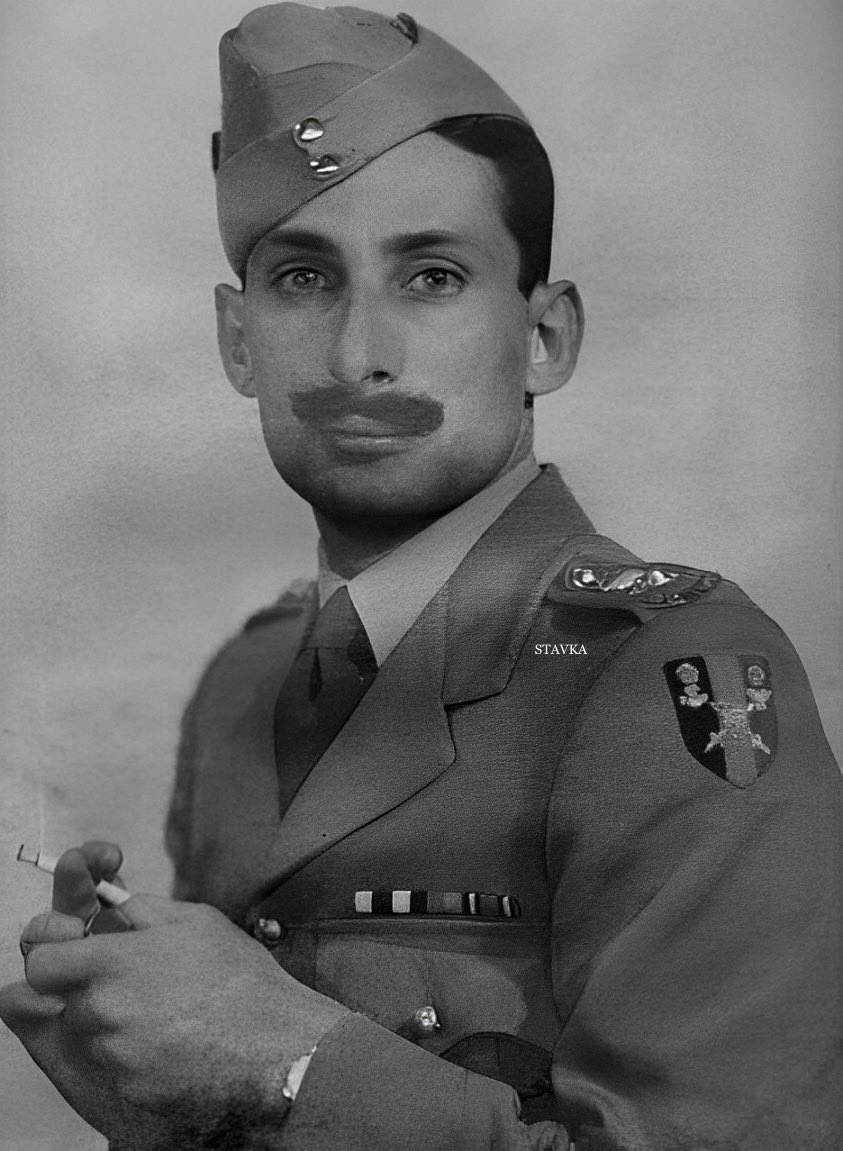
Today on Accession Day of Jammu & Kashmir, I will tell how India’s First MVC, Brig Rajinder Singh Jamwal,Chief of Army Staff of the J&K State Forces personally led a small force of 200 men and demolished the bridge at Uri that immobilised tribals for 4 days & saved Srinagar. 
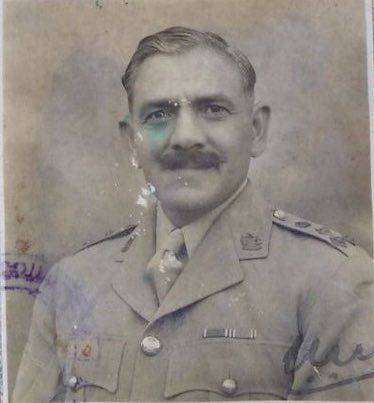
Muzaffarabad, one of the three major towns of Kashmir, is located astride the Kishenganga River about two miles to the north of the Domel bridge over the Jhelum river. About seven miles to the west of Muzaffarabad is the West Pakistan-Kashmir border.
The town was primarily a trade centre, most of the exports and imports of the State passing through the hands of its merchants. The sanctions imposed by Pakistan relating to the import of essential commodities into Kashmir, especially petrol, had begun to have a telling effect+
on the movement of merchandise, and was the subject of much adverse comment locally. Rumors of raids against the State Forces outposts in Jammu province had reached the townsfolk, but they were not unduly perturbed since one of the better battalions of the State Forces, +
the 4th Jammu and Kashmir Infantry (4 J&K Infantry), was located in the Muzaffarabad-Domel area.
This unit had seen service in Burma during World War II, and had done reasonably well. +
This unit had seen service in Burma during World War II, and had done reasonably well. +
It was a mixed battalion, its composition being 50 per cent Dogra (Jammu Hindus) and 50 per cent Poochie Muslims. It was commanded by a Dogra officer, Lt. Col. Narain Singh Sambyal, who had spent most of his career with the battalion.
As was normal, defensive positions had been constructed on the features that commanded the approaches into the State, and the Domel bridge in particular. But these were only required to be manned in an emergency, and, not apprehending any such type of threat, the battalion lived+
in its peace-time barracks. As is acceptable under such circumstances, the weapons were stacked in the Company armouries when not required. Although there had been incidents in Jammu, in which the State Force outposts had been assaulted and in some cases annihilated, there had+
been no such happenings on the borders of Kashmir. Kashmir State Intelligence sources had given no indication whatsoever that either Dowel or Muzaffarabad was likely to be subjected to any form of attack.
With reports of continued assaults on the border posts in Jammu Province, Headquarters Jammu and Kashmir State Forces eventually became alarmed. It drew attention on the Commanding Officer of 4 J&K Infantry to the fact that in certain areas the Poonchie Muslims had proved to be+
unreliable and had defected. It suggested, in fact advised him, that it might be prudent to return his Muslim troops to Srinagar in order to avoid the possibility of a similar occurrence. Dogras would he sent forward to replace them.
Lt. Col. Narain Singh Sambyal was furious when he received the proposal and rejected it. He stated that he had served with the battalion for many years and had more confidence in his Muslim troops than in the Dogras. To order half his command to return to Srinagar and have it+
replaced by Dogras would be to inflict a grievous insult on his Poonchie Muslim men. This laudable attitude of the Commanding Officer resulted in the battalion remaining intact, but Lt. Col. Narain Singh Sambyal was to pay a very heavy price for his loyalty to his men.
In the early hours of the morning of 22 October, while their Dogra comrades lay sleeping, the Poonchie Muslim troops rose. They drew their weapons from the Company Armouries and trained light automatics and medium machine guns on the barracks occupied by the Dogras+
and in their Armouries so that they would be incapable of reaching their weapons. They then moved in and killed their comrades, including Lt. Col. Narain Singh Sambyal who had placed implicit trust in them. This accomplished, they made contact with the tribal convoy which had+
arrived and lay halted on the Pakistan side of the border. With the town of Muzaffarabad open to them, the tribals swarmed in. Rape, loot and arson engulfed the town. The tribesmen were only brought under control with the promise of even better booty ahead in the Valley.
The tribal convoy, now led by the Poonchie Muslims of 4 J&K Infantry, moved up the road towards the Valley.
One might form the impression from these incidents in Jammu and in Muzaffarabad-Domel area that the Muslims of the State had risen against the Government and wished to+
One might form the impression from these incidents in Jammu and in Muzaffarabad-Domel area that the Muslims of the State had risen against the Government and wished to+
join Pakistan. Nothing could be further from the truth. Thousands upon thousands of Muslims in the Government, the State Forces and in the National Conference, the political party led by Sheikh Abdullah, braved death in stemming the invasion. Many Muslim officers and men of the+
Jammu and Kashmir State Forces were later absorbed into the Indian Army. Their loyalty is beyond question. It was only a certain number that got defected. The defection was primarily due to the subversive activities of Maj Gen Akbar Khan and of a few other officer of the+
Pakistan Army whose domicile was in Jammu or Kashmir. These officers also took a leading part in the conduct of the operations both in Jammu and Kashmir. Some of the Dogras of 4 J&K Infantry who had managed to escape the slaughter, slipped through the cordon thrown around by the+
mutineers and moved back along the road to Srinagar. Reaching a telephone, they informed Headquarters Jammu & Kashmir State Forces of what had happened in the Muzaffarabad-Domel area. The news was received with alarm and despondency. There were no State Force units of any+
description located between Domel and Srinagar, and the route to the Valley, and Srinagar the capital lay wide open to the tribals. With a mere 110 miles of good tarmac road to cover, the enemy could be at the gates of Srinagar in a matter of hours.
Brigadier Rajinder Singh Jamwal, who had taken over as Chief of Staff from Major General H.L. Scott, decided to deal with the situation personally. Collecting some 200 men from the rear details of the State Force units in Badami Bagh Cantonment in Srinagar, he rushed down the+
road to Domel by motor transport. Realising that the only hope in delaying the enemy as much as was possible, he took with him sufficient explosives to carry out demolitions of the numerous bridges on the route. He reached Uri, 62 miles from Srinagar, before the raiders, and,+
deploying his small force on the features to the west of Uri, began preparing the large steel-girder bridge at the eastern exit of Uri, which spanned a deep seasonal river, for demolition. This completed, the defenders waited the arrival of the tribal convoy.
It made its appearance soon after mid-day on 23 October, and was halted with long-range fire. The Brigadier was able to thwart the enemy attempts to outflank him, with a series of well staged withdrawals. But as the pressure increased and further enemy bands were thrown in to+
encircle him, he decided to pull well back, and gave orders for the bridge to be blown. The Engineers had prepared it efficiently and the raiders were presented with a yawning gap which it was impossible to span without equipment and engineering skill, neither of which was+
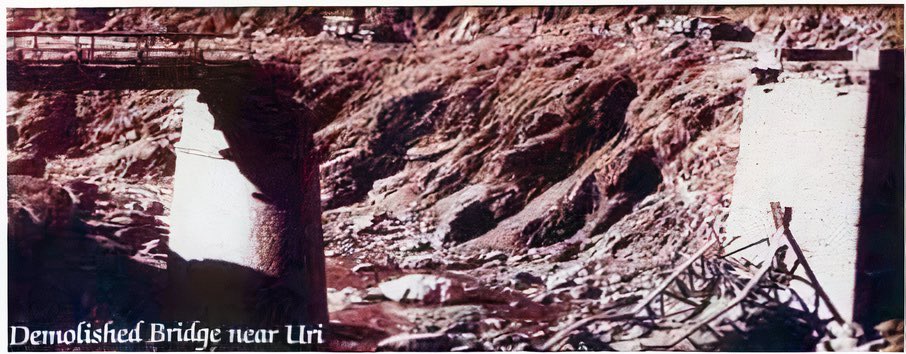
readily available to them. The blowing up of the bridge wt Uri was to make a difference more momentous than the gallant Brigadier Rajinder Singh Jamwal could have anticipated. By immobilising for three to four days the tribal raides who would not let themselves be separated from+
motor transport, it saved Srinagar from the fate that had overtaken Muzaffarabad. With the only motor-able route made impassable, the tribal convoy lay halted for as long as it would take to construct a diversion. With darkness falling, the raiders decided to postpone further+
action until the next day. On the morning of 24 October, elements of the raiders engaged the small token force which had taken up a defensive position on the hills to the east of Uri. Unable to dislodge it with a frontal attack, they decided to hold it frontally and to cut off+
it’s withdrawal with a wide encircling movement. They crossed the Jhelum River by a footbridge which lay to the north of Uri, and, advanced along the North bank in the direction of Mahura. Here lay another bridge across the river, and having crossed it they would have been in a+
position to occupy the features behind the State Force party. Their movement was, however, spotted. Brigadier Rajinder Singh Jamwal had no option but to evacuate his defensive position and withdraw. A running battle across the hills now took place until, at Diwan Mandir,+
Brigadier Rajinder Singh Jamwal fell, mortally wounded. Realising that any attempt to evacuate him would only hamper his men, he ordered them to leave him behind and to continue the withdrawal. His men placed him under a culvert, hoping he might escape detection.+
That was the last that was seen or heard of Brigadier Rajinder Singh Jamwal.
In Srinagar, the electric power supply failed at about mid-day. Those in authority drew the only possible conclusion. The Mahura Power House the fallen to the raiders. +
In Srinagar, the electric power supply failed at about mid-day. Those in authority drew the only possible conclusion. The Mahura Power House the fallen to the raiders. +
That Brigadier Rajinder Singh’s action was gallant in the extreme is unquestionable. It disrupted the planned time schedule of the enemy and gave the Valley the hope of survival, but there is one point in connection with his action which is inexplicable. +
Available to him in Badami Bagh Cantonment was a total of 1,850 officers and men of the Jammu and Kashmir State Forces of whom 500 were Poonchie Muslims. In view of what had taken place, he may have lost faith in the latter and decided not to put their loyalty to the test.
The remainder were either Sikhs, Dogras or Gorkhas- all trained soldiers who were the Depot parties of the battalions deployed in both Jammu and Kashmir or personnel who had returned from leave and courses of instruction who were awaiting movement orders.
This sizeable number of 1,350 officers and men could have been formed into two relatively able battalions. They might not have had full complement of light automatics and mortars, but they were all equipped with rifles and there was no shortage of ammunition or grenades.
These two ad hoc units would certainly have offered stiff resistance to the tribals in the country that lends itself to defence. Yet, well aware that half the 4 J&K Infantry had joined hands with the enemy, and knowing that the tribal force was of several thousands, he rushed+
forward with only 200 men. It is possible that the petrol supply situation in Srinagar was bad, severely limiting the motorised element that could be rushed to Uri. Brigadier Rajinder Singh Jamwal probably felt that the task of demolishing the bridge could be accomplished +
with a small force of 200 men. But in taking over personal command of this party, he demoted himself to the role of a Company Commander. It is difficult to understand why he did not place a junior officer in command of the token force, and, as Chief of Staff and the virtual+
• • •
Missing some Tweet in this thread? You can try to
force a refresh