

Some observations regarding the Pixel 6 devices.
I might update this as I´m exploring the source further.
I might update this as I´m exploring the source further.
First face unlock. Early leaks suggested this to be a feature of the Pixel 6 series, but it was seemingly removed at launch.
However there are some traces in the source to be found.
However there are some traces in the source to be found.
On July 9th a change was commited to the pixel 6´s powerhal config file for "face unlock".
Link here:android.googlesource.com/device/google/…
Apparently google is calling the feature "Tuscany" in this commit.
There might still be hope the feature will surface in the next feature drop.
Link here:android.googlesource.com/device/google/…
Apparently google is calling the feature "Tuscany" in this commit.
There might still be hope the feature will surface in the next feature drop.
According to the source, google had the clusters running at different maxfreqs during the last months.
Max freq of mid cluster was clocked at 1,9ghz and was changed to 2,25ghz approx 4 month ago:
android.googlesource.com/kernel/gs/+/12…
Max freq of mid cluster was clocked at 1,9ghz and was changed to 2,25ghz approx 4 month ago:
android.googlesource.com/kernel/gs/+/12…
Little Cluster initally ran at 2,0ghz and was set later to max out at 1,8ghz, while the Prime Cluster was restricted to 2,6ghz while its now running at 2,8ghz.
android.googlesource.com/kernel/gs/+/96…
android.googlesource.com/kernel/gs/+/96…
Higher CPU max freqs are still accessible when building the kernel from source.
My device ran fine at 2024mhz for little cluster and 2850mhz for the prime cluster.
Default is 1803mhz and 2802mhz for little/prime.
Screenshots from scaling_available_frequencies for cpu0 and cpu6:
My device ran fine at 2024mhz for little cluster and 2850mhz for the prime cluster.
Default is 1803mhz and 2802mhz for little/prime.
Screenshots from scaling_available_frequencies for cpu0 and cpu6:
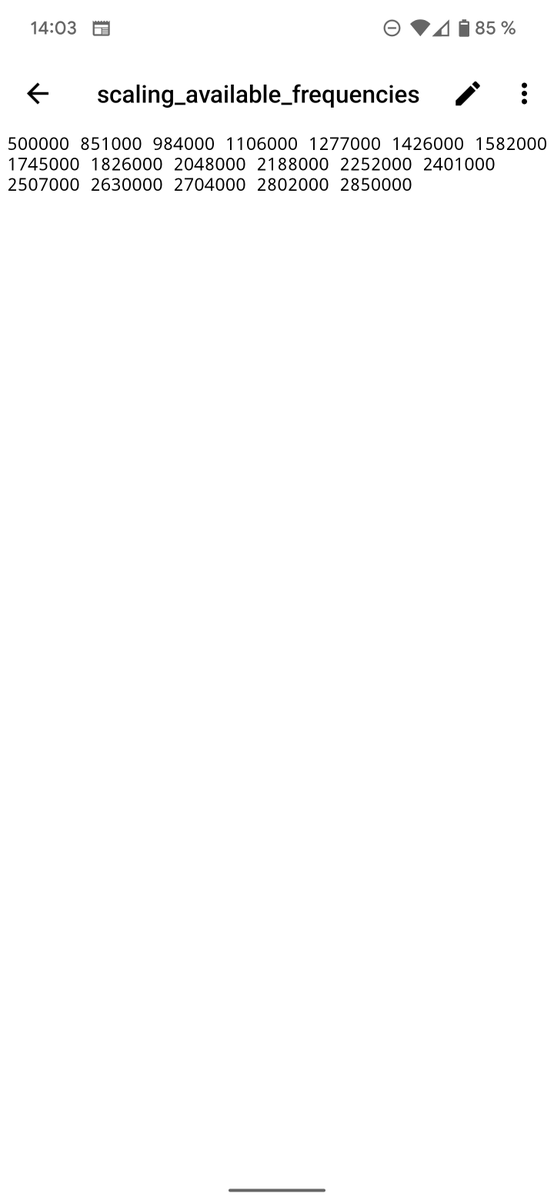
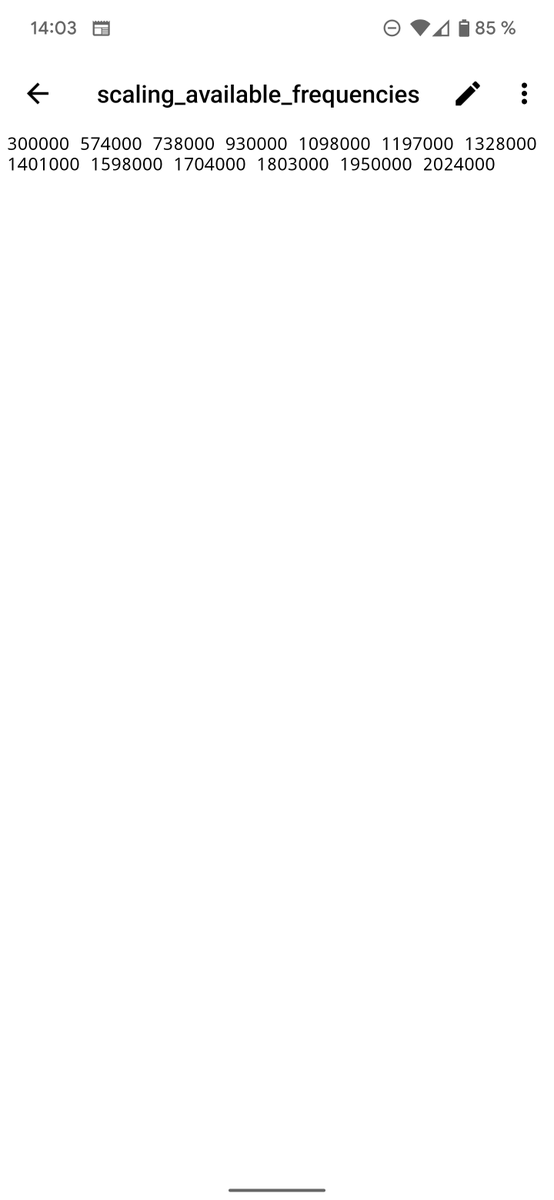
More references to faceauth in the dma-heap dtsi:
android.googlesource.com/kernel/gs/+/re…
It seems Google uses ML as hinted in that commit for faceauth:
https://t.co/GuNnxYQuPP
android.googlesource.com/kernel/gs/+/re…
It seems Google uses ML as hinted in that commit for faceauth:
https://t.co/GuNnxYQuPP
accidentally posted wrong link for the ML hint, correct one here:
android.googlesource.com/kernel/gs/+/87…
"Faceauth demands 20M more secure TPU memory to accommodate a new ML model."
android.googlesource.com/kernel/gs/+/87…
"Faceauth demands 20M more secure TPU memory to accommodate a new ML model."
Another interesting thing is that there are kernel device tree files for two different silicon variants of the Tensor SoC, which google internally calls gs101.
one is called gs101-a0, while the other one is gs101-b0.
gs101-b0 belongs to pixel 6 devices.
one is called gs101-a0, while the other one is gs101-b0.
gs101-b0 belongs to pixel 6 devices.
the a0 variant is clocked at 2,3ghz max cpu for the prime cores.
android.googlesource.com/kernel/gs/+/re…
this would theoretically fit @MishaalRahman ´s theory of whitefin being a pixel 5, with maybe an early variant of the tensor soc.
android.googlesource.com/kernel/gs/+/re…
this would theoretically fit @MishaalRahman ´s theory of whitefin being a pixel 5, with maybe an early variant of the tensor soc.
https://twitter.com/MishaalRahman/status/1453810037764280331
Fittingly whitefin is mentioned in the Makefile:
android.googlesource.com/kernel/gs/+/re…
android.googlesource.com/kernel/gs/+/re…
As mentioned by @andreif7 in the article about Googles new Tensor SoC, the Pixel 6 devices are indeed using the lz77eh zram compression algorithm.
From a pixel 6 Pro:
# cat/sys/block/zram0/comp_algorithm
[lz77eh] zstd deflate lz4 lzo-rle lzo
From a pixel 6 Pro:
# cat/sys/block/zram0/comp_algorithm
[lz77eh] zstd deflate lz4 lzo-rle lzo
This seems to be a hw accelerator for zram. According to @andreif7 Samsung left similar designs unused in the past.
Google calls the HW processor Emerald Hill:
github.com/freak07/Kirisa…
Google deploys 3gb of ZRAM on my Pixel 6 Pro.
Google calls the HW processor Emerald Hill:
github.com/freak07/Kirisa…
Google deploys 3gb of ZRAM on my Pixel 6 Pro.
• • •
Missing some Tweet in this thread? You can try to
force a refresh



