Alec Karakatsanis Profile picture
Nov 26, 2021 24 tweets 5 min read Read on X
This is a thread about how journalists decide what is “news” and what isn’t. Anyone shaping the news and anyone consuming the news should understand who decides what counts as news, how they decide it, and what determines what they say about it. Here, I ask a few questions:
This thread is inspired by the gap in what mainstream media treats as urgent and what are the greatest threats to human safety, well-being, and survival.
For example, air pollution kills *10 million people* each year and causes untold additional illness and suffering. It rarely features in daily news stories. Why?
Instead, daily news is dominated by “crime” stories. But even these are “crime” stories of a certain kind: they aren't stories about the many air pollution crimes. They are the kind of "crimes" publicized by police press releases, usually involving poor people.
Much of deadly U.S. air and water pollution is also criminal, but “law enforcement” chooses to ignore it, and thus so do most journalists.
Why is this important? What the media treats as urgent helps to determine what the public thinks is urgent. It shapes what (and who) we are afraid of.
A thought experiment: Imagine if every day for the last 25 years every newspaper and tv station had urgent “breaking news” stories and graphics about the *thousands of deaths the night before* from air/water pollution, climate change, or poverty?
Take the frenzy over “retail shoplifting” from big corporate stores, which has taken over local/national news. Same reporters don't cover the $137 million in corporate wage theft *every day,* including by the same companies whose press releases about shoplifting they now quote.
The media’s frenzy has led to emergency actions by many politicians, who are feeling intense political pressure to pass laws, assign thousands more police, increase police/prison budgets, and project an urgency they have *never* shown for wage theft: newsweek.com/california-gov…
Wage theft is more devastating than all other property crime combined. And unlike theft from big companies, wage theft is *by corporations* from workers, many of whom struggle to meet basic necessities of life. It makes people homeless and kids go without food and winter coats.
Did you know that mostly bank fraudulent overdraft fees amount to basically the same amount of property theft as all burglary, larceny, car theft, and shoplifting combined? Probably not, because the media doesn’t report on instances of overdraft fraud by banks every day.
If it’s hard to grasp the scope of the news’s silence on $50 billion wage theft epidemic, how can we grasp the scope of the news’s daily silence on the $1 trillion tax evasion epidemic by wealthy people? bloomberg.com/news/articles/…
Viewed in terms of absolute property value and objective harm, this makes much of the media’s obsession with retail shoplifting from corporate chain stores look absurd.
The same is true across public health, banking, manufacturing, employment, consumer protection, tax, and environment: things that cause greatest suffering and threats to public safety—many of which are crimes—receive a fraction of the attention as what police report as “crimes.”
Most people don’t know, because "news" didn’t tell them, that fraud crimes by bankers killed tens of thousands of people. Hundreds of thousands of people become homeless each year because of illegal actions by landlords. Almost never reported each day. yalelawjournal.org/forum/the-puni…
So, who is deciding to cover shoplifting with “breaking news” urgency but not air pollution, wage theft, and fraud that leaves people and their children homeless and in poverty?
The stakes are enormous. The world is careening toward extinction level events and millions are already dying from preventable causes that most people in the U.S. do not treat with urgency.
It’s hard to think of something more important than understanding the information-spreading apparatus that creates this gap between perception and reality.
Most people setting these agendas in the media are caring people committed to helping people understand the world. The NYT slogan is “all the news that’s fit to print.” The WaPo: “Democracy dies in the darkness.” How did such a gap between reality and "the news" develop?
Here are a few questions worth asking, and I hope you’ll add more:

Do the social and economic circles of journalists determine what they think is newsworthy?
Are there habits and customs relating to where journalists look for information, who their sources are, and who has the money to publicize things to journalists that determine what is considered news?
Are there professional economic incentives, racial and class biases, and jingoistic ideologies that shape *what harms* to *which people* count as important enough to be breaking news, or news at all?
What role does corporate ownership and consolidation of media companies play in determining what is covered and how urgently it is covered?

• • •

Missing some Tweet in this thread? You can try to force a refresh

 

Keep Current with Alec Karakatsanis

Alec Karakatsanis Profile picture

Stay in touch and get notified when new unrolls are available from this author!

Read all threads

This Thread may be Removed Anytime!

PDF

Twitter may remove this content at anytime! Save it as PDF for later use!

Try unrolling a thread yourself!

how to unroll video
  1. Follow @ThreadReaderApp to mention us!

  2. From a Twitter thread mention us with a keyword "unroll"
@threadreaderapp unroll

Practice here first or read more on our help page!

More from @equalityAlec

Mar 18
There has been an alarming development in our legal system. Judges are starting to contract with a private corporation started by an ex-Palantir employee--whose bio says he is also a former speechwriter for Israel's UN ambassador--to have **secretive proprietary AI help decide cases for them.**Judges in one of the nation’s largest court systems have started using artificial intelligence, testing a tool that can rapidly distill hundreds of pages of legal motions and use samples of a jurist’s writing style to help reach conclusions and even draft tentative rulings.
The pressure to be "efficient" and to process more and more cases in assembly-line fashion is one of the great legal crises of our time. More and more, the legal system is eviscerating the capacity for even the tiniest level of critical thinking; any semblance of justice amidst the extraordinary pressure to rubber stamp; time for reflection; accountability; transparency; and the hope of some balancing of integrity, moral courage, intellectual rigor, etc.
These developments are happening with almost no democratic public debate, and almost no meaningful public oversight. Most lawyers even are totally in the dark about how the cases they are working on are being decided--and by whom.
Read 4 tweets
Mar 14
THREAD. I have to say that I am very disappointed with John Oliver. I finally watched his segment on police body cameras, and it was abysmal. Missed the whole point, and in the process bought into some of the worst copaganda about them.
The show correctly (but not strongly enough) points out that police body cameras don't "work"--meaning they are a total failure if one assumes their goal is to make police less violent and more accountable. They do not do that. They do not do the thing most liberals have been told is their purpose. The research is overwhelming on this point. The mainstream news has numerous articles on the evidence. Oliver reports this with some decent jokes, but he largely makes the cardinal error that I identified in my study of a decade of body camera propaganda: **Oliver assumes that the marketing of body cameras to well-meaning liberals accurately reflects their true purposes and functions.** As a result, he follows a long ling of liberal propaganda in obscuring the reasons that police, the surveillance industry, prosecutors, and politicians keep pushing them. Isn't he the slightest bit curious why both Hakeem Jeffries, every prosecutor in the U.S., and Kristi Noem/Tom Homan are celebrating them?
Incredibly, Oliver misses almost all the key parts of the story: 1) The original plan of the tech industry and cops to market them as good for cops/surveillance; 2) They had no success with this and had to rely on private donations for body cameras from people like Steven Spielberg! 3) So, after Ferguson, they pivoted to pitching them to liberals as "accountability and transparency." 4) This is worth literally tens of billions of dollars, and it's inextricably linked to the surveillance industry, AI, facial recognition, voice recognition, cloud computing contracts, policing of protests, databases on activists and poor people and immigrants, and protecting cops from liabilityl etc. 5) The enormous pressure from prosecutors and cops to get liberals to fork over the billions of dollars necessary to give every cop a body camera so they can use it overwhelmingly in low-level cases to coerce guilty pleas from poor people because the entire system is crushed if people exercise their right to trial; 6) The cops love them because they control the footage and can hide bad stuff, make stuff they like go viral, and control public narrative; 7) They play an extremely important propaganda function as we see after police killings and after recent ICE killings of focusing conversations on individual incidents and bad actors to get people to stop asking much deeper questions about why we have these forces and why they are in the neighborhoods they are in and what they are doing.
Read 7 tweets
Jan 31
All people of good will must know the history of body cameras. Why did Democrats, consultant, and pundits push them as "police reform"? The truth is quite dark.
I set out the shameful history of Democratic Party propaganda about body cameras in my 2024 study called The Body Camera: The Language of Our Dreams. campuspress.yale.edu/yjll/volume-4/…
For those in other places where liberals and the multi-billion dollar surveillance industry is pushing this "reform," my article was translated into French and published as a book. As always with everything I write, the royalties are donated to charity. ruedorion.ca/la-camera-dint…
Read 4 tweets
Jan 14
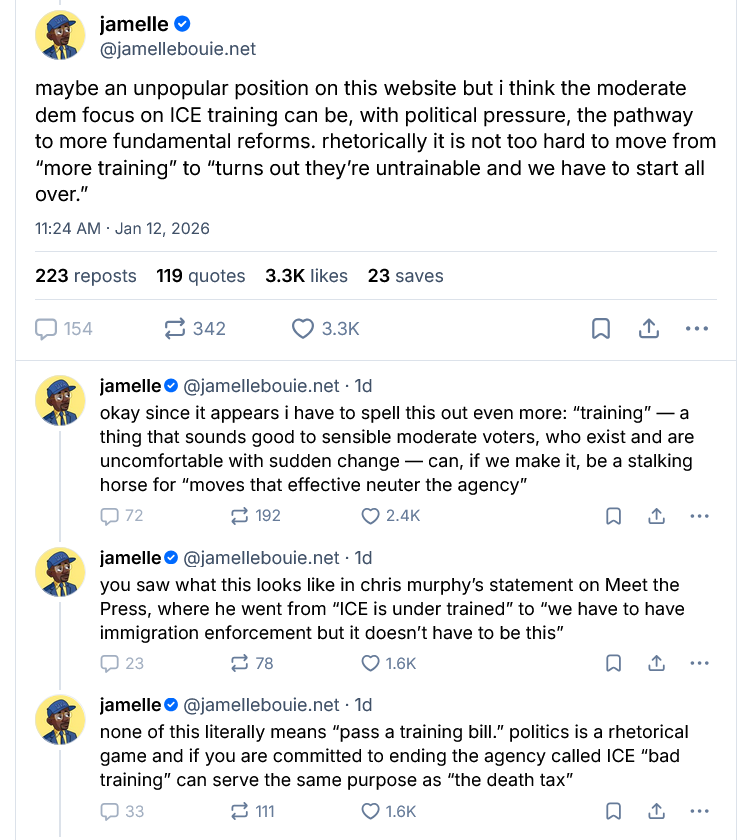
THREAD. This can be a big educational moment for progressive people who don't work in or study the punishment bureaucracy. Having spent 20 years in it--and just publishing a book on exactly this topic--I can say that reality works in the opposite way that Jamelle assumes: Image
Rhetoric about stuff like "training" has, time and again, in dozens of contexts I studied, had the opposite effect on the approach of liberals to addressing the violence, lawlessness, and ineffectiveness of the punishment bureaucracy.
It's quite similar to the Democratic party and liberal punditry's approach to body cameras, which I wrote about at length last year: . "Training" rhetoric is an even more stark example of effective counterinsurgency propaganda.campuspress.yale.edu/yjll/volume-4/…
Read 8 tweets
Jan 2
THREAD. Every year, I tell the story of Ezell Gilbert. It's the story of one of the most remarkable cases in U.S. history, and you’ve probably never heard of it. The story of what the U.S. government did to him is vital for understanding the current moment we are in.
In 1997, Ezell Gilbert was sentenced to more than 24 years in federal prison in a crack cocaine case. Because of mandatory sentencing (treating crack 100 times as severely as powder), he was put in a cage for a quarter century, and even the judge said this was too harsh.
At sentencing, Gilbert noticed an error that increased his sentence by about *10 years* based on a misclassification of a prior conviction. In 1999, without a lawyer, he filed a petition complaining about the mistake. The Clinton DOJ opposed him, and a court ruled against him.
Read 18 tweets
Oct 12, 2025
THREAD. Did you know that at about 1/3 of all stranger homicides in the U.S. are perpetrated by police? But there's something hidden here that is important to understand in this authoritarian moment.
First the basics: The vast bulk of physical and sexual violence in our society is *not* perpetrated by strangers, but by people who know each other. Obscuring this fact is a critical feature of copaganda in the news. People are shocked to hear it. Why?
A simple answer is that the news makes people extremely scared of strangers--the person next to you at CVS, the person walking down the street, the unhoused person in a tent, the anonymous burglar, etc. These are the kinds of crimes associated with surveillance, policing, etc.
Read 12 tweets

Did Thread Reader help you today?

Support us! We are indie developers!


This site is made by just two indie developers on a laptop doing marketing, support and development! Read more about the story.

Become a Premium Member ($3/month or $30/year) and get exclusive features!

Become Premium

Don't want to be a Premium member but still want to support us?

Make a small donation by buying us coffee ($5) or help with server cost ($10)

Donate via Paypal

Or Donate anonymously using crypto!

Ethereum

0xfe58350B80634f60Fa6Dc149a72b4DFbc17D341E copy

Bitcoin

3ATGMxNzCUFzxpMCHL5sWSt4DVtS8UqXpi copy

Thank you for your support!

Follow Us!

:(