Judge Musmanno really doesn't like the Supreme Court's "voluntary encounter" caselaw. (An alternative would be to say it's a compelled encounter but is allowed with no cause. But from a civil liberties perspective, isn't that worse?) pacourts.us/assets/opinion…
As I see it, the problem goes like this. The Justices think the 4th Amendment should let the police walk up to people and ask them questions without cause. You can get there two ways: (a) Either it's not a seizure, or (b) it's a seizure that is allowed without cause.
Which is better, (a) or (b)? The Justices went with (a), which lets them maintain the basic rule that seizures have to be justified. They then needed a test to allow (a) without gutting 4th Amendment protection for clearly compelled stops, like the officer who orders the stop.
It seems plausible to me that the choice they made is the most civil liberties protective answer that also allows the police to walk up to people and talk to them.
Of course, you might say the 4th should not allow the police to walk up to people and talk to them. But once you have a majority of Justices who look at that differently, you then need to figure out how to get there while not gutting the rest of the related 4A protections.

• • •

Missing some Tweet in this thread? You can try to force a refresh

 

Keep Current with Orin Kerr

Orin Kerr Profile picture

Stay in touch and get notified when new unrolls are available from this author!

Read all threads

This Thread may be Removed Anytime!

PDF

Twitter may remove this content at anytime! Save it as PDF for later use!

Try unrolling a thread yourself!

how to unroll video
  1. Follow @ThreadReaderApp to mention us!

  2. From a Twitter thread mention us with a keyword "unroll"
@threadreaderapp unroll

Practice here first or read more on our help page!

More from @OrinKerr

30 Nov
Among the many things in life that I don’t get, one of them is TikTok.
I’ve spent some time trying it, but I don’t get what is supposed to be appealing about it.

Oh, and get off my lawn.
Maybe I’ll start a channel to explain the Stored Communications Act to 14 year olds. A new song about the ECS/RCS distinction could really take off.
Read 4 tweets
23 Nov
Listening to the oral argument in Katz v. US (1967), am I right that the notion of reasonable expectations of privacy is voiced primarily by Justice Fortas?

A thread.

oyez.org/cases/1967/35
As I follow the argument, Katz's counsel argued for a test that asked whether an objective observer would conclude that a person intended the communication to be confidential.
According to Katz's lawyer, Harvey Schneider, the issue should be an objective inquiry into likely subjective intent.
Read 9 tweets
3 Nov
Oral argument video in the Florida Supreme Court in People v Garcia, on compelled decryption and the 5th Amendment, here starting at 1:15. A few thought below…

facebook.com/floridasupreme…
This is a compelled password case, not a compelled entry case, but the state has made clear that either is fine: If it can't get compelled disclosure but *can* get compelled entry, the state says, it will just do that next and it's fine with them.
That's potentially important because this case might be the one that goes up to SCOTUS. There are splits on both compelled entry and compelled disclosure, a case that considered both issues together (or at least made clear both issues were practically in play) would be appealing.
Read 8 tweets
2 Nov
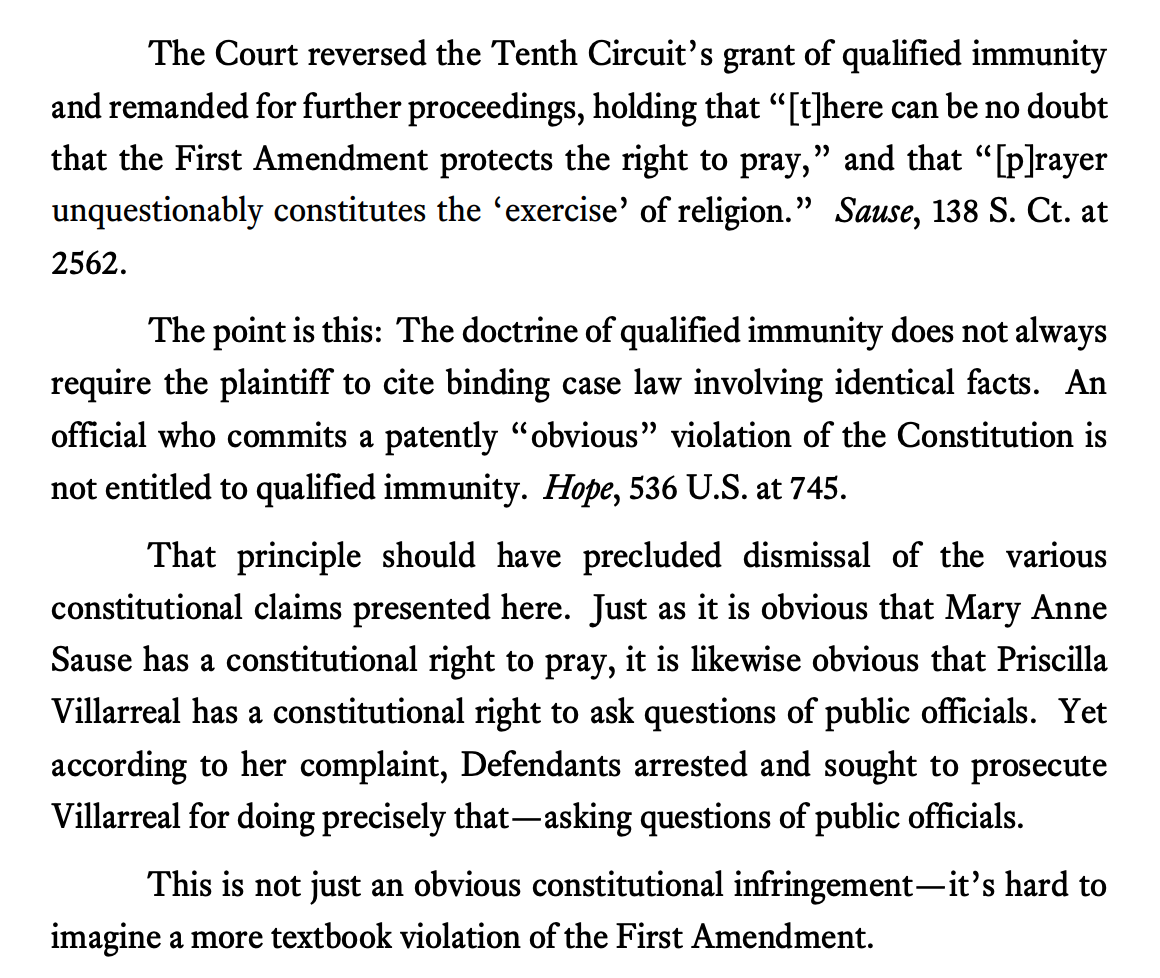
Two published 5th Circuit QI cases, two days apart, offer rather different perspectives on whether/when a factually similar precedent is needed to deny QI. (Judge Ho is right, I think, it's not; Judge Jones is wrong.)

ca5.uscourts.gov/opinions/pub/2…

ca5.uscourts.gov/opinions/pub/2… ImageImage
To be clear, it's possible to reconcile the two cases on their facts. But it seems to me that their overall approach to QI is quite different.
The basic dispute is a question that @JCSchwartzProf and I were discussing recently: If a violation is clear based on the rules announced in prior cases, even if the rules were announced in factually dissimilar cases, does QI apply?
Read 6 tweets
20 Oct
A common problem 1Ls have with their exams (and therefore their grades) is not understanding the role of analysis in answers. They often won't entirely get what analysis is, and why it's the most important part of an answer.

I thought I would explain how I see it. (Thread.)
First, some context. 1Ls are taught that there is analysis step in an exam answer for an issue-spotter question. Students often hear about IRAC – “Issue, Rule, Analysis, Conclusion.” But exactly what “analysis” is – and why it’s so important -- isn’t obvious.
Your prof may see it differently, so YMMV. But here’s how I see it.

“Analysis” is the real guts of the answer. It’s an explanation of how the facts and the law match up. It requires detailing a thought process based on a nuanced and complete understanding of law and fact.
Read 16 tweets
24 Sep
Lease agreements in 1791 were pretty cool. A quick thread.
Opening it.
Fully opened.
Read 9 tweets

Did Thread Reader help you today?

Support us! We are indie developers!


This site is made by just two indie developers on a laptop doing marketing, support and development! Read more about the story.

Become a Premium Member ($3/month or $30/year) and get exclusive features!

Become Premium

Too expensive? Make a small donation by buying us coffee ($5) or help with server cost ($10)

Donate via Paypal

Or Donate anonymously using crypto!

Ethereum

0xfe58350B80634f60Fa6Dc149a72b4DFbc17D341E copy

Bitcoin

3ATGMxNzCUFzxpMCHL5sWSt4DVtS8UqXpi copy

Thank you for your support!

Follow Us on Twitter!

:(