

We will be live-tweeting the CPS school funding public forum this evening! The event should be starting shortly so stay tuned.
Maurice Swinney, interim CEO, opening the forum by thanking everyone for showing up and acknowledging that "we have a ways to go" in building trust with the community.
Swinney outlining that that the CPS 5-year plan emphasizes resource equity and fair policies and systems.
Heather Wendell, Chief Budget Officer, now explaining the School Funding Working Group. 

Wendell stated that CPS is looking to add more parents and students to the Working Group going forward.
Wendell: These formats are designed to "support robust dialogue and capture feedback." Forum will emphasize small groups where stakeholders can discuss and give feedback.
How CPS says they will use feedback from these forums:
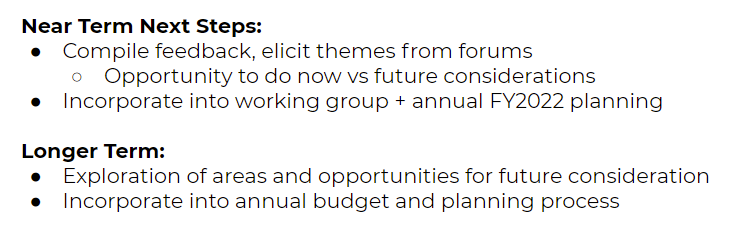
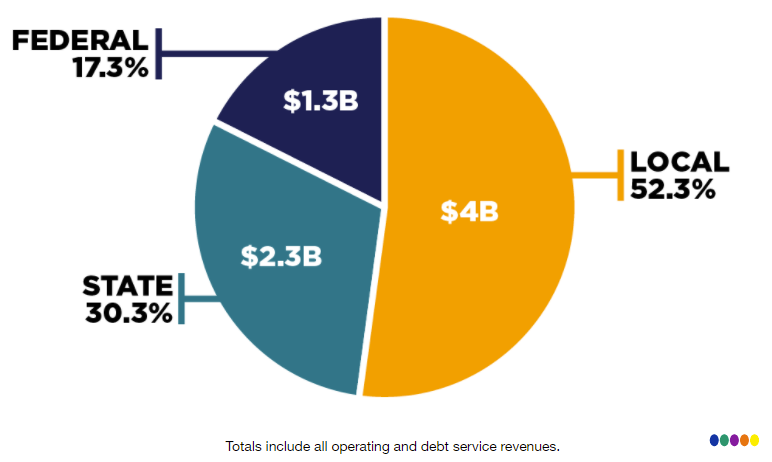
CPS assistant budget director Michael Sitkowski now presenting about where CPS gets its funding and how CPS uses that funding.
Sitkowski noting that CPS is getting increased federal funding this year compared to an average year.
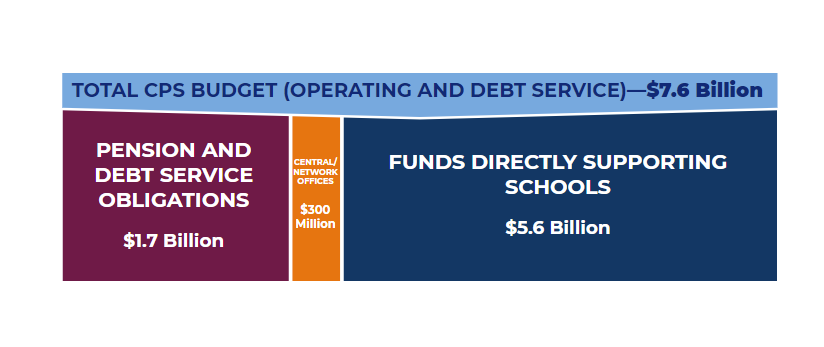
Sitkowski: CPS is still facing a nearly $2 billion shortfall. The average CPS students is getting about $5.6k less in funding each year than they should be.
Sitkowski: CPS is the only district that needs to fund their own teachers' pension fund. CPS needs to fund pensions before using any money on administrative expenses or schools.
Sitkowski noting that CPS does not just fund equally per student. CPS has specific funding streams that go to high-need students (e.g. low-income, special ed) or high-need schools.
Sitkowski: all CPS schools, even those with the lowest number of high-need students, do not currently have adequate funding.
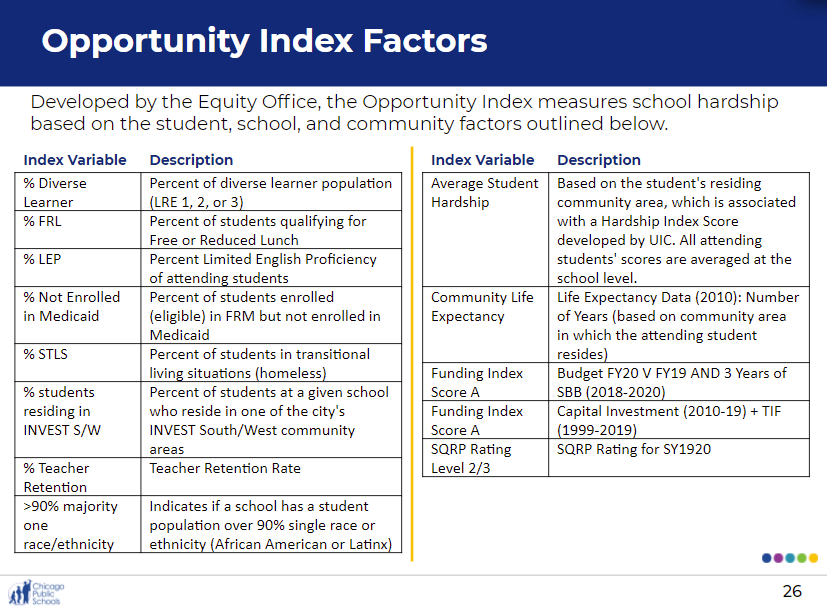
In this fiscal year, CPS started using an Opportunity Index to understand where there is the greatest student need. $26 million in equity grant funding was tied to this Opportunity Index.
Sitkowski: we incorporated feedback from the last school funding forum and did not penalize schools who experienced large enrollment drops due to COVID-19 pandemic. Schools were funded based on 3 year enrollment averages, rather than changes in the last year.
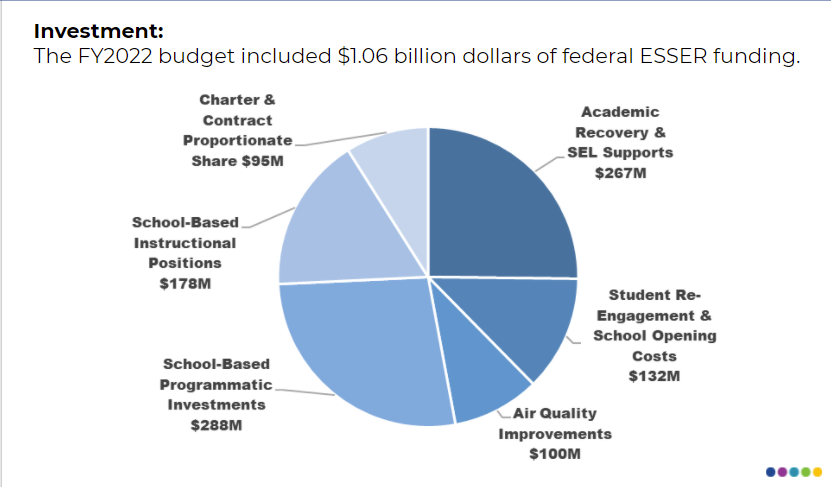
Sitkowski: CPS budget included over $1 billion in federal funding to address student and schools needs that arose as a result of the pandemic.
We are now moving into small groups to discuss these questions: What should CPS be prioritizing right now in terms of funding? What could CPS do to improve transparency, equity, stability, and/or sustainability in school funding? What should CPS be considering in the long term?
Facilitator: we are here tonight to really listen to you. The district wants to be clear and transparent. We want to make sure you understand what's going on, and if you have ideas we want to hear them.
School principal: we passed out all of our technology at the beginning of the pandemic. Now that we're back in the building, that technology is not in the same shape. I don't have what I need to meet the bare minimum. Our desktop computers are 15 years old.
Principal: we've also had ongoing maintenance issues - leaking roofs, a burst pipe, a gas leak. There is also a tremendous amount of red tape in order to secure any resources for teachers.
District employee stating that there are currently supply chain issues with technology. District is working on maintenance issues, but does not have the funding to fix every issue at every school currently.
Principal: these maintenance issues are systemic - they have been ongoing since before the pandemic. It's hard for me to say to parents that CPS is emphasizing equity when our building has not been maintained for years.
Parent: we need more staff to update school websites because they are all outdated, staff who apply for grants so that administrators and teachers don't have to beg for money or donations, staff who are working on enrollment, more SEL staff in high-poverty schools.
Parent: we also need more maintenance and engineering staff in older school buildings to ensure conditions remain safe.
District employee response: schools and principals have discretion over the federal funds they got this year, some have used them to hire attendance coordinators, some may have other priorities.
District employee: this is a funding issue, principals tend to prioritize teaching positions but we are also facing an ongoing budget shortfall.
Another parent is expressing concern about foundational skills (especially reading) that younger students have missed out on due to remote learning. Many students at her children's school are behind grade-level on reading, which impacts all subjects.
CPS teacher: there is no real clarity about how our feedback translates into actual policy change. My students surveyed MS and HS students across the city and the highest priority for them was mental health clinics and counselors, and those supports haven't been there.
CPS teacher: other high priorities that students expressed: free internet, housing for students experiencing homelessness, summer jobs.
District employee: we did cover how the feedback from previous forums was implemented, including increased funding for SEL. Some of those issues, like homelessness, are not just about CPS budget, but about partnerships with the city.
Principal: for improving transparency, we need a simple document explaining the budget that we could share with parents and families. The one-pager sent to principals is hard to understand. I'm spending a lot of time explaining the CPS budget process to families.
District employee: we do have a Google Slides presentation about the budget. The LSC team does distribute detailed information to the LSCs, those might be useful for explaining the process to families.
Parent: CPS needs to do a better job of identifying learning disabilities or dyslexia at an early age. We wait until 3rd or 4th grade when students are starting to fail. Our scores are showing that 40% of CPS students are not reading at grade-level.
Parent: students often lose interest or act out in school when they cannot read. Focusing on reading and foundational skills, especially among diverse learners and students of color would do a lot to improve equity in CPS.
Parent: in terms of transparency, the last audit at my children's school was in 2014. We don't know where student fees go or what is happening with the budget, and we are in the red at our school.
CPS Principal: we only have a half-time case manager for students with IEPs. Many students who came back to in-person learning need to be evaluated and I don't have the resources to do that. I will also probably lose this case manager once she finds a full-time position.
District employee: we might be able to look into adding case manager to our foundational positions (which currently include principal, clerk, counselor).
The last question: what should CPS's long term priorities be?
Principal: we need to change funding sources so that they do not just rely on taxes, that leads to inequities. We need more teacher training.
Parent: we need stability in terms of funding. Right now my student's class size dropped and I'm worried they will eliminate a teaching position, which might then need to be filled again in a few years.
District employee: we switched to the SBB model, where money follows students, in order to give principals more discretion on how to use money but there are pros and cons to both models.
CPS principal: I spend my summers applying to grants for my school, so I truly appreciate the CPS equity funds. The ESSER funds have also made things a little more bearable. There have been changes in a positive direction, though I think we need even more transparency and equity.
We are now back in the main room and small groups are sharing back about what they discussed!
Principal: teachers, students, and community members need to have more of a seat at the table. We want CPS to prioritize workforce development and pipeline from school to jobs.
Group 2: we need more SEL supports, students have suffered during this pandemic. Student and staff voices were missing from this conversation - what they experience every day is crucial. We want to know more about CPS's long-term budget plans. Federal funds were a one-time thing.
Group 3: we agree that funding for SEL is key. We need input from students, staff, nurses, counselors in these conversations. How do we ensure that funding continues when federal funds were limited and some funds follow students to charter schools?
Group 5: we need non-CPS families in these conversations to understand why they are not sending their students to CPS. Also need more SEL funding, children need help returning to in-person. We need improved transparency on the capital budget and money is spent.
Budget info needs to be more transparent and accessible for families and LSCs.
Group 7: all schools should be doing what selective enrollment schools are doing, so that all students get the same quality of education. Families are leaving CPS because we do not provide equitable education opportunities.
Group 8: we are happy that CPS introduced Wilson reading program, but we need more staff trained to support students. How are we going to address egregious maintenance issues in building? Students need to be at the table - there could be a student forum during the school day.
Participants discussed the possibility of using the Student Voice Committees to facilitate student forums.
Group 9: we are concerned about safety: mask-wearing, temperature checks, lead in water, social-emotional support. We want to know more about equity and what is done to support schools that struggle to attract students.
Heather Wendell closing out the forum by asking attendees to ask friends, students, and other community members to join the next forum on Thursday! You can register at the link here: docs.google.com/forms/d/e/1FAI…
• • •
Missing some Tweet in this thread? You can try to
force a refresh





