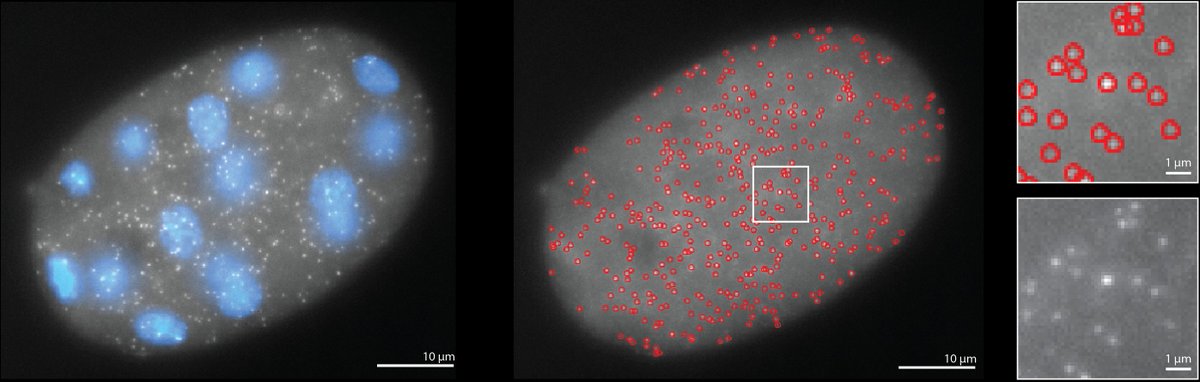
We (together with @nu_karaiskos & @N_Rajewsky) are excited to announce the open-source Spatial Transcriptomics Imaging Project (STIM). Its goal is to bring the worlds of transcriptomics and imaging together [1/8].
biorxiv.org/content/10.110…
biorxiv.org/content/10.110…
STIM is a computational framework for storing, exploring, visualizing, and processing of 2D & 3D spatial sequencing datasets that scales to large and high-throughput datasets [2/8].
STIM is built using #ImgLib2, N5, #BigDataViewer and allows the application of computer vision techniques to datasets with irregular measurement-spacing such as spatial transcriptomics data generated by multiplexed targeted hybridization or spatial sequencing technologies [3/8]. 

We illustrate STIM’s capabilities by representing, visualizing, and automatically registering publicly available spatial sequencing data from 14 serial sections of mouse brain tissue [4/8].

STIM stores data using the N5/Zarr-compatible file format allowing fast, distributed and memory-efficiently reading [& writing] in blocks using the Imglib2-cache framework, which can be accessed as values or as rendered images. Access is provided through Java and Python [5/8].

Spatial sequencing data can be interactively processed & visualized using BigDataViewer or rendered as “classical” images through Fiji/ImageJ, which can be exported as images or videos [6/8].
Documentation and tutorials are available on the GitHub pages:
github.com/PreibischLab/S…
github.com/rajewsky-lab/s…
We’d like to specifically point you to the tutorial that uses a small dataset:
github.com/PreibischLab/S…
[7/8].
github.com/PreibischLab/S…
github.com/rajewsky-lab/s…
We’d like to specifically point you to the tutorial that uses a small dataset:
github.com/PreibischLab/S…
[7/8].
Creating STIM was a lot of fun and turned into a great collaboration between @BIMSB @MDC @HHMI Janelia.
Its inception goes back to an informal discussion between myself and @N_Rajewsky on a sunny day at the campus of the Sapienza University of Rome [8/8].
Its inception goes back to an informal discussion between myself and @N_Rajewsky on a sunny day at the campus of the Sapienza University of Rome [8/8].
I forgot to tag @FijiSc in this thread! The rendered images/videos can be (automatically) processed and saved within Fiji, and then of course be further used in any language of your choice ... python, @napari_imaging, ...
• • •
Missing some Tweet in this thread? You can try to
force a refresh