1/10 January 6 was practice for Trump’s next coup attempt, @bartongellman reports. In our cover story, Gellman examines the convictions of Trump’s most fervent supporters, including some who stormed the Capitol. Here’s what he learned from researchers: bit.ly/3EuhxbR
@bartongellman 2/10 The first fact about insurgents that surprised Robert A. Pape, a political-science professor at the University of Chicago, was their age: Violent political extremists tend to be in their 20s and early 30s, but the median age of people at the Capitol that day was 41.8.
3/10 Then there were the economic anomalies: Only 7% of insurgents were jobless; more than half had a white-collar job or owned a business. “The last time America saw middle-class whites involved in violence was the expansion of the second KKK in the 1920s,” Pape told Gellman.
4/10 Six out of every seven insurgents charged with crimes had no affiliation with extremist groups like the Proud Boys or Oath Keepers. “January 6 wasn’t designed as a mass-casualty attack, but rather as a recruitment action,” another source told Gellman. bit.ly/3EuhxbR
5/10 Researchers also mapped the insurgents by home county. Counties won by Trump in the 2020 election were less likely than counties won by Biden to send an insurrectionist to the Capitol. Likewise, the more rural the county, the fewer the insurgents.
6/10 “Only one meaningful correlation emerged,” Gellman writes: “Other things being equal, insurgents were much more likely to come from a county where the white share of the population was in decline”—a link that held up in every state. bit.ly/3EuhxbR
7/10 A post-insurrection survey targeted toward people who don’t trust the election results found that 8%—or 21 million American adults—agreed that violence was justified to restore Trump to the White House.
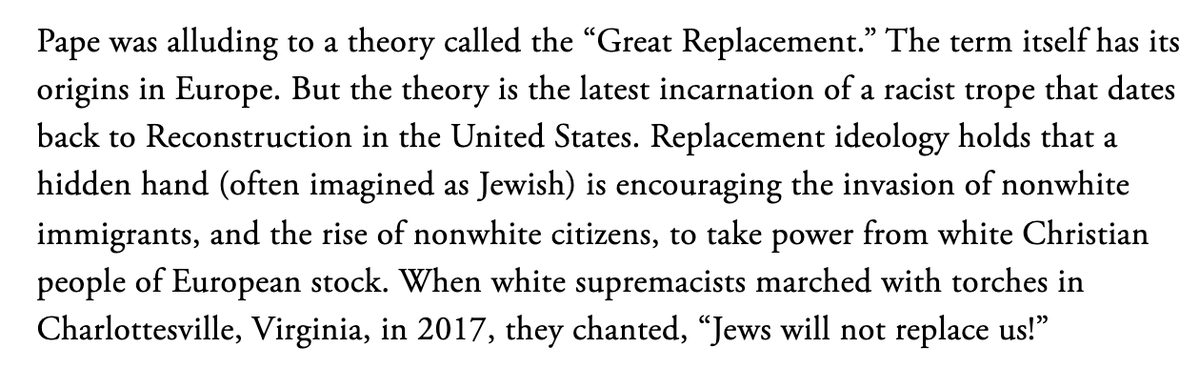
8/10 The same survey also found that almost two-thirds of “committed insurrectionists” agreed that “African American people or Hispanic people in our country will eventually have more rights than whites”—an ideology that aligns with the Great Replacement theory.
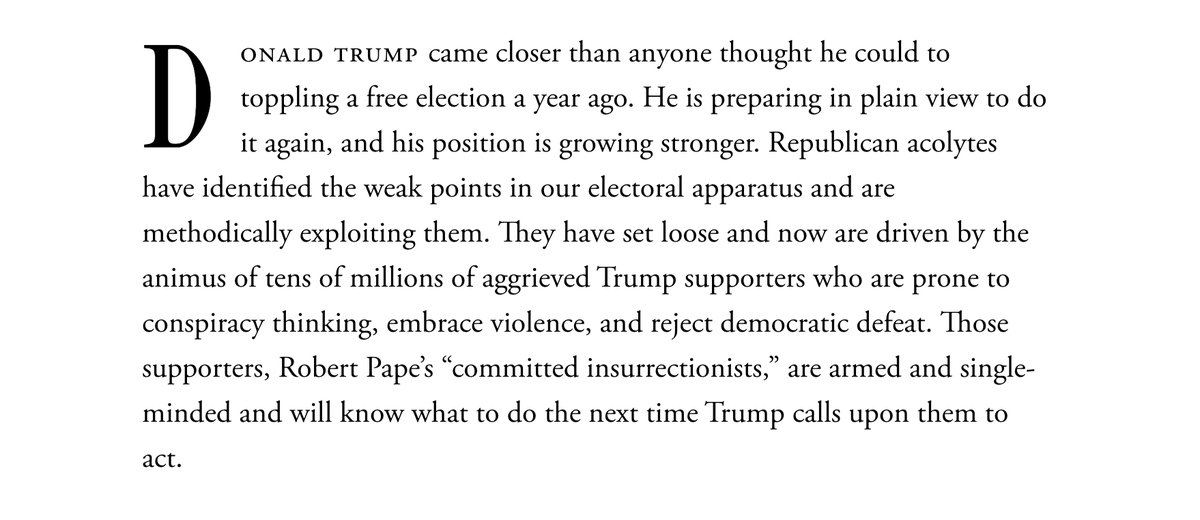
9/10 What researchers found doesn’t fit with the government’s characterization of attacks from lone wolves or small groups of extremists. “This really is a new, politically violent mass movement,” Pape told Gellman. “This is collective political violence.”
10/10 The DOJ and FBI “are chasing down the foot soldiers of January 6, but there is no public sign that they are building cases against the men and women who sent them,” Gellman writes. “Absent consequences, they will certainly try again.” Read more: bit.ly/3EuhxbR
• • •
Missing some Tweet in this thread? You can try to
force a refresh

The Atlantic’s January/February issue examines the threats to the American experiment one year after the January 6 insurrection. The system held, but barely. Our new reporting suggests that we are closer to losing our democracy than most ever thought possible:
2/ Donald Trump may be capable of winning a fair election in 2024, but he doesn’t intend to take that chance, @bartongellman reports. In our cover story, Gellman investigates how the former president is laying the groundwork to subvert the next election: theatlantic.com/magazine/archi…
3/ “If the plot succeeds, the ballots cast by American voters will not decide the presidency in 2024,” Gellman writes. “Thousands of votes will be thrown away, or millions, to produce the required effect.”
1/5 Today we’re introducing three newsletters by Atlantic staffers you might already know and love. Sign up here, and read on for more about our new offerings: on.theatln.tc/eRk33Gc
2/5 In his newsletter, Work in Progress, @DKThomp will explain today’s news and tomorrow’s trends in work, technology, and culture—all in plain English: on.theatln.tc/n0EeZDW
3/5 In his newsletter, Up for Debate, @conor64 will highlight timely, intriguing conversations––and share responses from thoughtful readers. on.theatln.tc/2xnwT7Y
1/ The #GRAMMYs have announced nominees in 86 categories. Over the past year, our critic @skornhaber reviewed many of the contenders for Album of the Year. Here are some of the highlights:
2/ “Sour,” by Olivia Rodrigo, “embodies a trend of treating songwriting as an act of explanation rather than exploration,” Kornhaber argued in May. theatlantic.com/culture/archiv…
3/ Billie Eilish’s success has “capped off a decade during which popular music made more space for malaise in its melodies,” Kornhaber wrote. theatlantic.com/culture/archiv…
2/6 The Confirming Respect for the Principles of the Republic bill, also called the anti-separatism bill, is the latest salvo in a centuries-old battle between the French state and organized religion, Donadio explains.
3/6 Among other things, the bill places stricter controls on religious associations, gives the state broad authority to temporarily shut down any house of worship if there is a suspicion that it is inciting hatred or violence, and puts tighter restrictions on asylum seekers.
1/7 The most important animal-rights case of the 21st century will be heard next year, Jill Lepore writes. It’s about an elephant named Happy. theatlantic.com/ideas/archive/…
2/7 Happy was captured and brought to the U.S. from Thailand shortly after she was born around 1970. For most of her life, she has lived at the Bronx Zoo, where she used to perform tricks and lounge with her friends Tus and Grumpy. Now Happy lives alone.
3/7 The Nonhuman Rights Project says that Happy’s detention is unlawful because under U.S. law she should be considered a person—and shouldn’t live alone. Personhood has been granted to corporations and ships. But can an elephant be a person? theatlantic.com/ideas/archive/…
1/11 Today we’re introducing nine new newsletters from The Atlantic, from exciting voices you may already know and love. These newsletters are a benefit of subscription, but anyone can sign up for free during a trial period, which runs until November 30: on.theatln.tc/zGrdqPv
2/11 .@JordanMCalhoun’s newsletter, Humans Being, searches for lessons in popular movies, books, TV shows, and more. Whatever you’re streaming, this newsletter will be your companion to help understand the story and decide what to play next: on.theatln.tc/wO9pZ18
3/11 In her newsletter, I Have Notes, @nicolesjchung will share conversations and essays, explore the craft of writing, discuss the books she’s reading, and give a little bit of advice—with room for your questions, quirks, and obsessions too. on.theatln.tc/nwnwFLA