
Our book, a 🧵.
1/ We hope Covering Muslims will engage scholars, students, activists, journalists & anyone interested in portrayals of Muslims, media analysis, or big data.
📢 Please RT.
If this 📖 has info you want/need, we want you to have a copy. Read on!
@amauritsvdv
1/ We hope Covering Muslims will engage scholars, students, activists, journalists & anyone interested in portrayals of Muslims, media analysis, or big data.
📢 Please RT.
If this 📖 has info you want/need, we want you to have a copy. Read on!
@amauritsvdv

2/ Our book has several key findings. But most importantly, there is one that can’t be overstated:
👉 COVERAGE OF MUSLIMS IS REMARKABLY NEGATIVE BY ANY MEASURE 👈
👉 COVERAGE OF MUSLIMS IS REMARKABLY NEGATIVE BY ANY MEASURE 👈
3/ We provide the first systematic, large-scale analysis of American newspaper coverage of Muslims, using big data techniques and readings of individual articles. 📈
4/ We compare coverage of Muslims in the US to coverage of Catholics, Jews, Hindus, African Americans, Latinos, Mormons, and atheists.
➡️ Bottom line: coverage of Muslims is FAR more negative than for any other group.
➡️ Bottom line: coverage of Muslims is FAR more negative than for any other group.
5/ We analyze articles from 1996 through 2016—looking specifically at the effects of 9/11 and other major events on the number and tone of articles, as well as the words most commonly associated with Muslims.
6/ We compare coverage in the US🇺🇸 to that in Britain🇬🇧, Canada🇨🇦, and Australia🇦🇺, as well as to newspapers in India🇮🇳, Kenya🇰🇪, Malaysia🇲🇾, Nigeria🇳🇬, Pakistan🇵🇰, and Singapore🇸🇬.
7/ We use topic modeling techniques to explore the themes most commonly associated with Muslims, identifying the ones that are the most (and least) negative.
8/ We conclude by thinking through the ways in which media outlets reproduce biases—especially Islamophobia—and how media consumers can “tone-check” ✅ the media to offset some of those biases.
9/ Stay tuned for short threads about each of these main findings in the coming days… 📅
(📢 Retweet please and thank you!)
(❓Questions/comments welcome!)
(📢 Retweet please and thank you!)
(❓Questions/comments welcome!)
10/ One main comparison we examine is coverage across groups.
Is coverage of Muslims really more negative than it is of other groups?
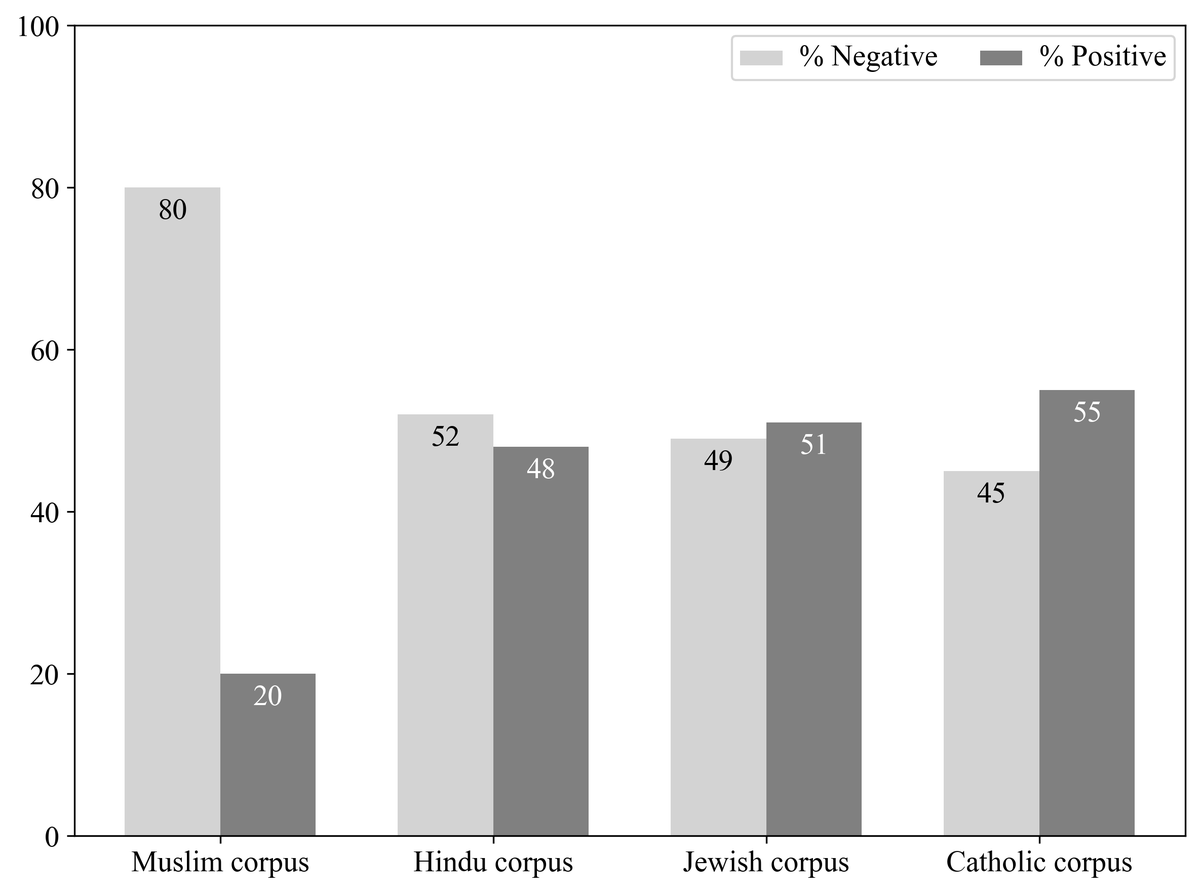
YES. By a long shot. One way to see this is by comparing the % negative and positive stories mentioning Muslims, Hindus, Jews, and Catholics.
Is coverage of Muslims really more negative than it is of other groups?
YES. By a long shot. One way to see this is by comparing the % negative and positive stories mentioning Muslims, Hindus, Jews, and Catholics.
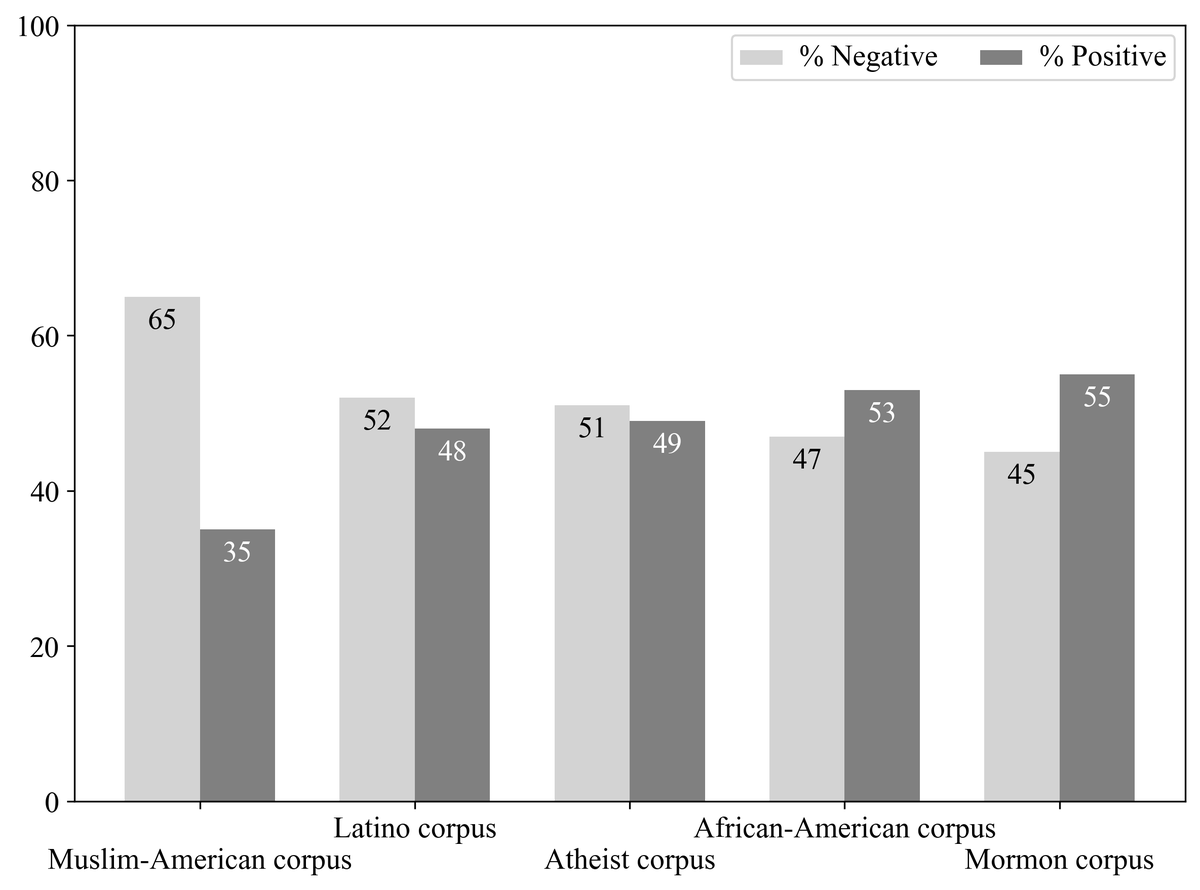
11/ Similarly, stories touching on Muslim Americans are more likely to be negative than those mentioning different US-based racial, ethnic, and (non-)religious minorities.
12/ We use a new lexical sentiment analysis tool, MultiLexScaled, to measure not only whether an article is positive or negative, but also just how positive or negative it is benchmarked against a random sample of over 48,000 US newspaper articles. 🤓
13/ This allows us to show that articles mentioning Muslims are far more negative than those touching on other groups. (The x-axis is standard deviations.)

14/ Coverage of most other groups is far less negative. Muslims are a striking outlier.

15/ In short, YES, coverage of Muslims is undeniably and strongly more negative than that of other groups.
In fact, the average article about Muslims is more negative than 84% of our random sample of US newspaper articles. No other group comes close.
In fact, the average article about Muslims is more negative than 84% of our random sample of US newspaper articles. No other group comes close.
16/ We also looked at change over time. ⏲️ How big a deal was 9/11 for the newspaper coverage of Muslims?
Surprisingly, not much in terms of overall negativity, as we see if we chart valence from 2000-2003.
Surprisingly, not much in terms of overall negativity, as we see if we chart valence from 2000-2003.

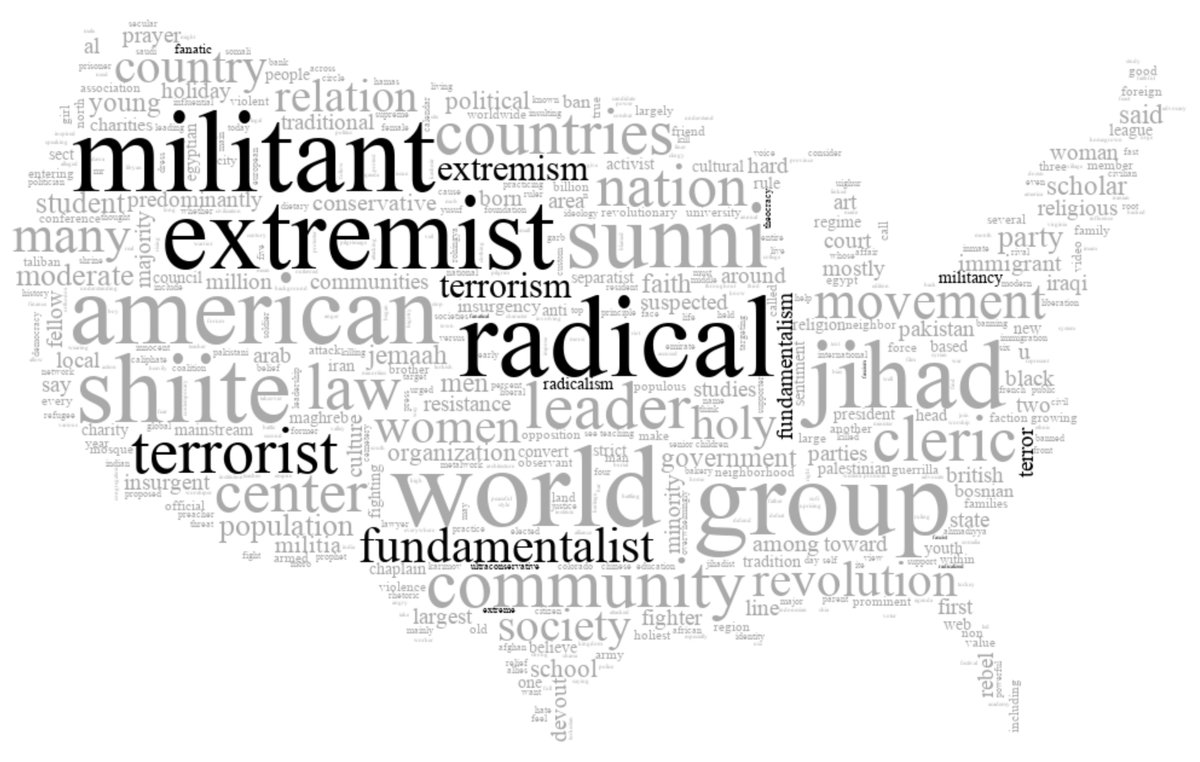
17/ However, 9/11 did mark an enormous jump in the prevalence of references to terrorism and extremism.

18/ This is clear, too, if we look at the words most commonly appearing right next to “Muslim” or “Islam” in newspaper articles since 9/11, shown in this word cloud (terrorism and extremism words are highlighted in black).
19/ We then looked at geographic comparisons in coverage.
If Muslim articles in the United States🇺🇸 are so negative, is that unusual? We check by compiling comparable sets of articles from 1996 to 2016 from Britain🇬🇧, Canada🇨🇦, and Australia🇦🇺.
If Muslim articles in the United States🇺🇸 are so negative, is that unusual? We check by compiling comparable sets of articles from 1996 to 2016 from Britain🇬🇧, Canada🇨🇦, and Australia🇦🇺.
20/ The answer is NO. Coverage of Muslims in these four countries is very similar. And similarly negative compared to our representative sample of articles.

21/ Words like “radical,” “fundamentalist,” “militant,” and “extremist” are among the 10 most common words associated with Muslims or Islam in all four countries.
22/ The picture changes a bit when looking at newspapers in India🇮🇳, Pakistan🇵🇰, Kenya🇰🇪, Nigeria🇳🇬, Singapore🇸🇬 and Malaysia🇲🇾. The Kenyan newspaper is JUST as negative. The Malaysian newspaper is on average POSITIVE. The rest are in between.
23/ World events do not dictate negative coverage with respect to Muslims. But developed Anglophone countries are uniformly extremely negative. Why is that? 🤔
24/ A topic model shows that a large share of Muslim coverage is foreign coverage 🌐 (news events in Muslim-majority countries such as those in the Middle East). Previous scholarship shows that foreign news tends to be negative, and we find this as well.
25/ Not all of this news is negative _about_ Muslims. About 3% of all coverage of Muslims is linked to the former Yugoslavia, Uighurs (China🇨🇳), and Rohingya (Myanmar🇲🇲). These articles tend to portray Muslims as victims of violence and oppression.
26/ Also, not all topics of coverage are extremely negative. Articles about culture and education are close to neutral in valence, on average. This includes the article by @lydiakiesling with the art by @maxomatic that is featured on our book’s cover: nytimes.com/2016/10/09/mag…
27/ Somewhat surprisingly, news articles focused on religious topics are also much less negative than the average article in our dataset.

28/ On the whole, though, 👉articles about Muslims and Islam are strikingly negative— 👉negative compared to other groups, across time, across Anglophone countries, and across topics.
29/ This raises the question of whether journalists are perpetuating Islamophobia. Even if they don’t mean to have that effect, their rhetoric has a cumulative impact. Negativity matters.
30/ We show that negative coverage affects individual attitudes in forthcoming experimental research in @PandRJournal. We argue that readers need to “tone-check” ✅ the media.
31/ When you read a story about Muslims, what words or allusions trigger a negative reaction?
There are A LOT of these for Muslim articles. And for other marginalized groups.
You can partly offset that instinct by realizing just how negative the story is. 🧐
There are A LOT of these for Muslim articles. And for other marginalized groups.
You can partly offset that instinct by realizing just how negative the story is. 🧐
32/ For those interested in the methods, the sentiment analysis tool we used to assess the tone of Muslim coverage, MultiLexScaled, is available at GitHub: github.com/amaurits/Multi….
33/ It includes python code and notebooks, along with the scaling parameters used to calibrate and benchmark valence measures.
34/ The method outperforms individual lexica as well as some machine learning classifiers across a range of validation tests, and can be applied off-the-shelf. The code at GitHub also includes a text cleaning function to preprocess texts. 🧹
35/ Finally, for those who stuck with this to the end, we want you to be able to read the 📖.
💥✨If you are a student or scholar without a research budget or a way to easily access the book, email one of us. We will try to get you a copy. ✨💥
/end
💥✨If you are a student or scholar without a research budget or a way to easily access the book, email one of us. We will try to get you a copy. ✨💥
/end
• • •
Missing some Tweet in this thread? You can try to
force a refresh




