arrus, a profile worth following because he seems genuinely interested in metaphysics & theology/morality, posted cringe about Parmenides (pbuh) and cited Eric Perl.
So I tried reading the relevant opening of Perl's dissertation (the rest is neoplatonist/christian gibberish).
So I tried reading the relevant opening of Perl's dissertation (the rest is neoplatonist/christian gibberish).
https://twitter.com/_arrus/status/1477495249026961409
Look at this... When we describe particular things, we use distinction to whittle away everything else. We also affirm its place it in a context - we say it partakes in certain broad contexts or categories, like change or colour. 

To explain THE WORLD, what-is, we do no whittling at all, we affirm no particularity. We have a particular perspective, so the effort is imperfect.
The point is: we're not trying to find something “other than itself” (beyond what-is) to explain what-is. Sheer gibberish.
The point is: we're not trying to find something “other than itself” (beyond what-is) to explain what-is. Sheer gibberish.
Here, I agree, but I have strong suspicions about what is meant by “the law of intelligibility”. It is enough to say that whatever we think of, whatever we reference, it is subsumed within that omnipresent, inescapable context – Being. Whatever you mention, IT IS.
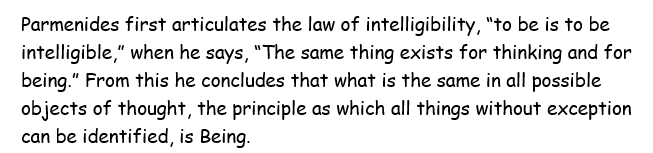
…and now rank error, for we have not eliminated all difference. We have simply acknowledged the omnipresent whole given our position as limited, wholly-subsumed entities. Parmenides has only eliminated false ontological claims of “becoming” and “passing away”, rightfully so.
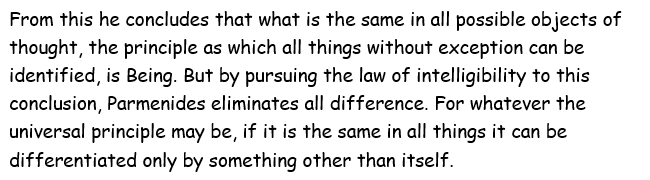
Where to go from here? See attached: the thread of error continues.
We do not seek to differentiate Being, for it is omnipresent! This is true omnipresence, beyond any god! Neoplatonism & Thomism rest on their respective foundations of irredeemable error. Abandon them.
We do not seek to differentiate Being, for it is omnipresent! This is true omnipresence, beyond any god! Neoplatonism & Thomism rest on their respective foundations of irredeemable error. Abandon them.

Such a prisoner to your own mistakes! There is no need for differentiation FROM BEING, for we lack an alternative to Being! If you look to Parmenides, then tell me – what does he say about talk of that which "is not"? Exactly.

I stop the quotes now; it is tiresome and the thread of coherence has long been abandoned by Perl. He argues that Parmenides wants to have a “way of seeming” to describe distinction, and a “way of truth” for the absolute. Hence @_arrus's reference to dualism. What a train wreck.
Meanwhile, we know that there only is what is. The way of seeming is an ultimately incoherent attempt at describing what is. The way of truth recognises the breadth of reality and honours necessity. Maybe @_arrus will have more to say; for now I will not touch this dissertation.
If you think I don’t understand Parmenides, or the Eleatic Trinity is inconsistent: ok. I’m no great scholar of ancient greek language & philosophy. Maybe Melissus, Parmenides & Zeno conflict.
Yet, Neo-Eleatic philosophy honours broadest Being and focuses on the path of truth.
Yet, Neo-Eleatic philosophy honours broadest Being and focuses on the path of truth.
So often neoplatonists & thomists uncharitably read their assumptions & concerns into superior thinkers & models. It’s not wholly their fault: they're fueled by Aristotle, the worst historian of ancient philosophy. At least until Bertrand Russell wrested the crown.
Retvrn.
Retvrn.
• • •
Missing some Tweet in this thread? You can try to
force a refresh