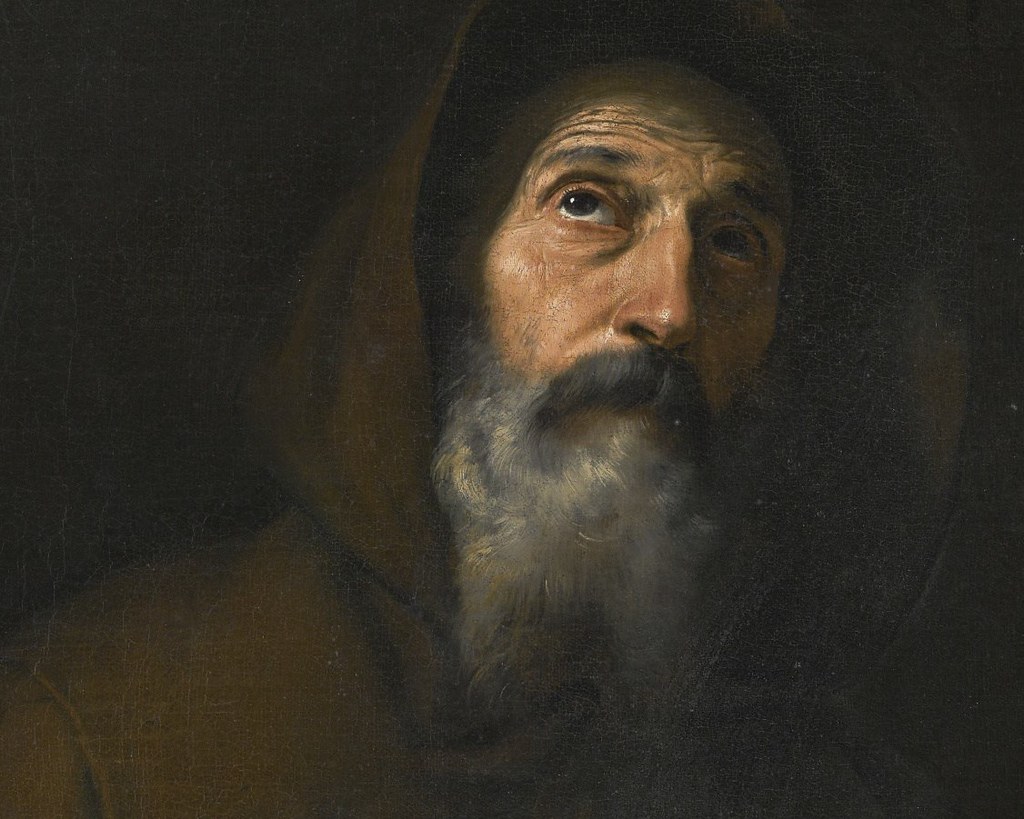
Michel Lara Profile picture
Jan 12, 2022 9 tweets 3 min read Read on X
At the end of his life (375 BC), having reached a great age of 108 yrs, the sophist Gorgias was overcome by weakness gradually slipping into sleep.

When a friend asked how he was, Gorgias said: "Sleep (Hypnos) is now beginning to hand me over to his brother." (Death/Thanatos). Image
This anecdote about the renowned rhetorician Gorgias (483–375 BC) was recorded by the Roman writer Aelian in his 'Varia Historia' (early 3rd c. AD)

Fragment of a marble grave stele; upper part depicting an old bearded man in relief-Greek c. 340-320 BC at British Museum [1]
Hypnos bronze statuette. In his right hand he carries a horn of sleep-inducing opium while in his left he holds poppy capsules.

Hypnos also has other attributes like a branch dripping with water from the river Lethe (forgetfulness) & an inverted torch signifying darkness. Image
Hypnos bronze statuette- 2nd century AD copy from a Greek original 4th c. BC -At Kunsthistorisches Museum, Vienna [1]
This bronze cista served as a constant reminder to the owner of the fleeting nature of her/his existence...

Bronze Cista [large jewelry box] handle: Hypnos & Thanatos Carrying off the Slain Sarpedon
ca. 400-375 BC- Etruscan-at Cleveland Art Museum. Image
Nyx, "Night" & Erebus, "Darkness" were the parents of Hypnos,"Sleep" and Thanatos, "Death". Both Nyx & Erebus were offsprings of the first thing to exist, Chaos.

Hypnos' bronze winged head-Roman copy of a Hellenistic original at British Museum Image
Metamorphoses Bk. XI, Ovid describes "The House of Sleep" where Somnus/Hypnos dwells:
A mansion within a cave, so deep sun's beams cannot pierced. There "muted silence dwells" (muta quies habitat) no sound can be heard, save the hypnotic murmuring of river Lethe (Forgetfulness) Image
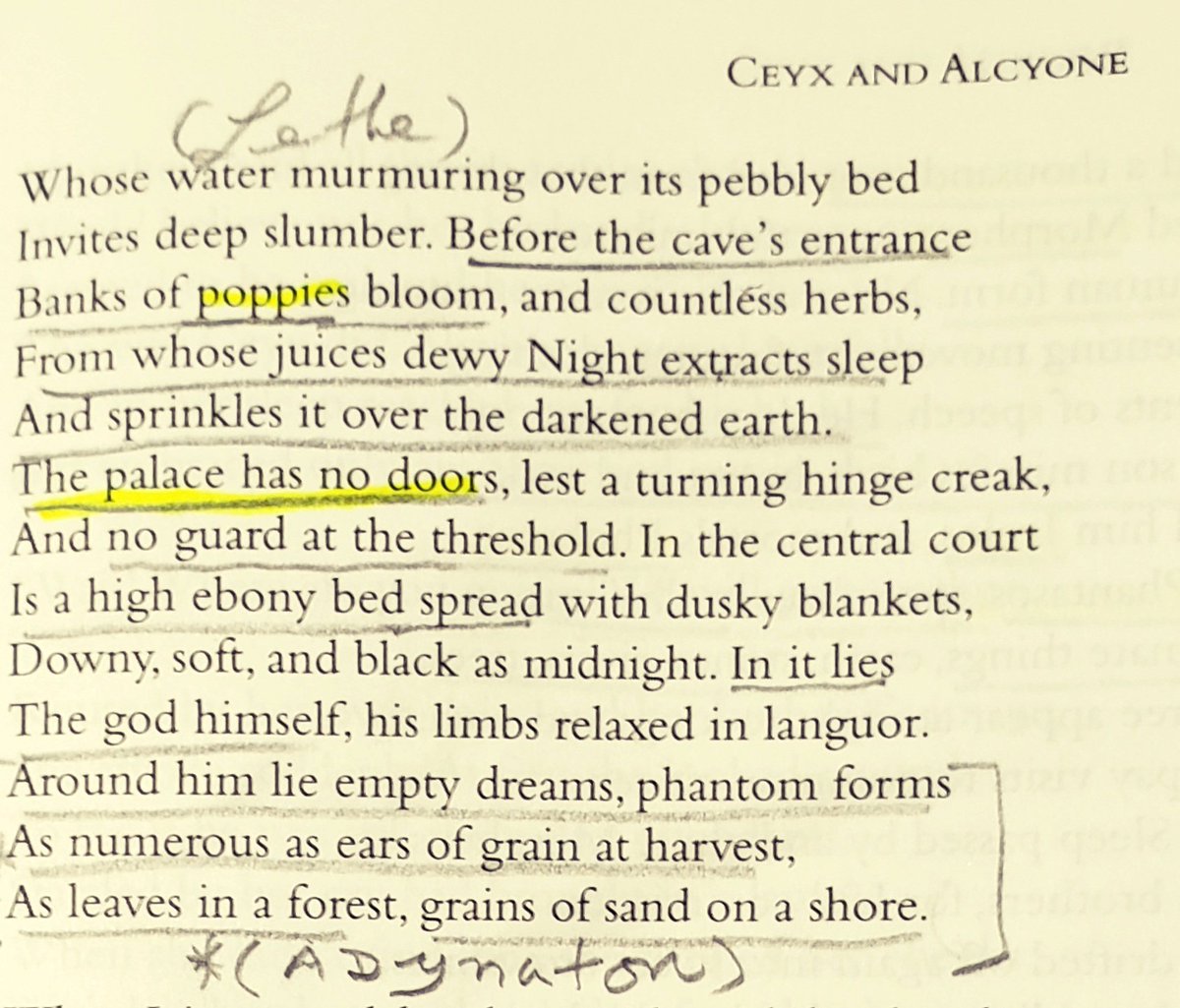
Few days ago, I posted about Adynaton,“impossible thing” Classical figure of speech to express an impossibility when words seem to fail us.

Here Ovid uses it to compare countless dreams/phantoms in the House of Sleep as there are ears of grain, forest leaves & grains of sand.
I'd like to end this thread by quoting Homer who in the Iliad describes Hypnos as "lord over all mortal men and all gods" that is, not even the Olympian gods could resist Hypnos' sleep-inducing power.

• • •

Missing some Tweet in this thread? You can try to force a refresh

 

Keep Current with Michel Lara

Michel Lara Profile picture

Stay in touch and get notified when new unrolls are available from this author!

Read all threads

This Thread may be Removed Anytime!

PDF

Twitter may remove this content at anytime! Save it as PDF for later use!

Try unrolling a thread yourself!

how to unroll video
  1. Follow @ThreadReaderApp to mention us!

  2. From a Twitter thread mention us with a keyword "unroll"
@threadreaderapp unroll

Practice here first or read more on our help page!

More from @VeraCausa9

Nov 30, 2023
In this fragment by German mystic Meister Eckhart (1260-c. 1328) he seeks to explain why "the divine One is a negation of negations", that is God is the fullness of being thus by defining what God is we limit what is unlimited. Image
The Christian mystic's vision of God can't be translated into human language. One of the ways to describe this boundless vision is by way of negation or via negativa (apophatic way) where anything we say of God must negate every attribute due to unknowability= "divine darkness" Image
Apophatic is the Latinized form of Greek apophatikos from apophasis "denial, negation," from apophanai "to speak off," from apo "off, away from" (see apo-) + phanai "to speak," related to pheme "voice"

**Jusepe de Ribera- Saint Francis of Paola (detail) ca. 1640 [1]
Read 7 tweets
Mar 23, 2023
His life is not poor
He has riches beyond measure
Pointing to the moon
Gazing at the moon
This old guest follows the way

Hotei, 10th c. wandering Chinese monk venerated as “god of good fortune” with his treasure bag,he points to the moon, expressing the pure joy of nonattachment
Fugai Ekun (1568–1654) Hotei Pointing to the Moon, hanging scroll, ink on paper.

P.S The Hotei figure is executed in grey, wet strokes, with only spare use of black, which characterizes the Zen figural style known as “ghost” or “apparition” painting [1]
The above accompanying poem is the English translation of what's inscribed on the hanging scroll. [2]
Read 4 tweets
Jan 10, 2023
Did you know Julius Caesar famous phrase before crossing the Rubicon “let the die be cast! (anerrhíphthō kúbos) was declaimed in Greek as it was written by the Greek comic playwright Menander?

In 49 BC (perhaps) on January 10,
Caesar leads his legion across the Rubicon.
Did Caesar really utter this phrase? Yes according to Suetonius, who recorded as alea iacta est ('the die is cast') & Plutarch in Greek

Caesar knew his Greek, also had a great sense for the dramatic, it was a momentous occasion & he wanted these words to pass unto history books.
Caesar might have also found inspiration in the words of Roman playwright Terence:

Ita vita est hominum, quasi quum
ludas tesseris

"The life of man is like a game of dice"
Read 4 tweets
Sep 25, 2022
"Knowledge is proud that he has learned so much; Wisdom is humble that he knows no more."

-William Cowper, English poet (1731–1800)
Gerrit Dou- Astronomer, after 1665 at Liechtenstein Museum, Vienna [1]
What we know
is finite

what we don't
infinite.
Read 4 tweets
Aug 6, 2022
The evocative candlelit night scenes of Dutch Romantic painter Petrus van Schendel (1806-1870
Petrus van Schendel paintings:

1-Market by candlelight, 1865
2-Market by candlelight, 1860s
3-Before the Ball, 1835
4-The Apple Seller, 1863
Petrus van Schendel- A young market girl by candlelight, 1860s
Read 4 tweets
Aug 5, 2022
The Art of Judgment derives from discerning truth beyond appearances and emotions so the fool judges out of ignorance, the proud out of scorn and the wise out of character.
Daniele da Volterra-Head of a Bearded Old Man-drawing ca. 1550s [1]
In his 'Tusculanae Disputationes' (3.56), Cicero tells us to seek truth in a man's character even those living in poverty by quoting Statius Caecilius maxim:

saepe est etiam sub palliolo sordido sapientia

"There's often wisdom even underneath a tattered little cloak"
Read 4 tweets

Did Thread Reader help you today?

Support us! We are indie developers!


This site is made by just two indie developers on a laptop doing marketing, support and development! Read more about the story.

Become a Premium Member ($3/month or $30/year) and get exclusive features!

Become Premium

Don't want to be a Premium member but still want to support us?

Make a small donation by buying us coffee ($5) or help with server cost ($10)

Donate via Paypal

Or Donate anonymously using crypto!

Ethereum

0xfe58350B80634f60Fa6Dc149a72b4DFbc17D341E copy

Bitcoin

3ATGMxNzCUFzxpMCHL5sWSt4DVtS8UqXpi copy

Thank you for your support!

Follow Us!

:(