
Most of us think that applied knowledge consists of learning generalisable principles and THEN looking for places to apply them.
In this view, cases are simply examples of the principle in action.
But check this out:
In this view, cases are simply examples of the principle in action.
But check this out:
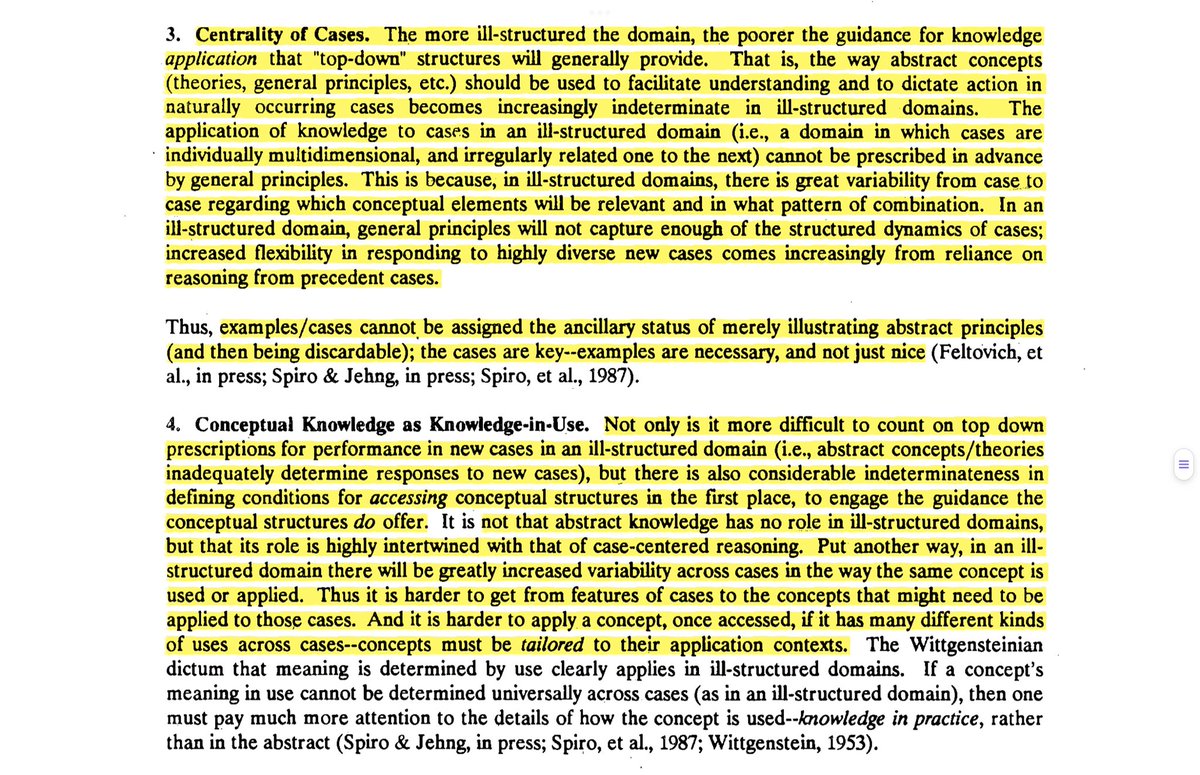
The source is Spiro et al’s Cognitive Flexibility Theory, and most of the examples in the paper are about medical education. (A highly applied field, albeit on a messy, complex biological system — but at least with some settled science!)
researchgate.net/publication/27…
researchgate.net/publication/27…
Now consider how this might apply when talking about business education.
Business is messier — there isn’t ‘settled science’.
So there’s probably more to be said for reading messy business biographies + the ‘case method’ over imbibing contextless business frameworks.
Business is messier — there isn’t ‘settled science’.
So there’s probably more to be said for reading messy business biographies + the ‘case method’ over imbibing contextless business frameworks.

Why? The argument the authors make is that at the higher levels of expertise, you start to grapple with the fact that everything is connected to every other damn thing.
Teaching concepts atomically hinders the student’s ability to apply them in real world cases.
Teaching concepts atomically hinders the student’s ability to apply them in real world cases.
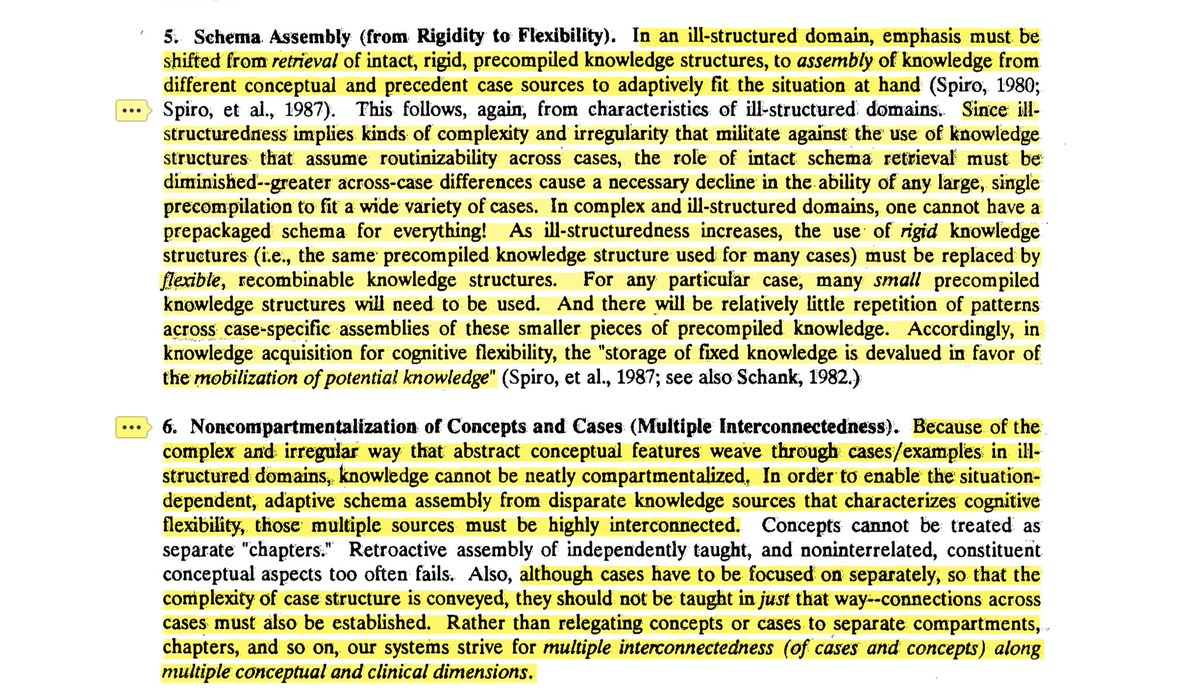
So the next question is obviously: what do you do when you’re studying cases?
The authors suggest something surprising to me: you mark up all the possible concepts that are instantiated in each case (and here you might need an expert) and then link to all OTHER cases.
The authors suggest something surprising to me: you mark up all the possible concepts that are instantiated in each case (and here you might need an expert) and then link to all OTHER cases.
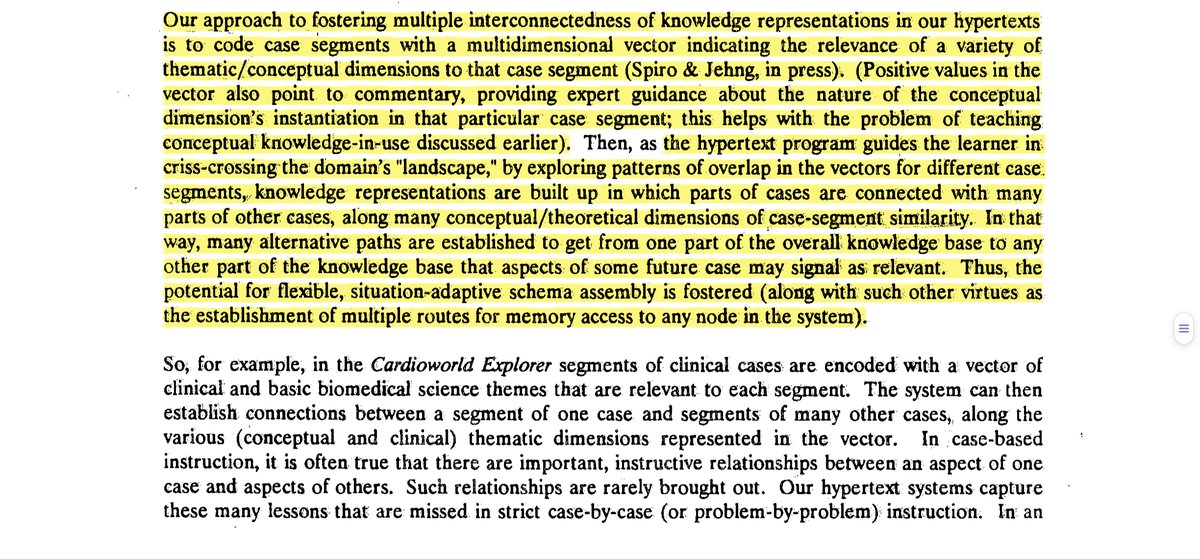
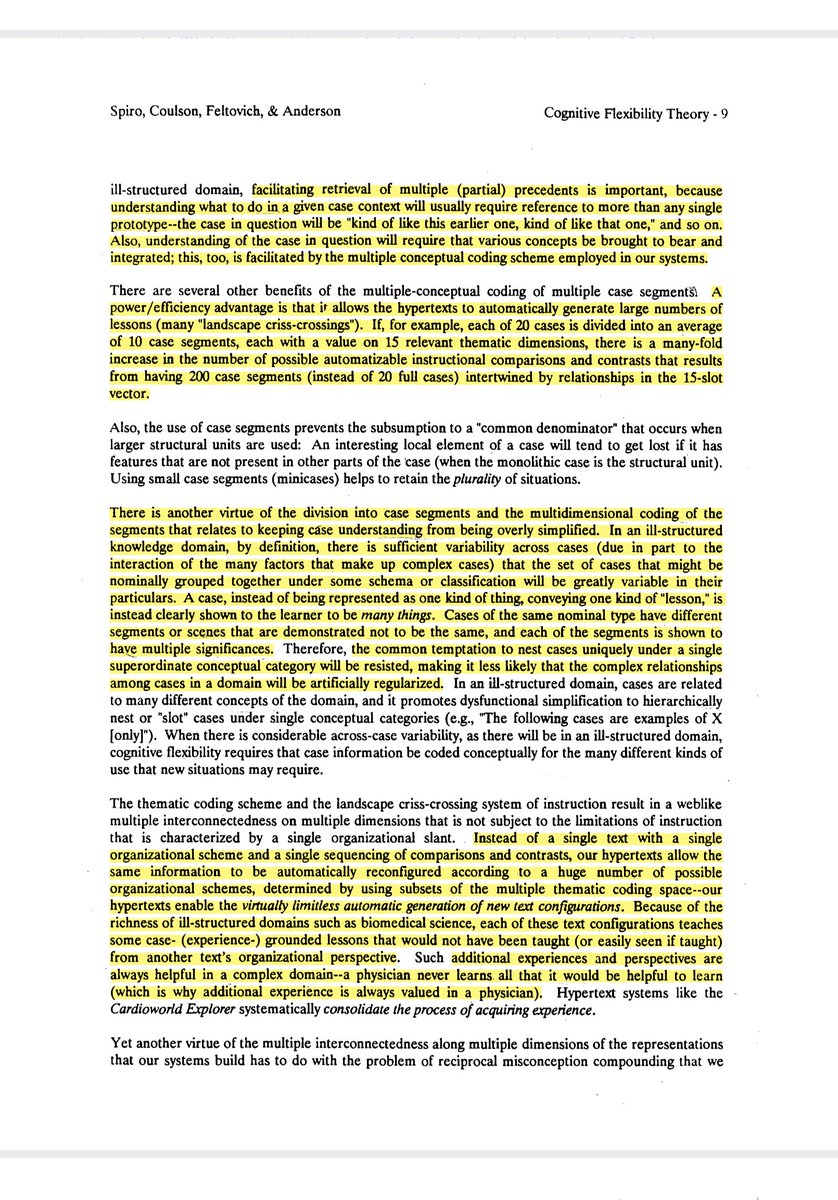
This forces the learner to grapple with the real complexity of reality, instead of learning just the clean simple abstractions that frameworks seem to offer.
And the reality of medicine (and business) is that everything is messier than you think.
And the reality of medicine (and business) is that everything is messier than you think.
A couple of follow-up thoughts: first, the authors write about a learning system they developed called Cardioworld Explorer, which means there’s probably some empirical results I can look up.
I’m planning to dig into that later.
I’m planning to dig into that later.
Second, this DOES sound like the ‘backlinking’ and ‘complex shared knowledge networks’ that the tools for thought people keep harping about, doesn’t it?
Except the authors here focus on the cognitive science of learning, not the trappings of the tool itself.
Except the authors here focus on the cognitive science of learning, not the trappings of the tool itself.
The important thing to focus on seems to be:
1. You encode a multi-dimensional set of concepts for each case.
2. These concepts link cases together.
3. You are required to read through the messiness of each case, which is described in prose. (Though snippets may be recombined).
1. You encode a multi-dimensional set of concepts for each case.
2. These concepts link cases together.
3. You are required to read through the messiness of each case, which is described in prose. (Though snippets may be recombined).
More importantly, the pedagogical goal:
You want the system to expose you to as MANY possible instantiations of the concept as possible.
This probably requires somebody with expertise to come in and link things for you, though — they are likely able to spot cues that you can’t.
You want the system to expose you to as MANY possible instantiations of the concept as possible.
This probably requires somebody with expertise to come in and link things for you, though — they are likely able to spot cues that you can’t.
Actually my language here is problematic — I say things like ‘instantiations’ as if the concept is more important than example.
But the point the authors make is that principles in messy domains ONLY make sense through cases.
But the point the authors make is that principles in messy domains ONLY make sense through cases.
Expert practitioners reason by comparison to many other cases, recombining bits of prior cases in their heads.
Principles only make sense when expressed through cases.
So you can’t ‘teach the principle first’; you always have to teach the cases together.
Principles only make sense when expressed through cases.
So you can’t ‘teach the principle first’; you always have to teach the cases together.
Huge caveat: everything in this paper/thread is about learning in ill-structured domains, where 'ill-structured' means a domain where no universally generalisable principle may be extracted from the average case (think less math and more business, investing, or medicine).
• • •
Missing some Tweet in this thread? You can try to
force a refresh






