

As the world becomes safer around us, are we shifting our standards to be tuned in to smaller and smaller provocations?
That's the question we tested in a new paper just published in the Journal of Experimental Psychology: Applied. psycnet.apa.org/record/2022-20… (open link @ end)
That's the question we tested in a new paper just published in the Journal of Experimental Psychology: Applied. psycnet.apa.org/record/2022-20… (open link @ end)
In a world of ambiguous signals and noise, we constantly shift our standards to preserve optimal detection.
Psychologists and rationalists have studied these effects for years under the umbrellas of range-frequency theory, signal detection, Bayesian reasoning, etc.
Psychologists and rationalists have studied these effects for years under the umbrellas of range-frequency theory, signal detection, Bayesian reasoning, etc.

But what about cases where there is no clear "true" distribution we can lean on? Ambiguous, human-made concepts such as "rudeness", "morality", "threat", "trauma", or "the color blue"?
Levari and colleagues argue that the human tendency to shift our thresholds leaks into these socially constructed domains, causing the very meaning of these concepts to creep when stimulus prevalence decreases.
wjh-www.harvard.edu/~dtg/LEVARI201…
wjh-www.harvard.edu/~dtg/LEVARI201…
Scholars have been noticing for a while now that in the West, our harm-related concepts are creeping. From trauma, to harassment, to bullying, it seems as if we are defining and redefining almost on a yearly basis to keep up.
researchgate.net/profile/Nick-H…
researchgate.net/profile/Nick-H…
Along the same timeline, the actual behaviors (that is, trauma, harassment, and bullying) are in rapid decline. Could this be an example of prevalence-induced concept change?
paytonjjones.com/publication/di… (see Chapter 2)
paytonjjones.com/publication/di… (see Chapter 2)
That's exactly what we sought to test in this study.
We asked participants to rate hundreds of events as either "trauma" or "not trauma". Unbeknownst to them, we shifted the underlying distributions of the events we were showing.
We asked participants to rate hundreds of events as either "trauma" or "not trauma". Unbeknownst to them, we shifted the underlying distributions of the events we were showing.
When we showed participants ALL types of events, from very mild to very severe, we were surprised to see they became universally *stricter* in their ratings, whether or not we shifted the prevalence.
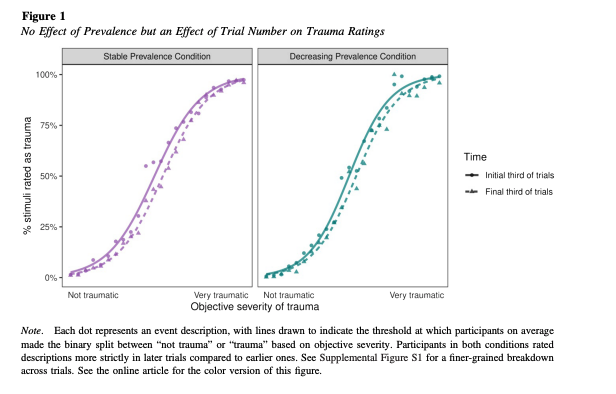
Our best guess? On average, these American participants already entered the experiment with such a watered-down idea of trauma that being reminded of *any* very-severe events (e.g., "being tortured as a prisoner of war") was enough to tighten up their concept.
To test this, in a second experiment we either completely omitted severe events, or completely omitted mild events. This time, we saw the theorized result in abundance.
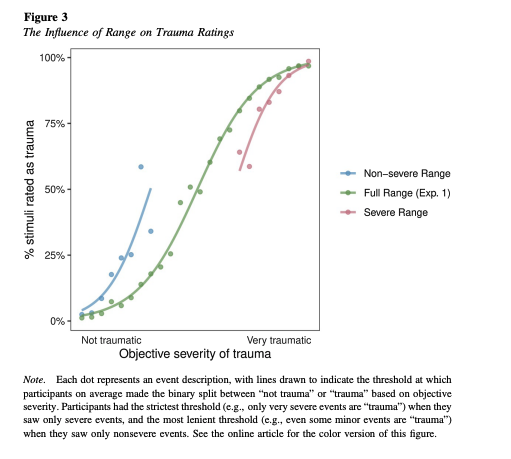
This suggests that the perceived absence of certain threats (genocide *does not happen* in Boston) may play a special role in concept creep beyond the perceived rarity of certain threats (assault happens *rarely* in Boston).
What does this all mean?
Well, it suggests that as we eliminate the worst of the world's horrors, we can expect to see continued creep in the meaning of "trauma".
Well, it suggests that as we eliminate the worst of the world's horrors, we can expect to see continued creep in the meaning of "trauma".
On one hand, this could be a good thing. For instance, it could open the door for us to address the next-to-worst horrors with the same vigor as we addressed the worst ones.
But perhaps it could also lead us down a neurotic treadmill - experiencing the same pain despite having improved our reality researchgate.net/publication/35…
Open link to the paper: paytonjjones.com/publication/ex…
• • •
Missing some Tweet in this thread? You can try to
force a refresh



