1/ In 2020, Parvin, a young woman from Iran, crossed the Greek-Turkish border 7 times; 6 times across the Evros/Meriç river and once over the Aegean Sea. She was arrested and pushed back 6 times. We worked w/ @ECCHRBerlin, @rights360 and Parvin to reconstruct her journey.
2/ Parvin recorded her first 3 crossings through photos, videos, audio messages & live location sharing. Unprecedentedly, she was able to record videos from inside Greek border guard stations that revealed the cell interiors & conditions of detention, all previously undocumented.
3/ Analysing this evidence, we found that she was held in four Greek Border Guard stations: Neo Cheimonio BGS, Iasmos BGS, Tychero BGS, and Soufli BGS, twice.
4/ Before her first pushback, in Neo Cheimonio BGS Parvin was tortured by officers and received death threats. Using her testimony, her videos, found footage, and satellite imagery we created a 3D model of the BG Station and positioned her recollections in space.
5/ Before her second and sixth pushbacks, at Soufli BGS Parvin was held for hours on end with numerous other people in a container without aeration or a toilet. We located this container in the parking lot of the BGS, exactly where she remembered it.
6/ During her third pushback, at the Kastanies/Pazarkule border fence in late February 2020, Parvin was tear gassed and shot at, and became an early witness to the violent March 2020 events which would leave at least two dead, Muhammad al-Arab and Muhammad Gulzar.
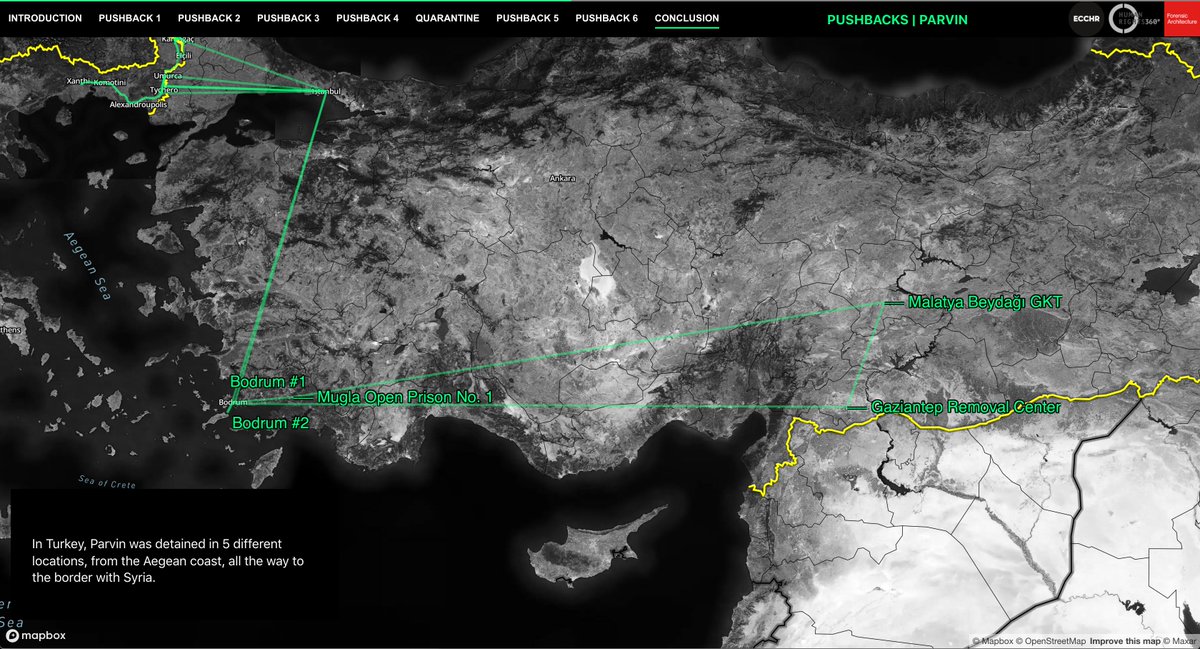
7/ Following her fourth pushback, when she was left adrift in the Aegean Sea by the Hellenic Coast Guard, Parvin was detained in 5 different locations in Turkey, from the Aegean coast all the way to the border with Syria.
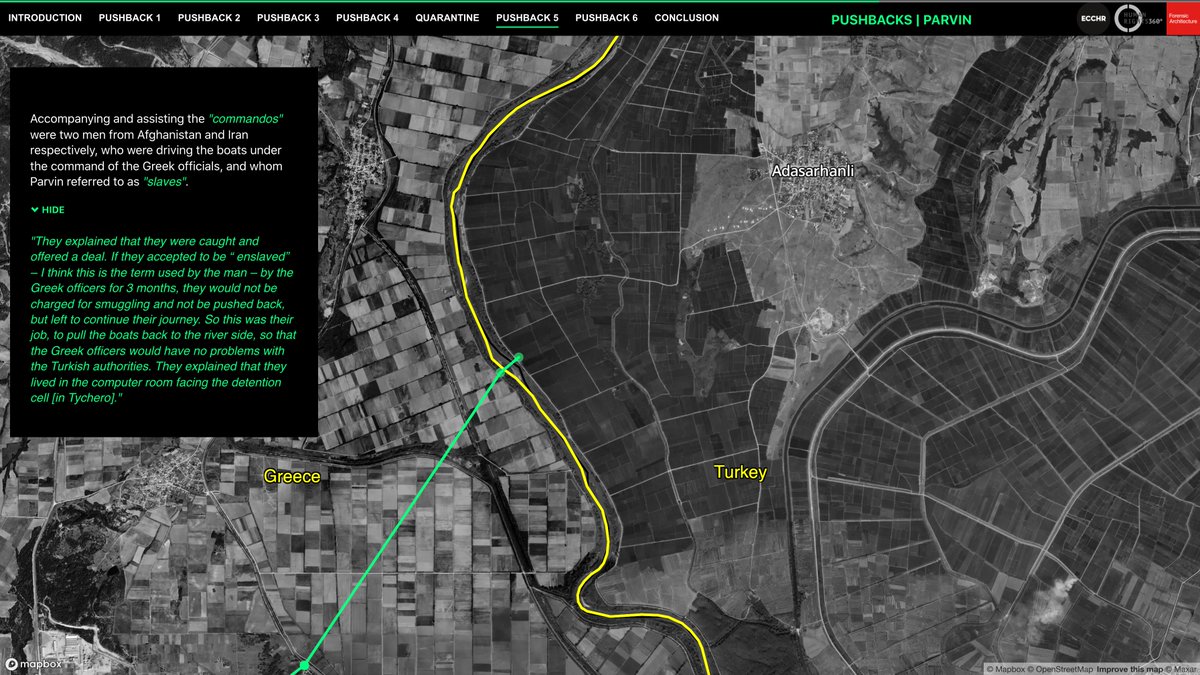
8/ During her fifth & sixth pushbacks through Tychero & Soufli BGS, guards were assisted by men from Afghanistan & Iran. In exchange for not being pushed back themselves, these men—who identified as 'slaves'—had to live in the BGS and ferry other asylum seekers back into Turkey.
9/ Spanning summary expulsions & torture in the Evros/Meriç, apprehensions deep inside GR territory, ‘drift-backs’ in the Aegean & extended periods of detention in TR, Parvin’s pushbacks cover the full spectrum of this violent practice. A thorough investigation is long overdue.
FA returns to @hkw_berlin today to launch our new Berlin-based sister agency, FORENSIS, and the Investigative Commons, a new community of practice founded on the work of FA and our partners including @ECCHRBerlin, Praxis Films, @bellingcat, @amnesty, @mnemonicorg, among others
Investigative Commons serves as both the title of a landmark exhibition at @hkw_berlin and the name of a pioneering new model for collaborative counter-investigations operating across multiple forums: courts, citizens’ tribunals, cultural institutions and media platforms
With the rise of neo-fascist 'post-truth' epistemology, societies have clung to traditional pillars of power-knowledge—state institutions, legal systems, the police. But how should civil society react when these same institutions are guilty of crimes, state-terror & cover-ups?
Forensic Architecture y el grupo chileno @nomaslacris colaboraron para analizar la represión policial y el uso gas lacrimógeno el 20 de diciembre de 2019, uno de los días más intensos de la represión.
Una combinación de OSI y simulación dinámica de fluídos es la primera en medir la concentración de partículas de gas en aire y suelo, estableciendo un punto de referencia.
La lucha completa por la toma de la #plazadignidad está registrada en cámara. Reconstruímos el cono de visión de la cámara y confirmamos su código de tiempo.
Together with the Chilean @nomaslacris we analysed police use of teargas on the 20th of Dec 2019, to repress one of the most intense days of the Chilean protests.
Using a combination of OSI and fluid dynamics simulation is the first to measure airborne and ground deposited teargas concentration, establishing a benchmark.
The entire battle for the #PlazaDignidad roundabout was caught on CCTV camera. We reconstructed the camera’s cone of vision and confirmed its time code using shadow.
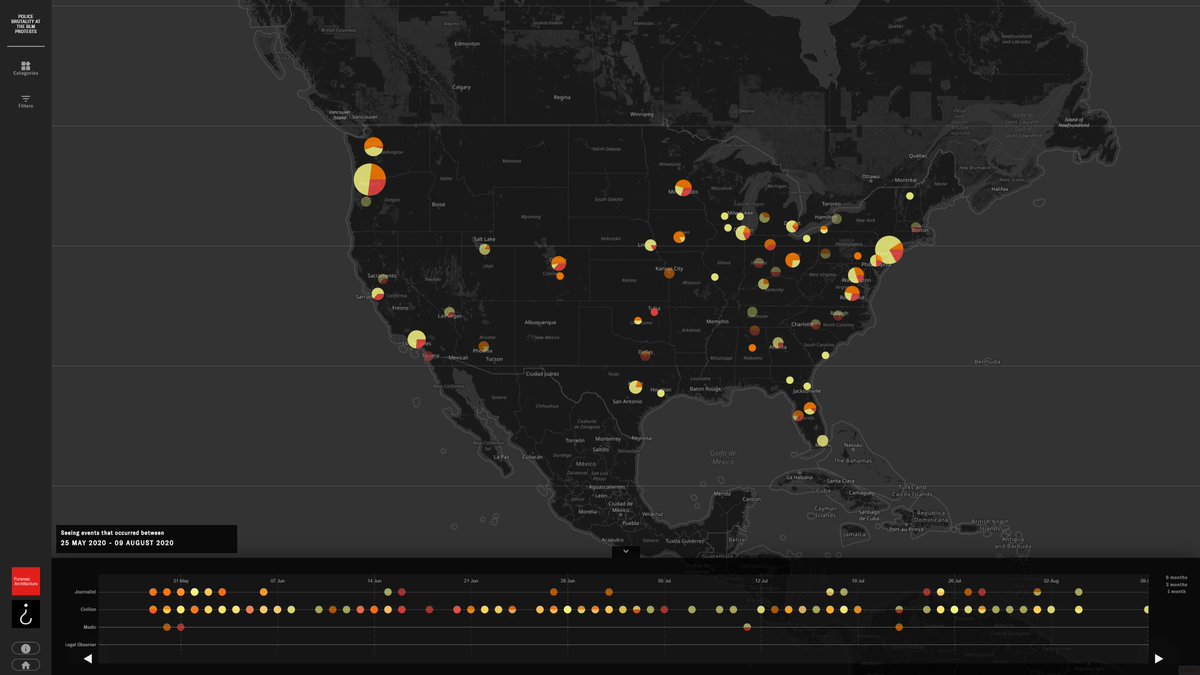
- 400+ attacks on civilians using chemical agents
- 300+ instances of unjustified arrest, detention, and intimidation
- 300+ physical assaults by officers
- 250+ attacks on journalists, medics, and legal observers
And we're still adding more.
Now, we're putting this data at the service of organisations pursuing accountability at a local and national level.
1/ Our latest investigation with @rights360 confirms reports that migrants crossing the Evros/Meriç river from Turkey to Greece are beaten, illegally detained, and forcefully expelled by Greek forces, a practice known as “pushbacks”. bit.ly/31gEcXo
2/ We used 3D models to undertake ‘situated testimony’ that helped four victims of pushbacks identify the locations where they were detained and pushed back, and reconstruct their experiences. forensic-architecture.org/investigation/…
3/ Witnesses described and modelled the buildings they were detained in. Using satellite photographs, ground footage and documents we confirmed these locations to be of key sites operated by the Greek authorities.
(1/8) In November 2019, we interviewed people who had been held and mistreated in an obscure detention centre near the village of Poros, #Evros, Greece, before being forcefully and illegally pushed back to Turkey.
(2/8) Recently, @nytimes reported on the presence of this centre, bringing a relatively unknown detention facility to international attention: nyti.ms/2Q5Vuko
(3/8) Our methods helped witnesses reconstruct the facility from memory. The process aided their recollection and helped corroborate their testimonies. The models produced from witness memory matched the one we built from satellite images and photos taken on the ground.