
1/ Let's talk about how note taking can help you accelerate expertise.
Yes, I know how that sounds like.
No, this isn't hype.
There's some solid cognitive science here, and it has FASCINATING things to say about the nature of learning in messy, real world domains.
Yes, I know how that sounds like.
No, this isn't hype.
There's some solid cognitive science here, and it has FASCINATING things to say about the nature of learning in messy, real world domains.
2/ The theory I'm going to talk about is Cognitive Flexibility Theory, originally published by Spiro, Coulson, Feltovich and Anderson in a 1988 paper.
The theory has 30 years of ACTUAL system implementations. We're going to talk about those in a sec.
researchgate.net/publication/27…
The theory has 30 years of ACTUAL system implementations. We're going to talk about those in a sec.
researchgate.net/publication/27…
3/ What is CFT? CFT is a theory that asks: "how do experts deal with novelty?"
Some domains are well-structured, like chess. But other domains, like business or medicine, are ill-structured.
CFT is a theory about this second type of domain. It comes from medical education.
Some domains are well-structured, like chess. But other domains, like business or medicine, are ill-structured.
CFT is a theory about this second type of domain. It comes from medical education.

4/ CFT has four big ideas. Two of them are the central claims of the theory.
Before we get to those, we need to do some setup.
There are two big ideas that we have to look at first. Then we'll talk about the claims, and then note-taking. 😉
Before we get to those, we need to do some setup.
There are two big ideas that we have to look at first. Then we'll talk about the claims, and then note-taking. 😉
5/ Idea one: CFT is interested in ill-structured domains.
What is an ill-structured domain?
An ill-structured domain is a domain where there are concepts, but the way these concepts show up in reality are HUGELY variable.
What is an ill-structured domain?
An ill-structured domain is a domain where there are concepts, but the way these concepts show up in reality are HUGELY variable.
6/ Think about a heart attack. A heart attack is a concept. You can study it in a medical textbook. But the WAY a heart attack instantiates in the real world is hugely variable.
Some heart attacks start out as indigestion; others can last DAYS.
Some heart attacks start out as indigestion; others can last DAYS.

7/ Or think about business. Scale economies is a type of competitive advantage, yes?
But the way scale economies show up is HUGELY dependent on the context of the business!
Some businesses enjoy 'simple' unit cost reductions due to scale, others have learning curve effects.
But the way scale economies show up is HUGELY dependent on the context of the business!
Some businesses enjoy 'simple' unit cost reductions due to scale, others have learning curve effects.

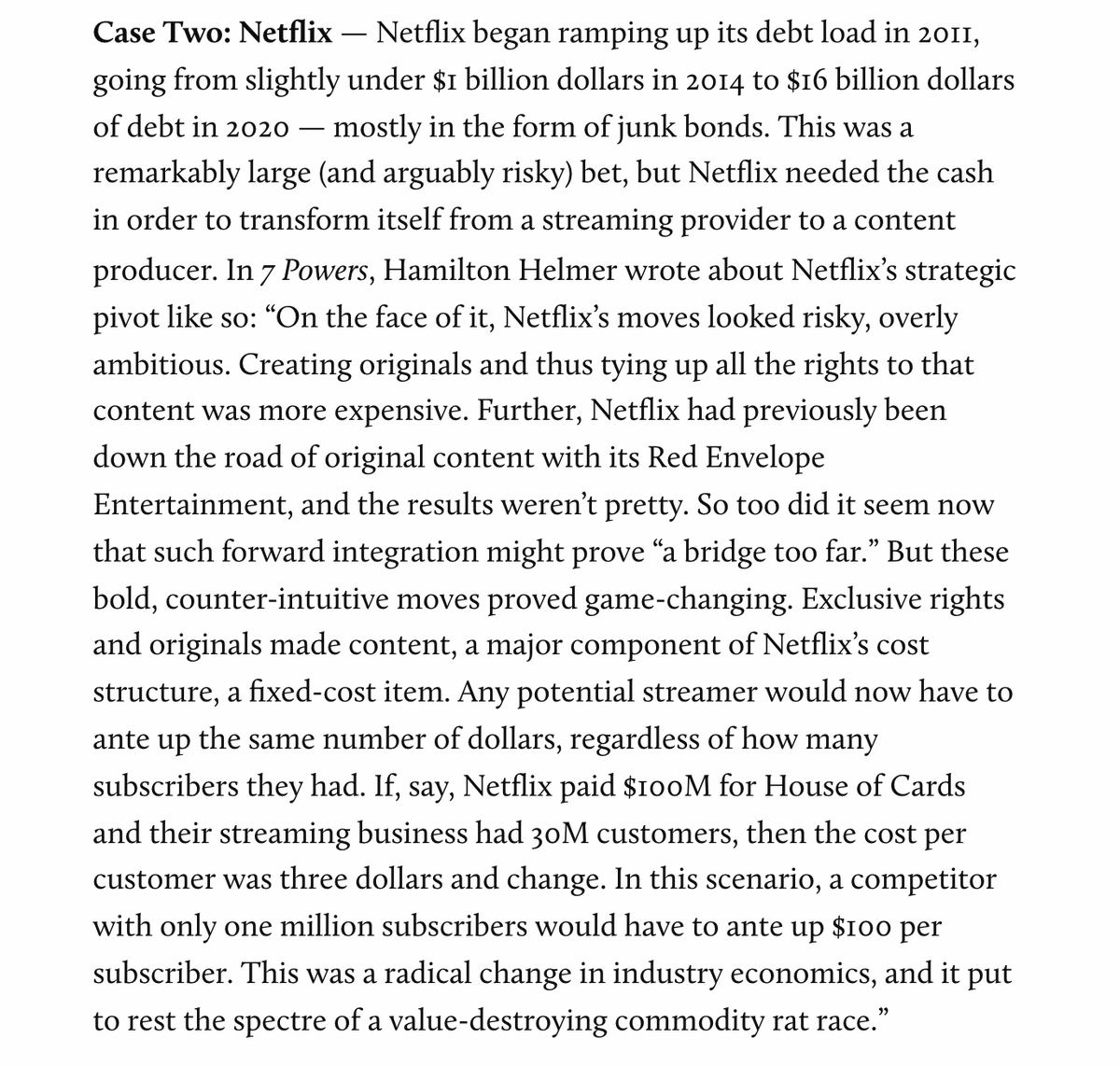
8/ The proper definition for ill-structured is "concept instantiation is highly variable for cases of the same nominal type."
Most fields are a mix of both well-structured and ill-structured. In software, computer programming is the former; software project mgmt the latter.
Most fields are a mix of both well-structured and ill-structured. In software, computer programming is the former; software project mgmt the latter.
9/ This leads us to Idea Two: in ill-structured domains, cases are AS if not MORE important than concepts.
This is a tricky idea, so let's slow down a bit.
I think most of us are taught to think that concepts are important, and cases are 'just' examples.
This is a tricky idea, so let's slow down a bit.
I think most of us are taught to think that concepts are important, and cases are 'just' examples.
10/ Usually we say something like "it's the PRINCIPLES that are important!"
How did we get here? I think we got here because we are taught to think like this.
In math class, for instance, we are given 1-2 examples but we know it is the formula that is important.
How did we get here? I think we got here because we are taught to think like this.
In math class, for instance, we are given 1-2 examples but we know it is the formula that is important.

11/ Yes, I know that certain schools teach from cases, not concepts alone.
But if you are trained to think that 'first principles' are important, you will think that the cases are so that you can extract generalised, abstract principles, and that THOSE are primary.
But if you are trained to think that 'first principles' are important, you will think that the cases are so that you can extract generalised, abstract principles, and that THOSE are primary.

12/ So what does CFT tell us?
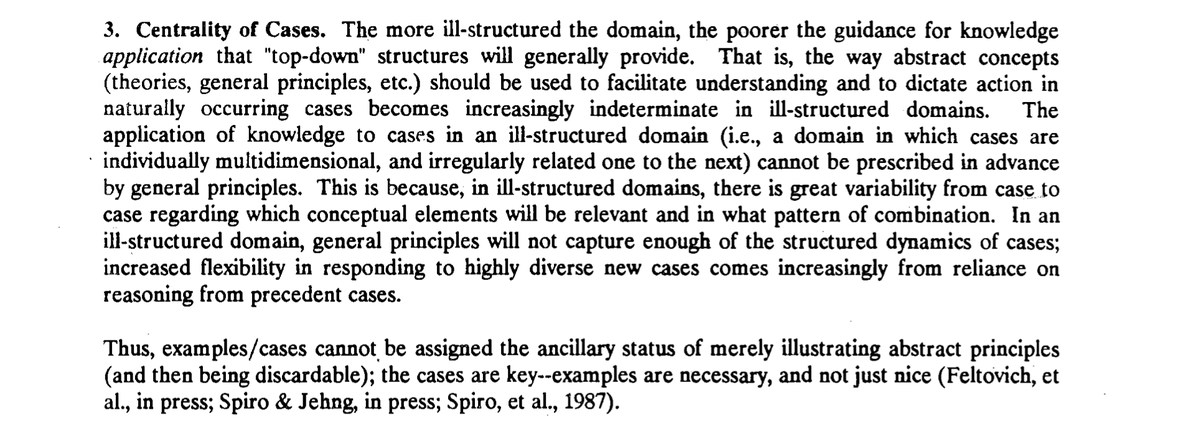
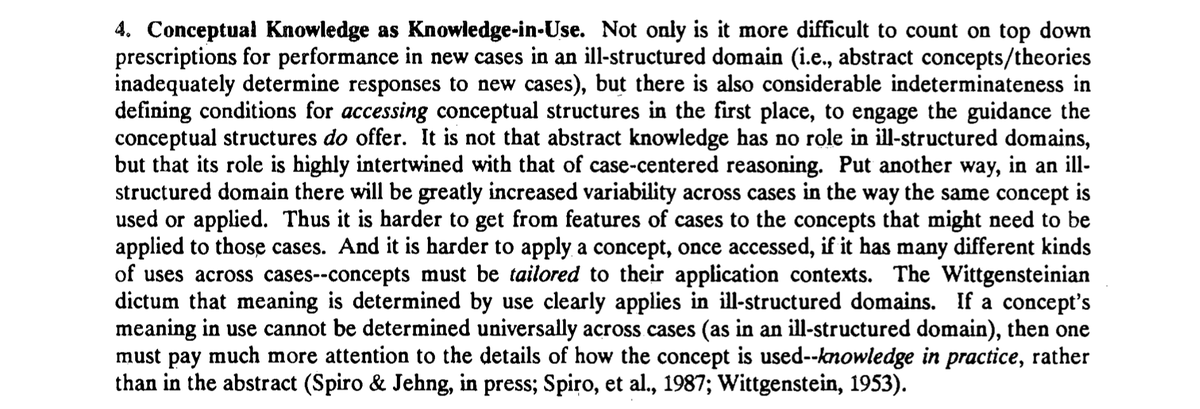
CFT tells us that in ill-structured domains, concepts are hugely variable so reasoning from concepts are insanely hard.
In fact, extracting generalisable principles from case studies is close to impossible!
CFT tells us that in ill-structured domains, concepts are hugely variable so reasoning from concepts are insanely hard.
In fact, extracting generalisable principles from case studies is close to impossible!
13/ It turns out that experts in ill-structured domains DON'T reason from first principles as much. They tend to reason from past cases instead!
(Sure, they may TALK about concepts and principles, but the concepts are clusters of cases in their heads.)
Read:
(Sure, they may TALK about concepts and principles, but the concepts are clusters of cases in their heads.)
Read:
14/ As a programmer, I find this difficult to accept. Isn't reasoning by analogy lousier than reasoning from first principles?
But it DOES resolve a question I've always had.
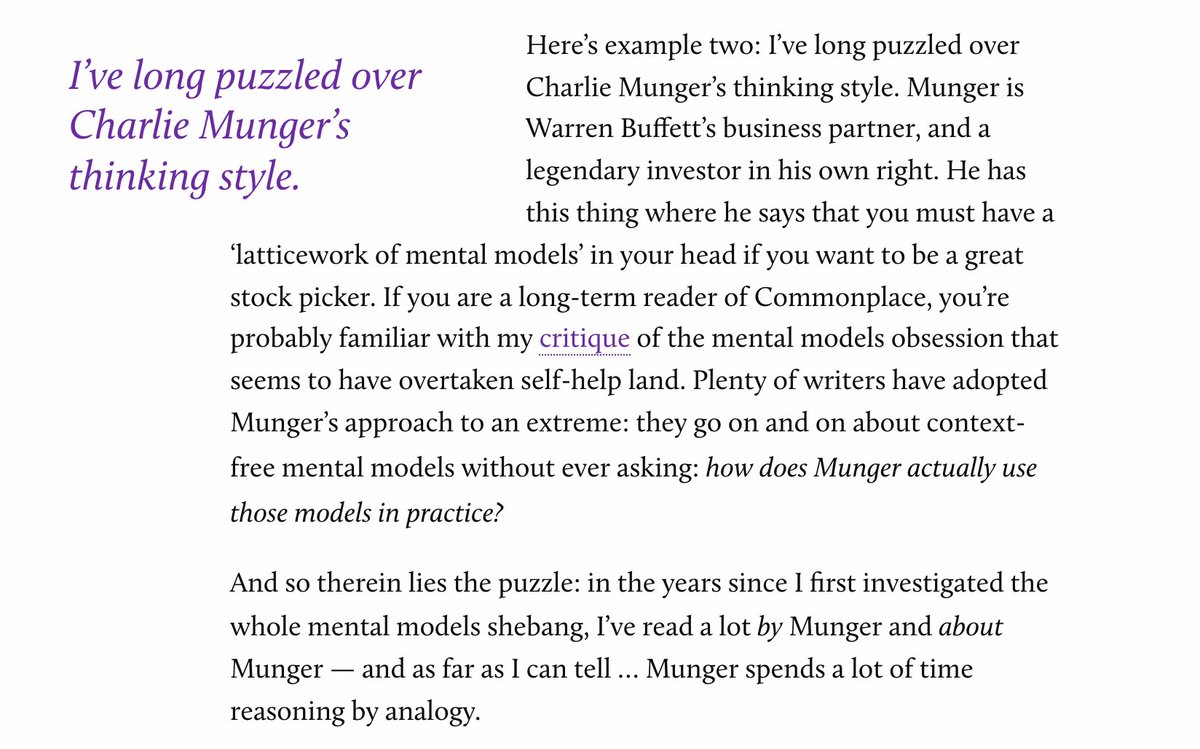
Which is this: why is it that Charlie Munger reasons so much from analogy?
linkedin.com/pulse/what-we-…
But it DOES resolve a question I've always had.
Which is this: why is it that Charlie Munger reasons so much from analogy?
linkedin.com/pulse/what-we-…

15/ This brings us to Ideas 3 and 4 of CFT, which happen to be the two central claims of the theory.
Recall: the question that CFT attempts to answer is "how are experts able to perform under conditions of novelty?"
We know now that ill-structured domains have a lot of novelty.
Recall: the question that CFT attempts to answer is "how are experts able to perform under conditions of novelty?"
We know now that ill-structured domains have a lot of novelty.
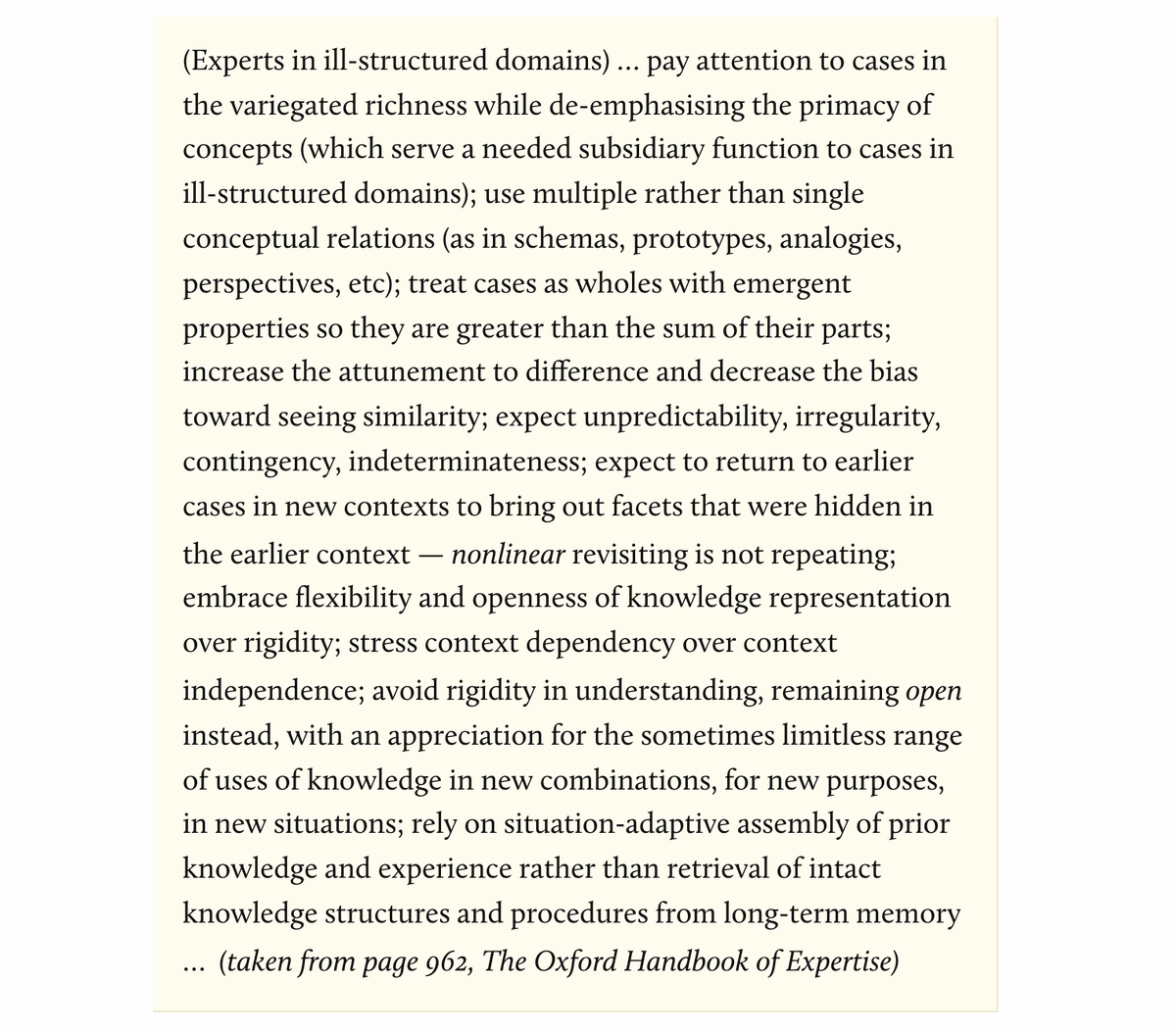
16/ CFT tells us that experts do two things:
1. They construct temporary schemas by combining FRAGMENTS of prior cases.
2. They have something called an 'adaptive worldview', which means they do NOT think there is one root cause or framework or model for any event.
1. They construct temporary schemas by combining FRAGMENTS of prior cases.
2. They have something called an 'adaptive worldview', which means they do NOT think there is one root cause or framework or model for any event.
17/ So this explains why Munger, like expert doctors, reason a lot by analogy to prior cases.
After all, if businesses are always the result of context-dependent events and factors, then you CAN'T reduce case history into simple principles.
It's just too complex.
After all, if businesses are always the result of context-dependent events and factors, then you CAN'T reduce case history into simple principles.
It's just too complex.
18/ Instead, the researchers say that experts do the following (read):
19/ What does this have to do with note-taking?
Well, now that we have the four big ideas, we can invert CFT's claims to get the pedagogical recommendations:
1. Expand the cases you know, so you have a larger set of fragments to draw from.
2. Inculcate the adaptive worldview.
Well, now that we have the four big ideas, we can invert CFT's claims to get the pedagogical recommendations:
1. Expand the cases you know, so you have a larger set of fragments to draw from.
2. Inculcate the adaptive worldview.
20/ And how do the researchers recommend doing this?
The researchers note that you cannot reduce cases, and real world cases tend to be rich with many concepts. So ... the researchers recommend using a hypermedia system to store cases.
That is: a backlinked note taking system!
The researchers note that you cannot reduce cases, and real world cases tend to be rich with many concepts. So ... the researchers recommend using a hypermedia system to store cases.
That is: a backlinked note taking system!
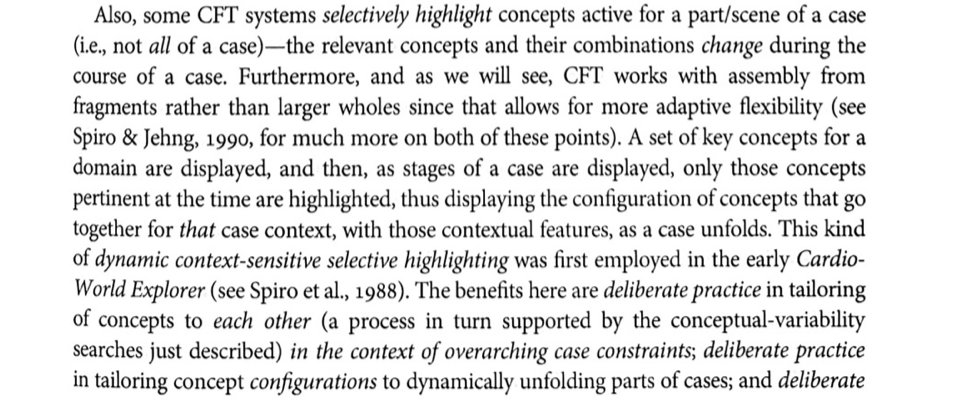
21/ Here's what you do: you get the student to store cases, and highlight concepts within the text of each case. Concepts are backlinked. They go to other cases.
There are many variations. Some systems come preloaded with cases, marked up by expert practitioners.
There are many variations. Some systems come preloaded with cases, marked up by expert practitioners.
22/ The initial presentation to the student is also chosen carefully. When presenting a concept for the first time, you want to give a student a case, and then give them a different case that is VERY different from the first.
So the student internalises that cases are variable!
So the student internalises that cases are variable!
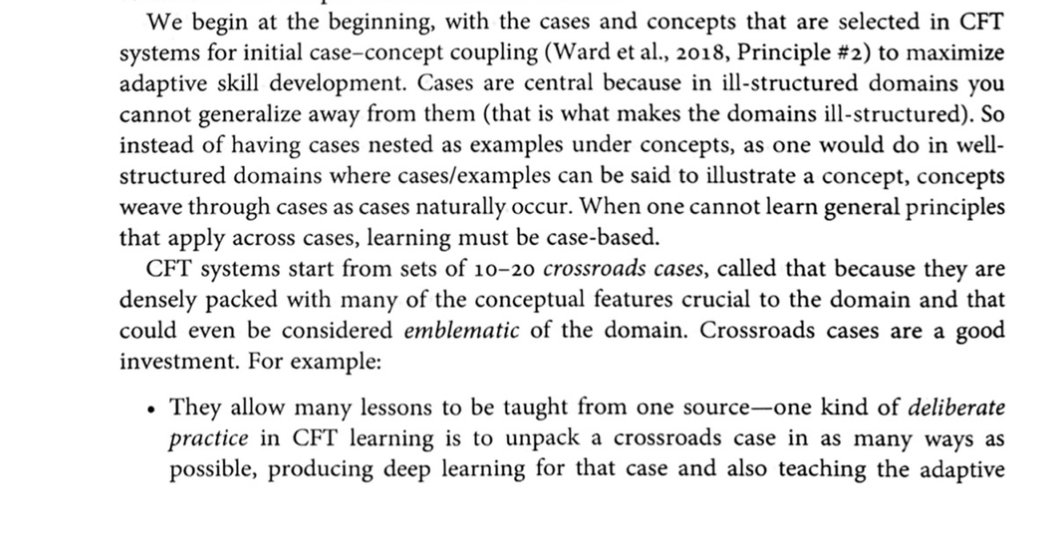

23/ Eventually, as the student does concept searches in the CFT system, they begin to overlearn the 'crossroad' cases — that is, the central cases that are the most conceptually rich and therefore the most connected.
These cases begin to be evoked from even small fragments.
These cases begin to be evoked from even small fragments.
24/ Once this happens, the student enters something called 'epitome mode', where case comparisons happen at the speed of thought.
In other words, they have a set of representative cases in their heads, available for on-the-fly schema assembly in the real world.
In other words, they have a set of representative cases in their heads, available for on-the-fly schema assembly in the real world.

25/ Ok, I'll wrap up. A couple of days ago, I said that it's probably worth it to dig for cognitive science results in the tools for thought space.
CFT is an example of what I was talking about.
CFT is an example of what I was talking about.
https://twitter.com/ejames_c/status/1489418153449123841?s=20&t=wynnW24IYkJCq20ES1aEHA
26/ If you enjoyed this thread, you should read the full essay, which goes into way more detail on how to create a CFT system for yourself: commoncog.com/blog/how-note-…
27/ I also write a newsletter: commoncog.com/blog/subscribe… where you can subscribe for updates on essays like this. I mostly write about better business and career decision making.
28/ Finally, you can follow me on Twitter, where I write about expertise acceleration from time to time. Here's a thread on that:
Thank you for reading! 🙇♂️
https://twitter.com/ejames_c/status/1435571556525264902?s=20&t=wynnW24IYkJCq20ES1aEHA
Thank you for reading! 🙇♂️
• • •
Missing some Tweet in this thread? You can try to
force a refresh






