USA Suicidology Update, 2020-2021
********
I can now create a 2021 provisional estimate, with error, for the suicide rates for 2021. My method will be described at the end of the thread.
Contrary to the #moralpanic 2020-2021 suicide rates did NOT increase.
/1
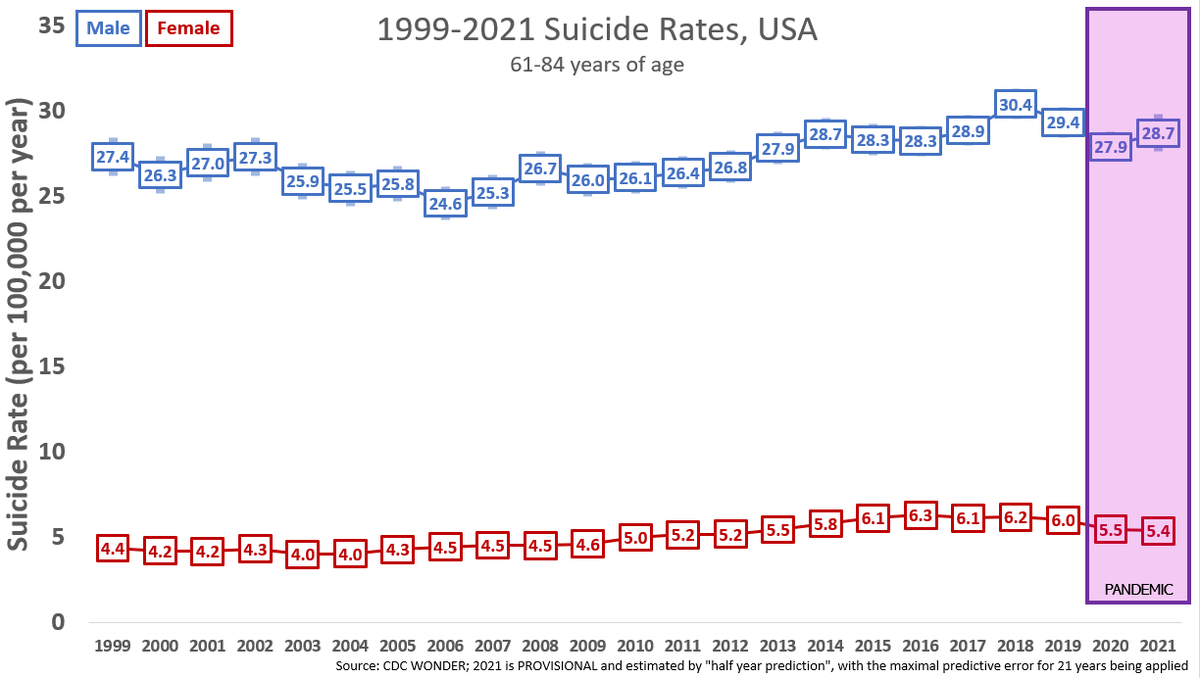
The rate for both males and females in the United States will likely be within the expected fluctuation of the previous years, and still less than the "peak" of 2018 pre-pandemic.
/2
For Adults 61-84, likely a slight uptick for men but within 2019 levels, and for women no overall change.
/3
For adults 41-60, the significant drop seen in 2020 will likely continue for both men and women.
/4
For adults 25-40, no changes are significant but there seems to be a continuing and increase of about 2.5% per year in the male rate since 2009.
/5
For YOUNG ADULTS (18-24), **please note that neither change is outside of the error prediction so this is best described as** no significant differences. If the point estimates hold, they will both be highs. However, neither increase unprecedented or "A TSUNAMI" if they hold.
/6
For PEDIATRIC POPULATION (0-17), **please note that neither change is outside of the error prediction so this is best described as** no significant differences. Even if the point estimates hold, none of these increases unprecedented or "A TSUNAMI".
/7
All-in-all, its looking like 2021 will be a mundane year for final suicide numbers. In the coming days I will do my best to take a peek at the racial divides.
/8
"2021 ERROR SIZE"
I ran a model in which all the previous "Jan thru June" rates were compared to that year's final rate, to get the most conservative (largest) error in this prediction.
For the second year in a row, the "TSUNAMI OF SUICIDE" moral panic will not test true.
/9
"2021 Provisional Rate"
The 2021 rate is then displayed as the Jan-June rate (adjusted to to increase by 2.6% when provisional to final, based off of previous CDC Wonder updates), with the error bars above.
/10
To be clear, my first answer is "well we know they are supposed to block serotonin reuptake, but it's not that simple and we don't really know."
But, if you want the best 2026 science...
/1
For a few particularly science-interested patients, I walk them through what we currently have for the 'best evidence' even though we're still not sure.
This is the "best story" I can tell about SSRI's right now.
(nb, this is NOT locked in, this is MY best synthesis)
/2
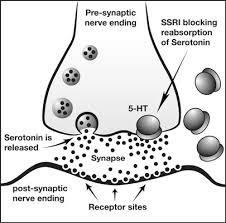
1) SSRIs BLOCK the Serotonin Transporter
The protein that pulls serotonin back into the neuron after its released is blocked. Serotonin lingers longer in the synapse, the gap where neurons signal each other.
This is very well established, & how SSRIs were designed.
Ask any person who has been even suggested to have BPD; they will uniformly tell you that they have been told to try DBT (Dialectical Behavioural Therapy). Reflexively recommended. "Gold standard."
This is not science-supported.
/1
Quick history: Marsha Linehan developed DBT in the late 1980s, published the foundational manual in 1993. She drew on CBT, Zen Buddhism, and dialectical philosophy. Brilliant clinician, brilliant marketer. Her institute has trained tens of thousands of therapists worldwide.
/2
That marketing machine is the reason DBT is "the BPD treatment." It is not the reason DBT works better than alternatives, because it does not.
The faint superiority signals in older trials evaporate once you adjust for allegiance bias (DBT researchers studying DBT).
/3
The McCullough Foundation's @NicHulscher — who posts garbage medical misinformation — styles himself an "independent epidemiologist."
His entire career has been spent publishing with, and working for, McCullough.
No academic post, no health agency, no clinical role, no pre-Foundation experience. Hired straight out of his 2024 MPH by the senior author on nearly every paper bearing his name.
/2
He publishes almost exclusively with McCullough, overwhelmingly in predatory or fringe journals, and has already been retracted twice — plus an Expression of Concern — in a career that's barely two years old.
/3
Since MAID has been enacted in 2014, approximately 90,000 Canadians have chosen dying by this method rather than painful, drawn out, or medically complicated deaths.
This represents 0.2% of the Canadian population and accounts for approximately 2% of all deaths since 2014.
The amount of time that American & Canadian right wingers spent on MAID is ridiculous. It is certainly a controversial policy, but it boogeymanning about it is bonkers.
It's not the #1 cause of death. Cancer, for example, kills 90k per year, or as many as MAID in 14 years.
/2
The reality of MAID:
1) The Median age of MAID is 79 years old. (the same age as the median age of COVID which right wingers have decided was 'fine' because they were old anyway)
2) 95.6% are track 1 (death imminent)
3) People who receive MAID do not disproportionately come from lower-income or disadvantaged communities.
4) People who receive MAID are less likely (not more likely) to live in remote areas.
5) 75% have received palliative (end of life) care and also choose MAID
6) A very small proportion (0.1%) required, but did not receive, disability support services; of these individuals, 91.4% confirmed that services were accessible to them.
7) Minorities are under-represented (not over-represented) in those receiving MAID.
/3
If we analyze a group of 40-year-old adults with the same diagnostic criteria & screening as we use currently on children, we get virtually identical rates of autism.
"Exploding rates of autism" likely a reflection of our exploding understanding.
A 2025 Canadian study estimated 1.8% autism prevalence in adults, similar to child rates, showing diagnosis consistency across ages despite evolving awareness.
/2
From 2011-2022 US data found increased autism diagnoses in children, alongside rises in young adult diagnoses simultaneously, not lagged. This implies that it is not something new to this generation.
/3