Alex Xu Profile picture
Feb 16, 2022 11 tweets 4 min read Read on X
Today, let’s design an S3 like object storage system.

Before we dive into the design, let’s define some terms. 1/11 Image
𝐁𝐮𝐜𝐤𝐞𝐭. A logical container for objects. The bucket name is globally unique. To upload data to S3, we must first create a bucket. 2/11 Image
𝐎𝐛𝐣𝐞𝐜𝐭. An object is an individual piece of data we store in a bucket. It contains object data (also called payload) and metadata. Object data can be any sequence of bytes we want to store. The metadata is a set of name-value pairs that describe the object. 3/11 Image
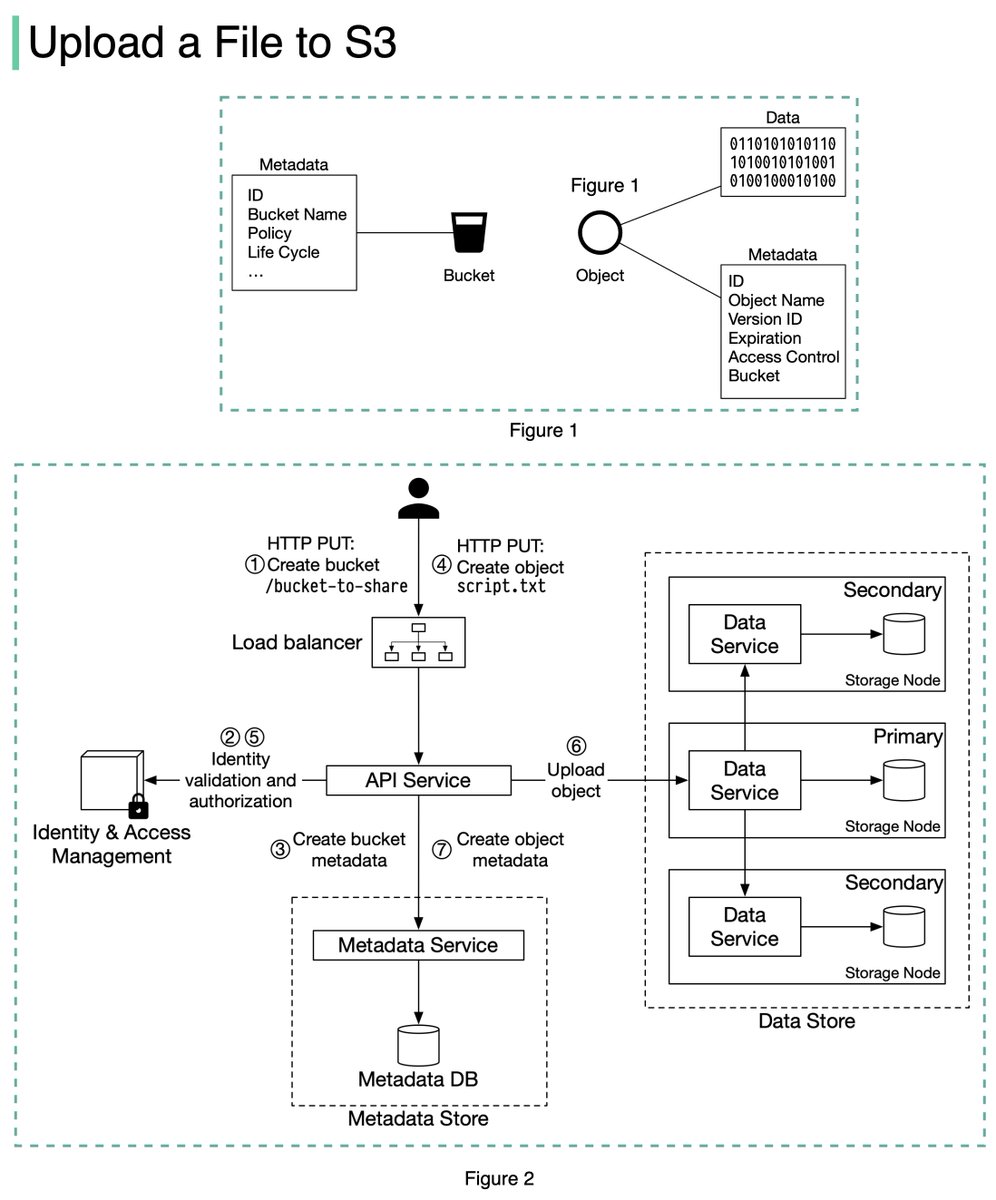
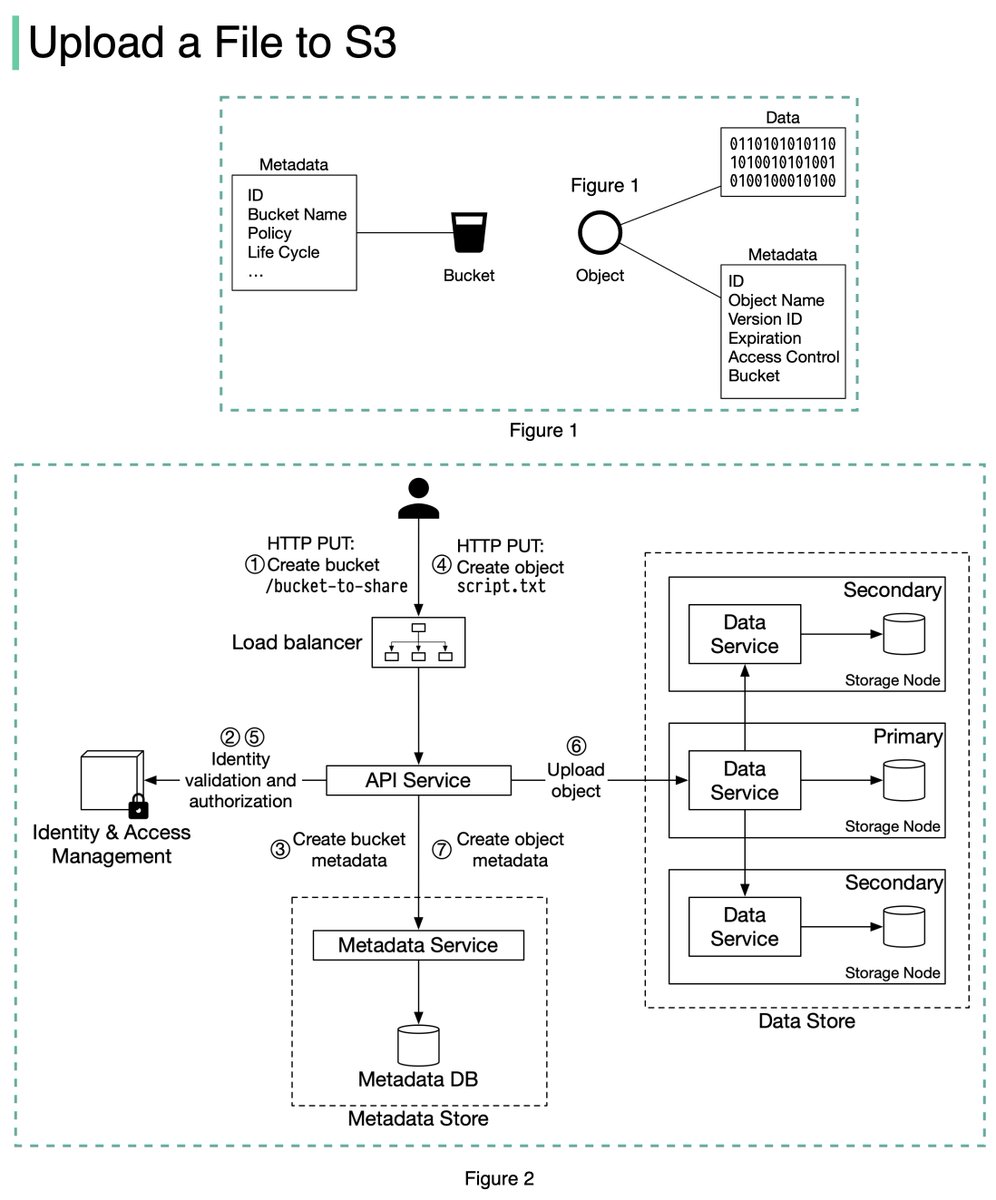
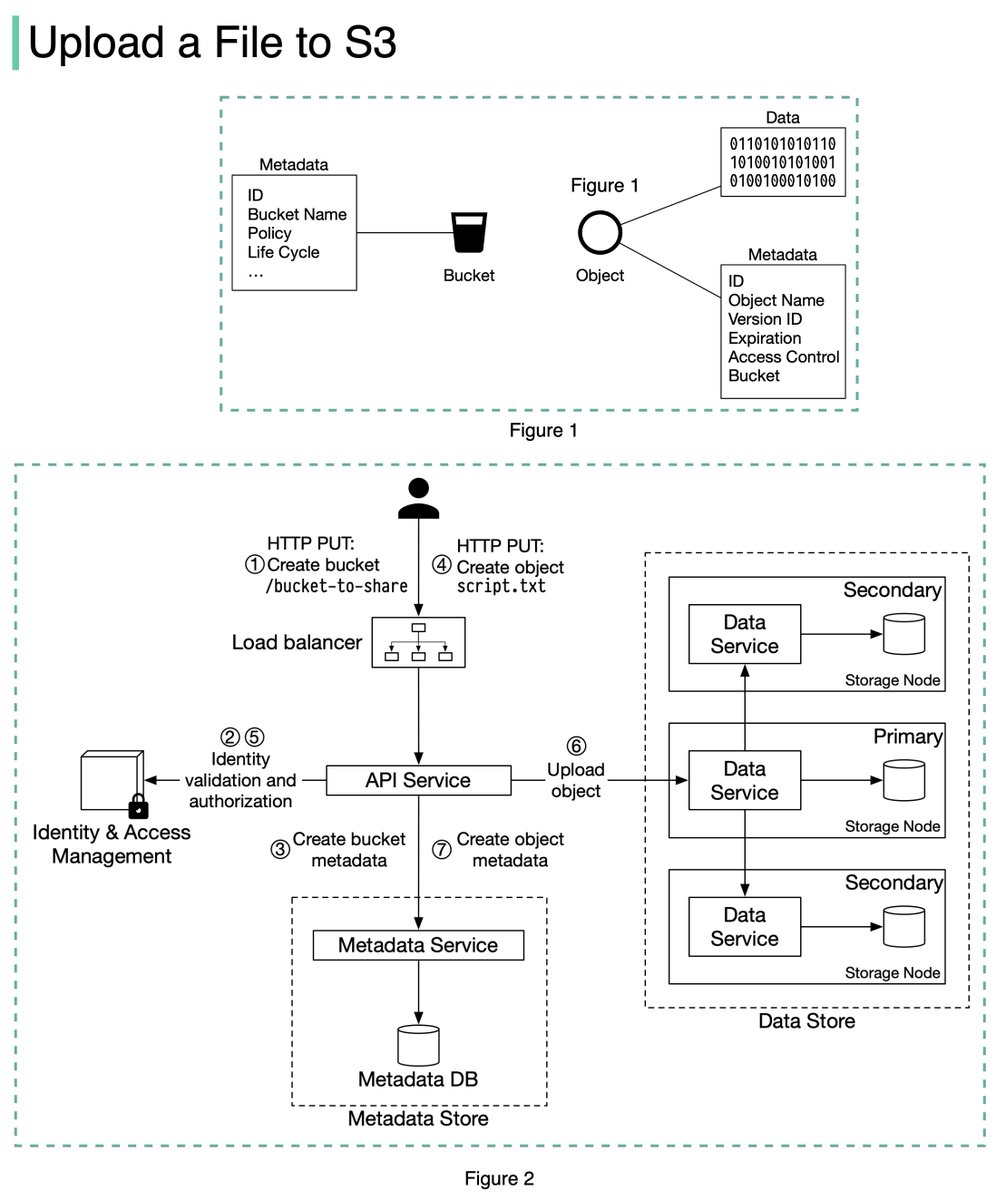
An S3 object consists of (Figure 1):
🔹 Metadata. It is mutable and contains attributes such as ID, bucket name, object name, etc.
🔹 Object data. It is immutable and contains the actual data. 4/11 Image
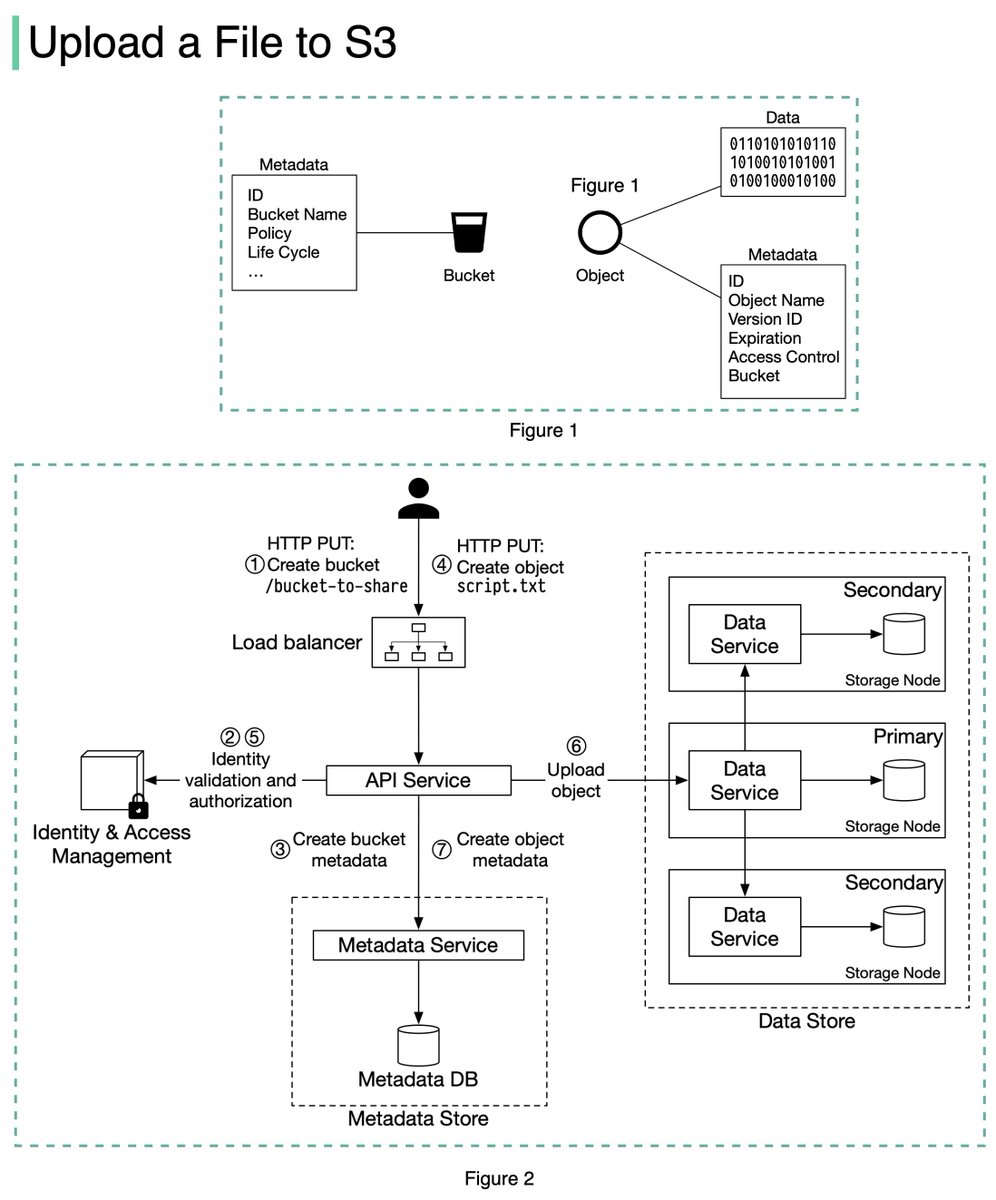
In S3, an object resides in a bucket. The path looks like this: /bucket-to-share/script.txt. The bucket only has metadata. The object has metadata and the actual data. 5/11 Image
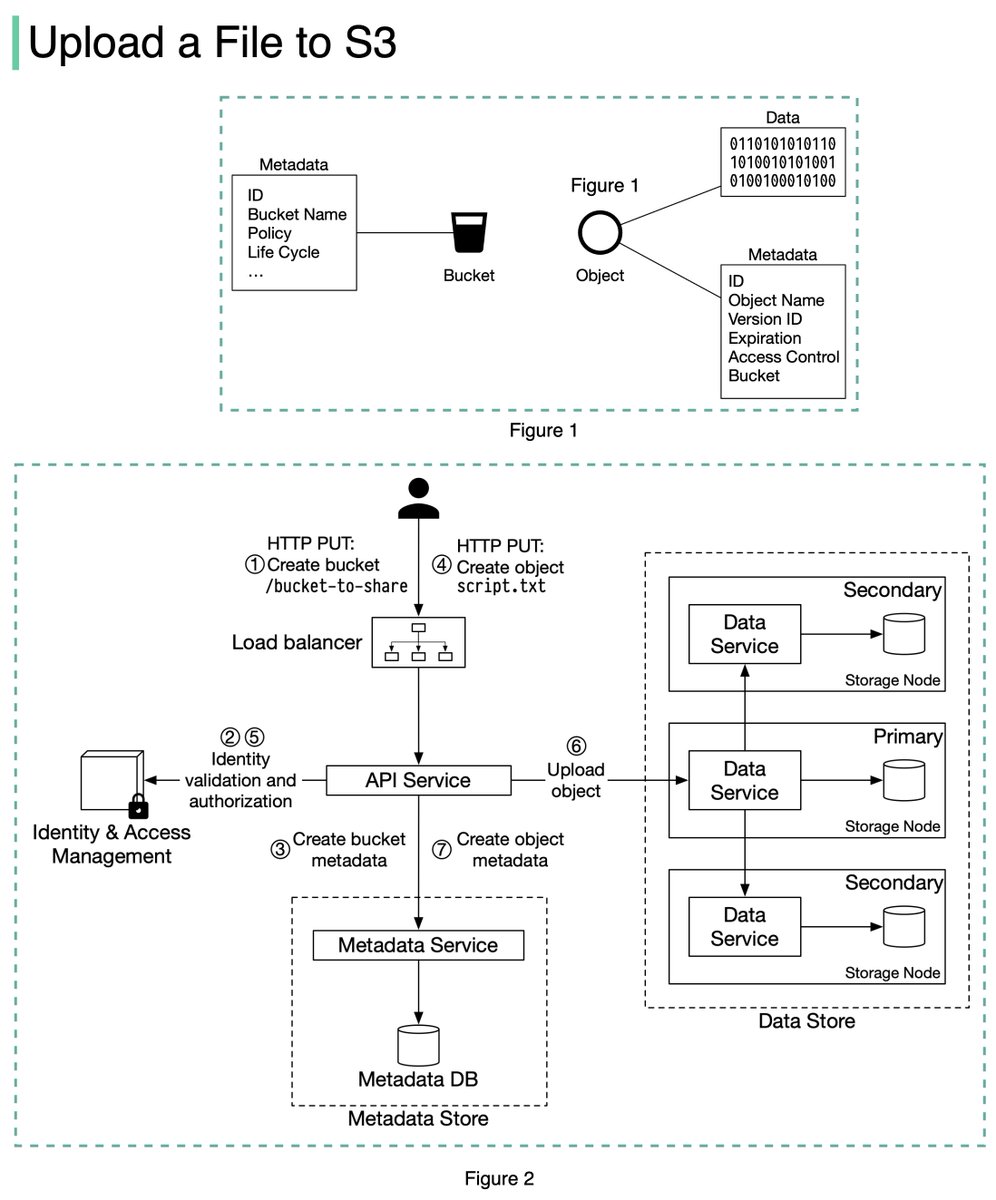
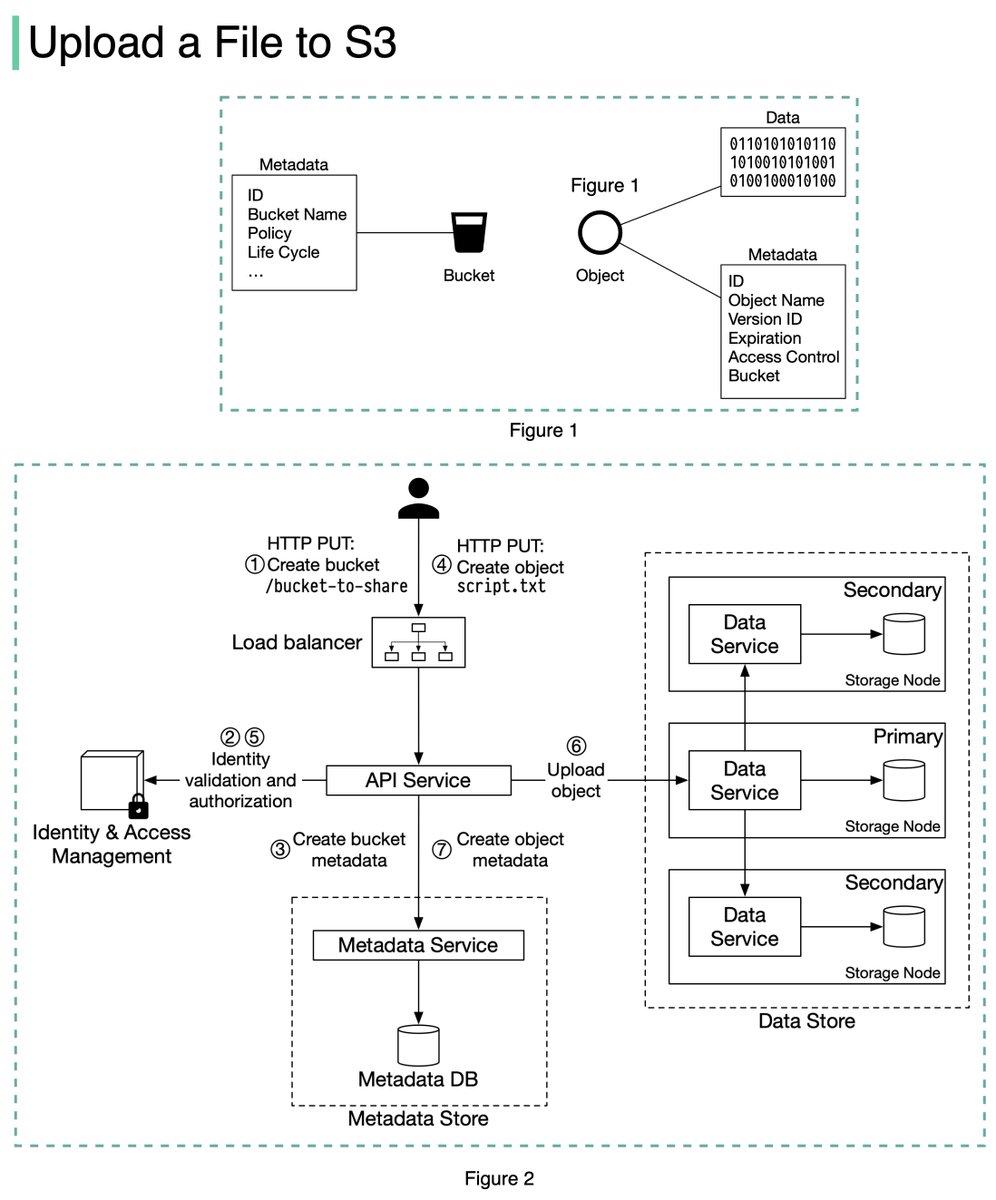
The diagram below (Figure 2) illustrates how file uploading works. In this example, we first create a bucket named “bucket-to-share” and then upload a file named “script.txt” to the bucket. 6/11 Image
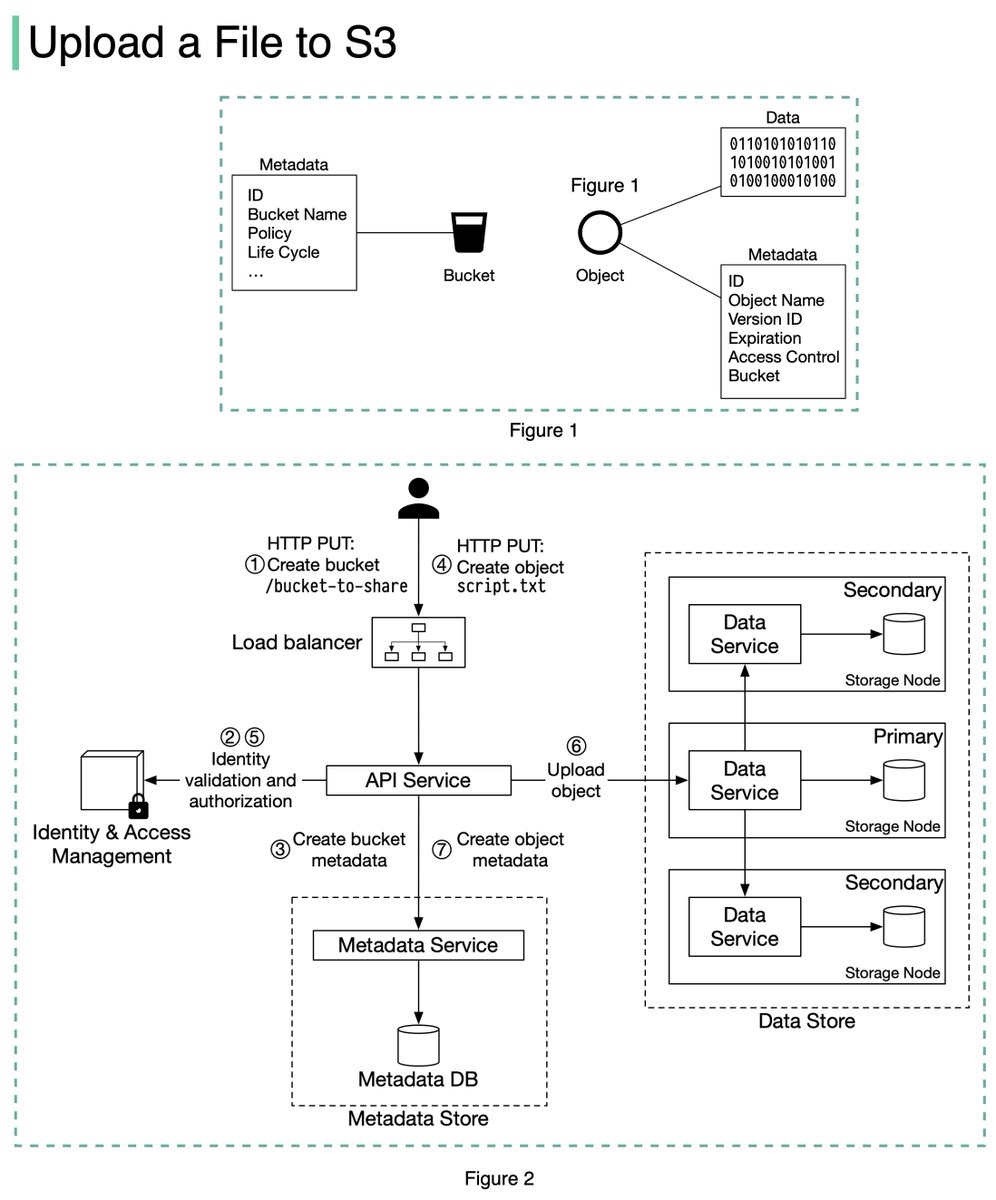
1. The client sends an HTTP PUT request to create a bucket named “bucket-to-share.” The request is forwarded to the API service.

2. The API service calls the Identity and Access Management (IAM) to ensure the user is authorized and has WRITE permission. 7/11 Image
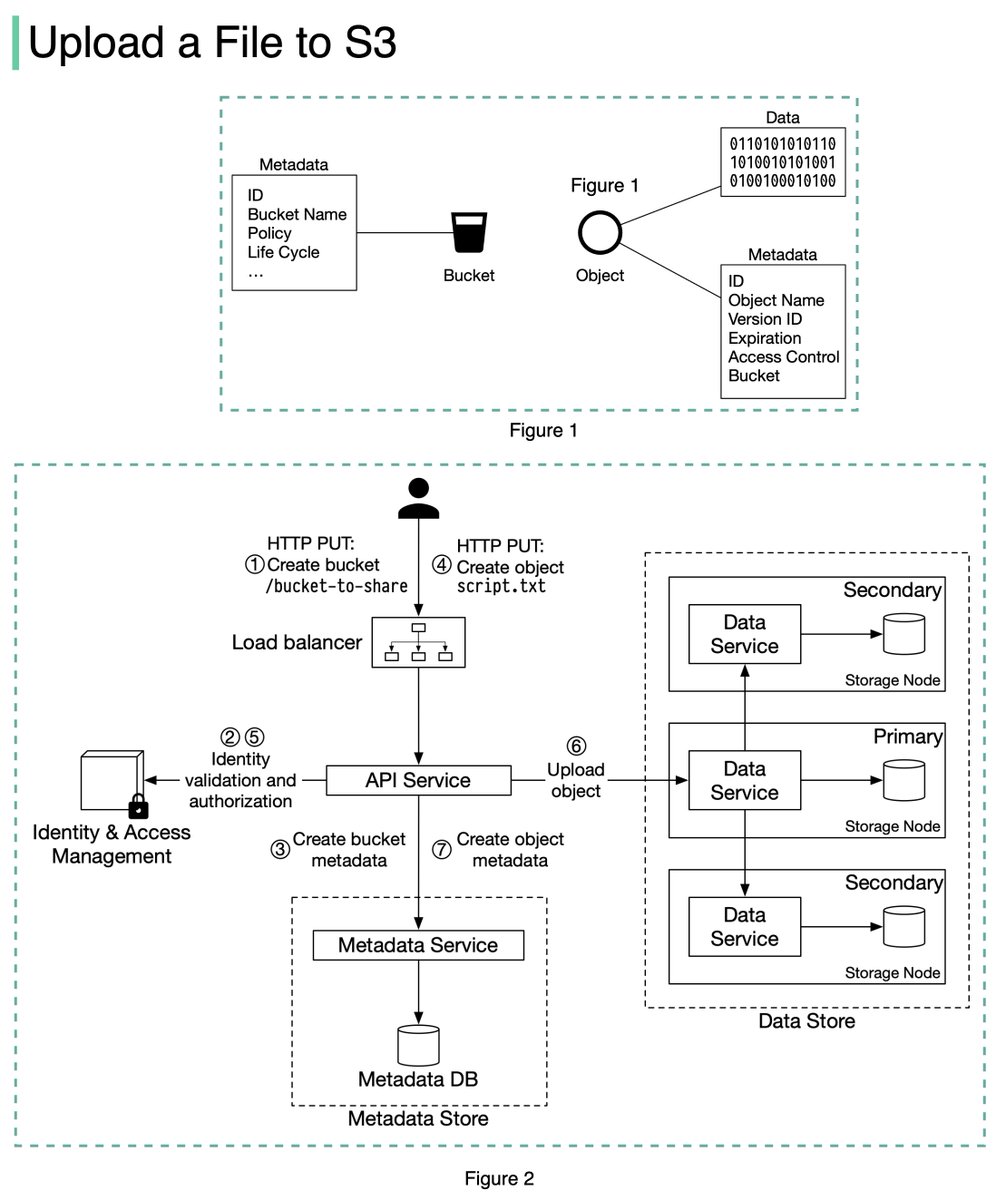
3. The API service calls the metadata store to create an entry with the bucket info in the metadata database. Once the entry is created, a success message is returned to the client. 8/11 Image
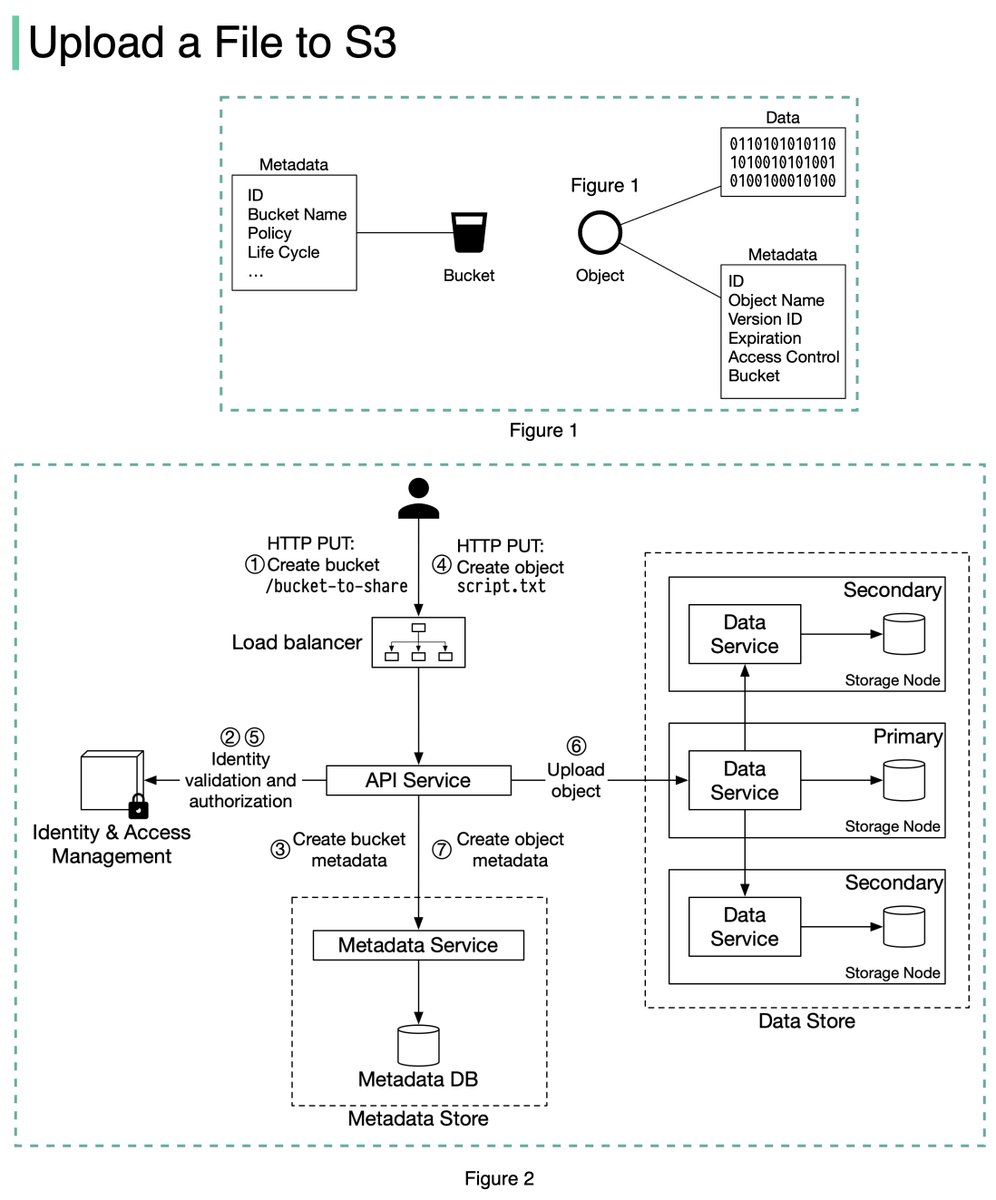
4. After the bucket is created, the client sends an HTTP PUT request to create an object named “script.txt”.

5. The API service verifies the user’s identity and ensures the user has WRITE permission on the bucket. 9/11 Image
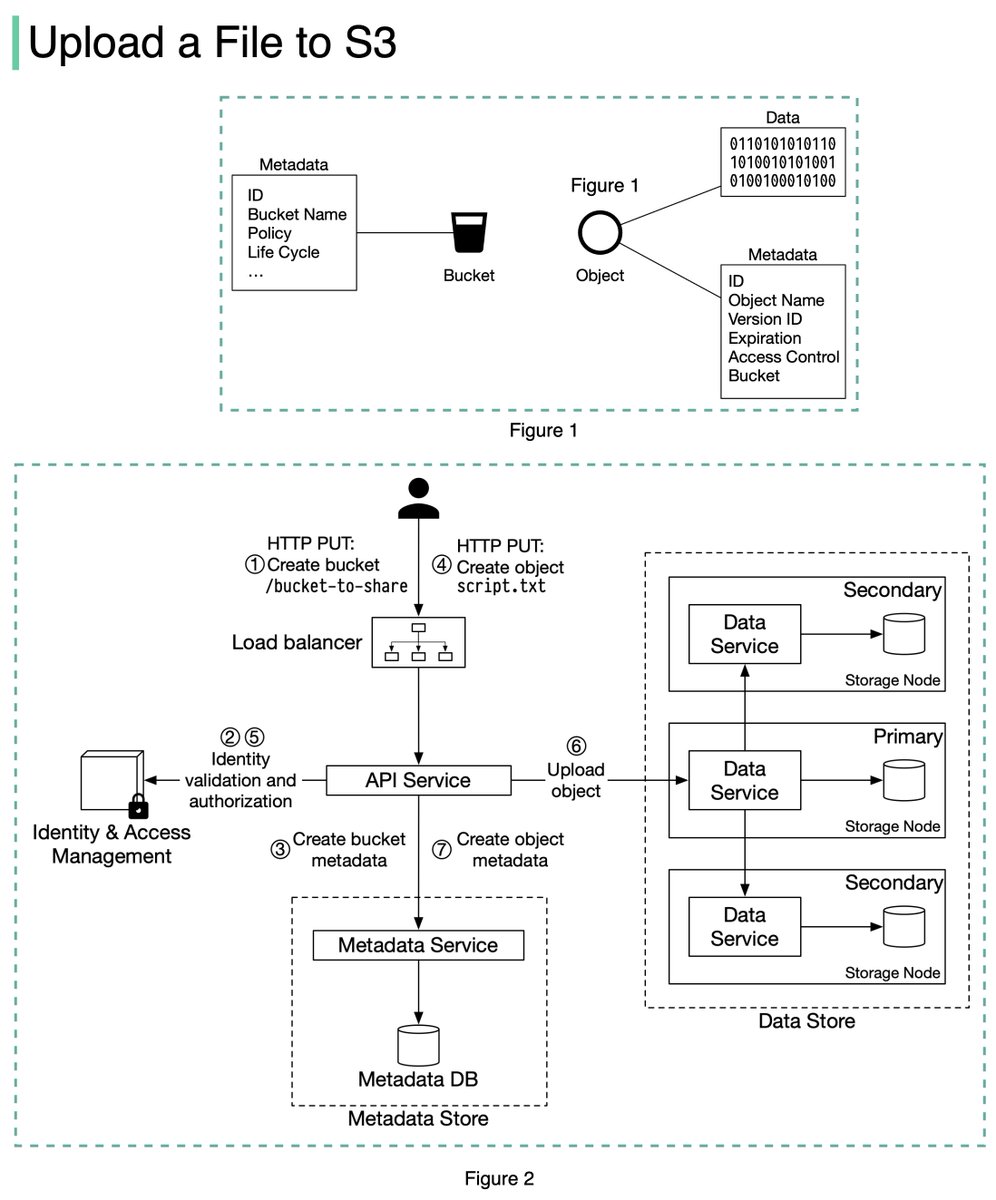
6. Once validation succeeds, the API service sends the object data in the HTTP PUT payload to the data store. The data store persists the payload as an object and returns the UUID of the object. 10/11 Image
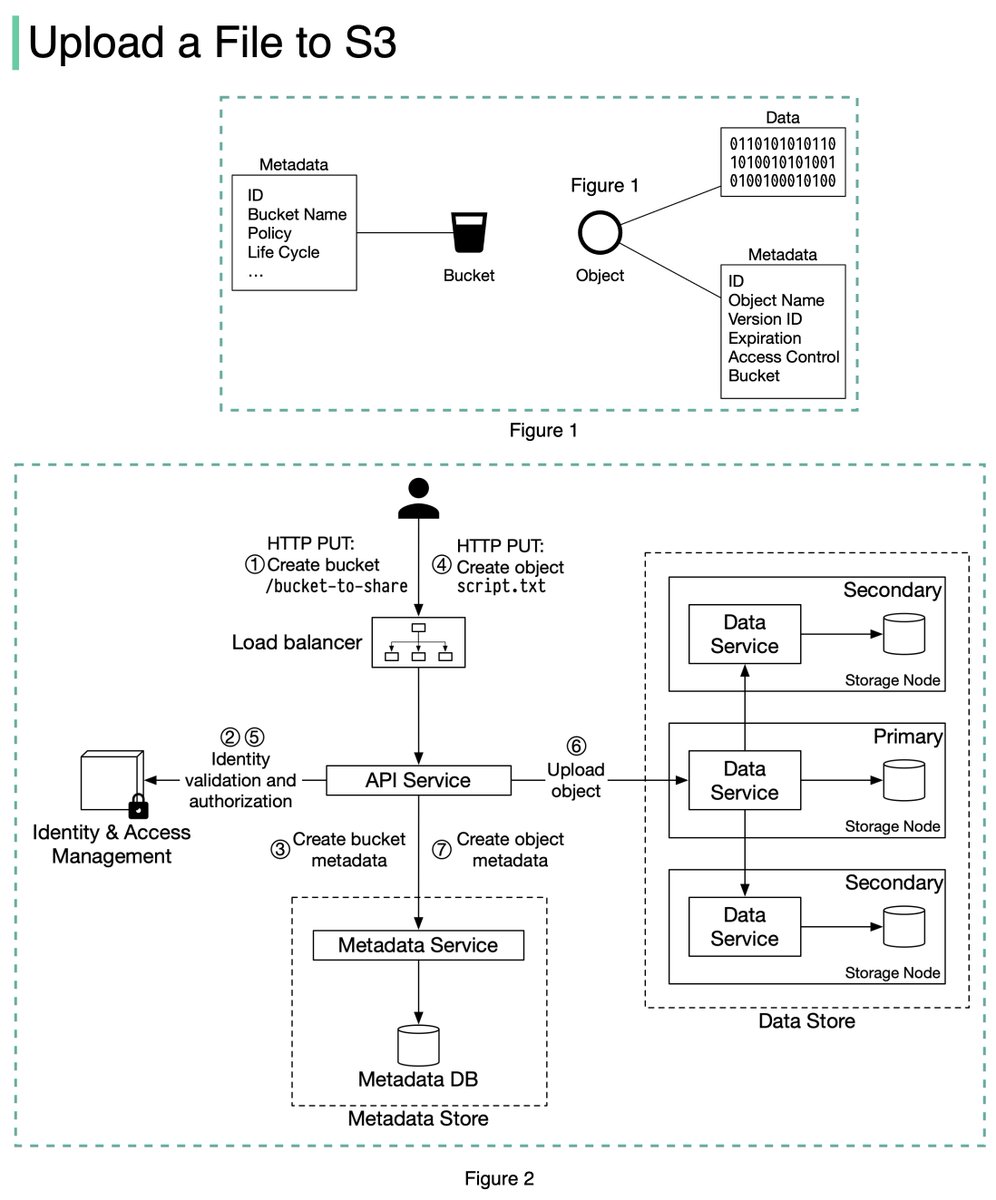
7. The API service calls the metadata store to create a new entry in the metadata database. It contains important metadata such as the object_id (UUID), bucket_id (which bucket the object belongs to), object_name, etc. 12/12 Image
• • •

Missing some Tweet in this thread? You can try to force a refresh

 

Keep Current with Alex Xu

Alex Xu Profile picture

Stay in touch and get notified when new unrolls are available from this author!

Read all threads

This Thread may be Removed Anytime!

PDF

Twitter may remove this content at anytime! Save it as PDF for later use!

Try unrolling a thread yourself!

how to unroll video
  1. Follow @ThreadReaderApp to mention us!

  2. From a Twitter thread mention us with a keyword "unroll"
@threadreaderapp unroll

Practice here first or read more on our help page!

More from @alexxubyte

Mar 10, 2025
What is MCP?

Why is everyone talking about it?

Let’s take a closer look.

Model Context Protocol (MCP) is a new system introduced by Anthropic to make AI models more powerful. Image
It is an open standard (also being run as an open-source project) that allows AI models (like Claude) to connect to databases, APIs, file systems, and other tools without needing custom code for each new integration.

MCP follows a client-server model with 3 key components:
1 - Host: AI applications like Claude that provide the environment for AI interactions so that different tools and data sources can be accessed. The host runs the MCP Client.
Read 7 tweets
Feb 12, 2025
How Kubernetes Works?

Kubernetes (K8S) is an open-source container orchestration platform originally developed by Google and now maintained by CNCF.

Here’s how developers interact with Kubernetes: Image
1 - Developers create manifest files describing the application.
2 - Kubernetes takes these manifest files, validates them, and deploys the applications across its cluster of worker nodes.
3 - Kubernetes manages the entire lifecycle of the application.
Kubernetes is made up of two main components:

1 - Control Plane: It is like the brain of Kubernetes and consists of the following parts:

- API Server: It receives all incoming requests from users or CLI.
Read 7 tweets
Jun 10, 2024
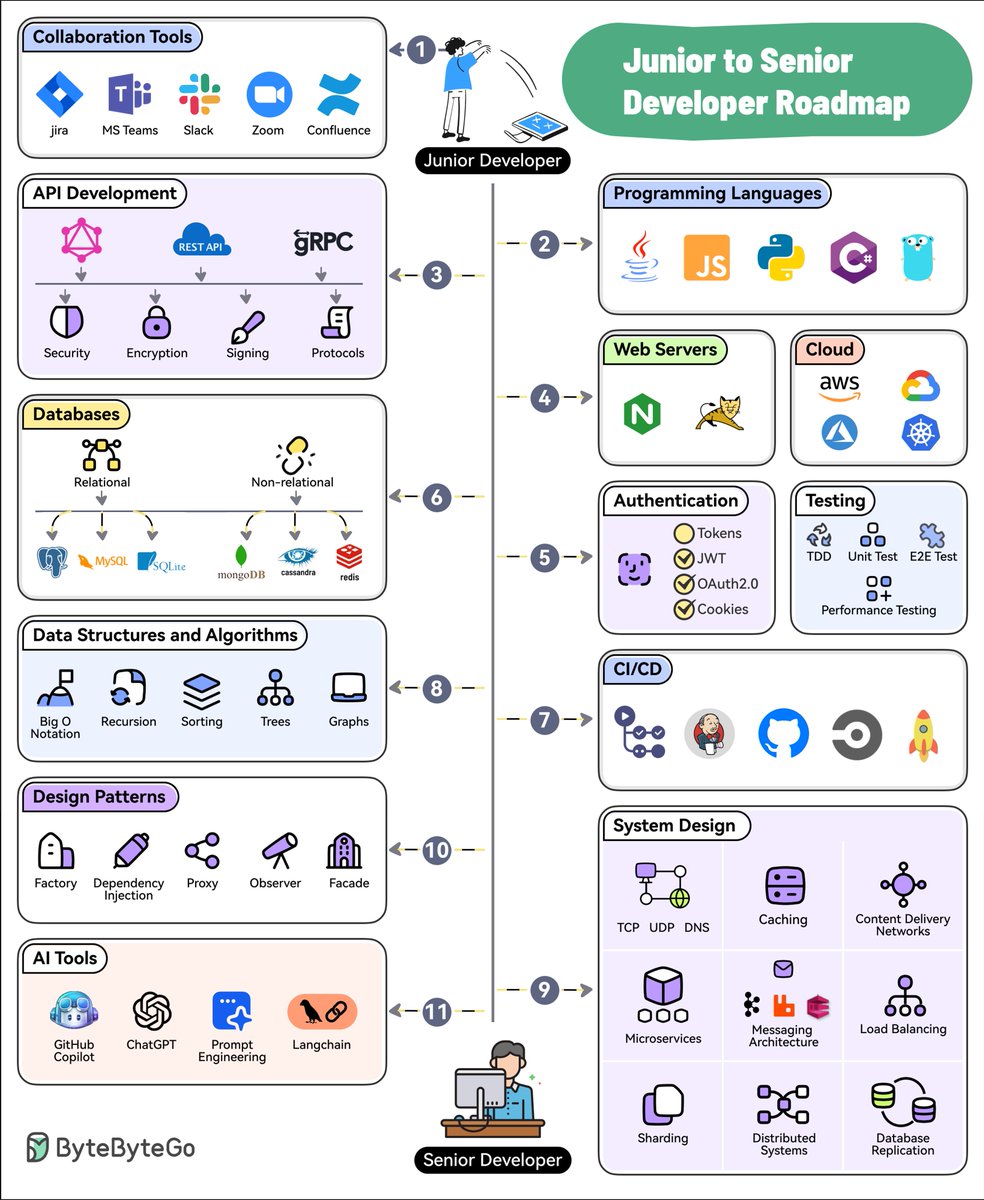
11 steps to go from Junior to Senior Developer Image
1 - Collaboration Tools
Software development is a social activity. Learn to use collaboration tools like Jira, Confluence, Slack, MS Teams, Zoom, etc.

2 - Programming Languages
Pick and master one or two programming languages. Choose from options like Java, Python, JavaScript, C#, Go, etc.

3 - API Development
Learn the ins and outs of API Development approaches such as REST, GraphQL, and gRPC.
4 - Web Servers and Hosting
Know about web servers as well as cloud platforms like AWS, Azure, GCP, and Kubernetes

5 - Authentication and Testing
Learn how to secure your applications with authentication techniques such as JWTs, OAuth2, etc. Also, master testing techniques like TDD, E2E Testing, and Performance Testing

6 - Databases
Learn to work with relational (Postgres, MySQL, and SQLite) and non-relational databases (MongoDB, Cassandra, and Redis).
Read 6 tweets
Jul 1, 2023
Twitter has enforced very strict rate limiting. Some people cannot even see their own tweets.

Rate limiting is a very important yet often overlooked topic. Let's use this opportunity to take a look at what it is and the most popular algorithms.

A thread.

#RateLimitExceeded
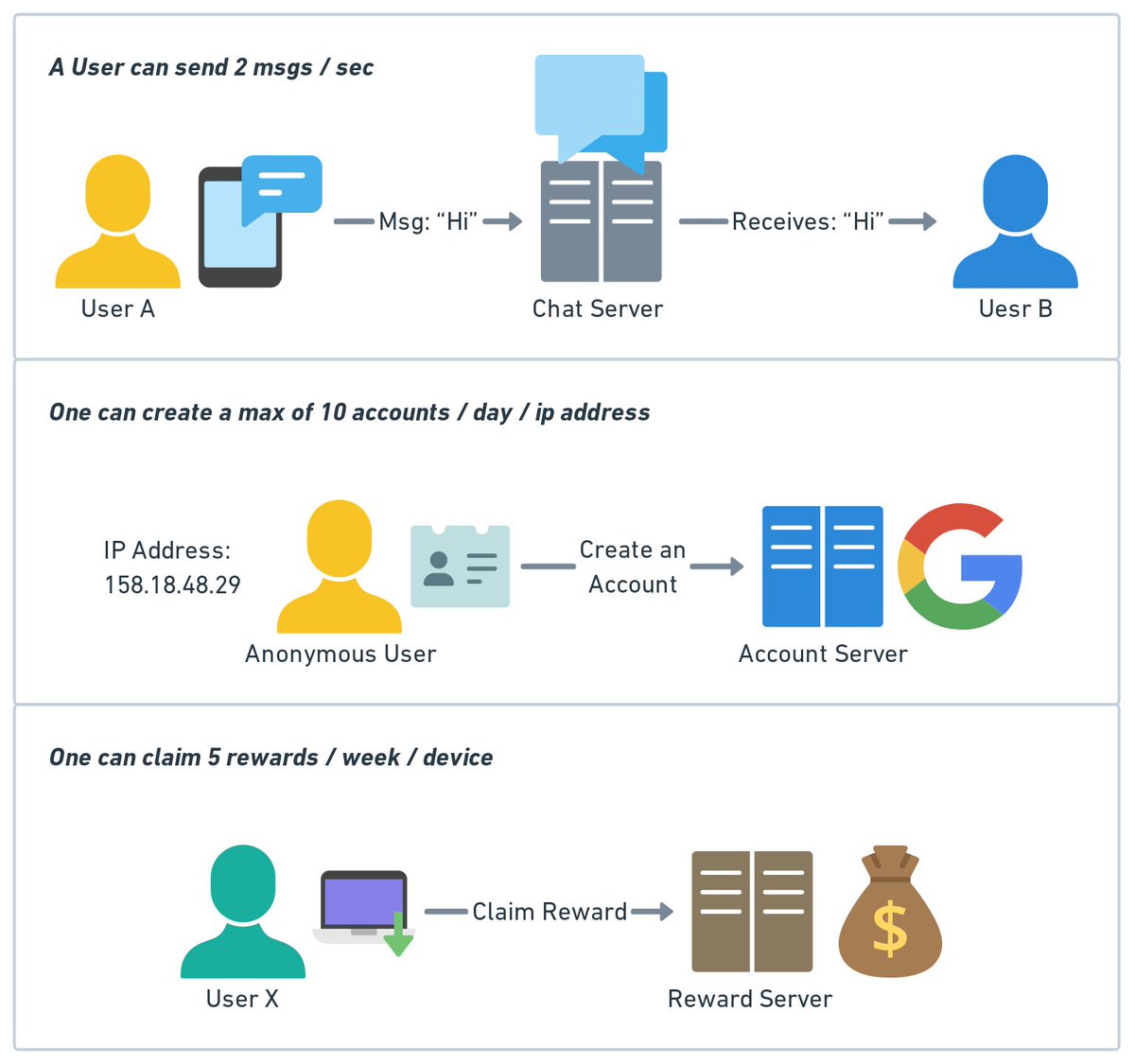
What is rate limiting? Rate limiting controls the rate at which users or services can access a resource. Here are some examples:

- A user can send a message no more than 2 per second
- One can create a maximum of 10 accounts per day from the same IP address
Fixed Window Counter

The algorithm divides the timeline into fixed-size time windows and assigns a counter for each window. Each request increments the counter by some value. Once the counter reaches the threshold, subsequent requests are blocked until the new time window begins
Read 9 tweets
May 29, 2023
/1 Our system design newsletter just reached a new milestone: 400,000 subscribers. Here are the most popular ones: 👇

Subscribe here: blog.bytebytego.com Image
/2 Understanding Database Types: blog.bytebytego.com/p/understandin… Image
/3 Password, Session, Cookie, Token, JWT, SSO, OAuth - Authentication Explained: blog.bytebytego.com/p/password-ses… Image
Read 7 tweets
May 19, 2023
/1 Free Algorithm, Git, Python, SQL, Java Books (And Many More)

These books were compiled from Stack Overflow Documentation and can be helpful for quick reference. Image
/2 The link to the books: books.goalkicker.com
/3 Subscribe to our weekly newsletter to get a Free System Design PDF (158 pages): bit.ly/42Ex9oZ Image
Read 4 tweets

Did Thread Reader help you today?

Support us! We are indie developers!


This site is made by just two indie developers on a laptop doing marketing, support and development! Read more about the story.

Become a Premium Member ($3/month or $30/year) and get exclusive features!

Become Premium

Don't want to be a Premium member but still want to support us?

Make a small donation by buying us coffee ($5) or help with server cost ($10)

Donate via Paypal

Or Donate anonymously using crypto!

Ethereum

0xfe58350B80634f60Fa6Dc149a72b4DFbc17D341E copy

Bitcoin

3ATGMxNzCUFzxpMCHL5sWSt4DVtS8UqXpi copy

Thank you for your support!

Follow Us!

:(