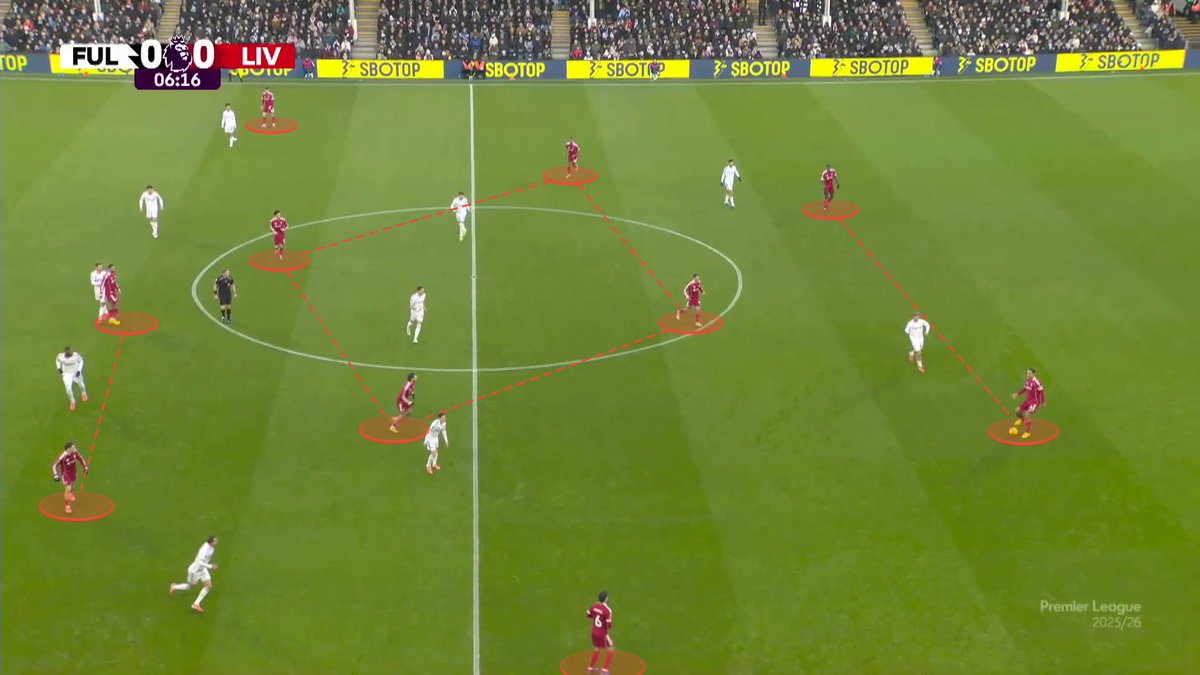
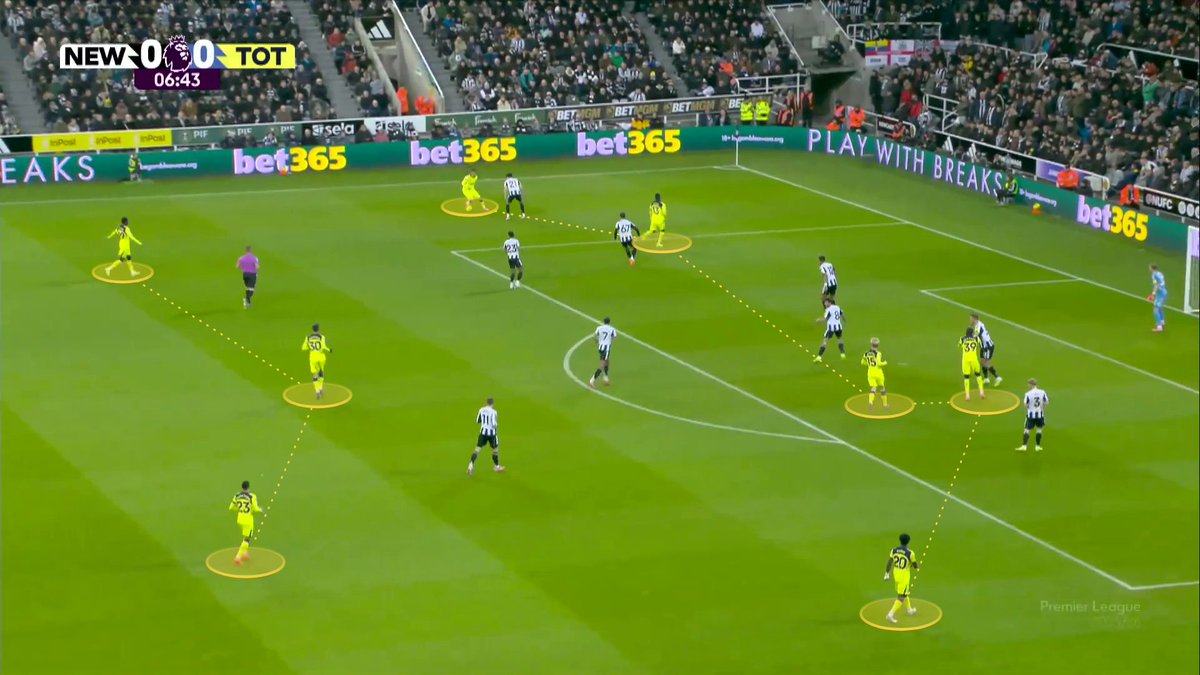
Positional play and "Juego de Posicion" is something that football fans fawn over, and rightly so, but the intricacies within the system that enable beautiful football centre around defensive principles. Xavi, Arteta, & Pep implement the 4-3-3 to an elite standard.
MEGA-THREAD.
MEGA-THREAD.

Positional play is associated with the 4-3-3 because of the positions the players occupy on the pitch (both half spaces, wings and the centre with the #6, CF and two CB's).
Any coach can line their players up in that shape, but implementing it successfully is the tough part.
Any coach can line their players up in that shape, but implementing it successfully is the tough part.
The 4-4-2 was a staple of the game for years because it naturally created compactness in midfield with 2 CM's and combinations out wide for target men in the box - not in the 4-3-3, though. The players become further apart centrally and close together on the two flanks.
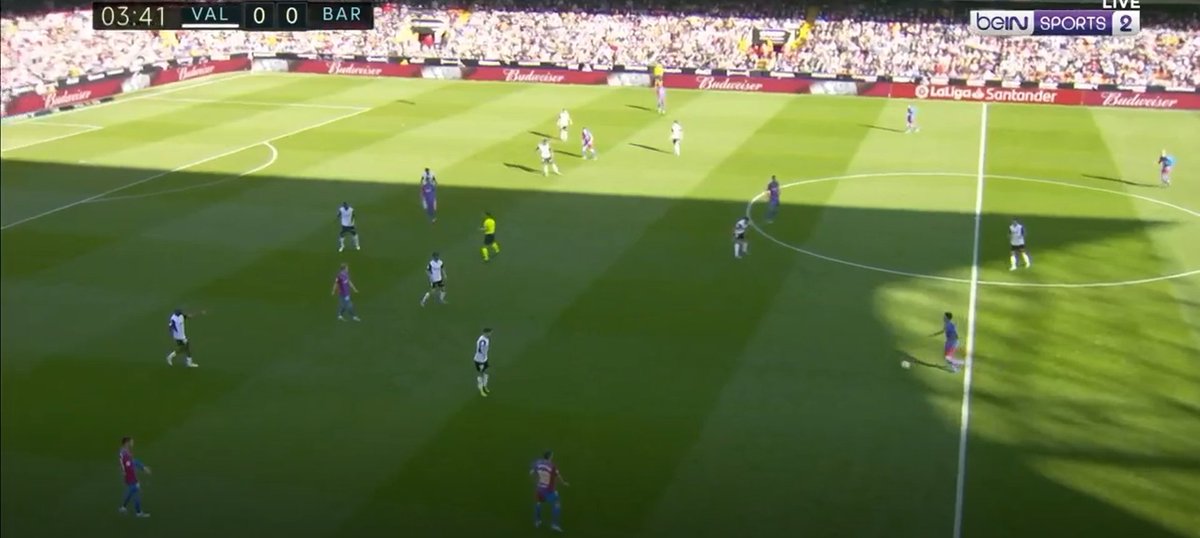
That's where the problems arise. Elite technical quality is required in central build-up because there's 3 players (CB-CB; DM) as opposed to 4 (CB-CB; DM-DM). Again, when play breaks down, the lone #6 can become isolated with too much space to cover. Solutions are needed for that
That's where the elite coaches start to separate themselves from the average 4-3-3 coach, but it's not as simple as simply tasking a midfielder who typically positions themselves in the half space between the lines with staying deeper, as then the positional play is hampered.
These coaches play the 4-3-3 to enable even occupation of spaces across the pitch which enable combination play, quick switches of play, isolation moments, etc., so they have to maintain those triangles on each flank to achieve that goal.


In terms of solutions, Xavi, Pep, and Arteta utilise an inverted fullback to ensure the midfield is compact in defensive transition. Klopp, on the other hand, plays 2 natural central midfielders (not #10's like Pedri, Odegaard, KDB), inverts the forwards, and pushes the FB's on.
Klopp's philosophy is centred around pressing and not technical dominance to the point which Xavi, Pep and Arteta attempt to achieve. The latter coaches invert their fullbacks to maintain compactness in midfield, but it also maintains the angles in which they want to create.
That's what Xavi, Pep and Arteta focus on - angles, and more so replication of angles, and the angles that the inverted fullback create are of high quality. When each teams fullback inverts, there's a passing lane created out wide to the winger.
Typical 4-3-3's don't have that.
Typical 4-3-3's don't have that.


However, again, it's not as simple as inverting your fullback and you're an elite positional play coach. No, the players must maintain these angles that the coach wants to create. There's has to be inversion in a defensive position, occupation of the half space, and a wide player
A triangle, at all times, and on both sides of the pitch. That understanding has to translate to the players. They must be highly aware of the positions they occupy on the pitch otherwise the system collapses i.e. the angles to combine in aren't there anymore. Rotations are key.
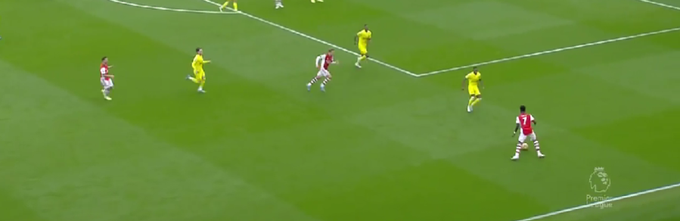


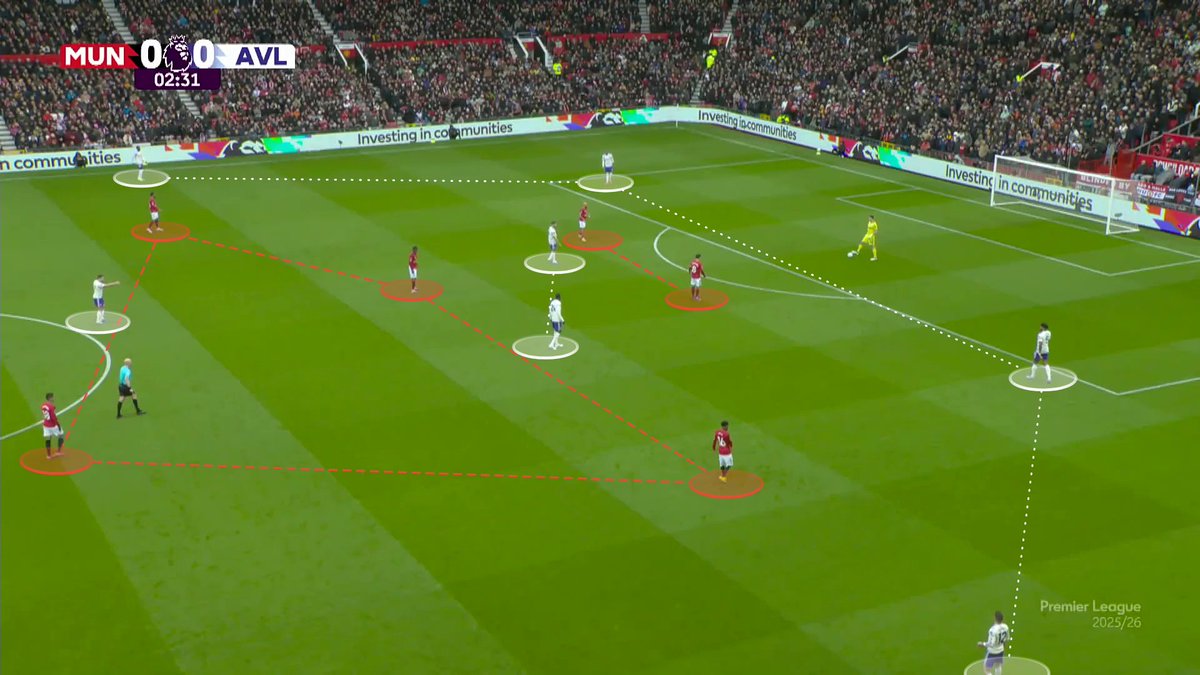
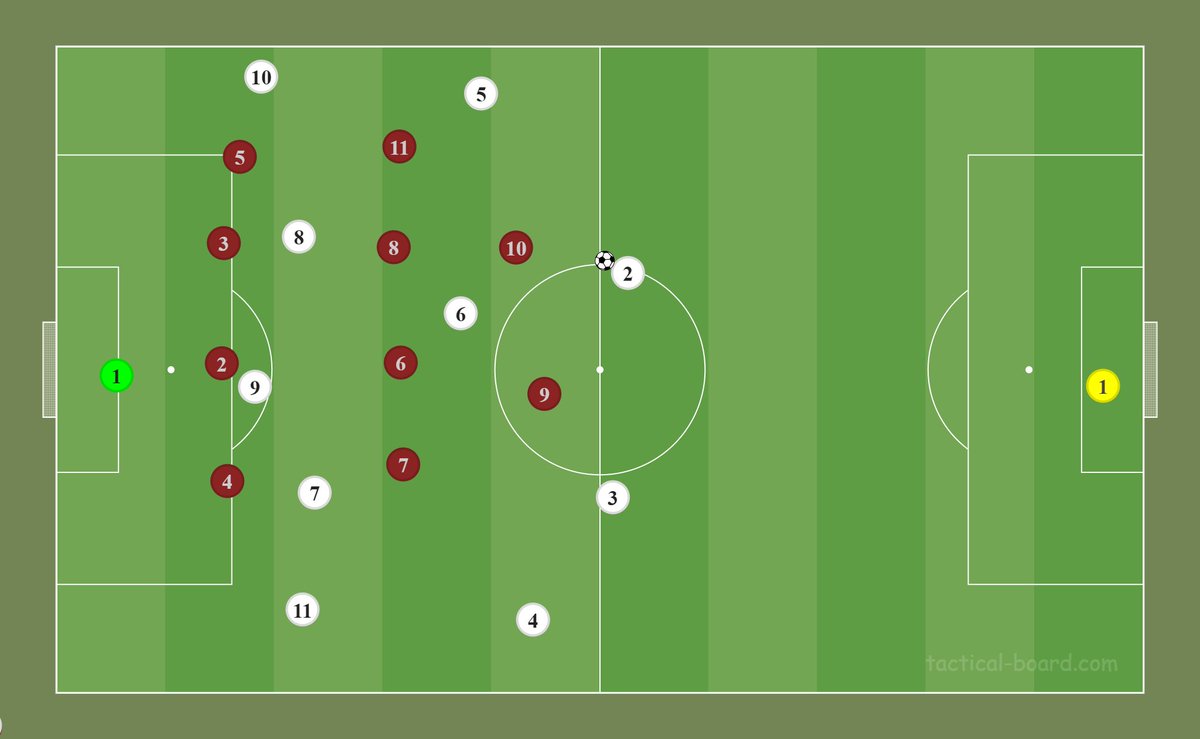
Within a standard 4-3-3, the spacing is like this (white team). It's very hard for the ball-side fullback to get on the ball to find a pass to the winger. They have to let the ball run across their body and pass in a very tight lane to a winger with a defender up his backside.
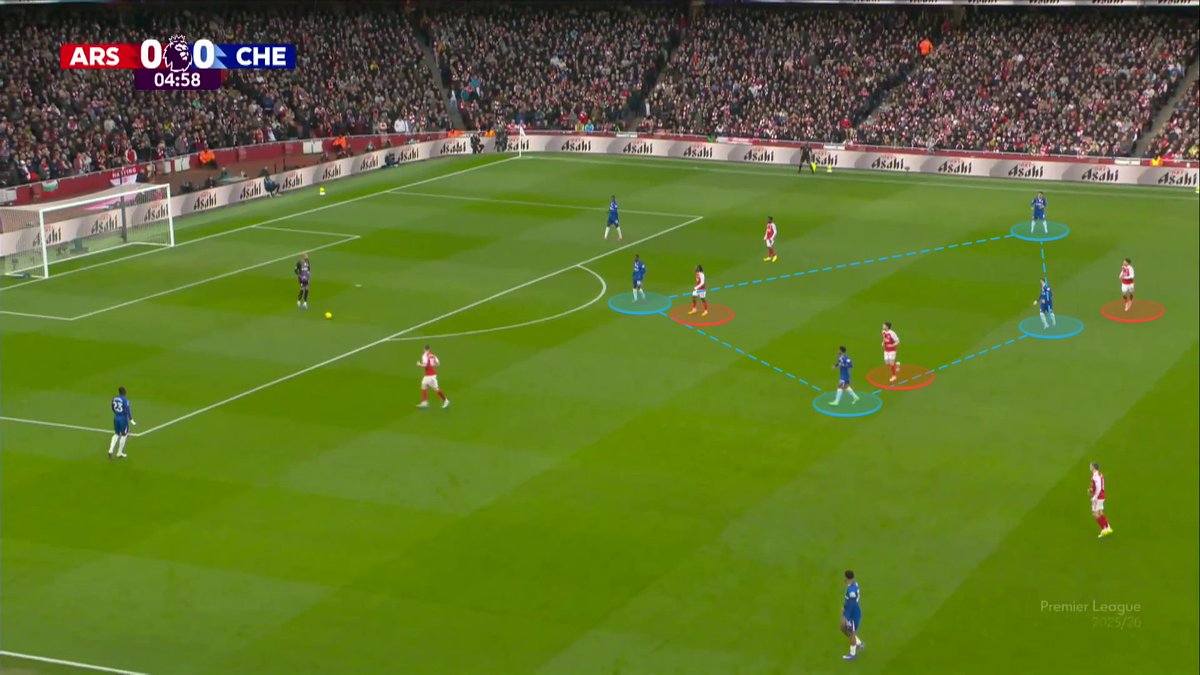
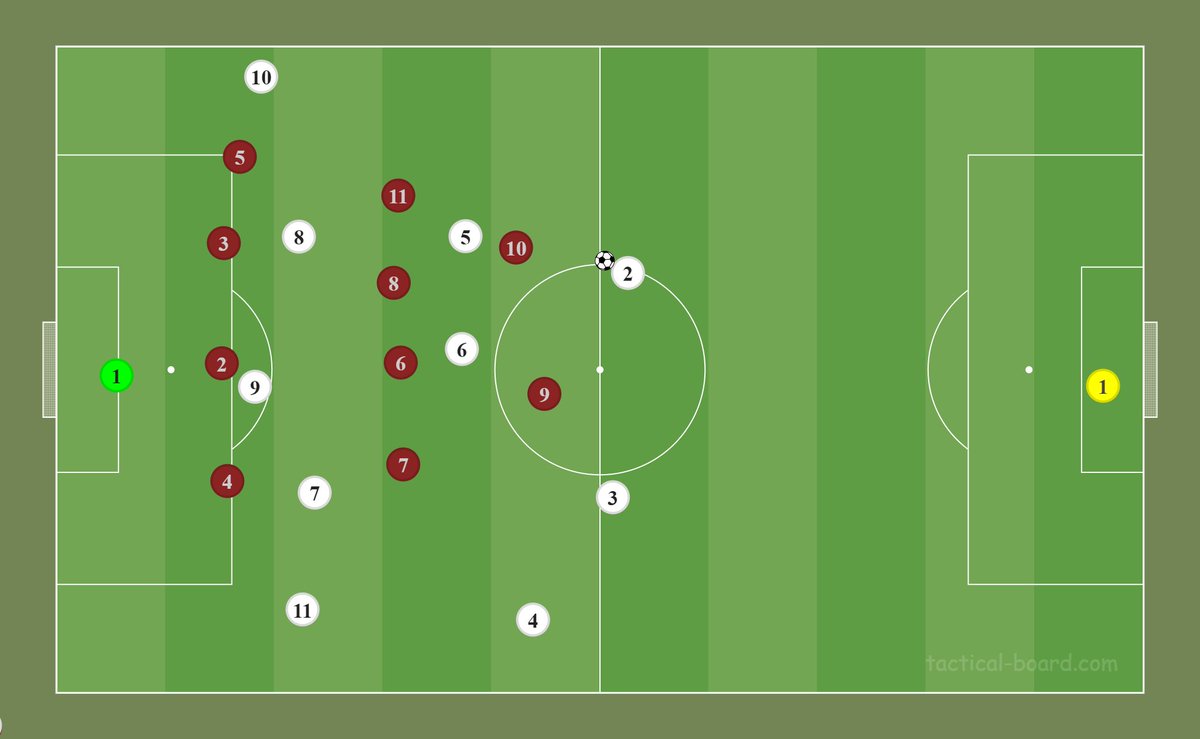
However, when he inverts, the passing lane opens up. Then the trio can combine, and there's also an extra central player in the midfield in case play breaks down. That's the essence of Arsenal, City, and the latest version of Barca. Defensive focus but maintenance of key angles.
Player balance is another key focus i.e. the ability to identify players who can play the inverted role, the ability to identify a #6 who is physically, mentally & technically capable of playing in such a demanding role by himself in the build-up, tactically versatile players....
However, it's not *just* about player balance. It's about team balance in terms of profiles. The team has to be balanced in terms of players who will come to, and run away from the ball to stretch teams and make it easier to pin their block back or exploit them in transition.

It's why Xavi signed Adama, Auba, and Ferran. The team were plagued with to feet players for years. The front 3 consisted of Messi alongside the likes of Coutinho & Griezmann. Barca's most penetrative player for the last half a decade was Jordi Alba. Messi needed more like that.
However, they have it now thanks to Xavi's understanding of balance. Barca still have elite technicians in the build-up & midfield, but now have some penetrative players, so they can create via passes in behind & in 1v1 situations. The runs also stretch the pitch for the passers.
City have Sterling, Mahrez, and use Foden as a runner type. Arsenal have Martinelli and Saka and want to replace Lacazette. It's part of the blueprint - balance. However, again, it's also not just as easy as that. The playmakers i.e. #10's have to attack the box too.
That requires coaching. İlkay Gündoğan never scored more than 3 goals in a single season at Dortmund, but scored 13 in one at City & is now a notorious goal threat from midfield. That's because Pep coached him to attack the box. To add extra penetration, much like ESR at Arsenal.
It's the same with Xavi and Pedri now. Xavi demands more goals from him, as did other coaches. However, Xavi provides solutions these other coaches did not offer. He firstly enables the team to get into positions where Pedri can attack the box before Pedri himself attacks it.
Pedri has nearly matched his goal tally in 31 less games this season when compared to last and he's only just back after a long time out. Watch this guy become a regular goalscorer from midfield under Xavi's tutelage despite it not being his natural game. That's all coaching.

Once that ball goes out wide and the trio's on each flank find an angle to cross, the #10's attack the box, and there's sufficient penetration to complement the striker. It's the same with the far player on the sides. Arteta has coached his far wide player to attack the box.

So there's lot of men in the box but still crucially compactness behind them thanks to the presence of the #6 and the inverted fullback. That's why City are relentless and why Arsenal and Barca are starting to show signs of it too. Elite coaching with defensive staples. Wow good.
As with the above image, off the ball, the block is in a position to counterpress because the spacing across the pitch is good and the midfield is compact with 2 players present. It is ideal. However, there's another major adaption required in the 4-3-3 - pressing in settled play

Xavi's Barca man-mark ala Bielsa (although revert to zonal deeper), Pep's City block space in a 4-4-2 and adapt to the opposition based on their build-up style, as do Arteta's Arsenal.
These coaches implement 4-3-3's with elite spacing, but it's all enabled by defensive staples.
These coaches implement 4-3-3's with elite spacing, but it's all enabled by defensive staples.
• • •
Missing some Tweet in this thread? You can try to
force a refresh