Our latest investigation + our first ‘open source archaeology’, documents the ancient city of Anthedon near Al-Shati camp in Gaza—Palestinian heritage under threat from coastal erosion, repeated bombings & the humanitarian disaster of Israeli occupation. forensic-architecture.org/investigation/…
Excavations at the site throughout the 90s unearthed Iron Age walls, Achaemenid period houses, Roman villas & fountain, a key Greco-Roman port city, & a Byzantine cemetery. The remnants were reburied by archaeologists for their protection as the occupation intensified in the 00s.
Our 'open source archaeology’ digitally reconstructs past & present layers of the site, using social media videos, satellite images, drone footage by @AinMedia, site visits, & archaeological reports & surveys.
Our analysis reveals 18 bomb craters (in red) since 2012 resulting from Israeli attacks across the site including the May 2021 offensive which killed 250+ and destroyed essential infrastructure.
Palestinian NGO @alhaq_org includes our findings in their report on cultural sites under Israeli apartheid, to be submitted @IntlCrimCourt & @OHCHR_MENA demanding recognition that destruction of Palestinian heritage is a war crime & crime against humanity alhaq.org/cached_uploads…
• • •
Missing some Tweet in this thread? You can try to
force a refresh

We’re honoured to announce a major new project supported by @wellcometrust.
UNLEARNING ‘EXCITED DELIRIUM’ brings together a world-class team to confront an urgent health, human rights, racial & social justice issue. Meet our partners below…
The project builds on decades of activism on race and policing by Stafford Scott, of @tottenhamrights and a Guest Professor with FA here at Goldsmiths. The seeds for this project were sown during 2021’s unforgettable WAR INNA BABYLON at @icalondon ica.art/exhibitions/wa…
In 2022, a major report by @p4hr exposed the racist origins of ‘Excited Delirium’ (ExD). Despite no scientific basis, ExD and its inheritor ABD are still often referred to when racialised men are killed by police.
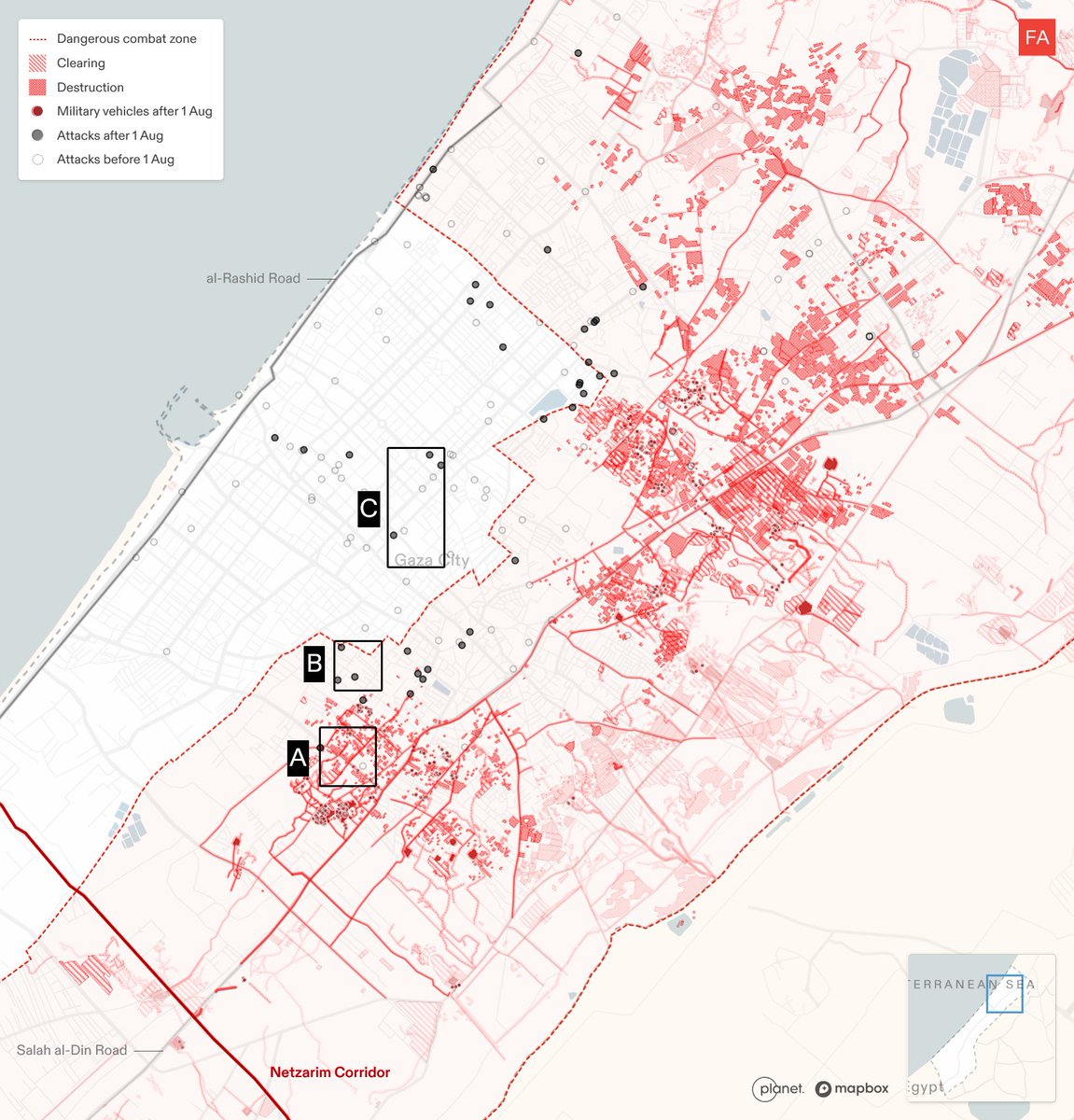
Israel is besieging Gaza City from three directions, pushing the nearly 1m Palestinians currently sheltering there towards southern Gaza.
Each military advance flattens homes and infrastructure in its path, threatening the erasure of millennia-old Gaza City, and displacing the people sheltering there. Most of the areas in southern Gaza which the military have allocated for relocation are within ‘no-go’ zones, or in areas unsuitable for habitation.
Israeli troops are advancing towards Gaza City from three directions: Jabalia in the north, Shujaiya in the east, and—most recently—the Netzarim Corridor in the south. This leaves Palestinians with only one place to go: towards the coast, along al-Rashid Road and into southern Gaza.
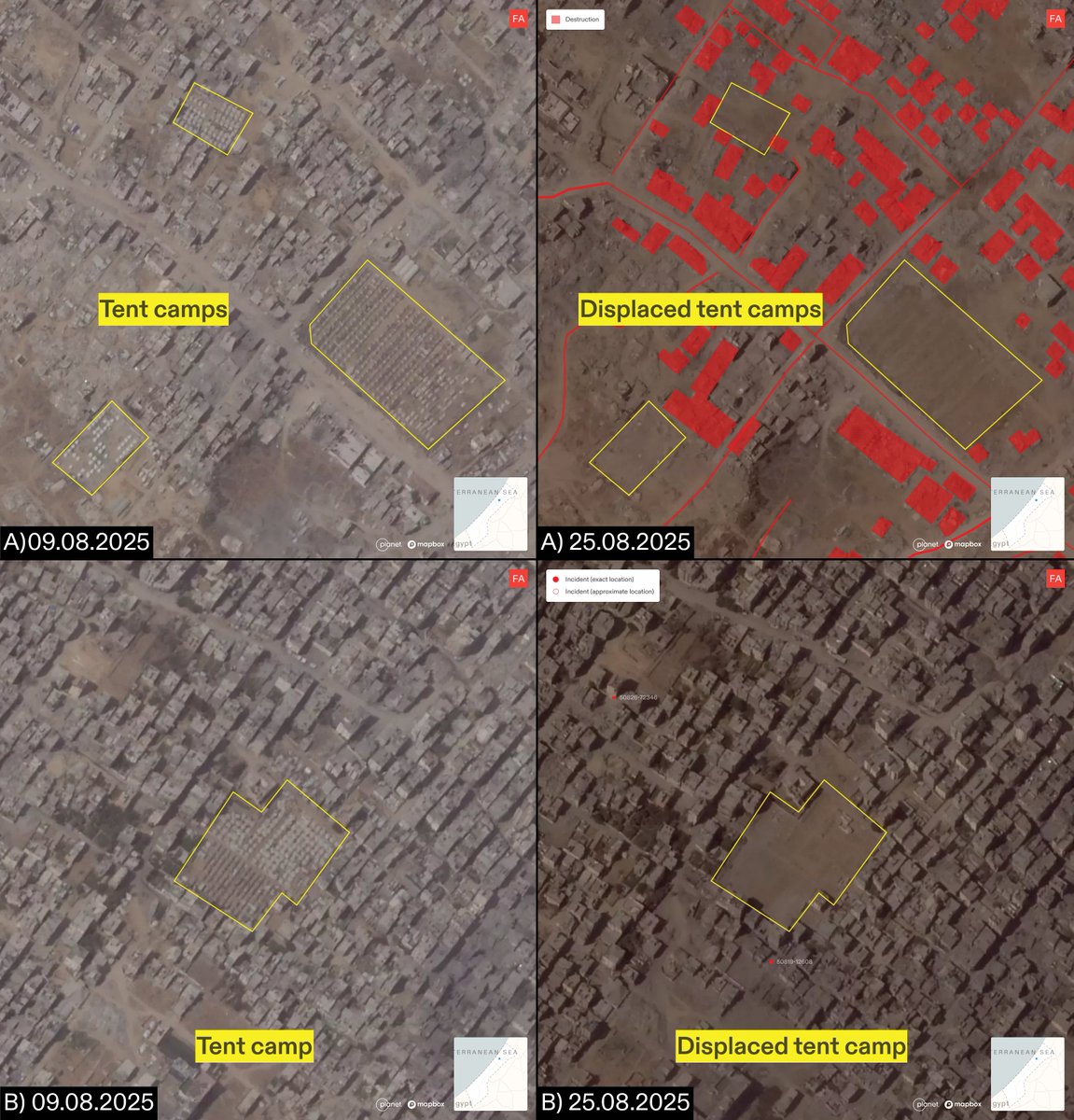
A comparison of satellite images from 9 and 25 August reveals the rapid dismantling of dense tent camps in Gaza City as Israel’s ground invasion has advanced. Meanwhile, tents, homes, markets, and community kitchens in the rest of the city have instead been subject to relentless bombardment, leaving the besieged, starving population with few options but to flee south.
NEW: Salman Abu Sitta is a Nakba survivor and historian of Palestine. Together, we digitally reconstructed his birthplace, the village of al-Ma’in, exploring its history and documenting how, in 1948, the village was destroyed and its people forcibly expelled: forensic-architecture.org/investigation/…
On 14 May 1948, al-Ma’in was occupied and demolished by Zionist forces.
We reconstructed the village to uncover its layered history — from its vibrant agricultural life, with a 95-metre deep well and a bayarah, to the 60,000 dunams (15,000 acres) of land cultivated by the Abu Sitta family, mostly wheat and barley.
FA has documented a pattern of Israeli attacks on areas into which they have previously instructed civilians in Gaza to evacuate. Our research confirms that the Israeli military carried out multiple attacks in areas towards which civilians had been directed, either on the same day as the evacuation order, or on the day after. See more: frames.forensic-architecture.org/gaza/updates/a…
1) On the morning of 23 Mar 2025, the Israeli military issued an evacuation order for Tel al-Sultan neighbourhood of Rafah, directing civilians to move northeast. That evening, there was an airstrike northeast of Tel al-Sultan, in Khan Younis, that hit the Nasser Medical Complex, the largest hospital in the area.
2) On the morning of 7 Apr 2025, the Israeli military issued an evacuation order to Deir al-Balah, directing civilians to move southwest. Later that day, there was an attack on a residential building southwest of Deir al-Balah. The following day, there were two attacks in areas southwest of Deir al-Balah.
Israel has designated the majority of the Gaza Strip for evacuation. 34 evacuation orders have been issued to civilians in Gaza since the dissolution of the ceasefire on 18 March 2025. Many of these orders define differing boundaries for the militarised buffer zone in the east of Gaza, gradually expanding the area designated for evacuation. See more: frames.forensic-architecture.org/gaza/updates/i…
We have documented 4 instances where the declared boundaries of the buffer zone have subsumed areas previously subject to evacuation orders. As of 3 June 2025, the buffer zone has expanded to encompass the municipality of Rafah, as well as areas to the east of Khan Younis and in the north of Gaza.
For example, an evacuation order was issued to the municipality of Rafah on 31 March and 1 April. In an evacuation order issued on 6 April, the declared buffer zone expanded to encompass the areas previously designated for evacuation.
Israel is constructing a second militarised ‘corridor’ in Gaza, to expand their control of the Strip. Plans for the Morag Corridor were announced on 2 April; since that time, we’ve identified widespread destruction throughout the remains of Rafah city, and several new Israeli military outposts. Follow this developing situation in our new mapping portal: frames.forensic-architecture.org/gaza/updates/m…
A comparison of satellite imagery from 3 April and 11 May reveals how entire areas of central Rafah have been destroyed by the Israeli military.
During the same timeframe, the Israeli military destroyed dozens of buildings and greenhouses, as well as agricultural land, to the north of Rafah, to make way for the construction of the Morag Corridor.