OK, I read it. Here’s my quick take on the executive order.
Over the past couple of weeks, we’ve seen a variety of politicians, media, and consultants (who are often former officials from two or three administrations ago) drive a narrative that crypto is not just useless but dangerous and should be seriously restricted.
In the background of this narrative fog, you could find statements from the professionals at Treasury and the White House on the front lines of crypto issues consistently saying that while it presents certain risks, they can be mitigated and that the tech holds great promise.
Well, the EO is just further affirmation that when serious officials take a sober look at crypto, the reaction is not to light their hair on fire, but instead to recognize it as a innovation that the U.S. will want to foster and lead while mitigating obvious risks.
The message I take from this EO is that the federal government sees cryptocurrency as a legitimate, serious, and important part of the economy and society, and I think it’s a good signal to serious people who’ve been holding back from getting involved.
The EO also presents another striking contrast with alarmist politicians and media in that it is ultimately a call for further study and deliberate planning, not a reactive rush to legislate or regulate.
If there’s anyone who should not abide by the motto “move fast and break things” it’s Congress.
So, Coin Center looks forward to engaging with the various agencies now tasked with studying and planning on the issues we’ve spent nearly a decade working on, as well as engaging with thought legislative proposal from serious leaders in Congress.
• • •
Missing some Tweet in this thread? You can try to
force a refresh

Included in the America COMPETES Act just introduced in the House, and which will very likely pass in some form, is a provision that would be disastrous not just for cryptocurrency but for privacy and due process generally. coincenter.org/new-bill-would…
2/ The so-called "special measures" provision (proposed by @jahimes) would essentially give the Treasury Secretary unchecked and unilateral power to ban exchanges and other financial institutions from engaging in cryptocurrency transactions. How would it do this?
3/ Bank Secrecy Act §5318A allows the Secretary to identify a "primary money laundering concern" and take "special measures" to (1) require financial institutions to report information on the concern, and/or (2) prohibit FIs from maintaining accounts related to the concern.
GM! Some good news: A comprehensive bipartisan bill has just been introduced in the House to fix EVERYTHING wrong with the infrastructure bill's crypto tax provision–including the unconstitutional §6050I individual reporting mandate. congress.gov/bill/117th-con…
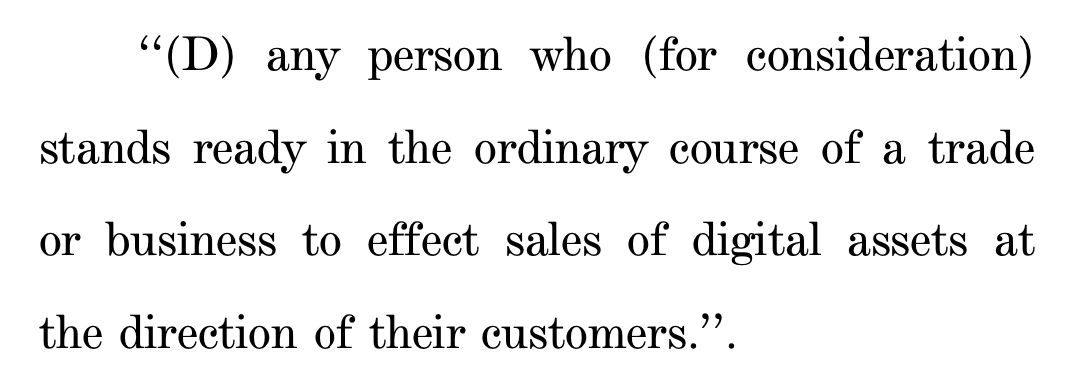
First, it would replace the overly broad definition of "broker" with one that is reasonably limited to exchanges that buy and sell crypto for customers.
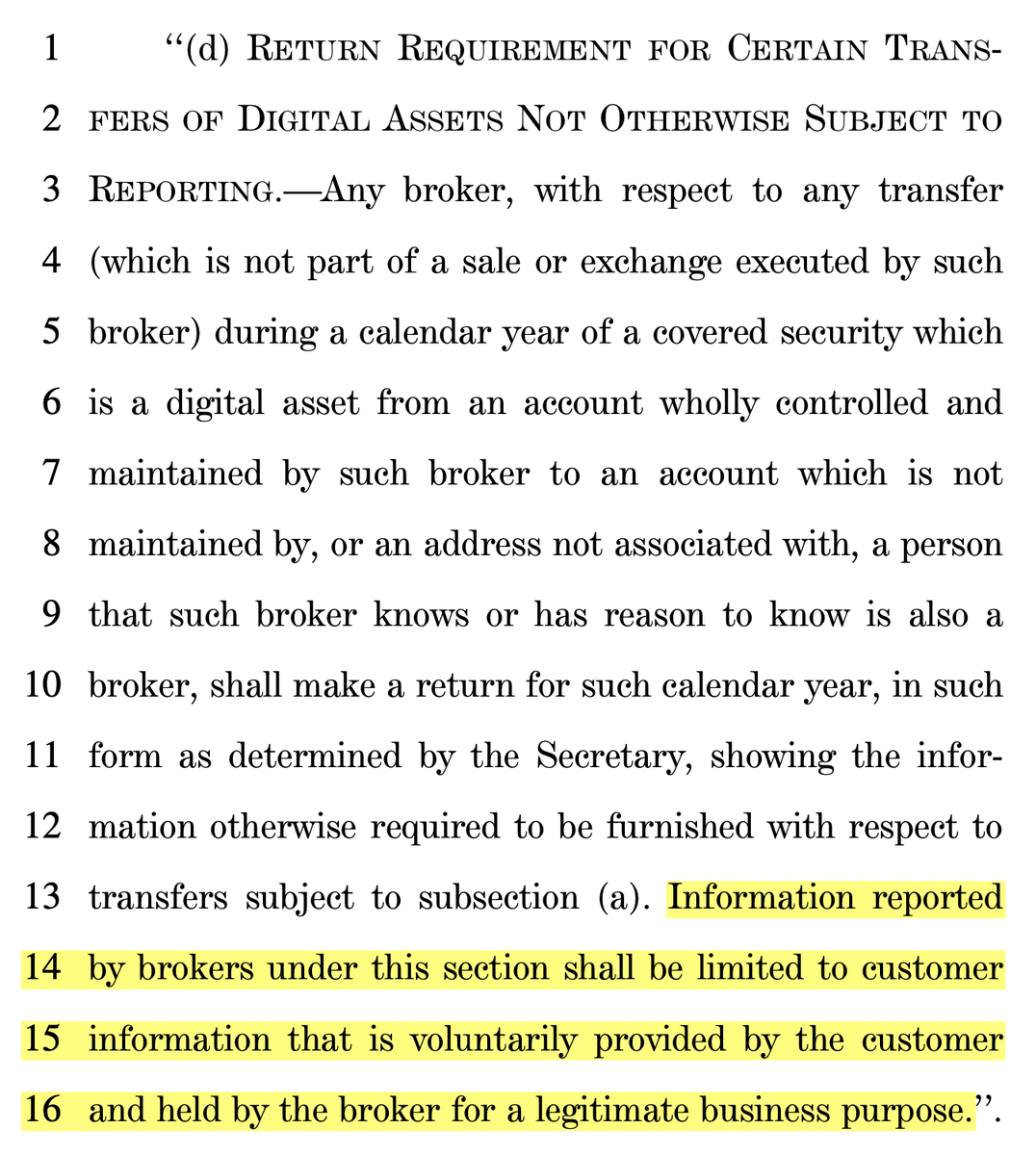
Second, it would limit the new requirement that brokers report mere *transfers* of cryptocurrency by making sure that only information that's voluntarily provided by customers and held for a legitimate business purposes can be shared, as the 'third-party doctrine' requires.
1/ Despite our best efforts, the infrastructure bill has passed with the terrible crypto tax reporting provisions. The fight is not over yet, however. We have several paths to continue to pursue a fix.
2/ It's important to note that the crypto provisions will not take effect until Jan. 1, 2024, so there is time to roll back this law before it affects anyone. So what can we do?
3/ First, the Senate will now work on a second major spending bill and it's possible an amendment could be included in that bill. We are lucky that Sen. Wyden, as Finance Committee Chair, will be a key to that bill.
1/ Been getting a lot of questions about this. Yes, this is a big deal and it was part of the same tax reporting provision that we fought in the Senate in August/September.
2/ We wrote about it at the time. We outlined what would be so pernicious about this proposed new requirement and pledged to challenge it in court if it became law. coincenter.org/an-unworkable-…
3/ For an update on the status of the infrastructure bill and its crypto tax reporting provision (including this 6050I piece) see this status update we put out a couple days ago:
1/ Stablecoin report from the President's Working Group on Financial Markets is out now. Here are some quick thoughts. home.treasury.gov/system/files/1…
2/ It matches very closely with what Peter and I outlined in our recent podcast. It recommends Congress enact legislation to limit stablecoin issuance to insured depository institutions, and says in the meantime SEC should enforce where appropriate.
3/ Also raises possibility of FSB designation of certain activities as systemically important payment, clearing, and settlement activities, but doesn't recommend it. Makes clear regulation is fine on the AML front. Bottom line: not a big deal from a crypto advocate's perspective.
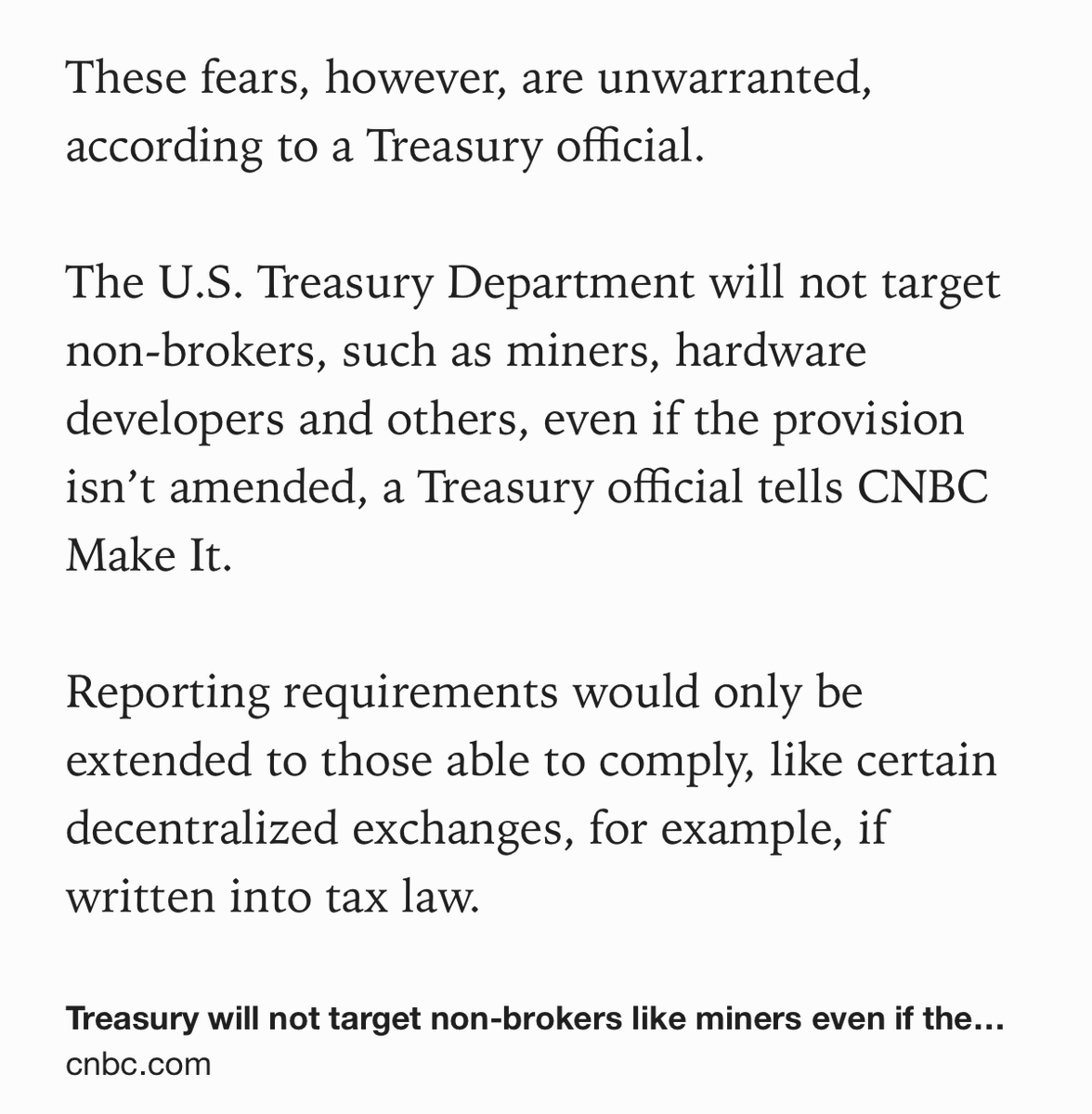
1/ I'm glad to hear that Treasury officials are telling reporters on background that they don't intend to target miners if the infrastructure bill's crypto tax provision becomes law, but I'm afraid that is little comfort. Let me explain. cnbc.com/2021/08/24/tre…
2/ First, it's a little strange to assure folks that you "will not target non-brokers" because by definition only "brokers" can be subjected to reporting obligations. Of course Treasury will never target non-brokers; whoever's targeted will have been interpreted to be broker.
3/ It's doubly strange when the point of the bill is to expand the definition of "broker" such that Treasury could interpret it to cover non-middlemen who would not qualify as brokers today.