I'm seeing the suggestion that the awful treatment of P&O employees is "caused by Brexit". First thoughts on this (hard-core employment lawyers, please correct me if I am wrong).
1/
2/ There is an EU law on collective redundancies. It used to exclude seafarers from its scope, but the exclusion was dropped before Brexit.
However it doesn't *ban* mass redundancies - Member States didn't want that much EU harmonisation of their employment law.
3/ Rather the EU law requires consultation and information in advance. Useful but not the same thing as banning redundancies.
And the remedy for breach of the consultation requirements is compensation. The employer's statement appears to concede a breach and offer compensation.
4/ Also AFAIK the EU law in question is still retained as part of UK law.
In short, this is horrible treatment of employees, but I can't see how it's "caused by Brexit".
5/ This is an analysis from an employment law perspective. There is an argument that the firings are part of the *economic* impact of Brexit - but I'll leave that to the economists
I've read the speech. @hayward_katy's critique is justified; the Telegraph headline is fair; and the speech is profoundly intellectually dishonest. Let's have a closer look. 1/
2/ First, Lord Frost states that 'we knew that couldn't be achieved without a short run economic cost'. But that is not the basis on which Leave campaign argued its position. Any suggestion of a negative impact of Brexit was dismissed as Project Fear.
3/ Lord Frost argues that 'trade policy [is] not subject to meaningful scrutiny' at EU level. In fact, trade agreements are subject to more parliamentary control by the European Parliament than in the UK Parliament. (The same could be said of some other non-EU countries, too).
I've extensively rewritten my blog post on temporary protection for people fleeing the invasion of Ukraine, how that the EU has adopted the temporary protection law: eulawanalysis.blogspot.com/2022/02/tempor…
Thread with main points 1/
2/ Who is covered by temporary protection?
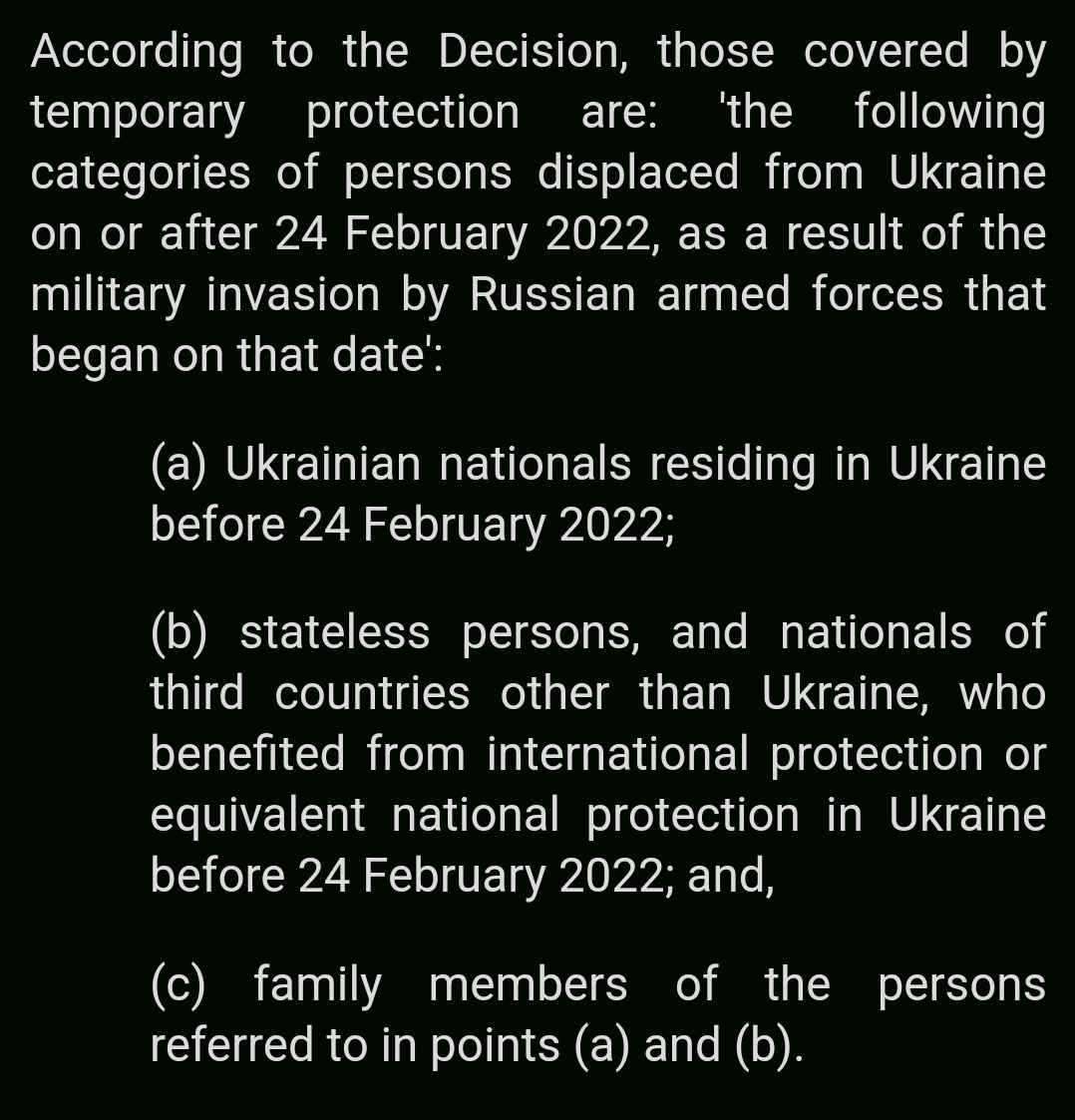
These are the core groups fully covered:
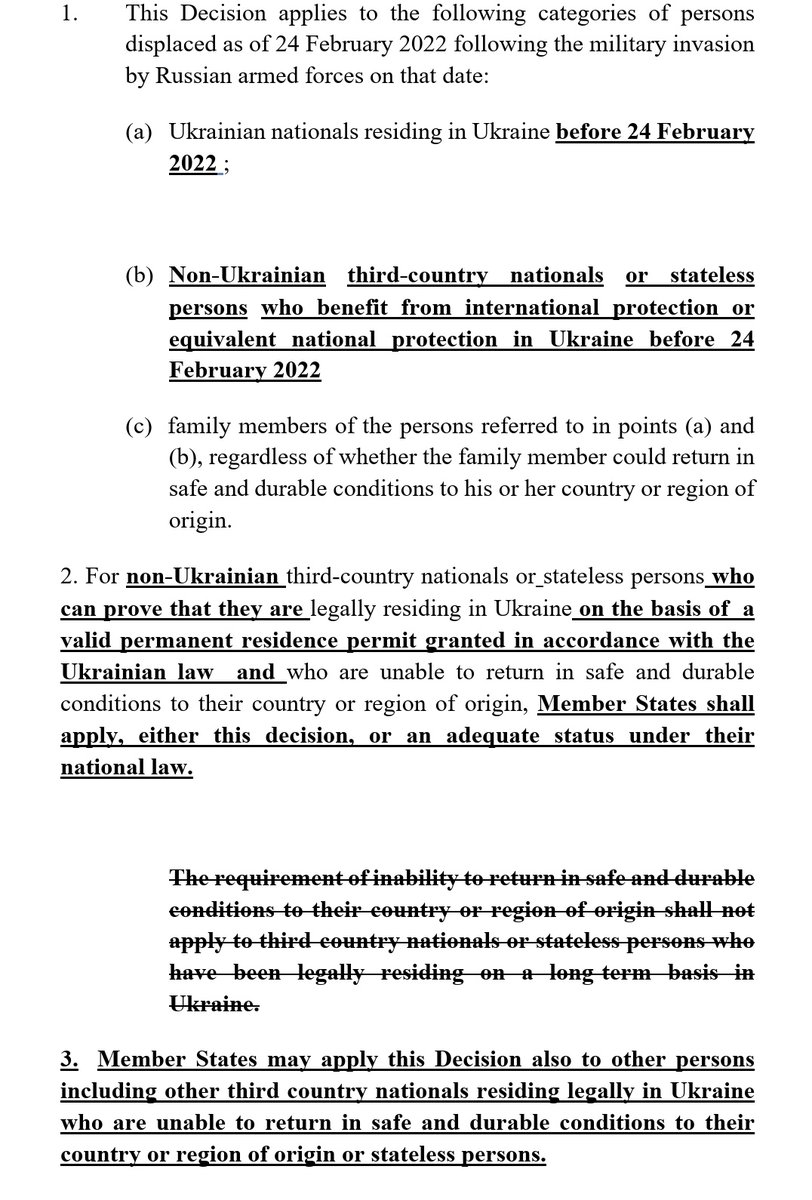
3/ A second group of people must be covered either by EU temporary protection or by adequate protection in national law (not further defined)
EU Member States' ministers agree to temporary protection for those fleeing the invasion of Ukraine. For more details see my blog post (pinned tweet). I will update it when the text of the Council decision is available.
It's not officially published yet, but here's the scope of who's covered by the temporary protection decision as agreed by the Council - reduced as compared to the Commission proposal.
Here's the Commission proposal for the sake of comparison
The Attorney General's piece is subtly but profoundly dishonest in its presentation of how EU law is adopted. At no point does she mention that the UK *government* had a vote on the adoption of EU legislation - usually in favour, in some cases with a veto. 1/
2/ Two straight falsehoods here. At least a qualified majority of Member States is necessary in order to pass EU legislation (this falsehood appears twice); and the European Parliament can remove the Commission.
3/ As an answer on an EU law exam, this would fail. For a practicing lawyer, misstatements on this scale might raise questions of competence and/or integrity for professional regulatory bodies.
But this person is the Attorney General of the United Kingdom.