
✨📜 Another paper out today!
'Actegories for the working amthematician', jww @bgavran3
arxiv.org/abs/2203.16351
A 90-pages behemoth on actegories with a focus on their role in optics/categorical cybernetics. Very proud of this one!
'Actegories for the working amthematician', jww @bgavran3
arxiv.org/abs/2203.16351
A 90-pages behemoth on actegories with a focus on their role in optics/categorical cybernetics. Very proud of this one!

This is a theory-heavy paper, which is partly meant to be a reference and partly meant to break theoretical ground for the work we (@mspstrath) have been doing on categories of parametric morphisms and optics. Actegories are the data both these constructions start from.
~30 pages in the paper are folklore/published stuff about actegories, categories thereof, examples, tensor product, etc.
The rest is mostly *new stuff* about various flavours of monoidal actegories, these being categories w/ monoidal and actegorical structures interacting nicely
The rest is mostly *new stuff* about various flavours of monoidal actegories, these being categories w/ monoidal and actegorical structures interacting nicely
There's three animals in that zoo: monoidal actegories, balanced algebroidal actegories, distributive algebroidal actegories, each with their own braided/symmetric version.
If you will remember *one* thing from this paper, let it be this table:
If you will remember *one* thing from this paper, let it be this table:
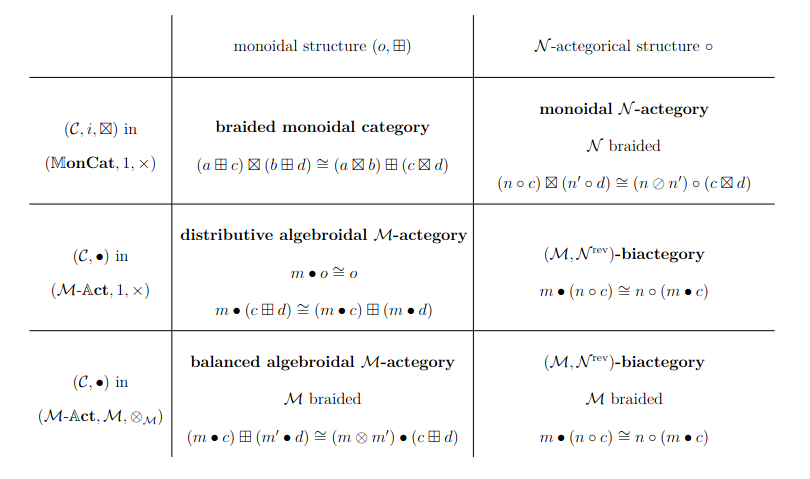
It turns out monoidal actegories and balanced algebroidal actegories coincide in most cases, whereas distributive algebroidal categories are wildly different beasts.
Both structures are somehow instrumental for optics and parametric morphisms (which are secretely the same thing)
Both structures are somehow instrumental for optics and parametric morphisms (which are secretely the same thing)
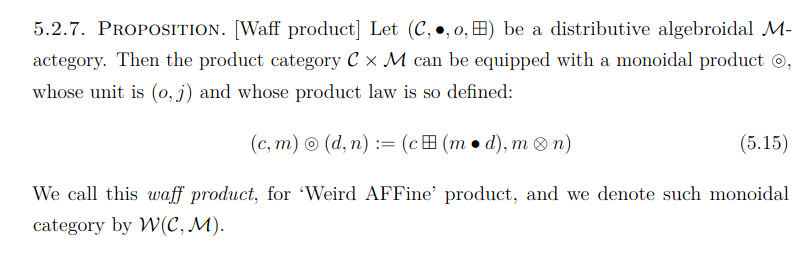
Distributive algebroidal categories capture the compositional story behind affine traversals and glasses, since the monoidal and actegorical structures can be put together to capture the algebra of 'affine functions compositions', by something we call 'waff product':
OTOH, monoidal actegories capture the data needed to make cats of parametric morphisms monoidal. We prove Para(C) is monoidal iff C is a(n oplax) monoidal actegory, and by duality this applies to Copara(C) too. As shown in arxiv.org/abs/2112.11145, this is enough to get optics:
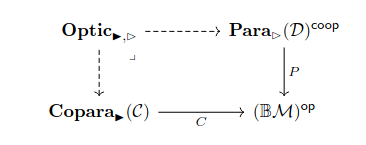
This single-handedly captures the two most important product structures we use on Para(C): parallel product and external choice. The first is induced by suitable tensor structure in C, the second by having products in M acting monoidally on coproducts in C.
Finally, we prove a bunch of classification theorems, which are very cool results:
1. Monoidal actions on C are given by monoidal functors into Z(C)
2. Braided actions by braided functors into Σ(C)
3. Symmetric actions by braided functors into C!
1. Monoidal actions on C are given by monoidal functors into Z(C)
2. Braided actions by braided functors into Σ(C)
3. Symmetric actions by braided functors into C!
The paper contains much more stuff, including a very cool perspective of 'actegories as parametrised morphisms' (comonads in Para(Cat)) which inspires quite a bit of algebra, and features some cool diagrams
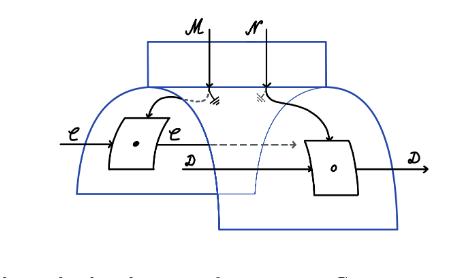
Also if you're a fan of coherence diagrams, you're gonna *love* the appendix!
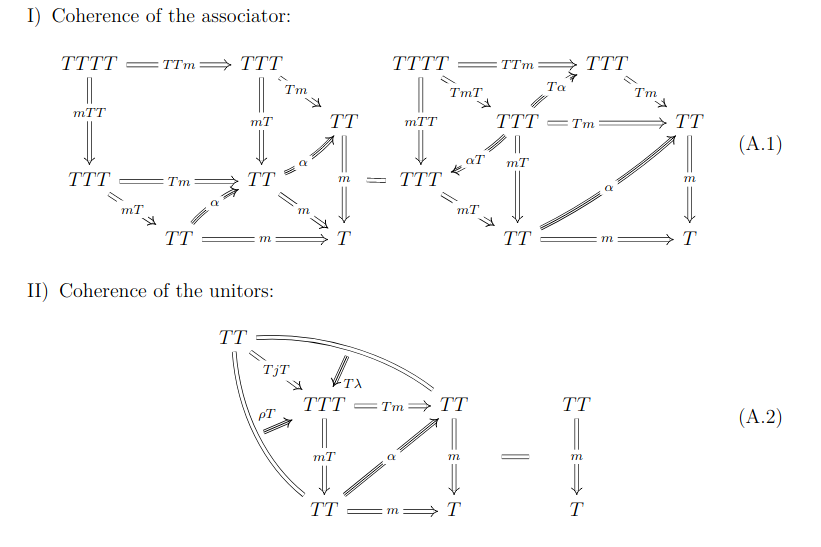
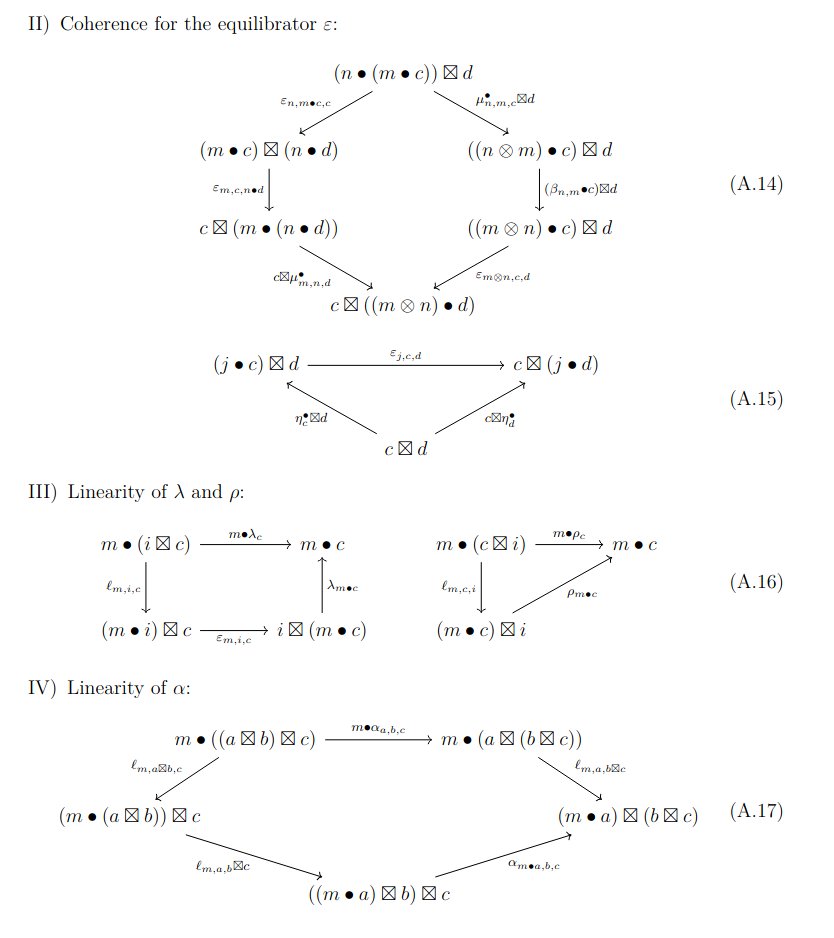
(Disclaimer: this is a preprint, I'm 100% sure someone is gonna find some mistake/inaccuracy. It's the first work of this nature and magnitude me and Bruno embarked on. So be kind but be also reckless in calling out stuff. We want to get this right!)
@threadreaderapp unroll
• • •
Missing some Tweet in this thread? You can try to
force a refresh






