1/10
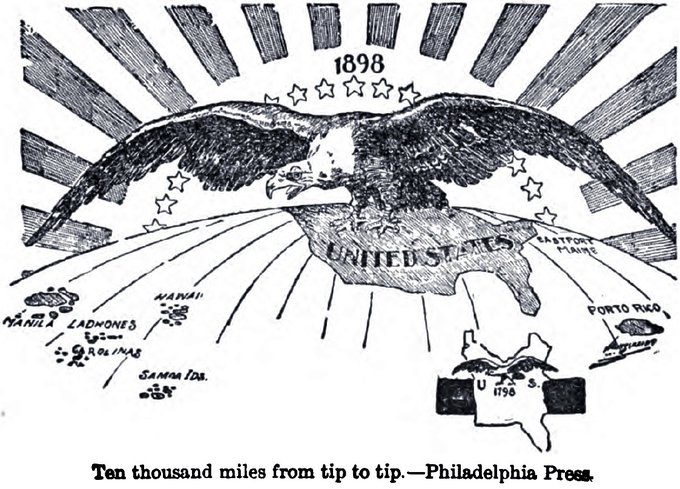
The popular view of the Boomers, captured in a picture. This is not a “Defense of Boomers” thread, but an anecdotal account of things I’ve seen.
2/10
I am a member of GenX: the kids of Boomers who were lucky enough to have survived newly-legalized abortion and the shrinking of the nuclear family after mothers entered the workplace en masse. We’re known primarily for our cynicism and comprise the last analog generation.
3/ I was raised by Boomer parents in the Rust Belt. I saw Boomers struggle, badly, during the stagflation of the 70s, and all of the industrial offshoring of the 80s & 90s.
Boomers get no "credit" (for lack of a better term) for this.
4/10
Entire towns, and swaths of large cities, died from the 70s-90s. Some of this was via relocation elsewhere in the US, but most was because TPTB decided offshoring to foreign countries was a better option than employing their fellow citizens. carnegieendowment.org/2018/12/10/how…
5/10
Offshoring/relocation caused a chain reaction. Factory jobs left, and then the ancillary jobs followed: diners where workers ate closed, so waitresses and cooks were out of work. Stores, barber shops, gas stations, house builders, etc, all followed suit.
• • •
Missing some Tweet in this thread? You can try to
force a refresh

I’m amazed at the number of people who say
a) it’s too difficult for America to reshore manufacturing, and
b) tariffs are going to doom the economy
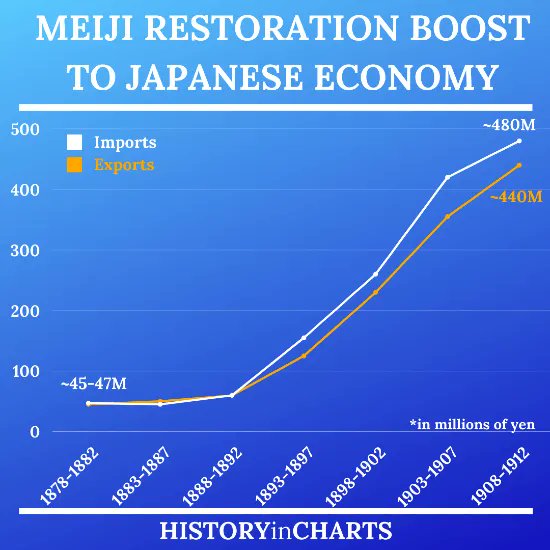
when Meiji Japan’s example of going from absolutely zero industry to world power is just sitting there for anyone to look at.
2
If resource-poor Japan with 30 million people, no coal and no machine-tool tradition could pull that off in 25 years, then a continental superpower that already has the world’s best research universities, capital markets and energy reserves doesn’t get to plead “too hard.”
3
“But it’s different now.”
It’s only different in the will to get it done, especially re: National Security.
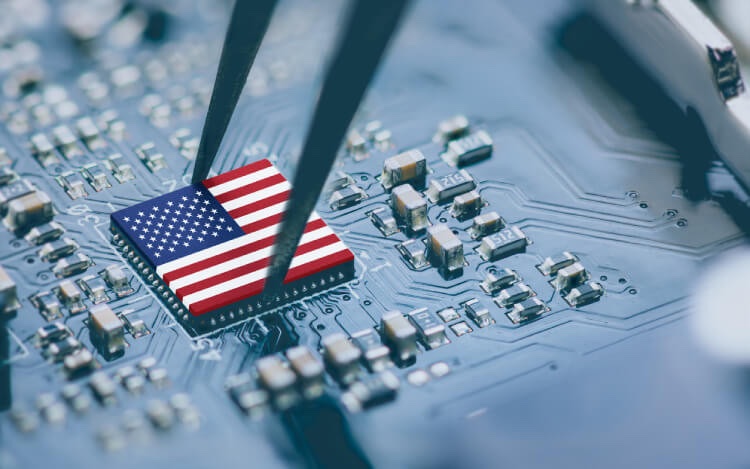
Take the subject of chip manufacturing: Japan re-industrialized twice (and while using high tariffs) - Meiji and post-1945.
1. Outside of my particular circle, this book is barely known and read even less. But it’s one of the most important books ever written, and illustrates both:
- the Social Cycle Theory (societies and their historical events happen in repeating cycles of rise and fall, growth and decay, instead of “progressing” in a linear direction)
- and Perennialist philosophy (there are universal truths that underlie all world religions and philosophies).
2
If I could choose one philosopher on which to model society, it would be Oswald Spengler, but as a —mirror image of what to prevent—.
His morphology is the genome we should hack in order to prevent the defects that kill civilizations. By making it the thing we constantly debug against, we would turn his fatalism into an Operating-System threat-model list.
3
That list would look something like:
a) Cyclical-time inoculation.
Spengler says every culture ossifies into a “civilization” phase: rule by money, megalopolis, Caesarism.
I want to admit something: I’m not that smart ("Yes, we know," say my detractors). This admission isn’t compliment fishing, etc. I’m considering locking replies to make that point, but I’m hoping for some insight or enlightenment.
2
There’s no way I’d pass a Mensa test with an IQ score of 140+.
- I understand only the dictionary definition of Heisenberg’s Matrix Mechanics.
- I can’t learn Dutch in 6 weeks and give a lecture in it on quantum physics like Oppenheimer.
- Nor can I write at PhD level on multiple subjects in a single book like Spengler.
3
What do have is something that most people in the top-right part of the IQ Bell Curve can attain, which is simply: the ability to be interested in things.
1/24 🧵
The Great Debate between Wendell Berry and Earl Butz on American agriculture and culture.
AKA: “How America’s Food, Farms, and Small Towns Got the Way They Are Today”
2
Wendell Berry was born in Henry County, Kentucky, in 1934. Raised as a farmer, he earned a BA and MA, and then two Fellowships, and became a writer, poet, and environmental activist. His work centers on sustainable agriculture, community living, connection to the soil.
3
Berry is mentioned in the video in my pinned tweet in which he, among others, represents a missed opportunity for American conservatism when conservatism pivoted hard(er) toward economics after WW2.
1/8 🧵
What Trump Should Do, According to Machiavelli
It’s obvious that this term will not be like the first: Trump has his cabinet picks all ready, each with a mandate. While American politics is slow and complicated, he appears to be ready to hit the ground, running.
2
Niccolo Machiavelli was a Florentine philosopher, historian, and diplomat during the Italian Renaissance. His most famous book, “The Prince” (1513), is an instruction guide for rulers. Its objective is to teach how to rule effectively, (even if not morally).
3
Of note is Ch. 8: “Concerning Those Who Have Obtained a Principality by Wickedness.”
I’m not implying that Trump won the election through treachery. However, a good portion of the electorate, fueled by the spiritual catamites comprising much of our MSM, will view him, at best, as a usurper.
1/10
I’ve been enjoying the book, 1177 B.C.: The Year Civilization Collapsed, by Eric H. Cline (@digkabri).
Great information, especially the small treasures like the one about the Battle of Megiddo, which I'll summarize.
@digkabri 2
Pharaoh Thutmose III ruled Egypt from 1479 to 1425 BC, and we know much about his rule because he had the details of his military campaigns recorded on the walls of the Temple of Amun at Karnak in Egypt.
@digkabri 3
In 1457 BC, 21-year-old Thutmose fought the Battle of Megiddo (Armageddon) against Canaanite chiefs who had rebelled against his ascension and rule.