

Alright, amigo. Let's build some affordable housing.
You have found the perfect site and you're ready to do some good. F*ck the NIMBYs, people are struggling and you're going to deliver great housing that will benefit the community. Time to put on your helmet and get in the game
You have found the perfect site and you're ready to do some good. F*ck the NIMBYs, people are struggling and you're going to deliver great housing that will benefit the community. Time to put on your helmet and get in the game
We're gonna look at Georgia for two reasons. I've done LIHTC deals there in the past, and @housingMark will jump in if I miss something. Mark used to work at Georgia DCA, knows the rules better than I do, and is someone I deeply respect. He's also worth a follow.
I want to show people how hard it is to build affordable housing not just in Georgia, but really anywhere.
Step one. Read the Qualified Allocation Plan (QAP). It's 121 pages this year and is a Low-Income Housing Tax Credit (LIHTC) developer's bible. Know it inside and out.
Step one. Read the Qualified Allocation Plan (QAP). It's 121 pages this year and is a Low-Income Housing Tax Credit (LIHTC) developer's bible. Know it inside and out.
Every state has a QAP. It is the state telling LIHTC developers what types of projects they would like to see built in a given year. Sometimes it changes, sometimes it doesn't. You need to understand every page and how it relates to your potential development.
In all QAPs is a guideline for scoring your project. The higher the score, the greater your chance of getting a LIHTC award. This is the first time your ideal underwriting will meet the machine. # of bedrooms, population served, services offered, etc., are all factors.
So, how does your project score? Be very critical, because DCA will. If you have a near perfect score, you might have a chance at the highly coveted 9% credits. If it scores well, but not top 10% well, then the non-competitive 4% credit is the path.
So, let's get back to your piece of land. It scores pretty well, 4% path it is. If it doesn’t score well, tough luck. "Oh, but I can build something beautiful here." Terrific, you gonna do that for free? No? Then find new land.
Your site works, you're on your way. Now, get it under contract (easier said than done). You don't want to close on land you can't develop, so you need a seller who's cool with a long DD period. Like, really long. Your offer is gonna look something like this, it's gross.
Assuming you're new to this game, and don't want to take development risk, this is what you're gonna give to a seller.
Purchase Price: X
Deposit: 25k
DD period: 90-180 days
Closing: "subject to DCA approvals"
Outside closing date: 18 months
Extensions: a few that you can buy
Purchase Price: X
Deposit: 25k
DD period: 90-180 days
Closing: "subject to DCA approvals"
Outside closing date: 18 months
Extensions: a few that you can buy
You have found a seller who's not in a rush and has a mild interest in the betterment of society; they accept your terms. Now it's time to chop some wood. Expensive, frustrating wood.
You're gonna meet some politicians with varying degrees of interest in affordable housing
You're gonna meet some politicians with varying degrees of interest in affordable housing
You'll meet some racist neighbors who show up to community meetings and are suddenly traffic experts, or they're concerned about indigenous moths. You'll meet people who hate your project (even though they would qualify to live there). You'll definitely meet some consultants.
But you're a crusader for good, undeterred you press on.
You are now entering what I call the Matryoshka spreadsheet phase. You'll start by filling out what's known as a "pre-app." It's the broad strokes of your project. You submit to DCA to essentially say, "we good here?"
You are now entering what I call the Matryoshka spreadsheet phase. You'll start by filling out what's known as a "pre-app." It's the broad strokes of your project. You submit to DCA to essentially say, "we good here?"
Pre-app approval does not mean you’re getting awarded tax credits, just that your project, as outlined, is interesting enough for DCA to want to hear more. Still, it’s a big milestone to get your pre-app approved.
If your project scores well (has features that are called out as desirable in the QAP) then DCA will invite you to move forward with the full, or "Core" application. You can see some of these items below. You'll be amazed when I tell you that each link has more links and sheets 
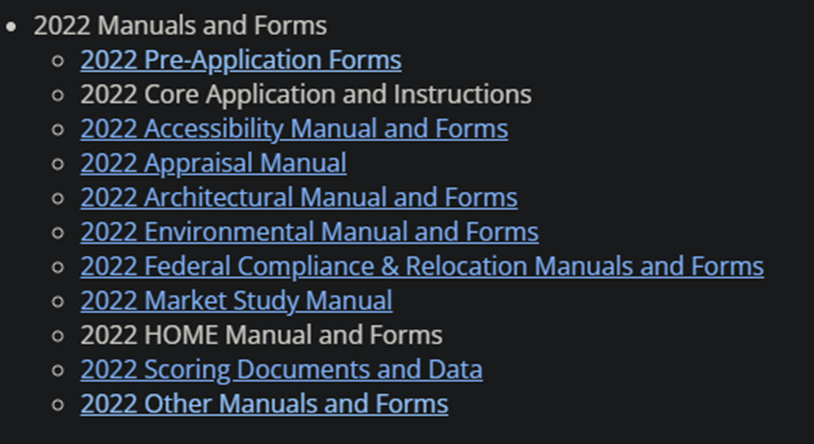
If you're reading this and thinking "big deal, I can spend a day filling out Excel sheets," I promise you, it's a rough ride that will take 9-12 months if you're hustling.
Go to this link dca.ga.gov/safe-affordabl… and take a look at the manuals and forms you may need to fill out.
Go to this link dca.ga.gov/safe-affordabl… and take a look at the manuals and forms you may need to fill out.
Too late to turn back, you've burned your boats! You have land under contract, your pre-app has been approved, you must press on. The Core app for 2021 can be found here 2021 Core Application and Instructions | Georgia Department of Community Affairs (ga.gov)
Odds are, if you haven’t developed LIHTC before, most of the Core app will seem like hieroglyphics. You’ll want to hire a development consultant who can help you understand what is being requested. LIHTC consultants are in the 100k range per project.
You will need to meet with your neighbors a few times to talk about the project. DCA wants to know what the community thinks. If you community is full of idiots, you will need to report to DCA why their idiotic ideas are not feasible for your project.
Because you are pursuing 4% credits, you will also want to pair that with tax-exempt bond financing. Typically, this means your local housing authority gets involved. They will issue/administer the bonds (for a fee of course) on behalf of the city you are in, if they like you.
A problem you will likely face, is that 4% credits, bonds, and traditional bank debt aren’t enough to close the funding gap. Meaning the cost of completing your projects is greater than the resources you can attract. Cool, still in the red. Now what?
You will go back to DCA and ask for some type of additional soft funds. This could be HOME funds, CDBG money, TCAP funds that are still kicking around, etc. You need more subsidy to make this project viable. Odds are, you’ll ask for HOME funds.
If you’re thinking, “I hope he tells me there are additional spreadsheets,” you, my friend, are in luck. Back into the Matryoshka doll you go. There is a new round of applications for this money. In addition, it’s pretty common to require local matching HOME funds.
This is a chance for you to meet the folks on your city council. Most will believe that supporting affordable housing is correct, but many are worried about the “public perception” of voting for low-income housing. They are elected officials who would like to stay elected.
I’d like to call out Al Tillman. The most useless politician in Macon, Georgia. Guy would complain in the press about needing affordable housing, refuse to return my calls. Showed up to the meeting late, dressed like shit, and leveled false accusations against me.
He almost singlehandedly derailed my project to build low-income housing for 200 at-risk seniors so he could score points in front of the camera. Thankfully, the rest of council knew he was an idiot and chose to ignore him. But, the world is full of Tillmans.
You have survived council, got your local matching HOME funds, but the total allocation is less than you needed. You can go back to the PHA for Series B bonds, but that’s a rough trade. I’ll be decent. Your allocation was enough, you have the capital stack secured.
If you’re reading this and think “why don’t the greedy developers just make less money?” Thanks for your valuable contribution. 1.) If the creation of affordable housing wasn’t profitable, people wouldn’t do it. 2.) DCA won’t fund upside down projects.
You will need to show your project, if awarded, is shovel ready. Which means utilities, architectural plans, commitments to buy the tax credits from a 3rd party, soft loan commitments, etc. Everything has to be ready. This can get expensive. For us, 300-500k in upfront costs.
Over the past 12 months you’ve spent 500k in pursuit costs, two of your staff have been working on this for a year, and there is no guarantee your project will be successful. There is real risk your project doesn’t survive for a host of reasons beyond your control.
If you’re project is successful, now all you have to do is build it without pissing off DCA or the IRS. Piece of cake. We can talk through post-award construction in a different thread.
The point of all this isn’t to pick on Georgia. Georgia is one of the easier states to develop in and I’ve found the people there to be super reasonable, unlike the northeast. The point is to highlight how difficult it is to create affordable housing.
You may think “well, it should be hard, you’re getting free money,” but that’s not entirely accurate. Also, the process is prohibitively hard. People who become interested in building affordable housing will be scared off by the cost/perceived level of difficulty.
So, you end up with the same entrenched players building the same looking housing. I’ll dig into the economics of this system next week. As always, this was written for the masses. If you’re a LIHTC developer looking to flex, write your own shit.
• • •
Missing some Tweet in this thread? You can try to
force a refresh



