Hard to tell, but the video below is a digitally-generated beauty-augmented face superimposed onto a normal person's body. Thousands of likes and simps in the comments, and the creators make money by having the character put out periodic shitcoin ads.
Here's another one. Totally different body from the earlier video, but the same digitally-generated face superimposed. A little easier to tell in this case, I think.
This is the original tiktok clip that the facially superimposed clip was constructed from:
for those interested, the ig of this fake hot girl account is: instagram.com/emily.yoo_?igs… can see that same face superimposed onto many different ethnicities and nationalities. very weird.
• • •
Missing some Tweet in this thread? You can try to
force a refresh

Volcker might not have been so hawkish today. He viewed excessive growth in the money supply as the key indicator of inflationary monetary policy. Do we have that right now?
On a YOY basis as of February, M2 is growing at 11%, the fastest pace since 1983, and faster than the average pace for the 1970s. BUT... that's primarily because of the distortion of QE.
Contrary to common misconception, QE doesn't just increase "bank reserves" or the "monetary base", etc. It also increases the actual broad money supply, on the liability/deposit side of the banking system.
THREAD: Want to share an excellent free resource that investors can use to evaluate and compare ETFs & mutual funds with respect to returns, sector & factor exposures, fundamental properties of the underlying holdings, and much more.
From what I've seen, there isn't anything else like this out there, on any of the free websites or at any of the brokerages. Especially the mutual fund part. Very hard to find. Morningstar would be closest, but only premium/subscription.
The tool is from Wisdomtree. You start by going to wisdomtree.com, set up a login, then select "Tools" in the dropdown menu, then "Fund Comparison."
While I agree w/ the pushback against Warren, I wouldn't frame the point in terms of profit margins. Yes, retailers have low profit margins compared to most companies, but they also turn those margins into profit much more quickly, given their massive sales.
A more accurate way to assess the state of competition in a space is to look at return on investment. How much are shareholders getting out in profit relative to what they've had to invest into the business?
If competition is working, then ROI should not be able to get excessively high, since others will be able to go make that same investment, and will do that, competing down the outsized return that the incumbent is earning.
Audio recording, w/ subtitles, of a 1971 debate b/t Lyndon Larouche, heterodox marxist organizer, & Abba Lerner, leading Keynesian economist, who developed the underpinnings of today's MMT.
Topic: INFLATION. Buckle-up!
It's from a Lyndon Larouche youtube channel, and is connected w/ all the deeply conspiratorial Larouche stuff. But it's still extremely interesting to listen to. Not just Lerner's view of the inflation and the proper policy response, but also Larouche's. VERY heterodox!
Larouche had been critical of Keynesian "quackademics" who were misdiagnosing the causes of the inflation & pushing Nixon towards anti-labor solutions, similar to those of the "fascist" junta in Brazil. Lerner was tasked w/ explaining the policies & defending the profession.
The most important thing is to open & use the bookmarked table of contents. If you click on the circled areas below, in either acrobat or chrome, can easily navigate b/t charts of interest, by category. There are over 100 charts in package. Table of contents therefore crucial.
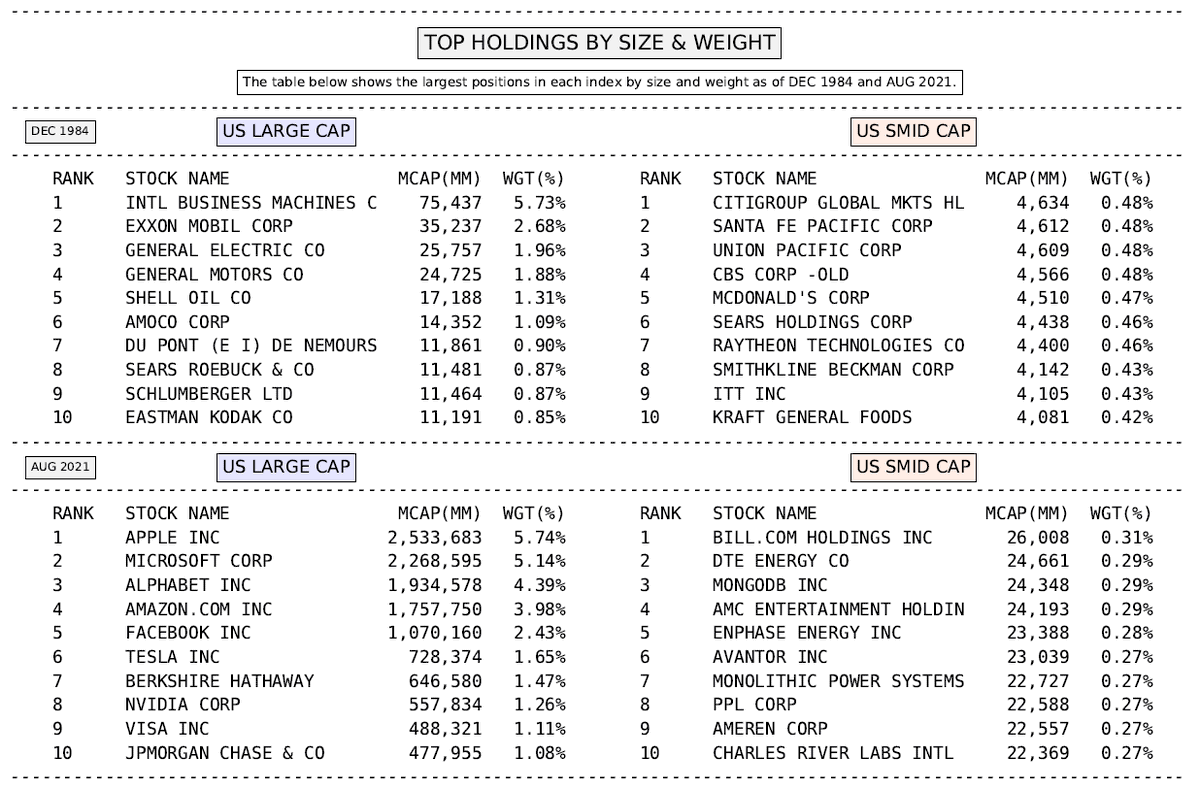
First chart for each region is simple: top holdings by size & weight at the beginning of the analysis period (Dec 1984) and at the end (Aug 2021).
If this inflation is limited to specific items caught in supply-chain bottlenecks (and a lot of it is), it should not only be transitory under the Fed's definition, but also reversible, as the bottlenecks clear.
Are we going to pay 20% more for appliances forever, simply because certain input parts were in shortage for awhile? If so, who is going to collect the associated windfall, and why will that windfall be protected from market forces?
Even if the windfall were to trickle down to wages in the affected areas, are wages for new entrants in those areas going to be permanently higher than the rest of the economy, even as other labor tries to come in? All because of what happened this year?