Slides are visual aids that assist your presentation. Anytime you put something on your slides, its primary purpose is to help the *audience*, not you.
Nothing should distract from your verbal presentation, it should only enhance it.
A mini-presentation on slide design. 1/
One common mistake is to clutter the slide with lots of text, which the speaker reads out to the audience, verbatim. This is a bit boring and inefficient. Condense down the text to the main question or point of the slide, and speak the rest. Scary, maybe, but you can do it! 2/
Refrain from using too many colors, texts, or animations. Again, these are more likely to distract the audience than they are to help them. Strip down slides to the key points, and make those clear. Do use animations to make items appear at the right moments. 3/
Relatedly, avoid color combinations that are hard to read, or distracting fonts. Don't tax the audience any more than you need to. 4/
If you're putting a graph on the slide, you should always orient the audience to the axes before plotting the data, & make sure they can actually *see* all of it. I see way too many complicated graphs with inscrutable text, and lots of "You probably can't see this, but..". 5/
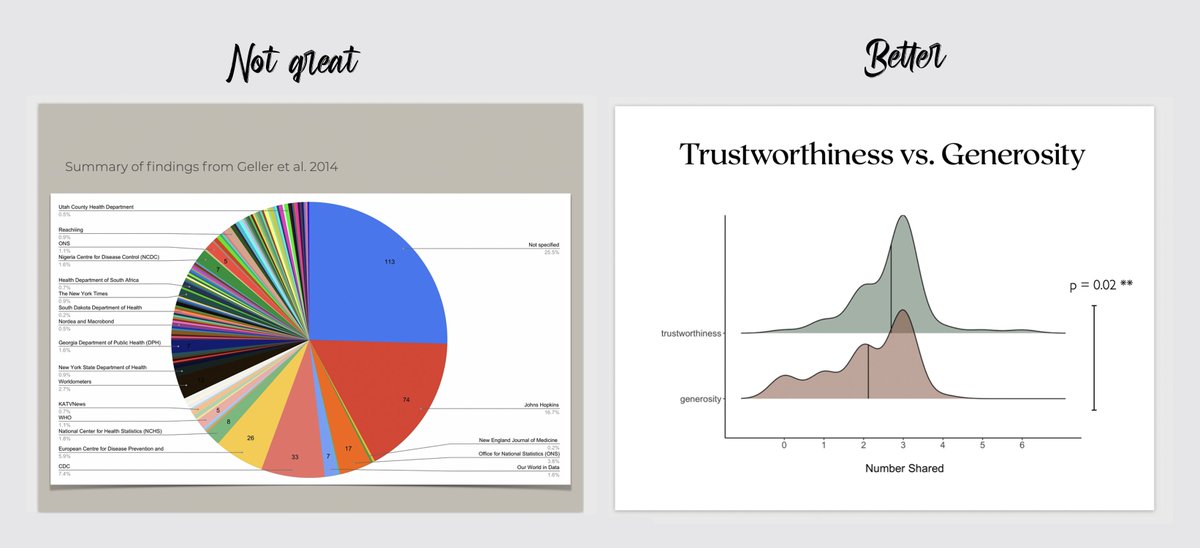
When using images or videos, always go for high-resolution. It may look okay on your laptop, but it will look much worse when it's tripled in size by the projector. 6/
When visualizing results, identify 1-2 key graphs to make your point. People often overdo this, and put up a dozen different visualizations of minor results. Find a small number of graphs that tell the big story. Also, give each graph its own slide; don't clutter. 7/
Remember that the audience is committing what you're saying to working memory, and trying to keep up. Don't overload them with complex jargon that isn't necessary, or acronyms that they have to remember. Relatedly, provide outlines and marker slides to segment information. 8/
Ok, this last point is about presenting. Public speaking is hard & many people read scripts so they don't forget key points. Fair enough, but audiences can tell & it's less engaging. Instead of a script, try jotting down key bullet points for yourself in the slide notes. 9/
As a presenter, your job is to guide the audience through your argument in the clearest, most engaging, & most efficient way possible. You gotta respect their time & attention, and use slides to support the verbal points you're making. Hopefully this has been helpful! 10/10.
Some really useful feedback & perspectives in the replies on accessibility. Here’s a great list of actionable steps from @socialslytherin:
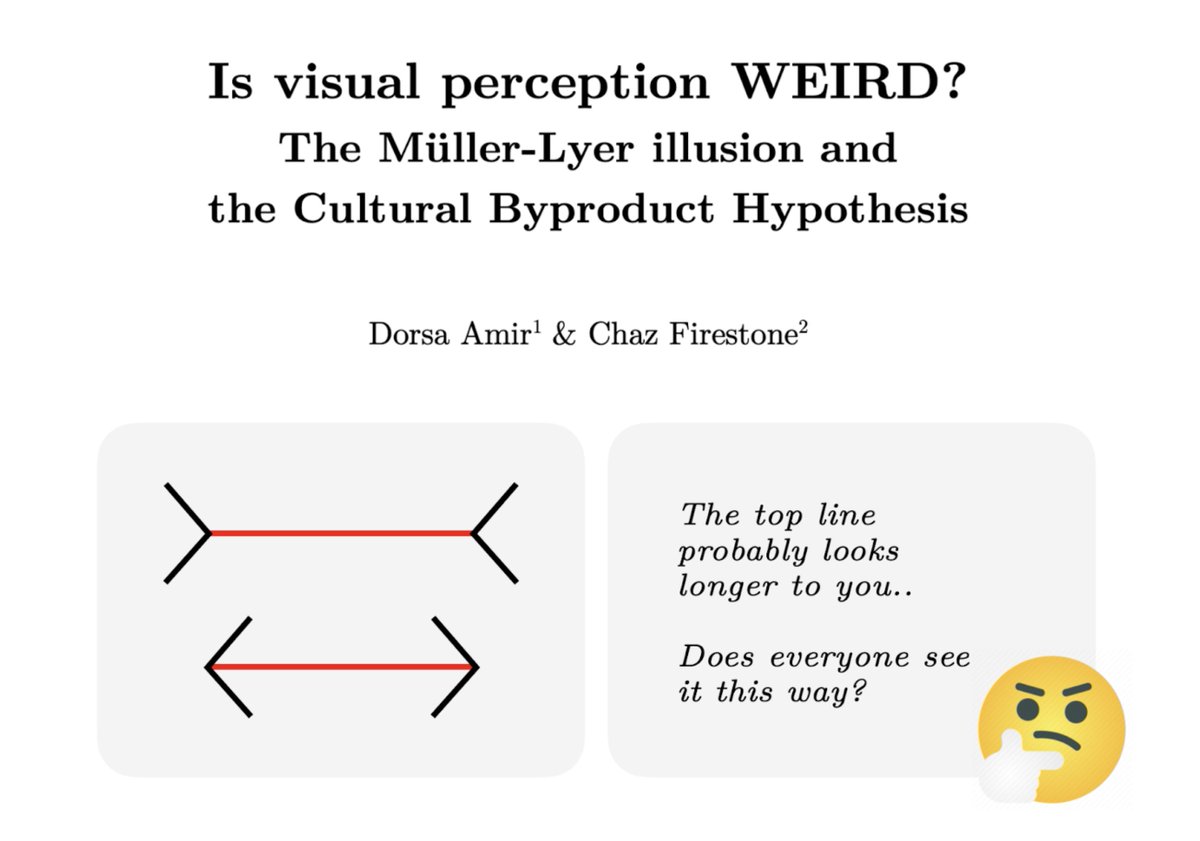
Does the culture you grow up in shape the way you see the world? In a new Psych Review paper, @chazfirestone & I tackle this centuries-old question using the Müller-Lyer illusion as a case study. Come think through one of history's mysteries with us🧵(1/13):
The ML illusion has puzzled scientists since the 1800s. The lines are equal, but the top one just SEEMS longer, no? Not long after its discovery, though, some argued that maybe the illusion wasn't obvious to everyone. Maybe it had to do with the culture you were raised in. (2/13)
More specifically, folks like Segall, Campbell, & Herskovits used data from 15 societies to argue that susceptibility to the ML illusion was caused by exposure to *carpentered corners*, like those found in buildings & rectangular artifacts. Could this be true? (3/13)
A few million years ago, our ancestors started walking upright. Big mistake! (Only slightly kidding). Bipedalism helped us a lot: it freed up our hands to use tools & engage in cool new behaviors. But it also came with a lot of costs, many of which we're still paying today (1/7)
First up: pain! My god, the pain. Usually in the back, knees, & ankles. These are some of the most common health issues & bipedalism is largely to blame. Walking upright places extra stress on our poor bodies, which are constantly aching under the strain & weight. (2/7)
Humans are also a massive fall risk. Bipedalism changed our center of gravity & point of contact with the ground, making it more likely that we'll topple over. This becomes way more dangerous in pregnancy. Look how much our spines have to arch to support the extra weight. (3/7)
I'm a developmental scientist who studies how children grow & learn across cultures. I'm also an American mom who feels the extreme pressure put on parents in the West. I'm here to offer you some parenting ANTI-advice — here are a few things you can worry less about: 1/🧵
First: not everything has to be "educational". It's truly completely okay (& indeed, good) for kids to play for the sake of play. They don't have to be learning the alphabet or animal noises. They can just do whatever silly thing they want to do. They are ALWAYS learning! 2/
Second: you don't have to put pressure on yourself to constantly teach them things. In fact, active & direct instruction from an adult is the rarest form of teaching in human history. Kids know how to learn in other ways — like observation — & they're extremely good at it. 3/
Protests continue in Iran today after #MahsaAmini's death in custody at the hands of the 'morality police' for violating the mandatory hijab laws.
How did we get here? The story is my family's story, and mine, too.
A personal history of women's oppression in Iran. 1/
Some background. It's 1952. Mosaddegh is the democratically-elected leader of Iran. Iran's oil is largely controlled by foreign interests. Mosaddegh fights back & dares to nationalize the Iranian oil industry. The West is angry; they organize a coup. 2/ npr.org/2019/01/31/690…
The coup succeeds in 1953. Great Britain & the US bring back the Iranian monarchy, putting Mohammad Reza Pahlavi in power. He quickly reverses course and gives split ownership of Iranian oil to Western companies. Just what they wanted. 3/
I didn't want to dignify this with a response but this thread is toxic — filled with inaccuracies, stereotypes, & the dumbest takes possible. I think almost every single point is wrong, actually, & extremely harmful.
Anthony, if you had any sense, you would delete this. 1/
First of all, the trope that hunter-gatherers are "wild humans" is flawed, harmful, & condescending, and the idea that they have "full genetic expression" is literally so stupid I don't even know where to start. They're.. expressing more genes than us? 2/
That actually sounds to me like "we only use 10% of our brains". It's just nonsense. Genes are differentially expressed all the time, everywhere, and are constantly responding to input from the environment. This belies a massive misunderstanding of genetics. 3/
When imagining the past, people tend to forget that a huge portion of the population was made up of children — playing, learning, getting into mischief, & sometimes even making art. Here are a few lovely & lively examples of children's art from the historical record 🧵 1/
First up are these (newly discovered!) tiny handprints, found in Tibet & dated to around 200,000 years ago. They seem to be intentionally made by at least two kids — probably between 7-12 years old — who found a layer of soft travertine & decided to leave their marks 🤚 2/
In the 1st century AD, a Roman child used a stylus to carve this little stick figure into a wall in Pompeii. More than half of children's graffiti in Pompeii can be found in public, suggesting kids had active lives outside of home & lots of access to public spaces. 3/