People often assume that capitalism is defined by "markets and trade". But markets and trade existed for thousands of years before capitalism. Capitalism is only 500 years old. So what is distinctive about this economic system? Three things (well, more, but three for now):
1. First, and most importantly, it is defined by enclosure and artificial scarcity. The origins of capitalism lie in a systematic effort by elites to restrict people's access to commons and independent subsistence, in order to render them reliant on wage labour for survival.
Over the past 500 years, this has taken the form of privatization of commons, forced dispossession, destruction of subsistence economies and - particularly in the colonies - taxing people in a currency they do not have in order to induce them to seek wages in that currency.
This continues today, with attempts to ensure an artificial scarcity of access to essential goods such as housing, healthcare, education, transit, and so on - goods that could very easily be provided, at high quality, on a universal public basis.
Where universal public goods do exist, these have usually been won by longstanding struggles by labour movements and other progressive forces (including the anti-colonial movement).
2. Second, capitalism is organized around - and dependent on - perpetual expansion, meaning ever-increasing production of commodified goods. It is the only intrinsically expansionary economic system in history (meaning it basically has a crisis if it doesn't continually expand).
Crucially, under capitalism the purpose of increasing production is *not* primarily to meet human needs, but rather to extract and accumulate profit. That is the overriding objective. (It is also the main objective of innovation).
It's important to distinguish here between small businesses, which quite often operate with a steady-state, use-value logic (and which obviously preceded capitalism), and corporations whose main objective is expansion and accumulation (which define the capitalist era).
To sustain the process of perpetually increasing surplus accumulation, capital requires an ever-rising quantity of inputs (labour and nature), and requires that these inputs be obtained as cheaply as possible.
This introduces a constant pressure to depress real wages and attack environmental protections wherever possible (in the absence of countervailing political forces). The result is a system that, left to itself, automatically generates inequality and ecological breakdown.
3. Finally, capitalism is notable for precluding democratic decision-making. Even in countries that prize political democracy, democratic principles are rarely allowed to operate in the sphere of production, where decisions are made overwhelmingly by those who control capital.
The result is that decisions about what to produce, for what purposes, for whose benefit, and under what conditions are generally made in the narrow interests of the capitalist class (workers, the people actually *doing* the production, rarely get a voice at all).
It is worth pondering how our production priorities (and our treatment of labour and nature) might be different under conditions of economic democracy. Existing evidence suggests that democratic conditions lead to less exploitation, more equality, and more care for ecology.
In sum, the tendency to equate capitalism with "markets and trade" naturalizes a system that is not natural, and prevents us from having a clear-eyed view of how it operates and how we might want to do things differently.
(The "more" I referred to involves exploitative relations of race, gender and imperial power, which are effects of the tendencies described here, and which sustain them, but this deserves a thread unto itself - coming soon).
We can have a democratic economy organized around meeting human needs at a high standard, where production is socially just and ecologically regenerative. Such a system is possible, but it will require a political movement to bring it into being.
• • •
Missing some Tweet in this thread? You can try to
force a refresh

US officials are constantly saying "socialism in Cuba is a failure". But in fact Cuba's achievements with socialism are extremely impressive:
First, remember that the US imposed sanctions and blockade on Cuba *immediately* after the revolution, with the explicit objective of destroying the economy, preventing development, and immiserating the people.
And yet Cuba nonetheless managed to achieve some of the very best social outcomes in the developing world, rivalling even high-income countries in the imperial core.
The pressure on Cuba intensified dramatically after the fall of the USSR, which was a key trading partner. The blockade bit harder and Cuba was forced into a severe economic contraction known as the "special period".
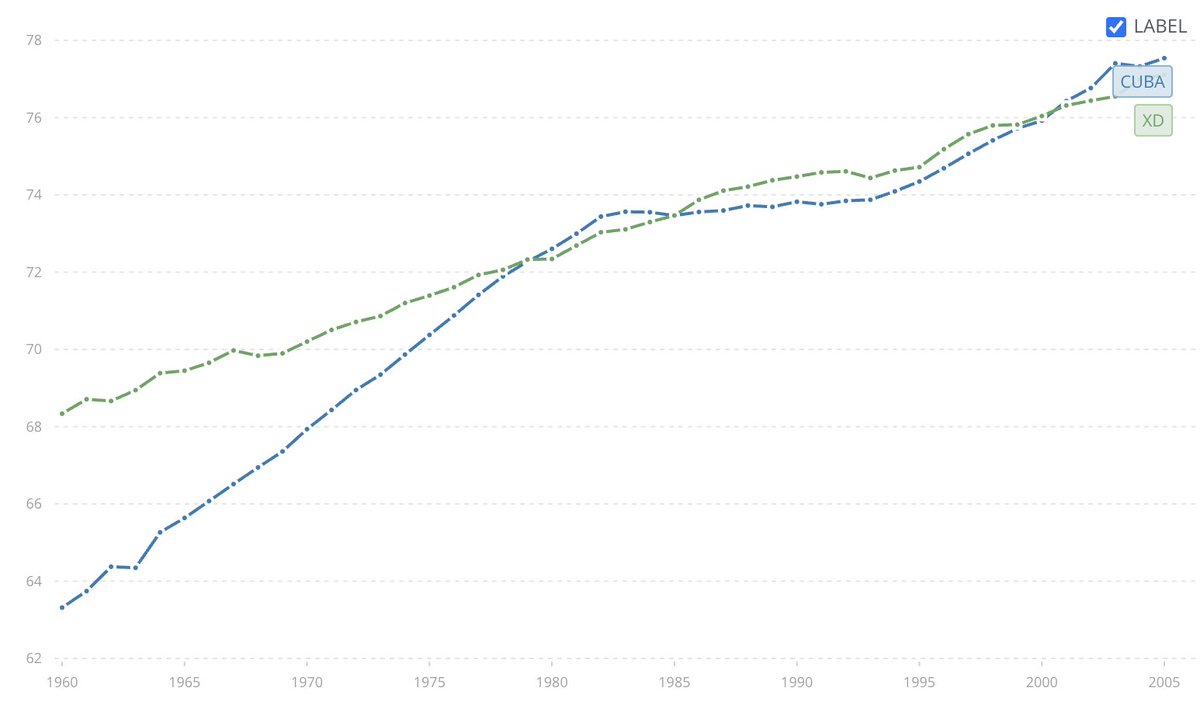
And yet, even while GDP and consumption were declining or stagnating during this period, Cuba not only *accelerated* its progress on life expectancy, it caught up to and surpassed the United States in 2003, despite having 80% less GDP/capita.
Cuba also used industrial policy to develop one of the most advanced biotech industries in the world, escaping dependence on Western monopolies, and providing life-saving assistance to other countries in the global South.
How? Because of socialism! Socialism enabled Cubans to organize production and resources around what is most important for human needs, rather than what is most profitable to capital. This made them *extremely* efficient at converting limited resources into human well-being, despite the blockade.
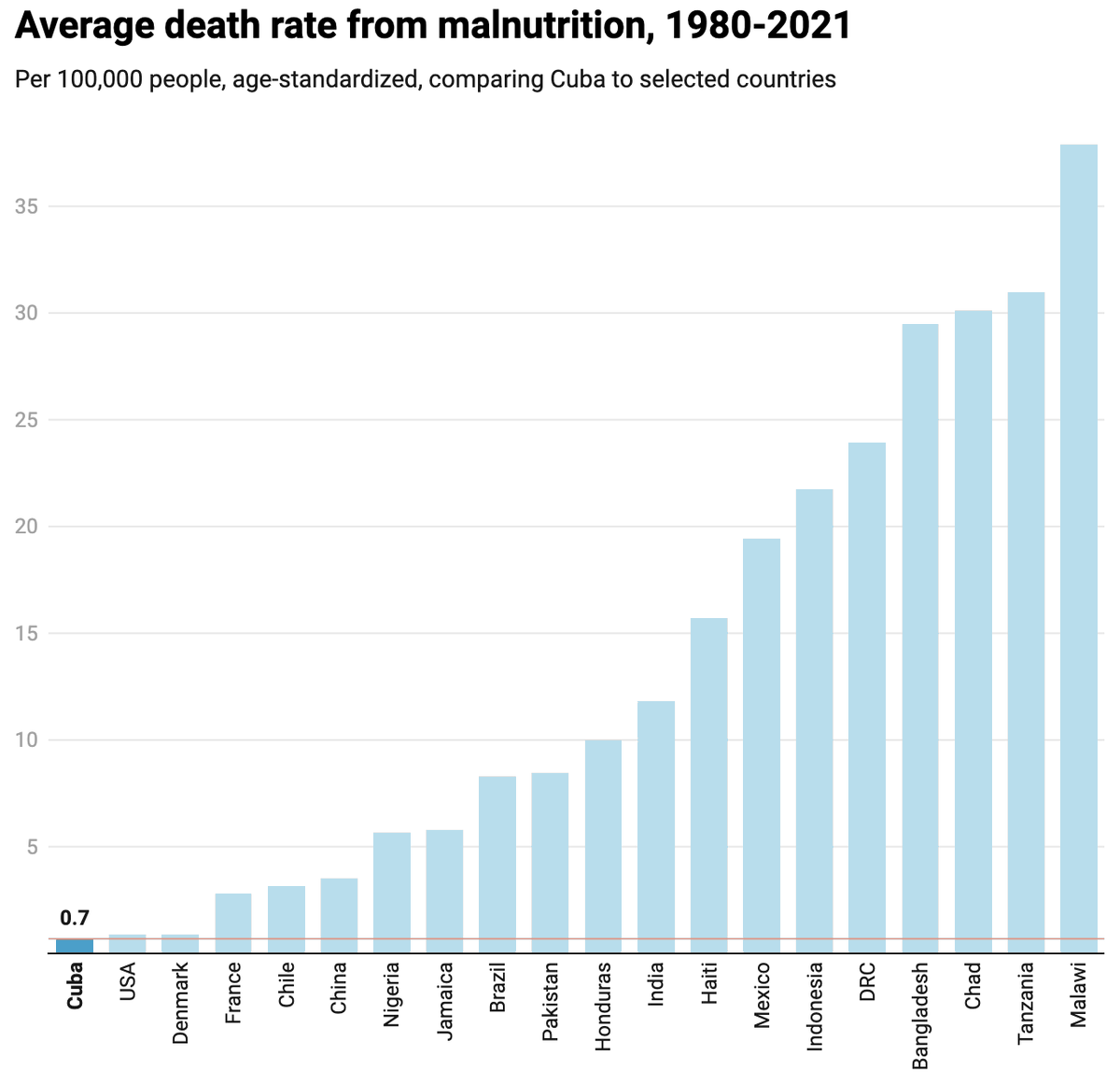
Cuba's food system is a great example of this. Cuba developed a public food system that guarantees everyone has access to basic nutritional requirements. Thanks to this system, Cuba has one of the lowest death rates due to malnutrition in the world, lower even than in many high-income countries, such as the United States, Denmark and France.
Anyone who visits Cuba immediately notices that it is totally unlike any other developing country. You just don't see people homeless and starving and begging on the street. People certainly aren't rich, but nobody lives in misery. People have *dignity*, they have freedom, they have sovereignty.
I always find myself thinking, what could Cuba be like if it was not for the US blockade? What if it had been allowed to develop freely? It is not difficult to imagine the heights of human progress the Cubans could have achieved.
The US blockade is tightening, strangling the country of basics, in order to destroy that potential. To destroy that dignity and sovereignty. They are doing it not because socialism "failed", but because it has succeeded, and that reality cannot be accepted.
Life expectancy in Cuba (blue), and the average in high-income countries (green), from 1960 to 2005.
This thread covers some of our latest work on capitalism, imperialism, post-growth and ecosocialist futures. It's all open access, and free PDFs are available via the link at the end of the thread. 🧵
1) We wrote this review of exciting recent developments in post-growth science, in The Lancet Planetary Health. It's your one-stop introduction to all the key questions, debates, and empirical evidence:
2) We assessed public backing for eco-socialist transformation in the UK and US, and found it enjoys strong majority support in both countries: 72% in the US and 82% in the UK. We also tested how different labels affect people's support:
How popular are post-capitalist/socialist ideas and policies?
Here's a list of studies and surveys with some striking results...
1. A survey shows that a majority of people around the world (56%) agree with the statement “Capitalism does more harm than good”. In France it is 69%, in India it is 74%.
Who is driving climate breakdown? Buckle up for some striking data... 🧵
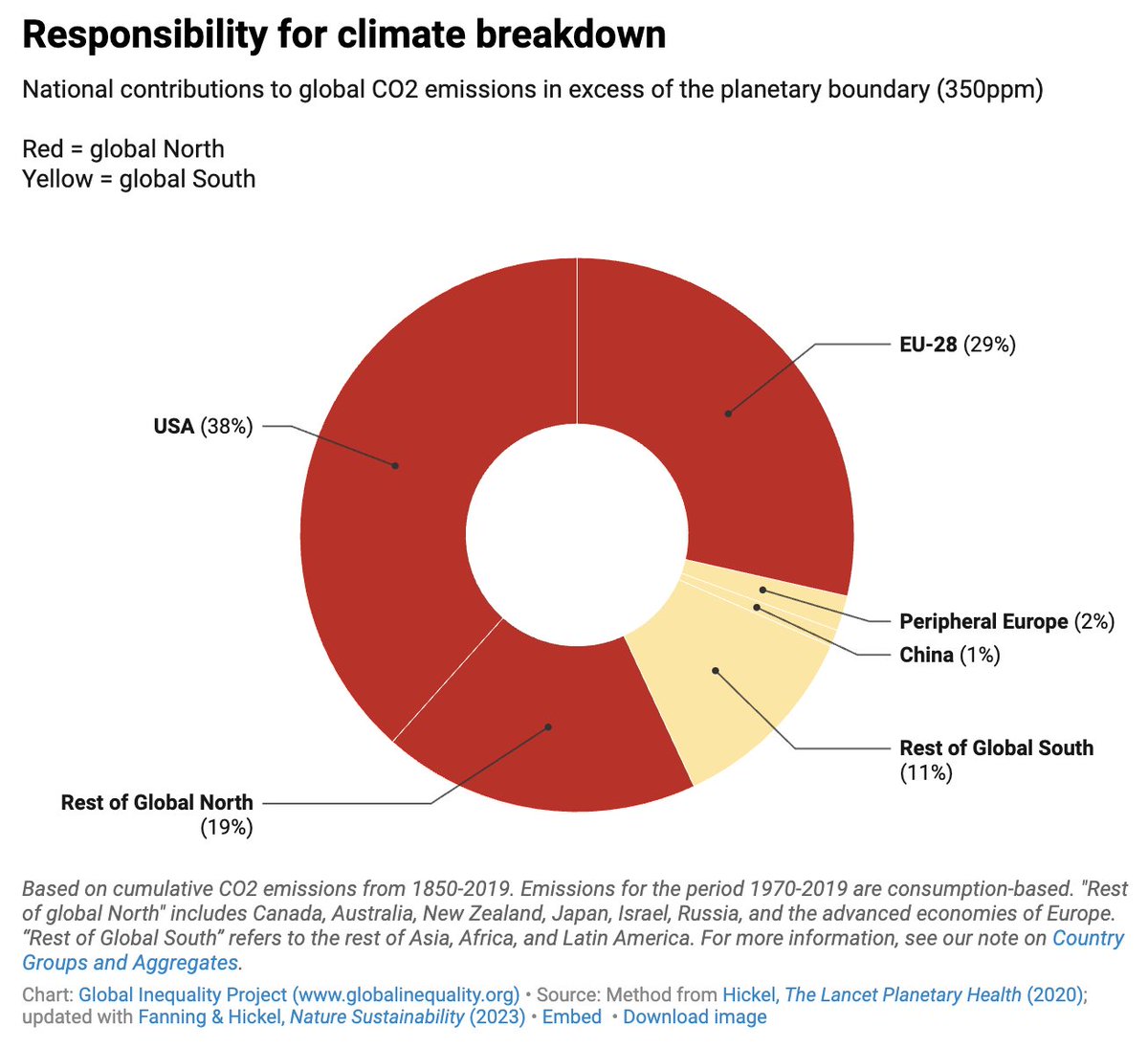
1. First, global North countries are responsible for 86% of cumulative emissions in excess of the safe planetary boundary.
China is responsible for 1%. The rest of the South and peripheral Europe is responsible for 13%.
These results arise from taking the safe carbon budget and dividing into national "fair shares" on a per-capita basis, and then assessing national emissions against national fair-shares.
2. This chart uses the same data.
The global South *as a group* is actually still within its fair share of the planetary boundary (350ppm), since the few "overshooting" countries are compensated for by "undershooting" countries.
By contrast, the global North has burned through not only its fair-share of the planetary boundary, but also its fair share of the 1.5C budget AND its 2C budget.
3. Here's the same data at the country level. The red countries are in overshoot, the green countries are still within their fair-shares.
I was honoured to write this for @tri_continental Pan Africa:
"One of the most damaging myths about the ecological crisis is that humans as such are responsible for it. In reality it's caused almost entirely by the states and firms of the imperial core." thetricontinental.org/pan-africa/new…
@tri_continental Because everyone always wonders about the China data, yes, as of 2019 (the final year of data in our analysis), China was responsible for only 1% of global emissions in excess of the planetary boundary. globalinequality.org/responsibility…
@tri_continental Curious users can check out the data for China and any other country they want using the interactive tools here: goodlife.leeds.ac.uk/related-resear…
About Spain's tourism problem... it seems intractable but the solutions are actually quite straightforward.
First, we need to recognize that tourism is not a good allocation of real resources and labour. It means producing goods and services that do not themselves directly benefit the local population. In fact, they are actively harmful to locals... gobbling up public space, destroying neighbourhoods, driving housing prices up, worsening climate change, etc.
It is much more rational and beneficial to allocate all this labour toward creating things that people actually need, like public services, affordable housing, renewable energy, and so on.
So, why do tourism at all? Two main reasons.
One reason is to get foreign currency. In this sense, tourism is basically an export (but where the export factories are plunked disastrously right into the middle of your historic downtowns). Why do exports? To pay for imports.
The solution here is simple: reduce unnecessary imports. Reduce luxury goods imports (these only benefit the rich), reduce car/SUV imports (build up your public transit system instead), etc. There are many options here. This reduces pressure for obtaining foreign currency.
A second reason to do tourism is to create jobs. This one seems like a strong argument but in fact it's not.
The obvious solution here is to implement a public job guarantee. Not only does this solve unemployment (a major problem in Spain), it mobilizes labour around socially and ecologically useful things that benefit society, rather than allocating labour to useless things like serving tourists.
In other words, there are simple alternatives to the two main reasons people cite for needing tourism. Any political party that realises this can ride the current wave of popular discontent and translate that energy into real, practical social improvements.
This is not to say that tourism should be abolished, far from it. But it's clear to everyone that extreme dependency on tourism is socially and ecologically destructive and it has to stop.
And for anyone wondering how to go about the practical business of actually scaling down the tourism industry, the answer is the same as for reducing any damaging industry (eg, fossil fuels, luxury goods, SUVs, etc): credit guidance! jasonhickel.org/blog/2024/8/20…
And for the avoidance of all doubt, tourism is an absolute, unmitigated climate catastrophe: nature.com/articles/s4155…