

"Immigrants Reduce Unionization in the United States"
New Cato Working Paper finds that immigration reduced union density by 5.7 percentage points between 1980 and 2020, which accounts for 29.7% of the overall decline in union density during that period.
cato.org/working-paper/…
New Cato Working Paper finds that immigration reduced union density by 5.7 percentage points between 1980 and 2020, which accounts for 29.7% of the overall decline in union density during that period.
cato.org/working-paper/…
We used the national skill cells method developed by Borjas (2003) to see how immigrants affected unionization in experience/education cells. Borjas used it to see how immigrants affected wages in those cells.
We also adapted a Social Customs Model of Union Formation from Naylor and Cripps (1993) to explain how a heterogenous population might diminish union formation.
Using data available on unionization in the experience/education cells going back to 1980, we found a substantial effect. 

The impact of immigrants on union density is concentrated in private sector unions, especially for men. Women are affected too, but less so.
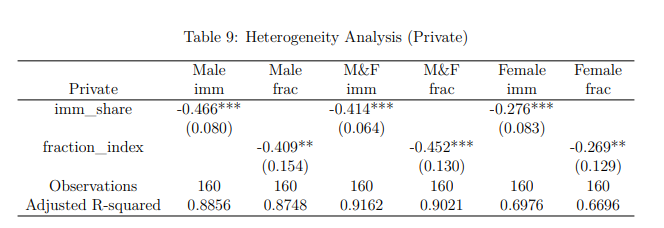
We didn't find statistically significant effects on public sector unionization.
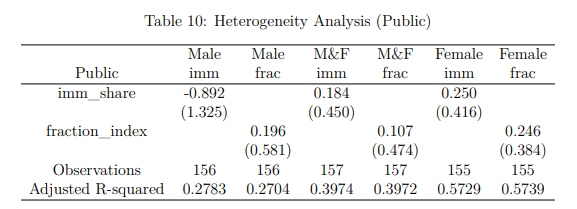
To test our hypothesis about cultural heterogeneity potentially explaining this we adopt a fractionalization index that gauges the cultural differences of the workforce. The regressions are consistent with that.
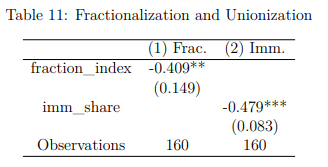
A 1 percentage point increase in the immigrant share corresponds to a 0.479 percentage point decrease in the union density. Immigration reduced union density by 5.7 percentage points (1980-2020), which accounts for 29.7% of the overall decline in union density during that period.
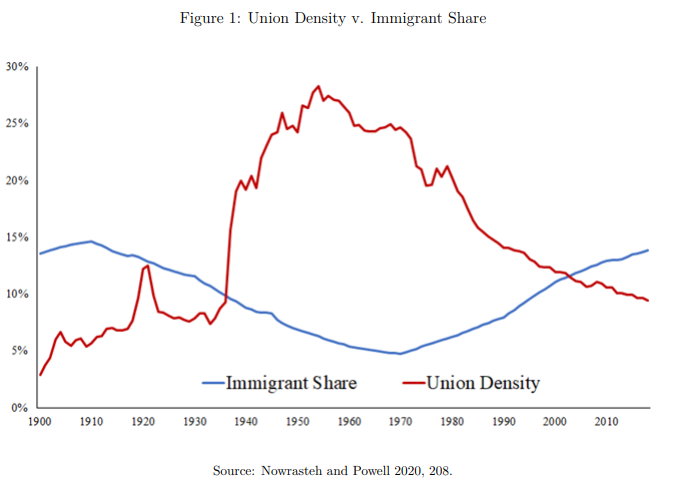
I looked into this because this figure from my 2020 book with Ben Powell piqued my interest. Strongly inverse, but not a lot of great work on the issue.
Reminder: This is just a Working Paper, so please read it with a critical eye and let us know of any problems you find.
Are the methods correct for this type of analysis?
Do we need more sectoral analysis?
Any other problems, please let me know.
Are the methods correct for this type of analysis?
Do we need more sectoral analysis?
Any other problems, please let me know.
Of potential interest to @VincentGeloso, @ATabarrok, @wwwojtekk, @ModeledBehavior, @jmhorp, @HJWallEcon, @zackbeauchamp, @stanveuger, @RAVerBruggen,@KhoaVuUmn.
• • •
Missing some Tweet in this thread? You can try to
force a refresh







