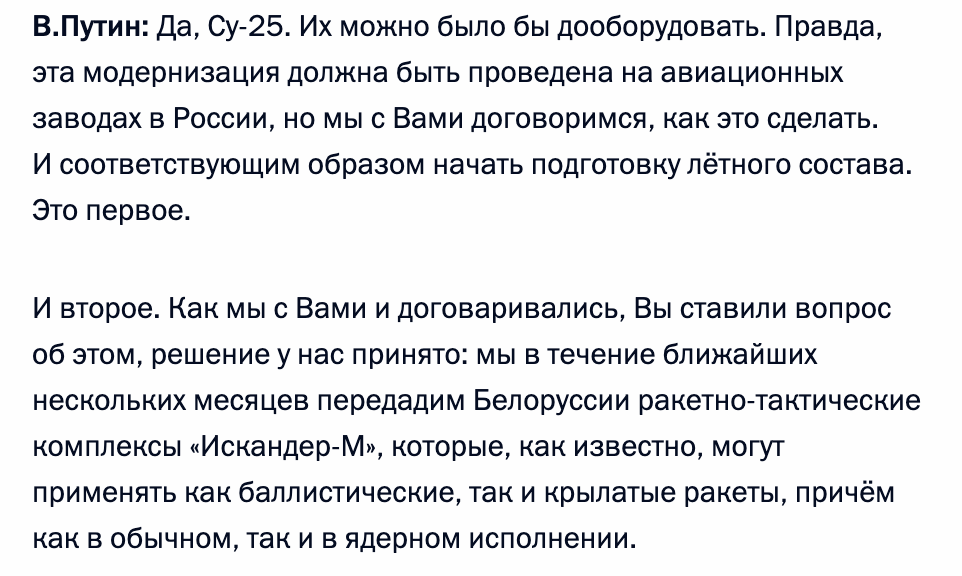
My take is that the probability of nuclear weapons deployed in Belarus is about zero. But there are options. Russia promised to modernize BY Su-25(?) aircraft and give BY Iskander missiles that "can be used with conventional as well as nuclear payload" kremlin.ru/events/preside… 1/
It is possible that the the aircraft and missiles will indeed be deployed in BY, crews will be trained, exercises held, etc. But it is very unlikely (in my view impossible) that actual nuclear weapons will be moved to Belarus 2/
Weapons could be stored in Russia, e.g. at the Bryansk-18 national-level site or maybe at smaller base-level facilities in Shatalovo and Shaykovka. As I understand it, if a decision is made to bring forces to the level of high readiness that includes deployment of weapons... 3/
... then weapons are taken out of storage and moved closer to delivery systems (aircraft, missiles). This would mean transporting weapons over a rather long distance - definitely more than 100 km or much farther. That is not something unheard of in the Soviet practice, though 4/
Once moved close to the delivery systems, warheads don't have to be mounted immediately - they could probably be kept "in tents" for some time. Definitely days, maybe weeks. But they would have to be returned to a permanent storage facility (if not used, of course) 5/
So, while some nuclear sharing-like arrangement might be possible, it does not mean that nuclear weapons will be stationed in Belarus. In that regard, the situations would be different from that in NATO, where weapons are as close to their delivery systems as they can be 6/
There is nothing good about either arrangement. Weapons should be moved away from their delivery systems as far as possible. It may not solve all problems, but it would introduce an additional visible step in the process. See our Lock them Up report unidir.org/publication/lo… 7/7

• • •

Missing some Tweet in this thread? You can try to force a refresh

 

Keep Current with Pavel Podvig

Pavel Podvig Profile picture

Stay in touch and get notified when new unrolls are available from this author!

Read all threads

This Thread may be Removed Anytime!

PDF

Twitter may remove this content at anytime! Save it as PDF for later use!

Try unrolling a thread yourself!

how to unroll video
  1. Follow @ThreadReaderApp to mention us!

  2. From a Twitter thread mention us with a keyword "unroll"
@threadreaderapp unroll

Practice here first or read more on our help page!

More from @russianforces

Jun 17
This is a good example of propaganda in the guise of analysis.
It drew my attention to a few gems from Celeste Wallander's testimony back in March armedservices.house.gov/_cache/files/8… It's interesting to see how this "laundering" of various claims works 2/
Wallander: "a military doctrine that emphasizes the coercive military value of nuclear weapons, including limited nuclear first-use in conventional regional conflict, at multiple levels of the conflict spectrum." The thing is, the doctrine doesn't say anything like that. 3/
Read 8 tweets
May 12
In a hypothetical Russia-NATO conflict, Russia would be fighting several Ukraines (and more capable ones at that). Why would anyone think that it would perform better? The key difference is that in a conflict with NATO nuclear weapons would play a somewhat different role. 1/
In the context of the war in Ukraine, the only way nuclear weapons could be used would be to hit cities Hiroshima/Nagasaki style in order to shock the opponent into a surrender. The threshold for this kind of use is actually very high (as it should be). 2/
Would the threshold be as high in a Russia-NATO conflict? Not necessarily. Since NATO declares itself a nuclear alliance, it could respond in kind. Which means that a use of nuclear weapons against NATO would not be to shock it into a surrender. 3/
Read 5 tweets
Apr 27
There seems to be quite a bit of confusion about 'tactical' nuclear weapons, their potential use, 'lower nuclear threshold,' etc. That's my strong impression from the kinds of questions that I've been getting. I don't claim to have all answers, but here is my take 1/
'Tactical' is a misnomer, of course. Nuclear weapon is a nuclear weapon. It's not the yield or the range of the delivery vehicle that counts. It's the mission. 'Tactical' normally means a weapon that is used to achieve a 'tactical' military goal 2/
Say, to stop an advancing tank column or to attack an aircraft carrier group. 'Strategic' would mean a weapon/mission that is intended to change the strategic outcome of a war. (It is a bit more complicated, but I hope my colleagues will forgive me) 3/
Read 17 tweets
Mar 30
I'm sorry, colleagues, but this is exactly the wrong way to talk about nuclear weapons in the context of the war in Ukraine. The fact is that no matter if you call them tactical or strategic, low- or high-yield, there are absolutely no military missions for them in this war 1/
The only mission for nuclear weapons, definitely in this war, is to either kill a lot of people or to show that you are willing to escalate and kill a lot of people. Period. There is nothing else. 2/
Why does it matter that a 5-kt weapon kills everyone inside a 2.5-mile circle and a 16-kt one - inside a 5-mile one? Why does it matter that Russia may have 1644 'tactical' weapons and US - 130? Do you expect a shootout? 3/
Read 4 tweets
Mar 12
Russia's claim that Ukraine had some kind of a nuclear weapons program is absolute bonkers. It is truly irresponsible of Russian diplomats to repeat this in official statements. I stand by my initial assessment Here is a longer take 1/
As a non-weapon state in the NPT, Ukraine is under obligation to place all its nuclear materials under IAEA safeguards. IAEA verifies it and reports. Moreover, since 2006 Ukraine has an additional protocol (AP) in force iaea.org/sites/default/… 2/
If there is no AP, the IAEA confirms that no diversion of declared materials has taken place. AP imposes additional reporting obligations and gives the IAEA access to all nuclear-related activities, so the Agency can reach so-called "broader conclusion" 3/
Read 10 tweets
Mar 11
It appears that "escalate to de-escalate" is no longer a purely academic issue. So, is it a real thing? A thread. TLDR: Yes, it appears that it might be an option in some circumstances. And it depends on how serious Russia is about its own declaratory policy. 1/
First, Russia's current (2014) military doctrine says that nuclear weapons could be used in response to "an aggression against [Russia] with conventional weapons that would put in danger the very existence of the state." See russianforces.org/blog/2014/12/n… 2/
So, how does "escalate to de-escalate" fit in? Does it? Technically, one can imagine a situation when Russia finds itself under a conventional attack and this attack gets to the point of threatening the very existence of the state. 3/
Read 11 tweets

Did Thread Reader help you today?

Support us! We are indie developers!


This site is made by just two indie developers on a laptop doing marketing, support and development! Read more about the story.

Become a Premium Member ($3/month or $30/year) and get exclusive features!

Become Premium

Don't want to be a Premium member but still want to support us?

Make a small donation by buying us coffee ($5) or help with server cost ($10)

Donate via Paypal

Or Donate anonymously using crypto!

Ethereum

0xfe58350B80634f60Fa6Dc149a72b4DFbc17D341E copy

Bitcoin

3ATGMxNzCUFzxpMCHL5sWSt4DVtS8UqXpi copy

Thank you for your support!

Follow Us on Twitter!

:(