

Find out why @quant_network's @Overledger is the industry leading end-to-end DLT interoperability solution. $QNT
We will not be looking at DeFi interoperability as that is not Quant's target audience. The target audience is enterprises & governments. (VASPs)
(1/26)
We will not be looking at DeFi interoperability as that is not Quant's target audience. The target audience is enterprises & governments. (VASPs)
(1/26)
They won’t interoperate permissioned business networks over a crypto network like $DOT, $ATOM, $STG, $FLR, $DAG and $LINK. Why use DLT relayers or interoperability blockchains when you can do gateway to gateway directly. (VASP, not DeFi PoV)
(2/26)
(2/26)

So who else is offering DLT interoperability to this audience?
1. Hyperledger, with:
- Cactus
- Weaver
- YUI
- FireFly
2. Digital Asset with DAML.
3. Ripple with Interledger
4. SETL's PORTL
(3/26)
1. Hyperledger, with:
- Cactus
- Weaver
- YUI
- FireFly
2. Digital Asset with DAML.
3. Ripple with Interledger
4. SETL's PORTL
(3/26)
Let's go into each solution's architecture design.
Starting with Hyperledger Cactus.
Accenture and Fujitsu first proposed a solution to establish a trusted “interoperability node”.
(4/26)
Starting with Hyperledger Cactus.
Accenture and Fujitsu first proposed a solution to establish a trusted “interoperability node”.
(4/26)

This was later abandoned in favour for a design without middleman node.
Cactus relies on validator nodes for each individual blockchain. The validator nodes for one blockchain interact with those for another blockchain.
(5/26)
Cactus relies on validator nodes for each individual blockchain. The validator nodes for one blockchain interact with those for another blockchain.
(5/26)

It describes these as similar to trusted third parties. However, there could be multiple validators for each blockchain. The more validators, the less trust is required, and at some level of decentralization, it’s potentially trustless.
(6/26)
(6/26)
But the flaw here is that both networks are required to run Cactus software.
This is not the case with DLT gateways. You can use any software internally such as Overledger or even Cactus and still interoperate through API’s.
(7/26)
This is not the case with DLT gateways. You can use any software internally such as Overledger or even Cactus and still interoperate through API’s.
(7/26)

Cactus has started to adopt the MIT & Quant's SAT protocol for gateway to gateway interoperability (formerly ODAP). github.com/hyperledger/ca…
(8/26)
(8/26)
Next, Weaver.
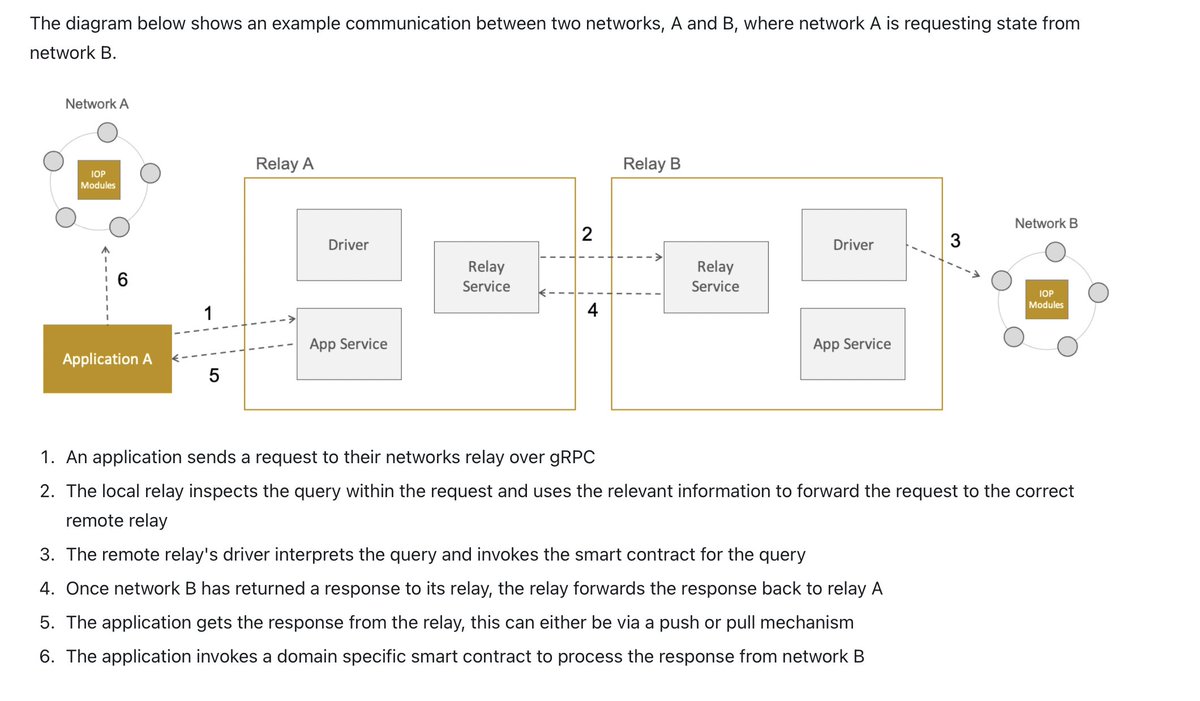
Each network in the system needs to contain an interoperability (IOP) module that enables them to communicate with the relays.
Same flaw is with Cactus, you need all networks you communicate with to run the same software.
(9/26)
Each network in the system needs to contain an interoperability (IOP) module that enables them to communicate with the relays.
Same flaw is with Cactus, you need all networks you communicate with to run the same software.
(9/26)

Imagine not being able to send a text message to your friend because he has a different brand phone or carrier.
Keep in mind, all these protocols can still adopt SAT to enable gateway based interoperability with other networks running their own software stack.
(10/26)
Keep in mind, all these protocols can still adopt SAT to enable gateway based interoperability with other networks running their own software stack.
(10/26)
Next, YUI.
Here they adopt IBC as a standard and relay these IBC messages to each network.
So what if the other network is not running relayer software to receive these messages?
You know the answer.
(11/26)
Here they adopt IBC as a standard and relay these IBC messages to each network.
So what if the other network is not running relayer software to receive these messages?
You know the answer.
(11/26)

Next, FireFly.
Once again, need each party to run the same node software.
(12/26)
Once again, need each party to run the same node software.
(12/26)

Next, DAML.
DAML provides a way to script business logic for many types of DLTs using their Digital Asset Modeling Language. This enables you to switch the underlying DLT technology if needed.
Once again, interoperability limited to parties running the same software.
(13/26)
DAML provides a way to script business logic for many types of DLTs using their Digital Asset Modeling Language. This enables you to switch the underlying DLT technology if needed.
Once again, interoperability limited to parties running the same software.
(13/26)


Next, Interledger.
Interledger protocol is a web protocol for routing payments across independent networks, across an interconnected set of ledgers. This is done by passing the payments from one inter ledger module to another until the destination is reached.
(14/26)
Interledger protocol is a web protocol for routing payments across independent networks, across an interconnected set of ledgers. This is done by passing the payments from one inter ledger module to another until the destination is reached.
(14/26)
xCurrent is their most used product, which enables bi-directional messaging globally. It does not use $XRP. It uses existing infrastructure to settle transactions.
(15/26)
(15/26)

xRapid on the other hand allows for instant settlement using $XRP.
But Interledger does not enable multichain contracts using various digital assets across heterogeneous networks using different DLTs.
(16/26)
But Interledger does not enable multichain contracts using various digital assets across heterogeneous networks using different DLTs.
(16/26)
Next, SETL’s PORTL solution.
Can’t find any documentation on it despite being “open source”. It’s more like providing a single console where an enterprise can orchestrate and monitor its activities across different DLTs.
(17/26)
Can’t find any documentation on it despite being “open source”. It’s more like providing a single console where an enterprise can orchestrate and monitor its activities across different DLTs.
(17/26)
It’s more or less a tool like Overledger but misses the gateway to gateway interoperability to connect with other ecosystems. Think of it as a tool to abstract complexity from managing nodes of different DLTs.
(18/26)
(18/26)
Finally, Overledger. $QNT
An ISO standardized blockchain OS + IETF standardized/SAT compliant Gateway package. All complexity is abstracted into a uniform data and interaction model.
(19/26)
An ISO standardized blockchain OS + IETF standardized/SAT compliant Gateway package. All complexity is abstracted into a uniform data and interaction model.
(19/26)
Overledger has no control over the data that is being sent through it. Private by design. Through this API gateway approach, it can connect the any system or network, be it running on centralized servers or DLT networks.
(20/26)
(20/26)
It is the only interoperability approach able to operate at the scale of internet. By using gateways we don’t need to agree on a common transport mechanism, all you need to do is adopt with SAT like we did with TCP/IP.
(21/26)
(21/26)
The reason why TCP/IP grew to be the internet protocol of today, is that it did not care how packets were being transported.
(22/26)
(22/26)
All Overledger transactions are paid for in $QNT. That does not mean every transaction is also an on-chain Ethereum transaction. Overledger Network scales through the use of layer 2 payment channels.
(23/26)
(23/26)
Like Bitcoin’s Lightning Network, but in this case it’s a Multi-DLT Lightning Network. This is just a fraction of the utility, you can find the full QNT token utility model here: t.me/QuantOverledge….
(24/26)
(24/26)
For more details on Quant’s partnership with MIT on Secure Asset Transfer Protocol (SAT, formerly ODAP) I’d like to refer you to Greg Lunt’s thread:
(25/26)
https://twitter.com/GregLunt27/status/1516431133185036295
(25/26)
It’s also the only solution you can invest in right now, the solutions listed above have no token, except for ILP, but as we’ve seen majority of ILP’s usage today doesn’t use $XRP.
(26/26)
(26/26)
• • •
Missing some Tweet in this thread? You can try to
force a refresh



