I want to tell you a story about something fascinating that has happened in Japan.
An academic named Kohei Saito wrote a book about democratic "degrowth communism".
Everyone said it would be a flop, because degrowth "is a terrible word", and communism "is a terrible word too."
But it wasn't a flop.
It was a runaway bestseller.
The publisher has sold half a million copies. Bookshops kept running out of stock.
Something about this idea lit a flame among Japanese readers - young people in particular. People are hungry for post-capitalist ideas.
It contrasts starkly with the West, where many socialists still cannot bring themselves to say degrowth, and many environmentalists still cannot bring themselves to say socialism.
People once thought the same was true in Japan. But someone had the courage to break the taboos.
Saito is an expert on Marx. He developed his ideas while reading Marx's unpublished notebooks from the last several years of his life. He draws on this work to articulate a vision for a just and ecological post-capitalist transition, rooted also in anti-imperialist principles.
The conventional wisdom was that the left in Japan was in decline. But with Saito's book, that seems to have changed. The media cannot get enough of him and his ideas. Not just in Japan, now in Europe too.
Saito has two books coming out in English soon. One is an academic text about Marx, ecology and degrowth. The other is a translation of his Japanese bestseller. Stay tuned - and in the meantime follow him at @koheisaito0131.
For more on this story, see nippon.com/en/news/yjj202…(this image was posted alongside an interview with Saito in NHK World News):
Here is a link to the academic text, coming out with Cambridge University Press. It is academic but also very accessible. I understand the English translation of Saito’s bestseller will be announced in the coming months. cambridge.org/us/academic/su…
• • •
Missing some Tweet in this thread? You can try to
force a refresh

This thread covers some of our latest work on capitalism, imperialism, post-growth and ecosocialist futures. It's all open access, and free PDFs are available via the link at the end of the thread. 🧵
1) We wrote this review of exciting recent developments in post-growth science, in The Lancet Planetary Health. It's your one-stop introduction to all the key questions, debates, and empirical evidence:
2) We assessed public backing for eco-socialist transformation in the UK and US, and found it enjoys strong majority support in both countries: 72% in the US and 82% in the UK. We also tested how different labels affect people's support:
How popular are post-capitalist/socialist ideas and policies?
Here's a list of studies and surveys with some striking results...
1. A survey shows that a majority of people around the world (56%) agree with the statement “Capitalism does more harm than good”. In France it is 69%, in India it is 74%.
Who is driving climate breakdown? Buckle up for some striking data... 🧵
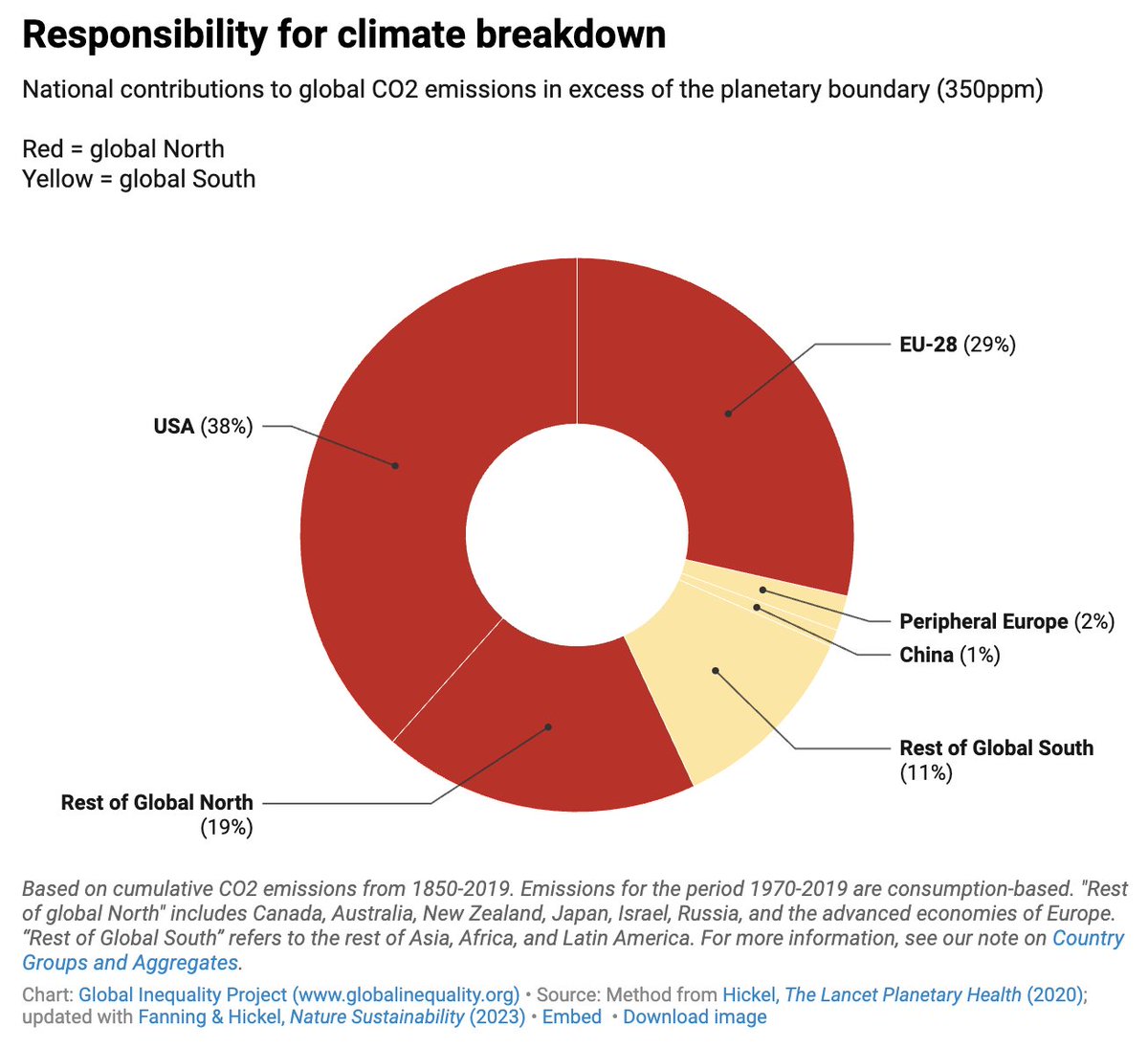
1. First, global North countries are responsible for 86% of cumulative emissions in excess of the safe planetary boundary.
China is responsible for 1%. The rest of the South and peripheral Europe is responsible for 13%.
These results arise from taking the safe carbon budget and dividing into national "fair shares" on a per-capita basis, and then assessing national emissions against national fair-shares.
2. This chart uses the same data.
The global South *as a group* is actually still within its fair share of the planetary boundary (350ppm), since the few "overshooting" countries are compensated for by "undershooting" countries.
By contrast, the global North has burned through not only its fair-share of the planetary boundary, but also its fair share of the 1.5C budget AND its 2C budget.
3. Here's the same data at the country level. The red countries are in overshoot, the green countries are still within their fair-shares.
I was honoured to write this for @tri_continental Pan Africa:
"One of the most damaging myths about the ecological crisis is that humans as such are responsible for it. In reality it's caused almost entirely by the states and firms of the imperial core." thetricontinental.org/pan-africa/new…
@tri_continental Because everyone always wonders about the China data, yes, as of 2019 (the final year of data in our analysis), China was responsible for only 1% of global emissions in excess of the planetary boundary. globalinequality.org/responsibility…
@tri_continental Curious users can check out the data for China and any other country they want using the interactive tools here: goodlife.leeds.ac.uk/related-resear…
About Spain's tourism problem... it seems intractable but the solutions are actually quite straightforward.
First, we need to recognize that tourism is not a good allocation of real resources and labour. It means producing goods and services that do not themselves directly benefit the local population. In fact, they are actively harmful to locals... gobbling up public space, destroying neighbourhoods, driving housing prices up, worsening climate change, etc.
It is much more rational and beneficial to allocate all this labour toward creating things that people actually need, like public services, affordable housing, renewable energy, and so on.
So, why do tourism at all? Two main reasons.
One reason is to get foreign currency. In this sense, tourism is basically an export (but where the export factories are plunked disastrously right into the middle of your historic downtowns). Why do exports? To pay for imports.
The solution here is simple: reduce unnecessary imports. Reduce luxury goods imports (these only benefit the rich), reduce car/SUV imports (build up your public transit system instead), etc. There are many options here. This reduces pressure for obtaining foreign currency.
A second reason to do tourism is to create jobs. This one seems like a strong argument but in fact it's not.
The obvious solution here is to implement a public job guarantee. Not only does this solve unemployment (a major problem in Spain), it mobilizes labour around socially and ecologically useful things that benefit society, rather than allocating labour to useless things like serving tourists.
In other words, there are simple alternatives to the two main reasons people cite for needing tourism. Any political party that realises this can ride the current wave of popular discontent and translate that energy into real, practical social improvements.
This is not to say that tourism should be abolished, far from it. But it's clear to everyone that extreme dependency on tourism is socially and ecologically destructive and it has to stop.
And for anyone wondering how to go about the practical business of actually scaling down the tourism industry, the answer is the same as for reducing any damaging industry (eg, fossil fuels, luxury goods, SUVs, etc): credit guidance! jasonhickel.org/blog/2024/8/20…
And for the avoidance of all doubt, tourism is an absolute, unmitigated climate catastrophe: nature.com/articles/s4155…
I'm excited to announce this new paper we have in The Lancet Planetary Health.
We show that the world is not moving towards a just and ecological future for all. Growth in energy and material use is occurring primarily in countries that do not need it and is not occurring fast enough (or is declining) in countries that do need it.
The capitalist world economy is not delivering for human needs and ecology. A substantial redistribution of energy and material use is required—both within countries and between them.
1. Globally, we use *a lot* of energy and materials. In fact, we use at least 2.5x more than would be needed to ensure decent living standards (DLS) for all.
DLS includes universal healthcare, education, modern housing, nutritious food, sanitation systems, transit, fridge-freezers, phones, computers, etc.
2. And yet, billions of people are denied access to DLS.
We find that 50% of nations do not have access to enough energy to ensure DLS, given existing national distributions. And for 20 of these countries, their consumption is actually *declining*. This is an extremely bad situation.