Kids, School, and Suicide
=-=-=-=-=-=-=-=-
People are asking about the stats I presented about school days being associated with child suicide. There are many ways to look at it.
Simply, using July as a reference month, you can easily see "school peaks."
It's very striking.
/1
=-=-=-=-=-=-=-=-
People are asking about the stats I presented about school days being associated with child suicide. There are many ways to look at it.
Simply, using July as a reference month, you can easily see "school peaks."
It's very striking.
/1

This is COMPLETELY UNLIKE what the graph looks like for adults (18-64), where we see small changes but undeniably summer adult suicide rates are higher than winter months.
Pediatric suicide is unique in its school month distribution.
/2
Pediatric suicide is unique in its school month distribution.
/2

We can do the same thing with days, using Sunday as reference. We drop the partial/nonschool months so we compare the days of the week for January-May & September to November.
Again, it is a striking effect. Weekdays are strongly associated with increased pediatric suicide.
/3
Again, it is a striking effect. Weekdays are strongly associated with increased pediatric suicide.
/3

The "heat map" for suicide I created allows you to see both months and days in a way that is intuitive. All numbers are "suicides per 100,000 per year" standardized. For children in the US, a clear school-month school-day relationship is easily visualized.
/4
/4
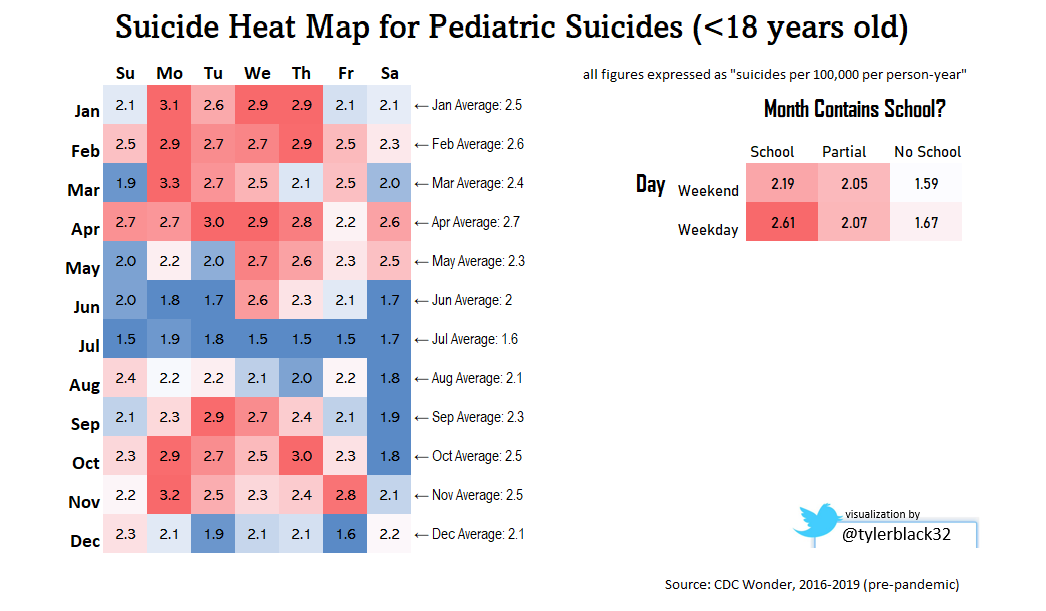
Once more, it's incredibly striking. If i use the minimum rate (Sundays in July) as a reference, we can see that many school days are associated with a 100%+ increase in suicide rate.
Overall, school days are associated with a 65% increase in suicide rates.
/5
Overall, school days are associated with a 65% increase in suicide rates.
/5

The data I used today is 2016-2019. It's been true since 1983. We see the same in the UK and Australia (Despite completely different school year structures). When school is in session, kids are more likely to die by suicide.
/6
/6

School comes with many things, good and bad (see my pinned tweet!). School can be incredibly stressful - whether its stress due academics, social groups, bullying, health-wise, barriers/discrimination, disability, and abuse.
/7
/7

Teachers, principles, school districts: YOU SHOULD ALL KNOW THIS. If you work with children in school and you do not know these statistics you will not take seriously the following recommendations.
To wit:
/8
To wit:
/8
1) less homework (none, preferrably)
2) mental health curriculum
3) address and solve racial discrimination, homophobia, and transphobia in school
4) take bullying seriously (both the bullies and the bullied need help!)
2) mental health curriculum
3) address and solve racial discrimination, homophobia, and transphobia in school
4) take bullying seriously (both the bullies and the bullied need help!)
5) RESTORE FUNDING TO PLAY, music, art,
6) end "perfect attendance awards"
7) allow mental health breaks/days off
8) START LATER, good lord start later
9) have a "💩 happens" policy with your kids, and stop punishing them
6) end "perfect attendance awards"
7) allow mental health breaks/days off
8) START LATER, good lord start later
9) have a "💩 happens" policy with your kids, and stop punishing them
10) DE-EMPHASIZE ACADEMIC OVERLOAD
11) be nonjudgmental to children's identity and identity formation
12) recognize and address child abuse in homes/caregiving environments, AND SCHOOL environments. Many teachers are abusive, punitive, and cruel. Not OK.
11) be nonjudgmental to children's identity and identity formation
12) recognize and address child abuse in homes/caregiving environments, AND SCHOOL environments. Many teachers are abusive, punitive, and cruel. Not OK.
And finally, no, pediatric societies and non-mental-health professionals, we do not have compelling evidence that schools are healing/helpful to children's mental health. In fact, the opposite. Same graphs could be shown for MANY pediatric mental health problems.
/12
/12
So in bungled, biased, & misinformation advocacy to "return kids to school" during COVID, the childish and un-founded notion that "getting kids back to school will solve their mental health challenges was NEVER going to bear fruit, as we've seen in new longitudinal studies.
/13
/13
As always, I firmly believe that data should guide our knowledge, not the other way around.
Minor edit, thank you L!
The first 2 graphs Y axis should read: "July" not "Sunday".
The first 2 graphs Y axis should read: "July" not "Sunday".
Edited:

• • •
Missing some Tweet in this thread? You can try to
force a refresh