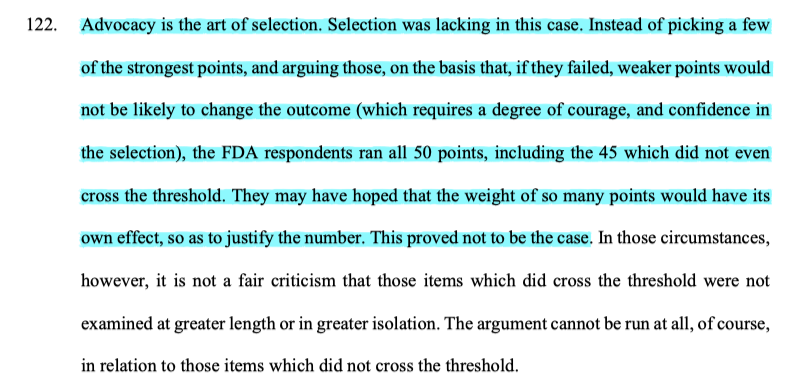
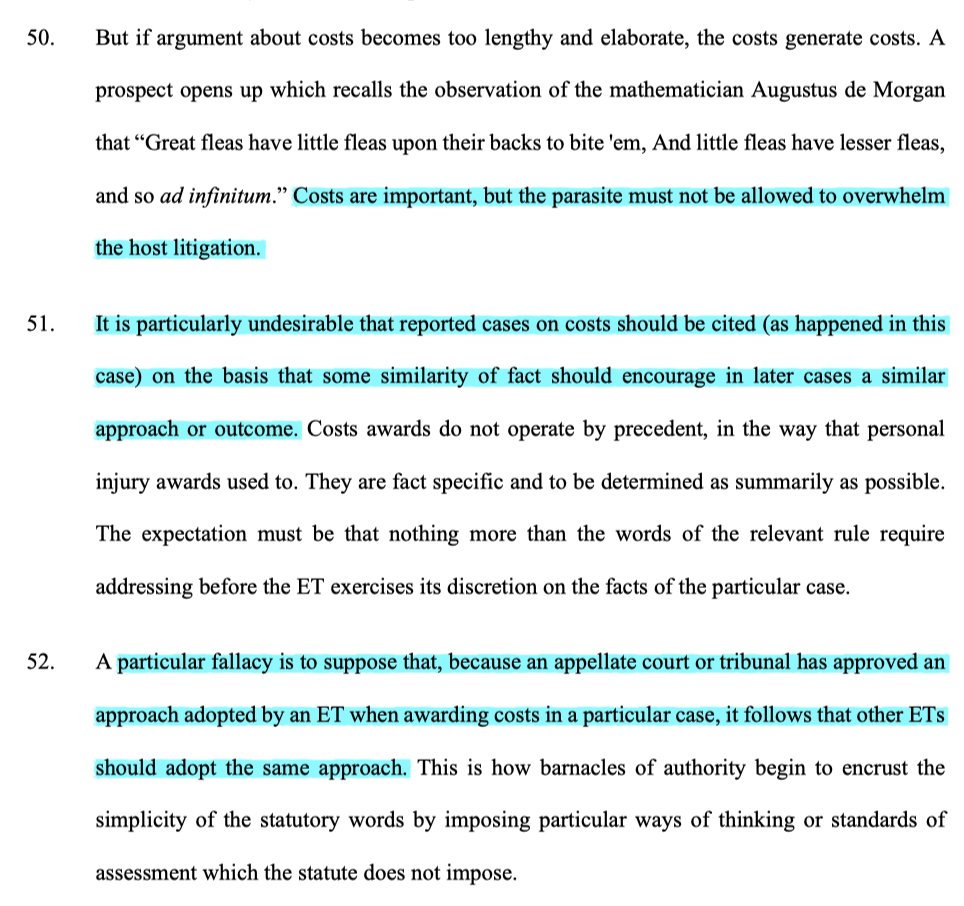
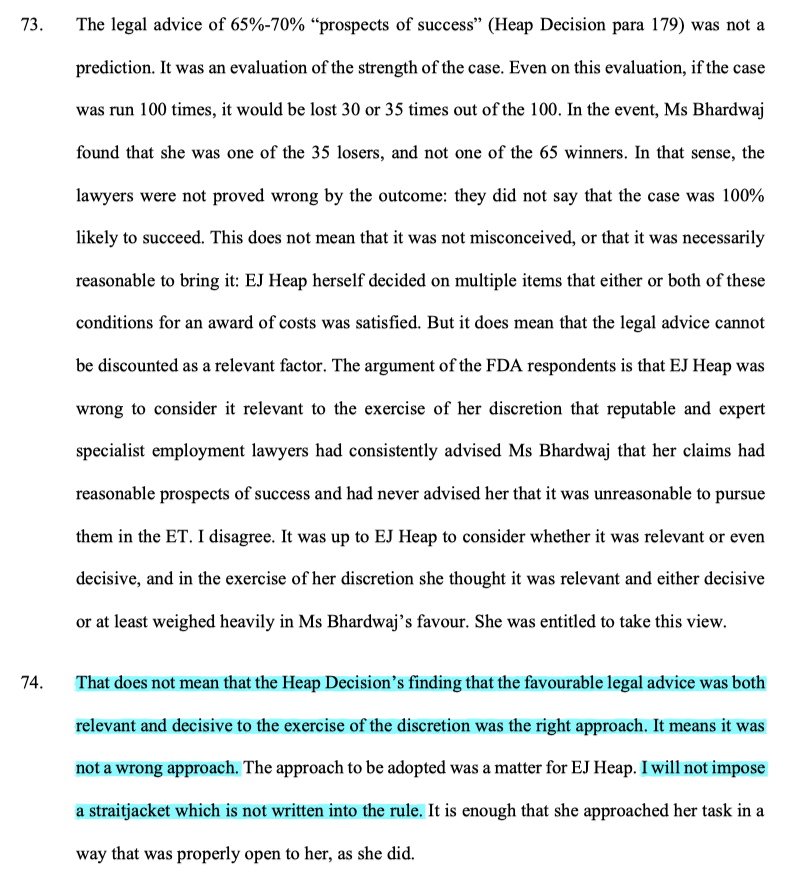
1/ FDA v Bhardwaj: EAT dismisses appeal against refusal of costs orders (& cross-appeal against making of 1), & derides issue-by-issue costs claims & discourages pernickety costs appeals. assets.publishing.service.gov.uk/media/62cea659… #ukemplaw
2/ This is lengthy litigation by B against her former union & 5 of its members. She started the litigation in 2008, lost it & then lost at the EAT & CA before the Supreme Court refused permission to appeal. The FDA applied for costs & partially succeeded. Both sides appealed.
3/ The EAT (Griffiths J) started by bemoaning how great the resources taken up by the case, & how litigation taking up the most resources seem to create their own chain reaction of further & more strenuous fighting. (It was a case in which FDA raised 50 points on costs alone!)
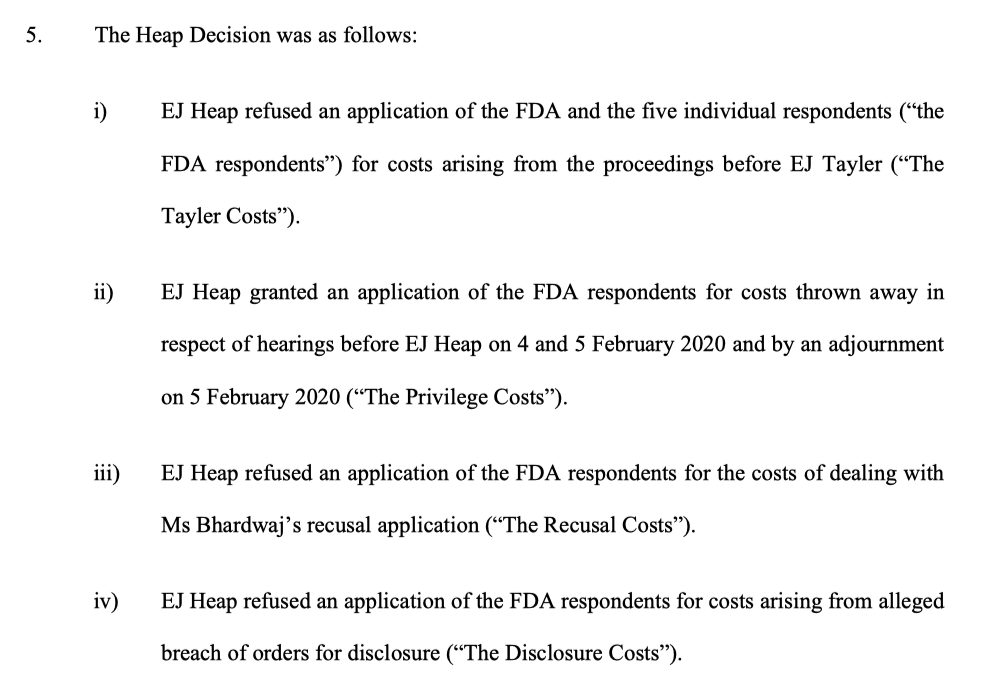
4/ The costs orders made (by EJ Heap) were limited to costs thrown away for 2 days' hearings/adjournment on a privilege issue. EJ Heap declined to make costs orders to FDA re more substantial applications in re the main ET proceedings & re B's recusal & disclosure applications.
5/ I'm not going to delve greatly into the maze of facts or their treatment in this thread, but there are some useful points to be made on points of law on the treatment of costs applications & appeals within the many grounds of appeal & cross-appeal, so let's focus on those.
6/ First, the difficulty in appealing a costs application, discouragement by the appellate courts from doing so, & the need to separate out helpful costs authorities explaining points of principle as against those reaching outcomes on particular facts.
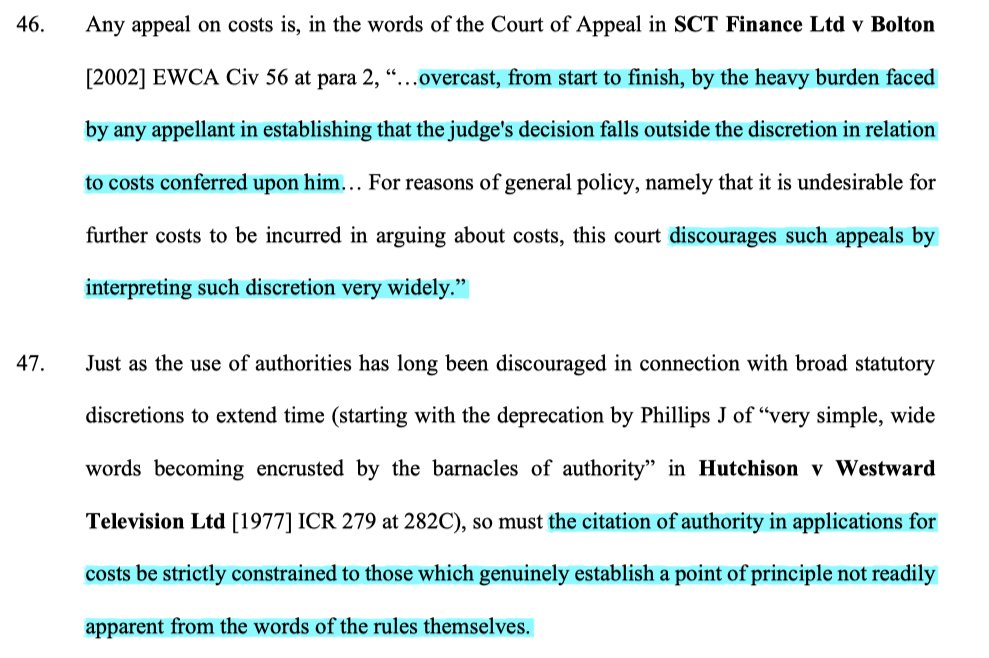
7/ On costs for being found to have lied, the FDA relied on Daleside Nursing v Mathew where the EAT found the ET should've made a costs order for a cynical lie at the centre of a race discrim case.
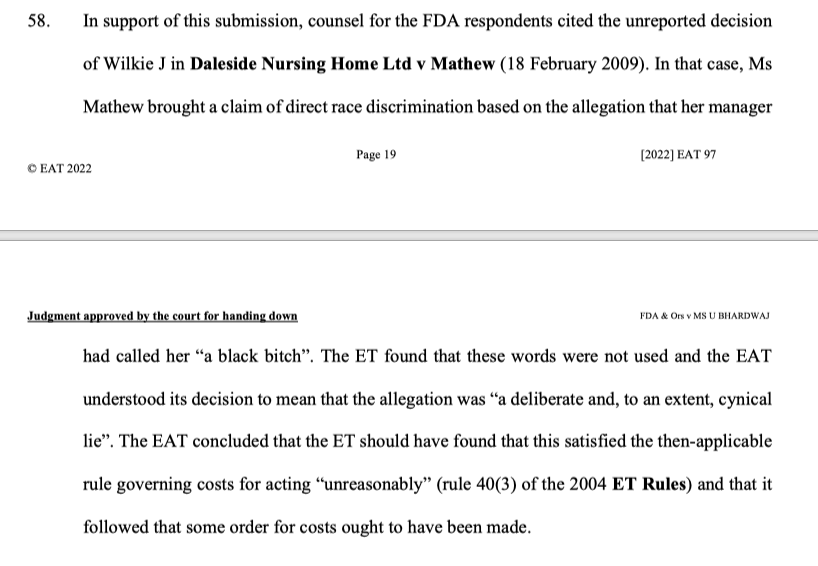
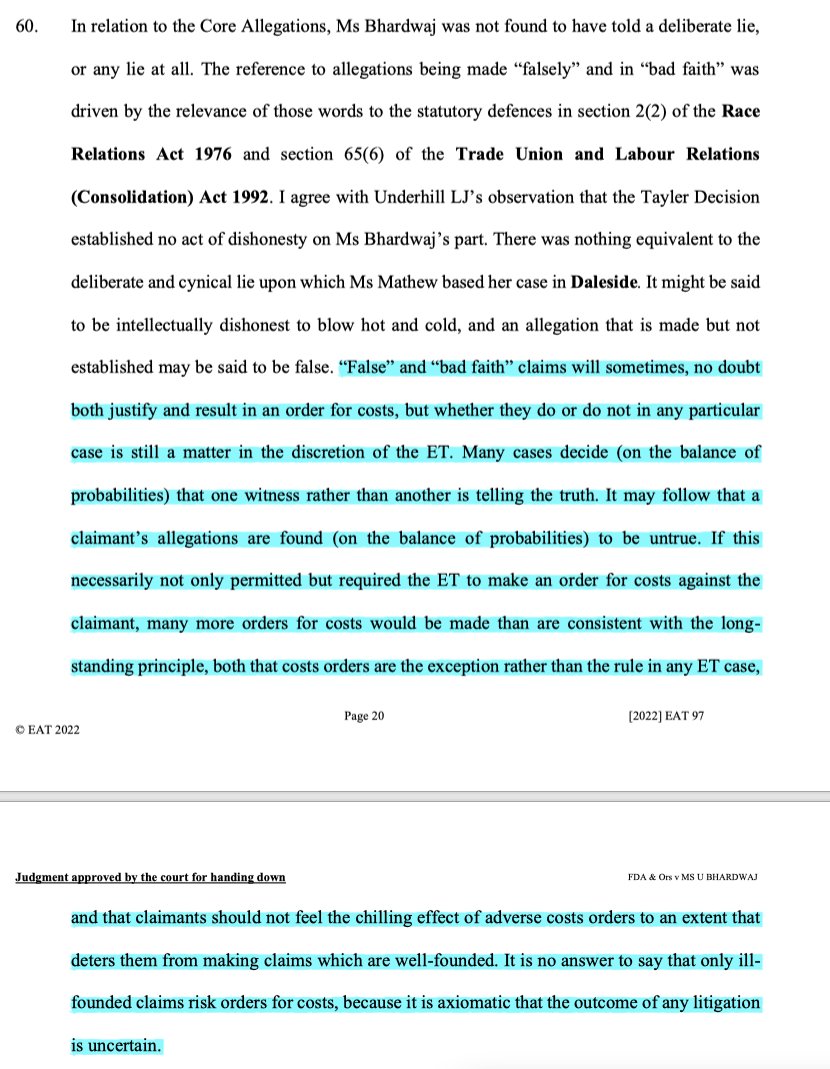
8/ However, Griffiths J didn't consider that decision set out any principle mandating costs for an untruth. It'd have a chilling effect if it did. It's a matter for the ET's discretion in context. There's a difference b/w the cynical lie & an ET preferring 1 side over the other.
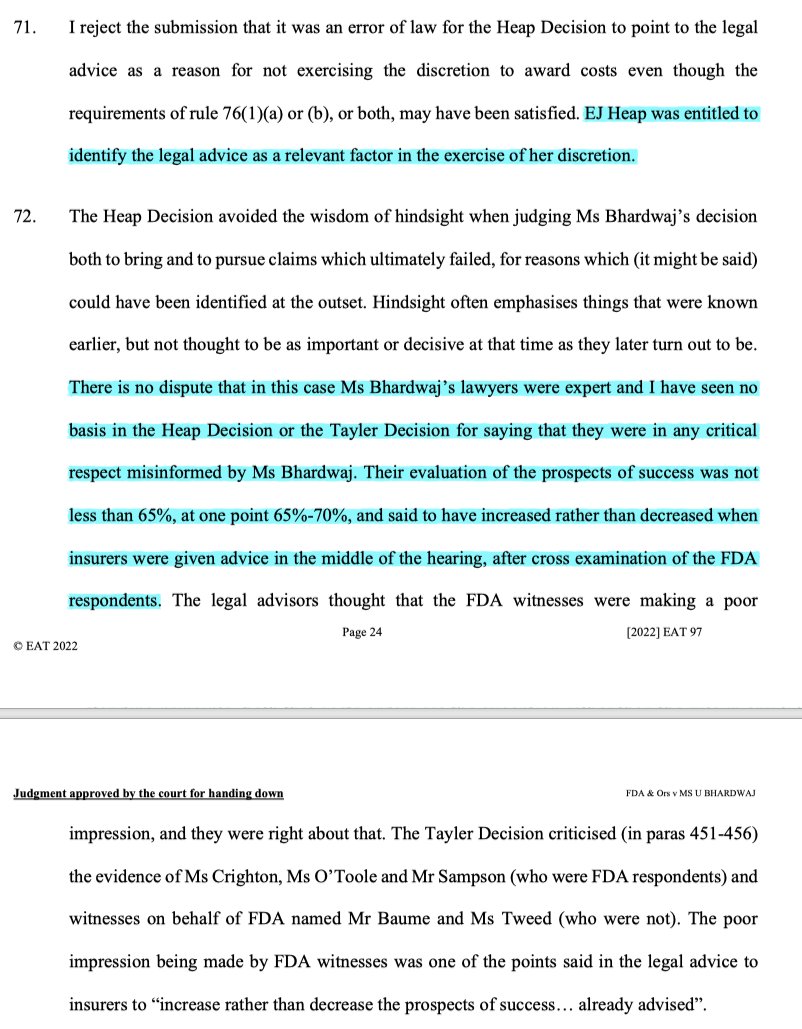
9/ In this case, as privilege had been waived the EJ had all legal advice, which advised B of good prospects of success. It was acceptable for the EJ to take that favourably advice (from experienced employment lawyers) into account in deciding not to award costs.
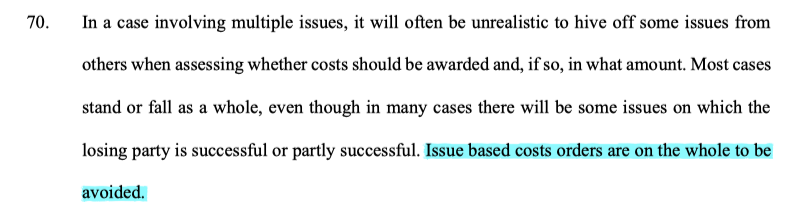
10/ Usefully for claimants facing costs applications on individual aspects of their claim, Griffiths J criticised most cases in which there are multiple issue-based costs applications rather than a holistic application (though I'd say deposit orders 1 of the potential exceptions)
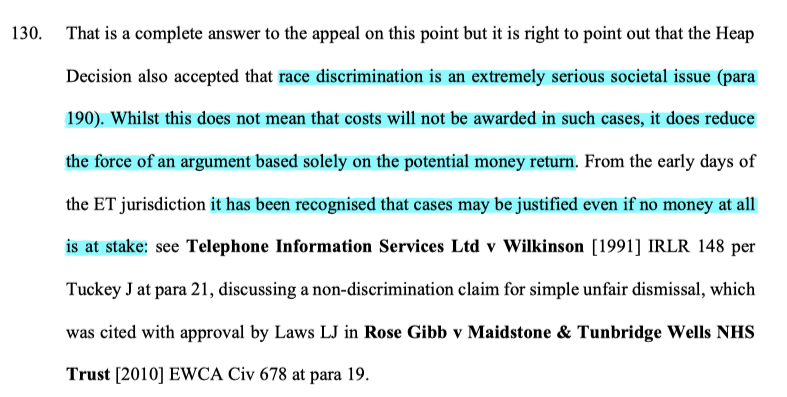
11/ The EAT was unswayed by an argument that it was disproportionate for B to bring her claim given that the value of claims was dwarfed by the costs of bringing them.
The EAT noted ire discrim claims how such serious societal issues can justify a claim even if for no money.
• • •
Missing some Tweet in this thread? You can try to
force a refresh

🧵SSBT v Mercer: Supreme Court issues declaration of incompatibility re the lack of protection from sanction short of dismissal for workers taking part in strike action. The current position breaches Art 11 ECHR.
2/ M was a support worker in the care sector & a UNISON workplace rep, who planned & participated in a lawful strike at her workplace. She was suspended, receiving normal pay but no overtime. Suspension removed her from the workplace during the period of industrial action.
3/ M was also given a first written warning, though that was overturned on appeal.
M brought an ET claim reliant on s.146 TULR(C)A, which provides protection against detriments for taking part in trade union activities. The statutory provisions are below:
🧵 R (TTT) v Michaela Community Schools Trust - High Ct finds it was neither a breach of Art 9 nor indirectly discriminatory for the school to prohibit prayer rituals in response to Muslim pupils seeking to pray during their lunch break.
2/ The facts of this case will be familiar. Michaela is the school run by Katherine Birbalsingh, which has superb results but some incredibly strict rules & practices, including restricting discussion topics & limiting break time socialisation to groups of 4.
3/ The school, which is 50% Muslim, places considerable stock not only in its disciplinary regime, but also in what it calls its Team Ethos by which it seeks 'aggressively' to promote integration and to disrupt separation.
🧵Mathur v HMRC: UT (Tax & Chancery) decides to broadly construe s.401 ITEPA so that a settlement including for claims re dismissal but also re unrelated pre-termination discrim is taxable where the trigger for bringing the claim is dismissal.
2/ M worked for Deutsche Bank. Her employment was ended when the bank entered settlement with the New York State Dept of Financial Services re manipulation of interbank offered rates. DFS ordered the bank to terminate 7 employees, including M, said to be complicit in misconduct.
3/ She was offered c.£80k in a draft settlement agreement for that termination but declined to accept. Instead she brought ET proceedings for an equal pay claim, harassment, direct sex discrim, victimisation, s.47B & s.103A claims & ordinary unfair dismissal.
🧵The Supreme Court's judgment in Tui Ltd v Griffiths is one of those rare non-employment law cases that all employment lawyers (& all other civil practitioners) really must read.
It's about whether you can impugn a witness without putting the point in XX. supremecourt.uk/cases/docs/uks…
2/ The case concerned the court's treatment of an expert report prayed in aid of a claim by Mr Griffiths for the serious stomach upset & longer term stomach problems he suffered following an all-inclusive Tui package holiday at a Turkish resort.
3/ Mr G relied on an expert report from a microbiologist, Prof P. Tui didn't rely on any expert report (they sought unsuccessfully to apply to rely on one at too late a stage) & called no witnesses to give evidence. They didn't require Prof P to attend court to be cross-examined.
🧵Garcha-Singh v BA: It wasn't unfair for BA to repeatedly extend the termination date in a medical incapacity dismissal - it was to G's advantage. There was also no need to provide an appeal against the final refusal to extend that date.
2/ G worked as long haul cabin crew. He was off for a year, 1st for physical health reasons & then stress reasons, at which point his employment was terminated with a little more than 4 months' notice.
3/ During the notice period. G returned to work, performing some duties albeit not his contractual role. BA decided to extend his notice period to allow him to demonstrate an ability to sustain a full flying roster, implying that if he did so the termination might not go ahead.
🧵Jackson v Uni Hospitals of North Midlands: EAT holds ET erred in law in finding a Hogg v Dover dismissal wasn't a Hogg v Dover dismissal. The EAT clarified that there's no special repudiatory breach threshold for a Hogg v Dover dismissal.
2/ J was a specialist research nurse, entitled to 4 weeks' notice of termination. In a restructure, she was placed in a lower grade research practitioner role, against her will (she'd refused to sign T&Cs). Those deciding on this hadn't appreciated this was a redundancy situation
3/ Because of that, J hadn't been offered a trial period in the new role, nor redundancy on enhanced contractual terms, which is what she sought. The contractual terms provided for a loss of enhancement if a person left their job prior to expiry of notice.