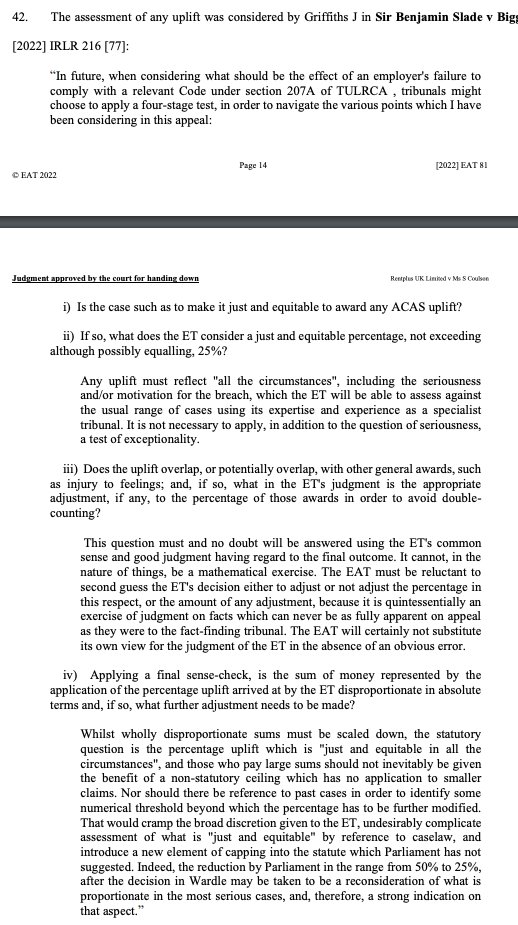
1/ FDA v Bhardwaj: EAT dismisses appeal against refusal of costs orders (& cross-appeal against making of 1), & derides issue-by-issue costs claims & discourages pernickety costs appeals. assets.publishing.service.gov.uk/media/62cea659… #ukemplaw
2/ This is lengthy litigation by B against her former union & 5 of its members. She started the litigation in 2008, lost it & then lost at the EAT & CA before the Supreme Court refused permission to appeal. The FDA applied for costs & partially succeeded. Both sides appealed.
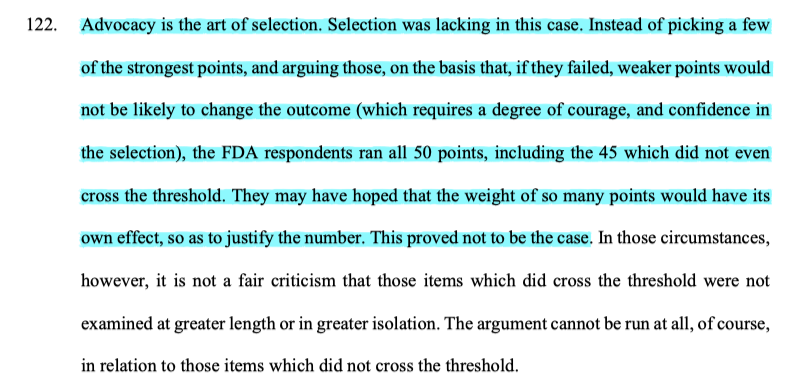
3/ The EAT (Griffiths J) started by bemoaning how great the resources taken up by the case, & how litigation taking up the most resources seem to create their own chain reaction of further & more strenuous fighting. (It was a case in which FDA raised 50 points on costs alone!)
4/ The costs orders made (by EJ Heap) were limited to costs thrown away for 2 days' hearings/adjournment on a privilege issue. EJ Heap declined to make costs orders to FDA re more substantial applications in re the main ET proceedings & re B's recusal & disclosure applications.
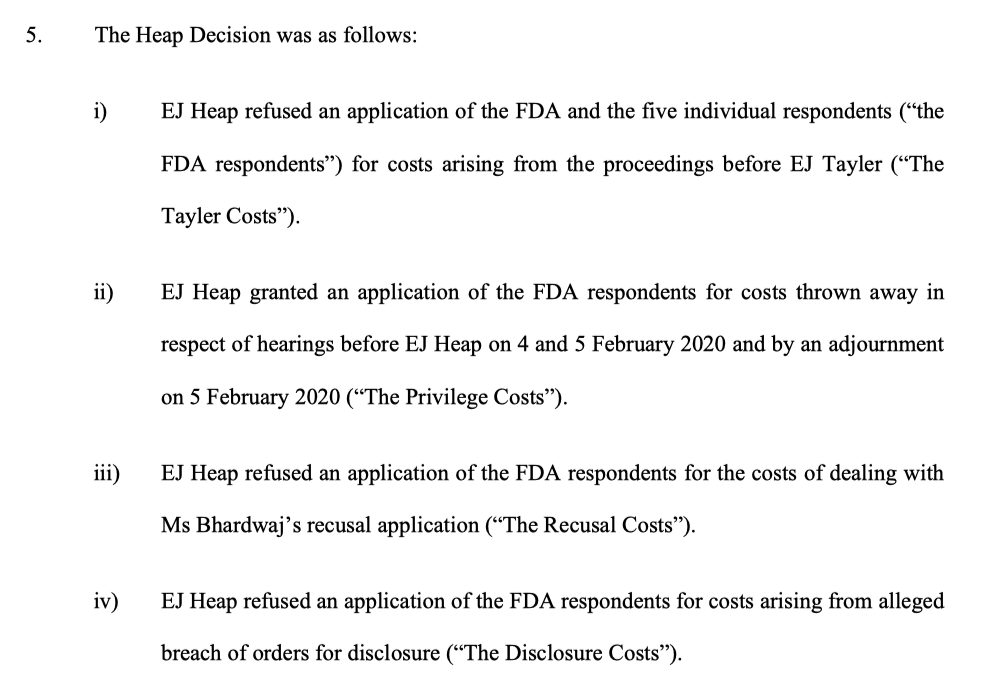
5/ I'm not going to delve greatly into the maze of facts or their treatment in this thread, but there are some useful points to be made on points of law on the treatment of costs applications & appeals within the many grounds of appeal & cross-appeal, so let's focus on those.
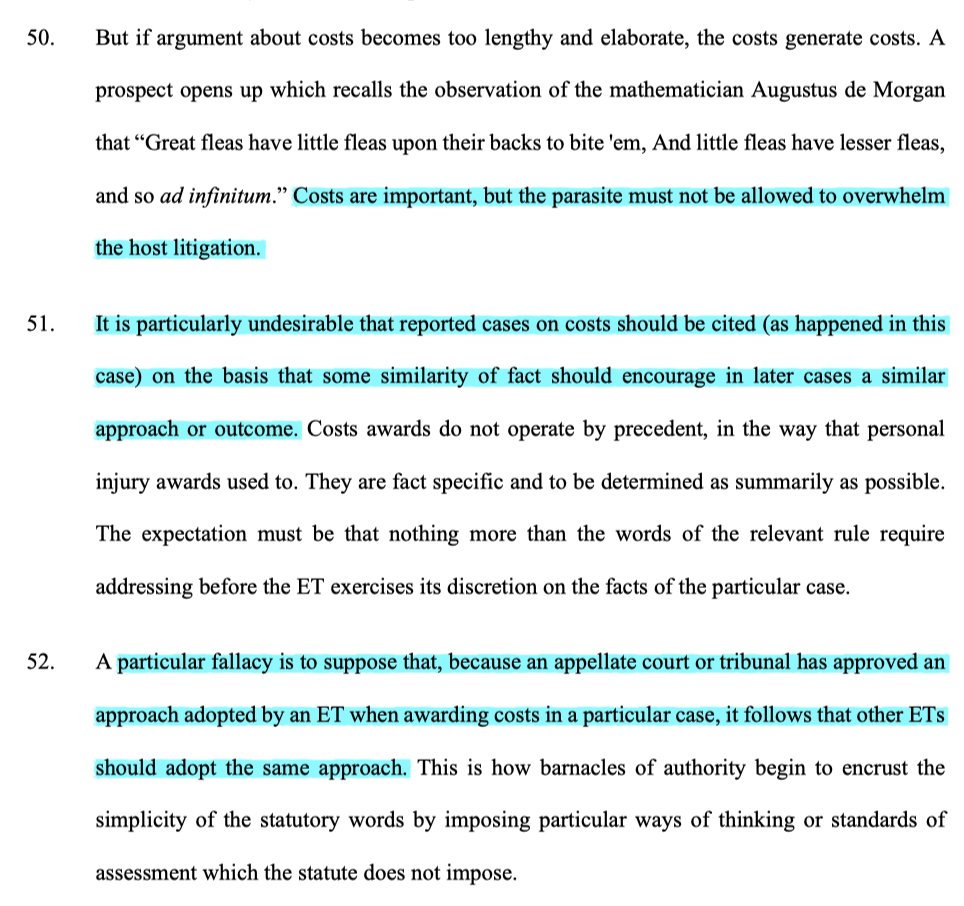
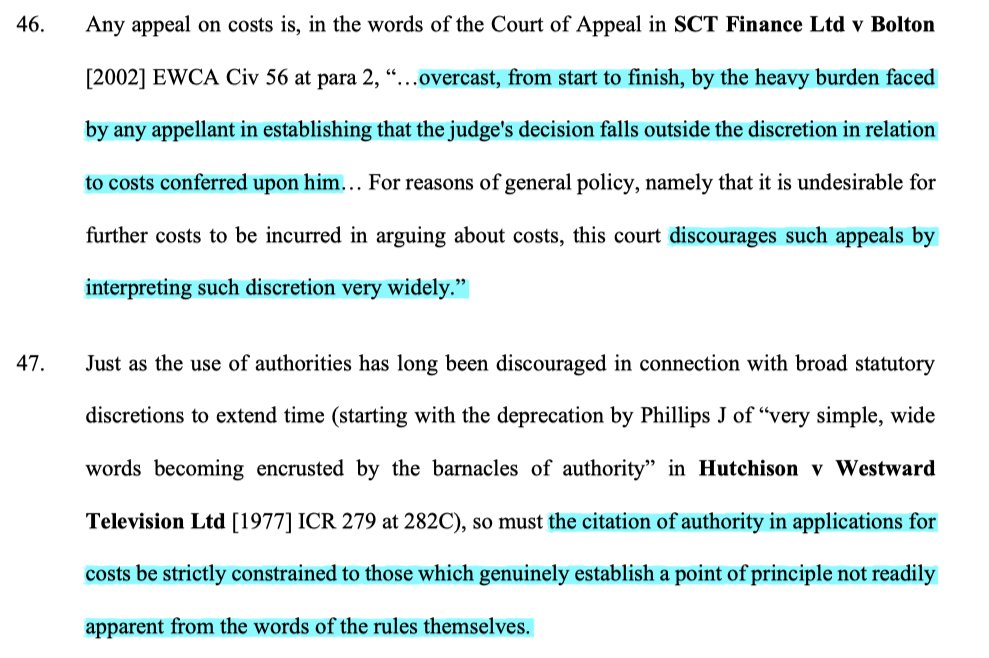
6/ First, the difficulty in appealing a costs application, discouragement by the appellate courts from doing so, & the need to separate out helpful costs authorities explaining points of principle as against those reaching outcomes on particular facts.
7/ On costs for being found to have lied, the FDA relied on Daleside Nursing v Mathew where the EAT found the ET should've made a costs order for a cynical lie at the centre of a race discrim case.
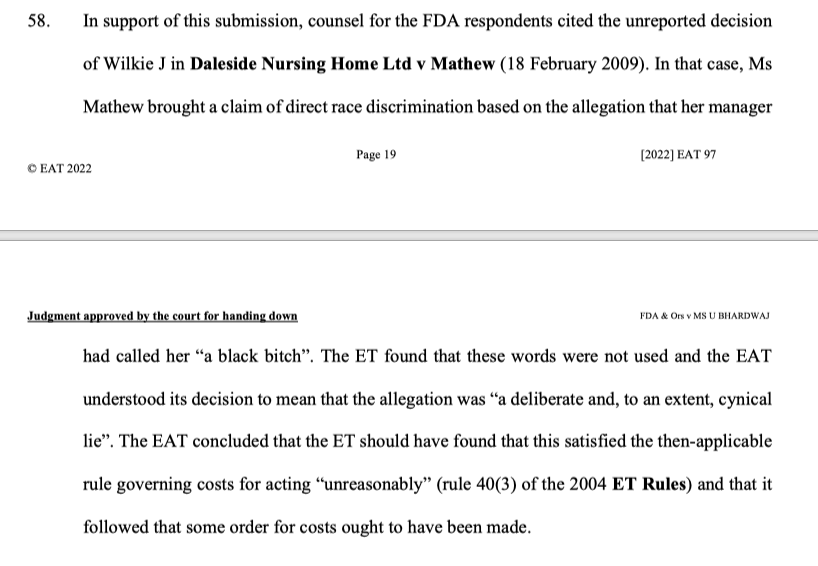
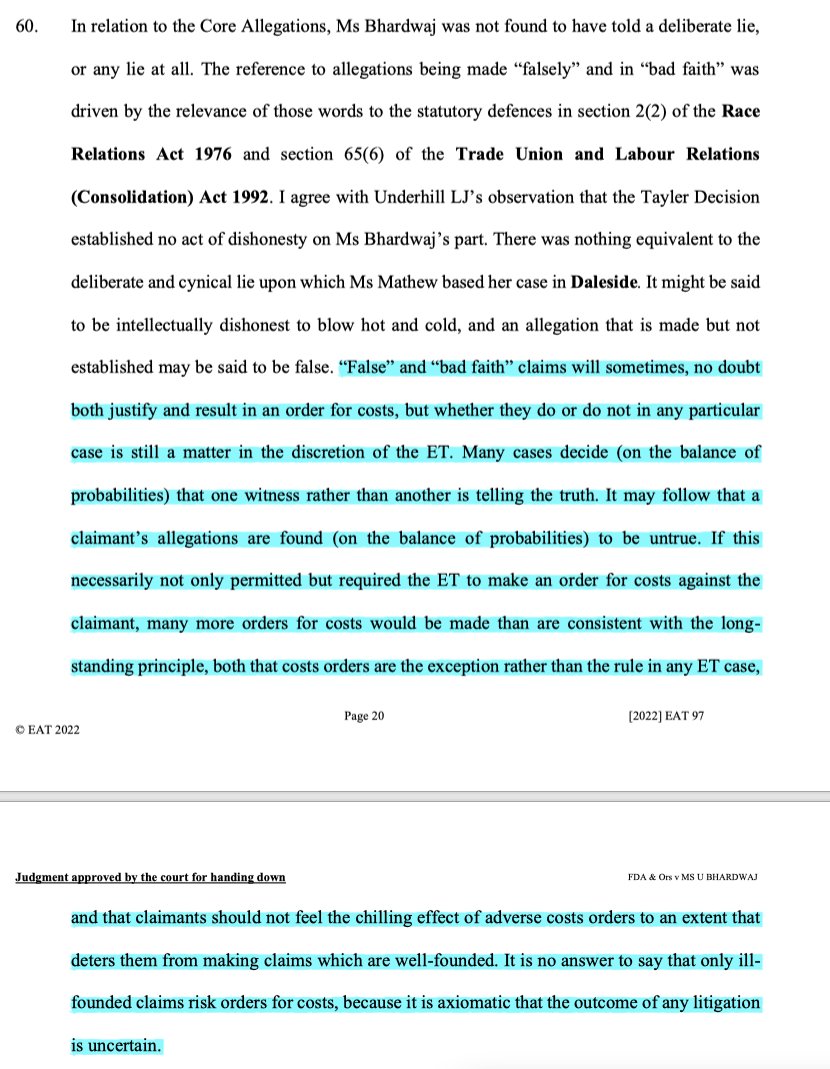
8/ However, Griffiths J didn't consider that decision set out any principle mandating costs for an untruth. It'd have a chilling effect if it did. It's a matter for the ET's discretion in context. There's a difference b/w the cynical lie & an ET preferring 1 side over the other.
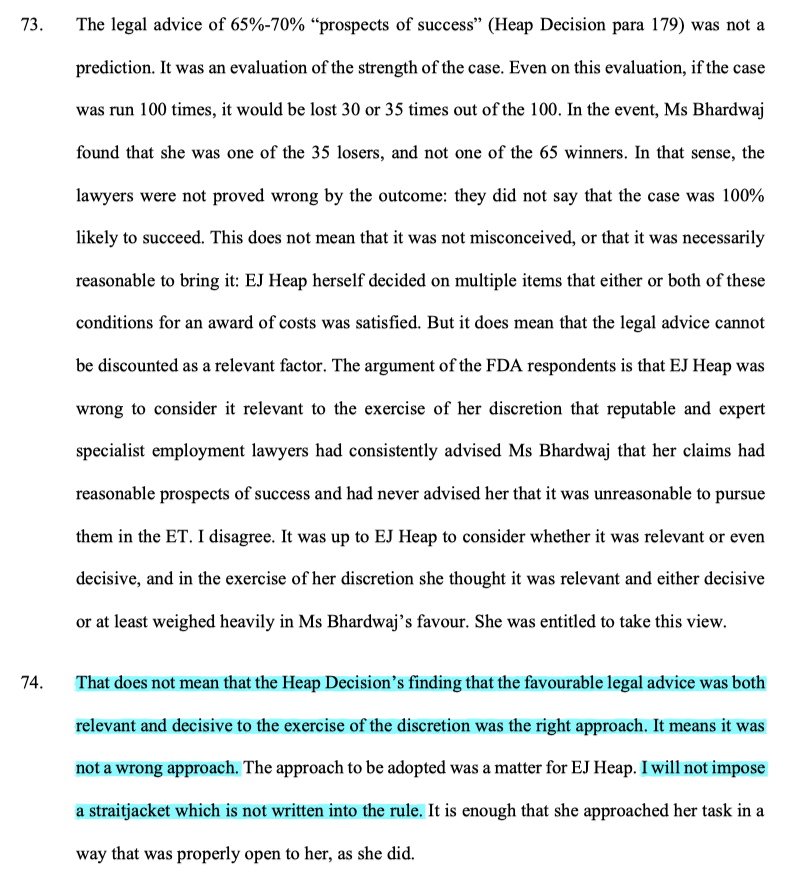
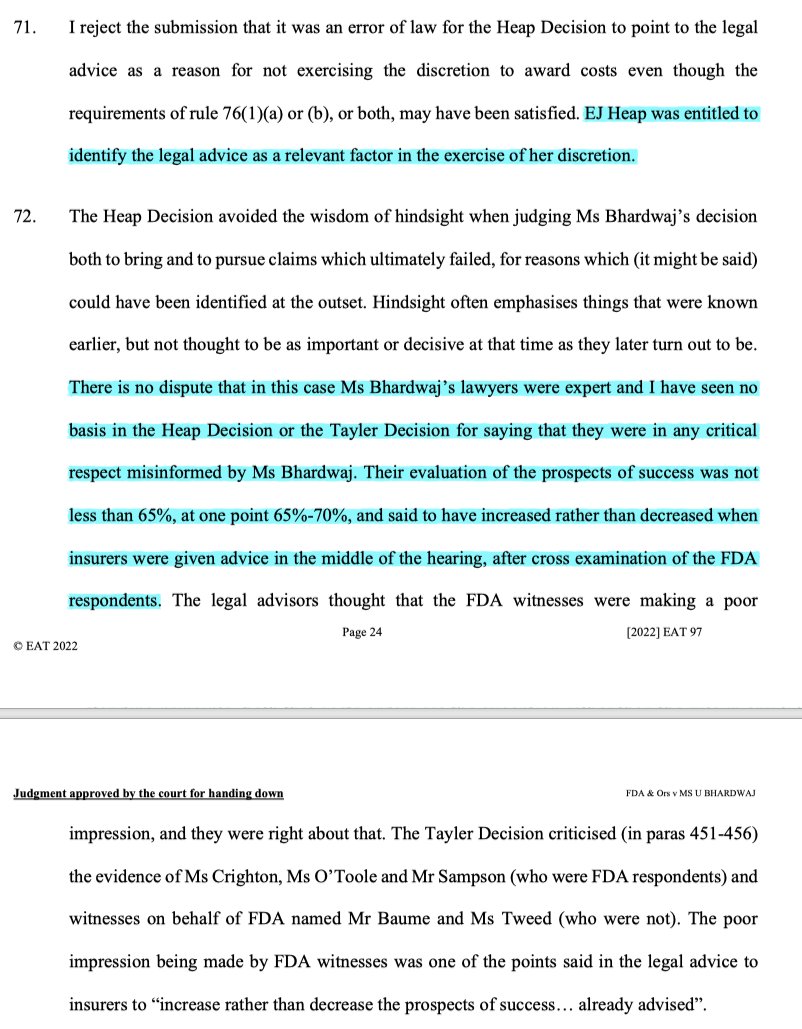
9/ In this case, as privilege had been waived the EJ had all legal advice, which advised B of good prospects of success. It was acceptable for the EJ to take that favourably advice (from experienced employment lawyers) into account in deciding not to award costs.
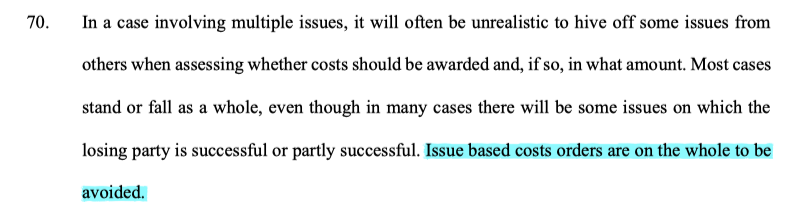
10/ Usefully for claimants facing costs applications on individual aspects of their claim, Griffiths J criticised most cases in which there are multiple issue-based costs applications rather than a holistic application (though I'd say deposit orders 1 of the potential exceptions)
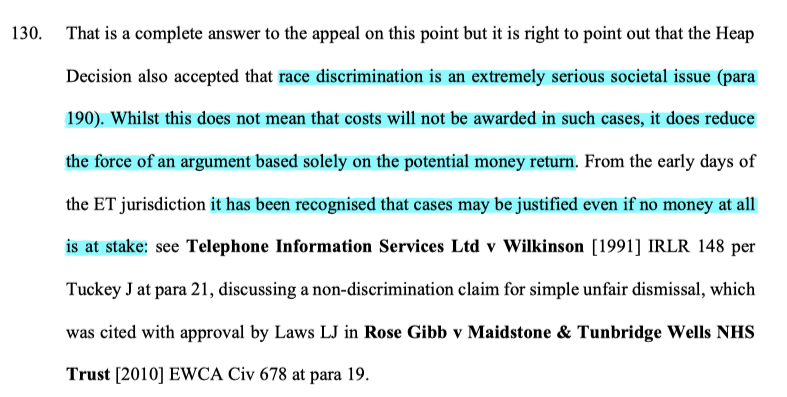
11/ The EAT was unswayed by an argument that it was disproportionate for B to bring her claim given that the value of claims was dwarfed by the costs of bringing them.
The EAT noted ire discrim claims how such serious societal issues can justify a claim even if for no money.
• • •
Missing some Tweet in this thread? You can try to
force a refresh

1/ USDAW v Tesco: CA reverses High Ct declaration & injunction to prevent fire & rehire of Tesco workers with a 'permanent' contractual right to retained pay. bailii.org/ew/cases/EWCA/… #ukemplaw
2/ The facts start in 2007, when Tesco were looking to move distribution centres & to encourage experienced staff to stick around in spite of the considerable inconvenience of the move.
3/ To incentivise them, they offered them "retained pay" a significant additional monthly sum to agree to move to the new centres. There were contractual restrictions on its alteration, & in collective bargaining it was described as 'permanent' save in certain circumstances.
1/ Sejpal v Rodericks Dental Ltd: a must-read case in which the EAT finds the worker status test is very simple, & then throws hand grenades under the reliance on an unfettered right of substitution as a way of denying worker status. caselaw.nationalarchives.gov.uk/eat/2022/91 #ukemplaw
2/ The appeal concerns the question of whether a dismissed dentist was a worker under the ERA (s.230) and in employment under the EqA (s.83(2)). In simple terms, we're looking at questions of limb (b) worker status.
3/ The contractual position was one in which S had worked under an "Associateship Contract" throughout the relevant periods. It had a substitution clause (of which more later) & a clause saying it was a contract for services and not an employment contract.
1/ DWP v Boyers: When considering a s.15 EqA claim re dismissal of a long absent employee, it's appropriate for the ET to look outside the strict contractual terms when reviewing proportionality & the potential solutions to avoid dismissal. gov.uk/employment-app… #ukemplaw
2/ In this case, B had been an admin assistant for 12 years. She was disabled as a result of chronic migraines & anxiety. She considered this to be exacerbated by a colleague & fell out with management due to how they failed to deal with the issue.
3/ After some time, B went off sick. She remained off work for the last 11 months of employment save a 6-week period of a work trial elsewhere. She'd refused to allow DWP to see OH reports & said she wasn't well enough to attend the capability meetings.
1/ Rentplus UK v Coulson: Another HHJ Tayler judgment to keep in your "Essential case law" folder. Almost everything you need to know about the s.207A TULR(C)A uplift in 1 neat, concise judgment. assets.publishing.service.gov.uk/media/62907f52… #ukemplaw
2/ The case concerned a redundancy dismissal for a senior director. The ET found the redundancy process a sham, merely used as a vehicle for a dismissal decided on beforehand.
The ET awarded a 25% uplift for failures to comply with the ACAS Code.
The EAT upheld the uplift.
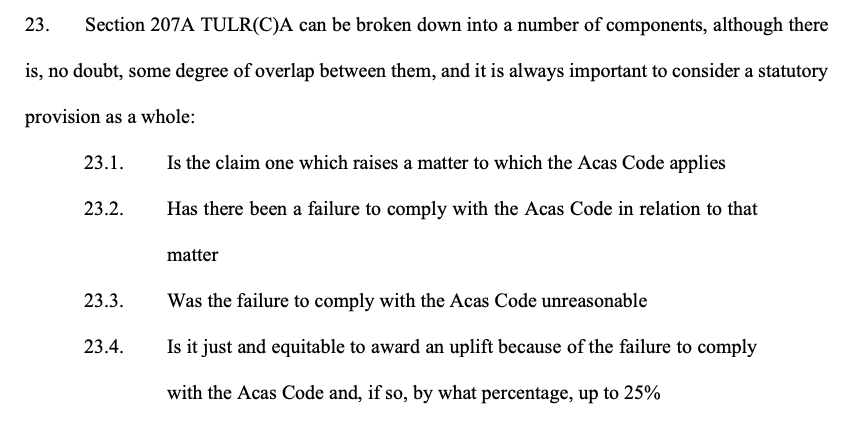
3/ HHJ Tayler provided lots of useful comments on the law on the uplift. First, a simple statement of the 4 stages of the s.207A test (though see Slade v Biggs for a 4-stage breakdown of the last question):
1/ Singh v Metroline West Ltd: It was a fundamental breach of contract to deliberately not pay wages due - it was immaterial that the employer took this action to encourage the employee to engage in a disciplinary process. assets.publishing.service.gov.uk/media/62a208e9… #ukemplaw
2/ In this case, S's contract provided for entitlement to contractual sick pay. S went off sick, it being possible that he did so in order to avoid disciplinary proceedings. S's contract allowed for cessation of sick pay if a thorough investigation found the employee not sick.
3/ There was no such investigation in this case. The employer merely ceased S's contractual sick pay for 7 weeks in order to encourage his participation in the disciplinary process which the employee suspected he'd gone off sick to avoid taking part in.
1/ Dafiaghor-Olomu v Community Integrated Care: In a case where the statutory cap applies & compensation is paid pursuant to an ET order, no credit is given for that payment as against the statutory cap is compensation is then revised upwards. #ukemplaw
2/ The above may sound confusing. The facts will make things simpler. D won her ordinary unfair dismissal claim & CIC was ordered to pay c.£46k in compensation. D then successfully appealed the remedy judgment & on remission the ET decided she was entitled to c.129k compensation.
3/ The relevant statutory cap at the time was £74,200. Should the £46k count against the cap (so that c.£28k remained owing on the remitted judgment) or should the £46k be taken off the £129k so that CIC now had to pay the statutory cap amount of £74,200?