Come to the @icmlconf ML4Astro workshop today to see some exciting new ideas for ML approaches to astronomy! icml.cc/virtual/2022/w…

Here are five contributed papers I coauthored which will be presented today–come check them out:
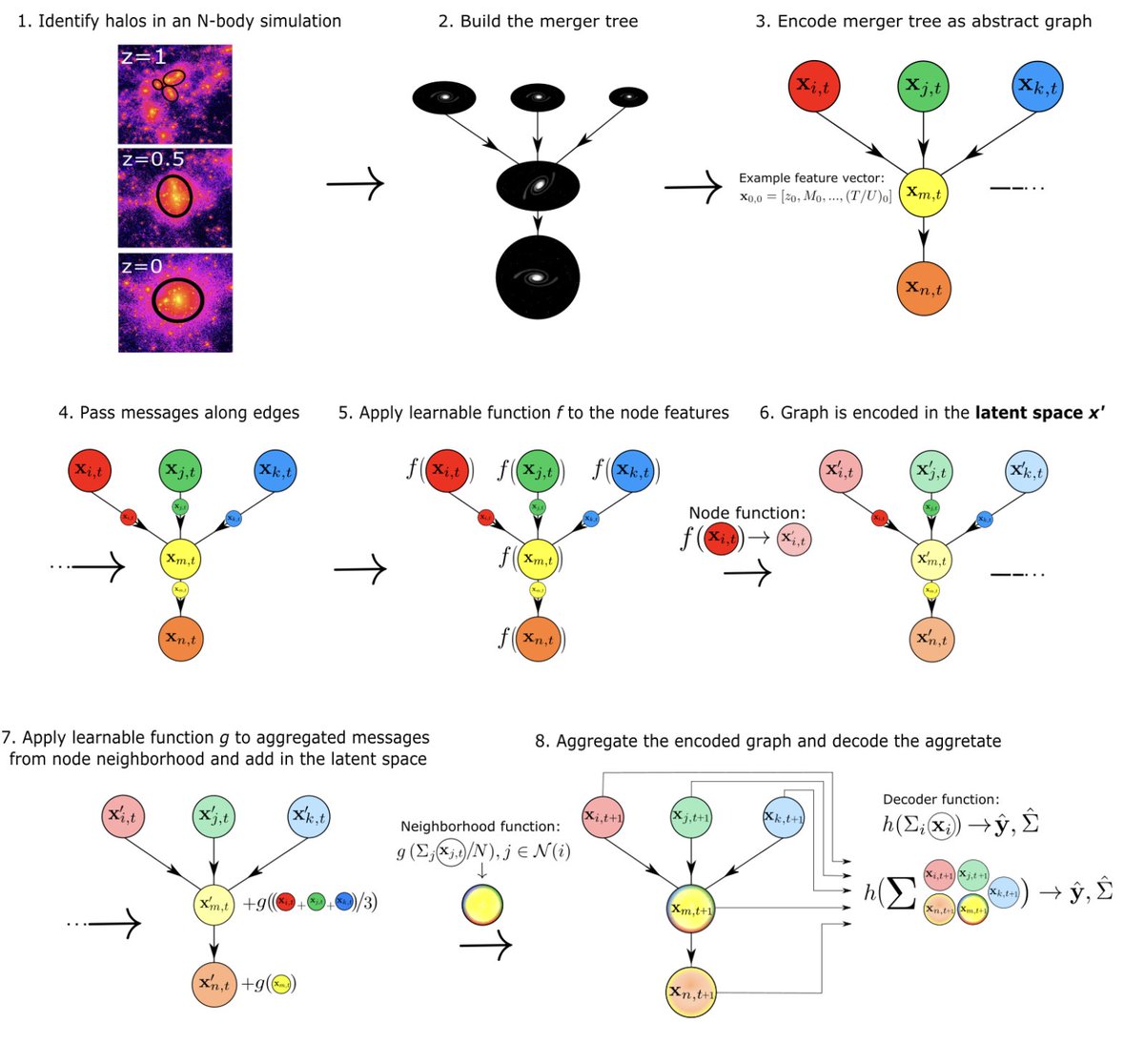
"Learning Galaxy Properties from Merger Trees"
Led by @AstroCKragh, this paper asks: can we predict galaxy properties by using dark matter halo merger history (i.e., the merger tree)? It turns out: yes, and quite accurately too!

ml4astro.github.io/icml2022/asset… Image
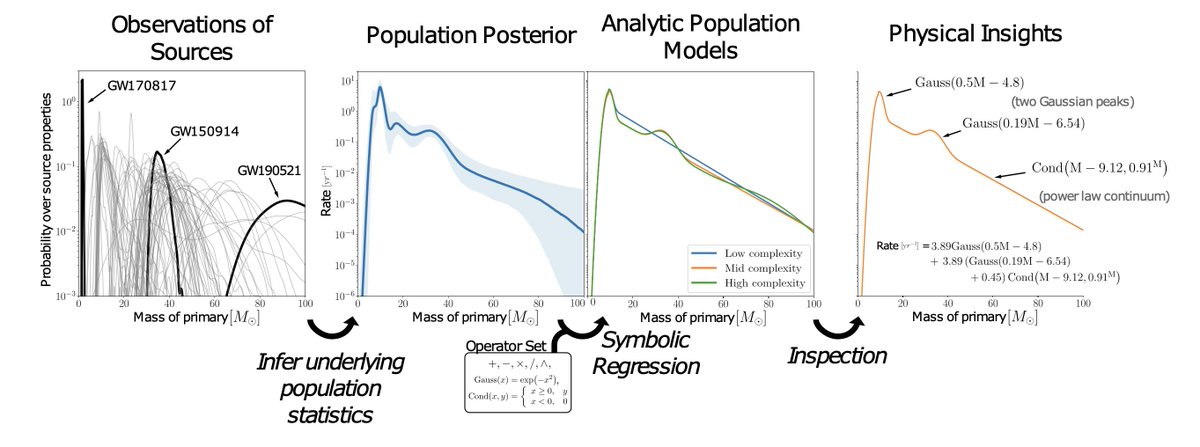
"Automated discovery of interpretable gravitational-wave population models"
w/ @physicskaze

This paper looks at using symbolic regression for astrophysical population models (i.e., the distribution)–particularly that of GW mergers!

ml4astro.github.io/icml2022/asset… Image
"TNT: Vision Transformer for Turbulence Simulations" (oral 2:45p)
Led by students Yuchen Dang + Zheyuan Hu, w/ @meickenberg @cosmo_shirley

Turbulence prediction may be improved with long-range dynamical information–vision transformers are great for this!

ml4astro.github.io/icml2022/asset… Image
"Robust Simulation-Based Inference with Bayesian Neural Networks"
Led by @PabloLemosP. This looks at making SBI generalize better to real data by using Bayesian neural networks!

ml4astro.github.io/icml2022/asset…

Check out Pablo's thread for more details here:
"GaMPEN: An ML Framework for Estimating Galaxy Morphological Parameters and Quantifying Uncertainty"
(oral 10am) by @aritraghsh09. This algorithm gives full posteriors over morphological parameters, w/ rotational equivariance!

Check out Aritra's thread:

• • •

Missing some Tweet in this thread? You can try to force a refresh

 

Keep Current with Miles Cranmer

Miles Cranmer Profile picture

Stay in touch and get notified when new unrolls are available from this author!

Read all threads

This Thread may be Removed Anytime!

PDF

Twitter may remove this content at anytime! Save it as PDF for later use!

Try unrolling a thread yourself!

how to unroll video
  1. Follow @ThreadReaderApp to mention us!

  2. From a Twitter thread mention us with a keyword "unroll"
@threadreaderapp unroll

Practice here first or read more on our help page!

More from @MilesCranmer

Mar 7
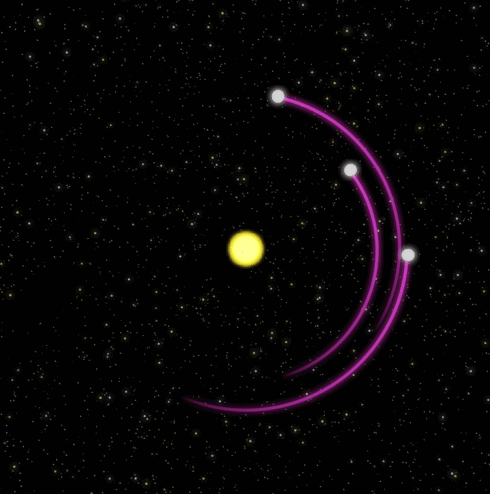
Could machine learning rediscover the law of gravitation simply by observing our solar system?

With our new approach, the answer is *YES*.

Led by: @PabloLemosP
With: @Niall_Jeffrey @cosmo_shirley @PeterWBattaglia
Paper: arxiv.org/abs/2202.02306
Blog: astroautomata.com/paper/rediscov…
Here are two classes of problems which we can already solve:

1. Known law, unknown parameters => parameter inference.

2. Unknown law, known parameters => model discovery (eg, / arxiv.org/abs/2006.11287)

Here we look at unknown law AND unknown parameters!
Summary of the algorithm:

1. Declare unknown physical properties of a system as trainable parameters in a machine learning model.

2. Update these parameters simultaneously with the model weights.

3. Finally, distill the learned model to a set of symbolic rules.
Read 6 tweets
Oct 5, 2021
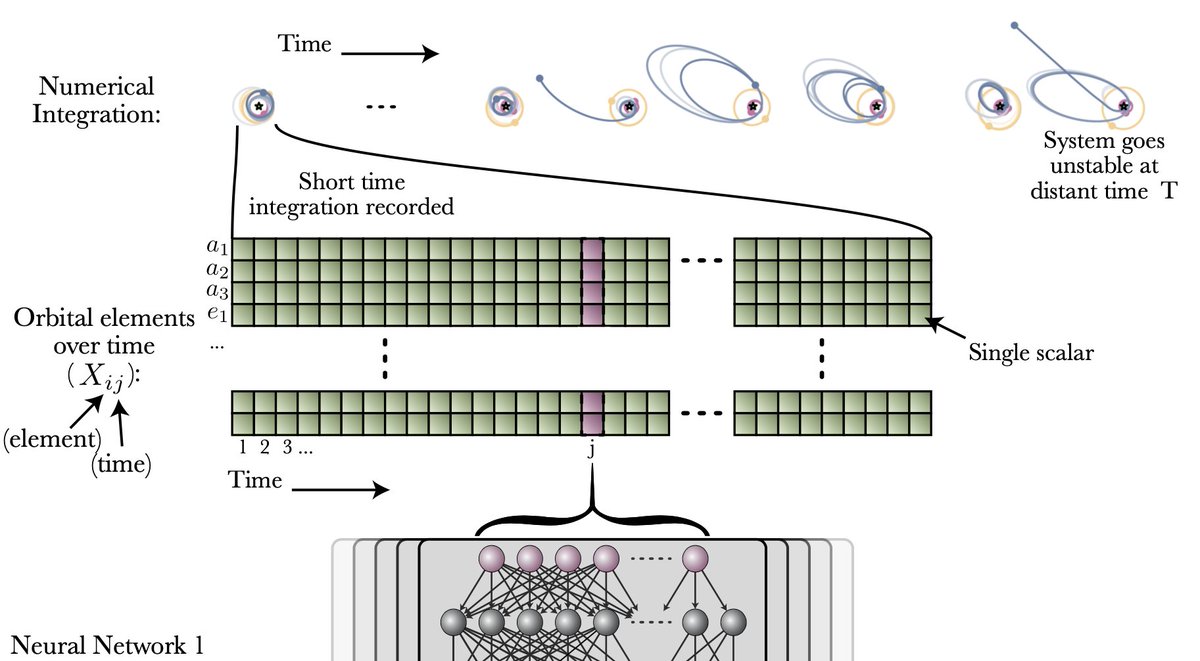
Our paper demonstrating the power of Bayesian Neural Networks for planetary dynamics comes out in PNAS today!

pnas.org/content/118/40… (open access)

This paper explores a match made in heaven: chaotic systems and Bayesian neural networks.

Thread:
2/n
Chaos is synonymous with the "butterfly effect," where infinitesimal changes grow into significant differences over time.

Here's a demo with a double pendulum (from commons.wikimedia.org/w/index.php?ti…):
3/n
This effect is experienced to some extent by nearly all natural systems - including planetary dynamics.

Moving one planet by the *width of a hair* can change the timescale over which a planetary system destabilizes (e.g., ejection of a planet) by a factor of three!
Read 12 tweets
Nov 19, 2020
Here's a thread on lesser-known tools and packages that I could not live without, starting with Python.
(suggestions are very welcome!)

einops:
- github.com/arogozhnikov/e…
- Easily-interpretable reshapes + tiling + aggregations for numpy/torch/tf/etc

1/n
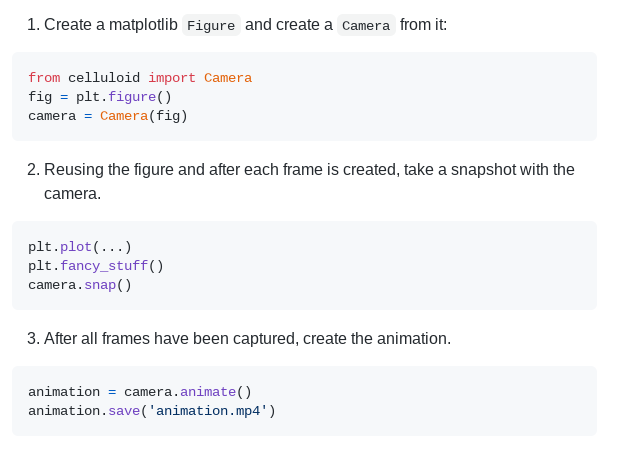
celluloid:
- github.com/jwkvam/cellulo…
- Create matplotlib animations by looping over your plot script and calling camera.snap() each time

2/n
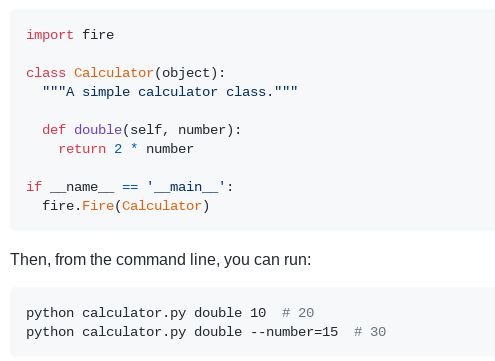
python-fire:
- github.com/google/python-…
- Turn a function/class into a command-line interface with absolutely minimal code

3/n
Read 13 tweets
Jun 23, 2020
Very excited to share our new paper "Discovering Symbolic Models from Deep Learning with Inductive Biases"!

We describe an approach to convert a deep model into an equivalent symbolic equation.

Blog/code: astroautomata.com/paper/symbolic…
Paper: arxiv.org/abs/2006.11287

Thread👇
1/n
Work w/ Alvaro Sanchez-Gonzalez and @PeterWBattaglia (@DeepMind), Rui Xu (@Princeton), @KyleCranmer (@NYUDataScience), and @DavidSpergel and @cosmo_shirley (@FlatironCCA).

2/n
Symbolic models are the language of the natural sciences. Unlike deep models, they are compact, explicitly interpretable, and generalize well.

Simple symbolic expressions are a uniquely powerful way of modeling the world. Though the origin of this connection is unknown:

3/n
Read 13 tweets
May 12, 2020
Machine learning is both underused and overused in astrophysics.

What do I mean by this? 👇

1/n
Overused:
Many ML applications in astrophysics aren't necessary. When applied to the wrong problem, modern ML can be overinterpreted and overextrapolated.

E.g., when deep NNs are applied to low-data low-dimensional problems.

2/n
A simpler algorithm will often do just as well and be far more interpretable. Interpretation is the essence of science!

In this regime we need more inductive biases and priors, more Bayes, and more explicit interpretation.

3/n
Read 7 tweets
Apr 18, 2020
1/10 This was a phenomenal discussion. I have many more questions than answers now but I think that's a good thing.

Here's a list of some interesting papers mentioned.
2/10 First, papers referenced in main tweet:
LNNs - arxiv.org/abs/2003.04630
HNNs - arxiv.org/abs/1906.01563
Graph Nets - arxiv.org/abs/1806.01261 (+ refs therein...)
Group-CNNs - proceedings.mlr.press/v48/cohenc16.p…
3/10 Now, some papers mentioned in the thread:
@KrippendorfSven - arxiv.org/abs/2003.13679 - identifies symmetries by considering generating operators in a compressed latent space
Read 10 tweets

Did Thread Reader help you today?

Support us! We are indie developers!


This site is made by just two indie developers on a laptop doing marketing, support and development! Read more about the story.

Become a Premium Member ($3/month or $30/year) and get exclusive features!

Become Premium

Don't want to be a Premium member but still want to support us?

Make a small donation by buying us coffee ($5) or help with server cost ($10)

Donate via Paypal

Or Donate anonymously using crypto!

Ethereum

0xfe58350B80634f60Fa6Dc149a72b4DFbc17D341E copy

Bitcoin

3ATGMxNzCUFzxpMCHL5sWSt4DVtS8UqXpi copy

Thank you for your support!

Follow Us on Twitter!

:(