Mike Driscoll Profile picture
Jul 24, 2022 5 tweets 3 min read Read on X
You need to know the basics of #Python to be able to use it effectively.

So let's talk about how you can slice a list. List slicing is where you use square brackets to "slice" out a subset of the list.

A slice is a portion of a list returned as a new list

🧵👇 Image
Here is an example of slicing a #Python list: Image
You can also use negative values when slicing a #Python list

This example demonstrates using a negative value for the beginning of the slice while ALSO not specifying the end of the slice Image
You don't need to specify the beginning of a #Python list slice either.

In this example, I want to grab all the values starting at index 0 up to but not including index 3. Image
What do you think happens when you don't specify a beginning or an ending in a #Python list slice? Image

• • •

Missing some Tweet in this thread? You can try to force a refresh

 

Keep Current with Mike Driscoll

Mike Driscoll Profile picture

Stay in touch and get notified when new unrolls are available from this author!

Read all threads

This Thread may be Removed Anytime!

PDF

Twitter may remove this content at anytime! Save it as PDF for later use!

Try unrolling a thread yourself!

how to unroll video
  1. Follow @ThreadReaderApp to mention us!

  2. From a Twitter thread mention us with a keyword "unroll"
@threadreaderapp unroll

Practice here first or read more on our help page!

More from @driscollis

Feb 1, 2024
Did you know that #Python supports SQLite in the standard library? That's right. You don't need to install anything! 🐍🚀

Let's talk a little about that!

🧵👇
If you have a pre-existing SQLite database file, you can use #Python's `sqlite3` module to connect to it

Here's how: Image
If you want to create a new SQLite database with #Python, you can use the same syntax that you'd use to connect to a pre-existing one.

Then create a cursor object and create your table, like this: Image
Read 8 tweets
Nov 21, 2023
Today is a great day to talk about #Python lambdas!

Let's learn about them in a thread

🐍🧵👇
A Python lambda is a one-line anonymous function.

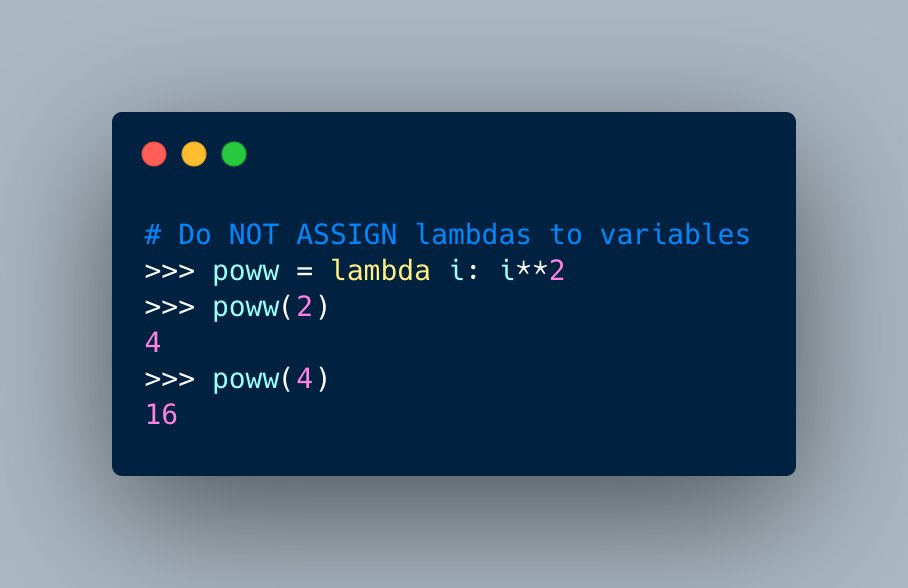
Rule #1 is do NOT assign a lambda to a variable.

When you do that, it's no longer an anonymous function. You should just create a regular function at that point Image
If you want to run a lambda in your REPL, wrap it in parentheses, like this: Image
Read 9 tweets
Mar 23, 2023
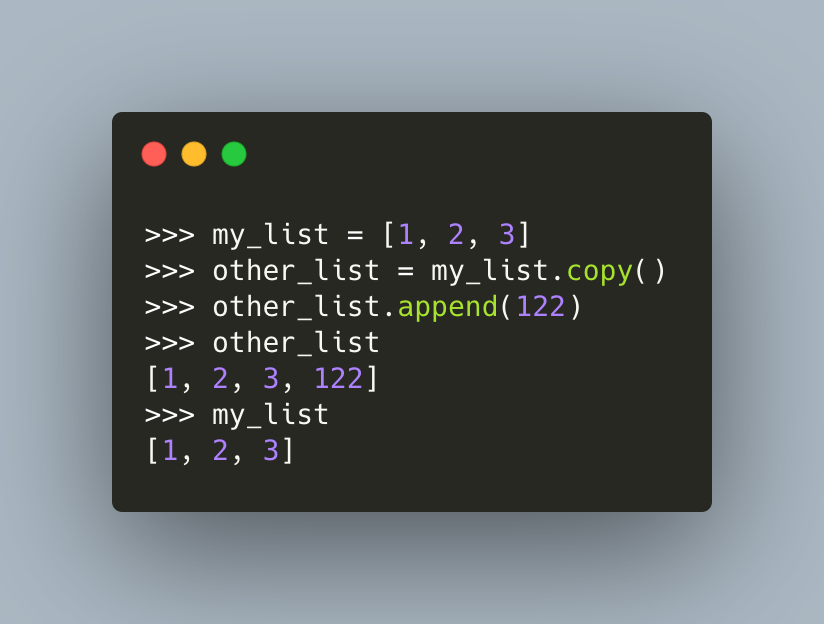
Want to create a copy of a #Python list? Use Python's `copy()` method!

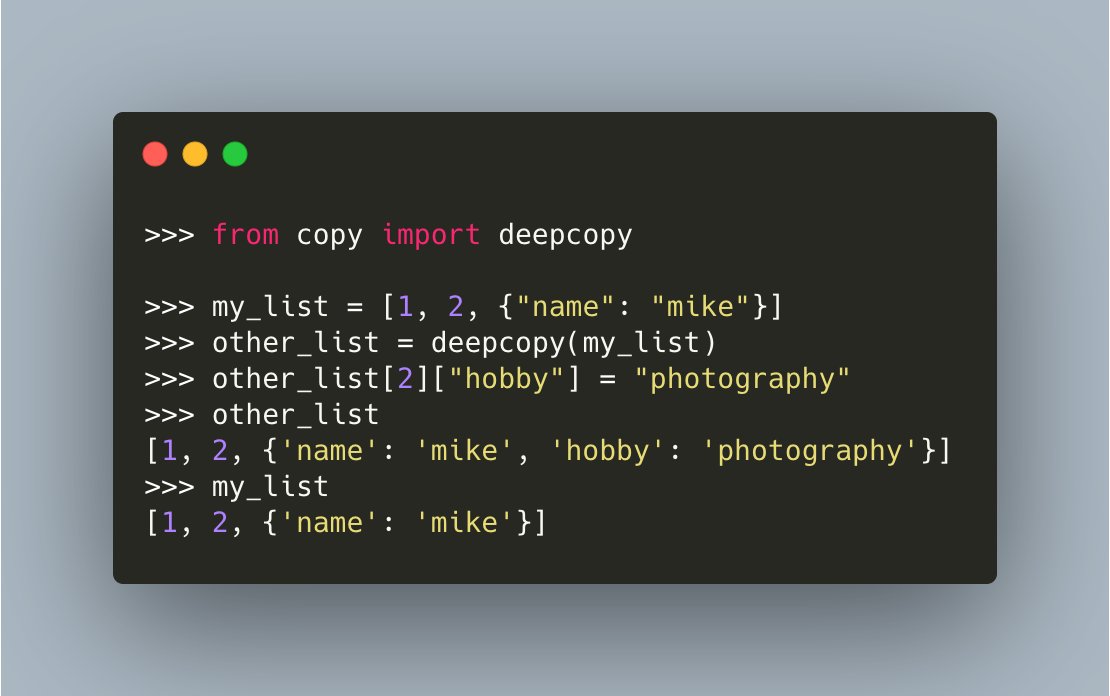
Note: Watch out if your list contains lists of dictionaries. In those cases, you might be better off using copy.deepcopy()
But be careful! If your list contains a mutable object, like another list or a dictionary, you may encounter some unexpected behavior.

In the following example, you `copy()` the list. Then you modify the nested dictionary in the copy, but that also changes the original list!
You can fix this behavior by using Python's `copy` module. It provides a deepcopy() function that you can use which will make a deep copy of the ENTIRE list!
Read 4 tweets
Mar 22, 2023
#Python generators aren't talked about enough.

So let's talk about them today!

🧵🐍👇
According to the #Python wiki, "Generator functions allow you to declare a function that behaves like an iterator"

One of their best use cases is to chunk through large data sets a piece at a time, which prevents you from running out of memory.

wiki.python.org/moin/Generators
To create a generator in #Python, you need to use the `yield` keyword instead of `return` inside a function.

Generators will continue to yield values until the generator is exhausted.

The following example will continue to yield numbers for as long as you call it: Image
Read 10 tweets
Mar 21, 2023
My 11th #Python book is now available! 🐍🤯

Test your Python skills and knowledge with over 100 PYthon quizzes. Answers are included if you get stuck!

Available on Amazon, Leanpub, and Gumroad (see following tweets)
Get my 11th #Python book, The Python Quiz book on Amazon in the following formats:

🐍 Kindle
🐍 Paperback

amazon.com/dp/B0BVT8DZV1
You can find The Python Quiz Book on @gumroad too in the following formats:

🐍 epub
🐍 PDF

driscollis.gumroad.com/l/pyquiz
Read 4 tweets
Mar 17, 2023
Starting in Python 3.7, the `breakpoint()` built-in function was added

It is defined in PEP 553 and simplifies adding a breakpoint to your code

#python_builtins_by_driscollis

🧵🐍👇
You can read about the `breakpoint()` function for Python here:

python.org/dev/peps/pep-0…
Here is some sample code showing how to use the `breakpoint()` function in your Python code
Read 6 tweets

Did Thread Reader help you today?

Support us! We are indie developers!


This site is made by just two indie developers on a laptop doing marketing, support and development! Read more about the story.

Become a Premium Member ($3/month or $30/year) and get exclusive features!

Become Premium

Don't want to be a Premium member but still want to support us?

Make a small donation by buying us coffee ($5) or help with server cost ($10)

Donate via Paypal

Or Donate anonymously using crypto!

Ethereum

0xfe58350B80634f60Fa6Dc149a72b4DFbc17D341E copy

Bitcoin

3ATGMxNzCUFzxpMCHL5sWSt4DVtS8UqXpi copy

Thank you for your support!

Follow Us!

:(