Where did the pandemic begin?
Was it from nature or a lab?
Since the start, this fundamental question has gone unanswered.
Until now.
Out in @ScienceMagazine: SARS-CoV-2 emerged into humans via the live animal trade at the Huanan Seafood Market.
science.org/doi/10.1126/sc…
Was it from nature or a lab?
Since the start, this fundamental question has gone unanswered.
Until now.
Out in @ScienceMagazine: SARS-CoV-2 emerged into humans via the live animal trade at the Huanan Seafood Market.
science.org/doi/10.1126/sc…
This is a companion to this paper, by @jepekar et al, also out today in @ScienceMagazine. This shows that there were at least two separate zoonotic spillover events at Huanan, probably a week or so apart.
science.org/doi/10.1126/sc…
science.org/doi/10.1126/sc…
For the last 2.5 years there's been lots of acrimonious debate on the various origin hypotheses: nature or lab leak? Much of it was data-free, conspiratorial speculation.
The only thing everyone could agree on was the need for an independent, evidence-based investigation.
The only thing everyone could agree on was the need for an independent, evidence-based investigation.
Along with an extraordinary team of collaborators led by @MichaelWorobey & @K_G_Andersen, we set out to do just that. We are a group of academic virologists & evolutionary biologists with no financial or political agenda. We are independent. We follow the evidence where it leads.
And while the evidence base is incomplete, imperfect, & inaccessible, there *is* still evidence. Quite a bit, actually.
So we set out to verify & analyze the evidence that we could access. And the results were clear:
All data points lead back to the Huanan Seafood Market.
So we set out to verify & analyze the evidence that we could access. And the results were clear:
All data points lead back to the Huanan Seafood Market.
Exactly 5 months ago, we released our findings as preprints. While *we* were convinced of our findings, we knew the next step toward consensus required subjecting our work to the rigors of peer-review.
https://twitter.com/angie_rasmussen/status/1497692666997329923?s=20&t=VXgx4f8wqG6iGr9aI47kWw
So we did. After multiple rounds of highly critical review over months, these papers are substantively improved. Although many questions remain, these provide conclusive evidence that SARS-CoV-2 emerged via at least 2 zoonotic spillovers from animals sold at Huanan.
Yes, the data is incomplete and imperfect, but it overwhelmingly shows that the pandemic began at Huanan through zoonosis, not at the WIV or any other lab.
The evidence has stacked up for zoonosis. There remains no evidence for lab leak besides "started in Wuhan."
The evidence has stacked up for zoonosis. There remains no evidence for lab leak besides "started in Wuhan."
That brings me to the evidence itself. How do we know it's from nature and not a lab?
Let's start by looking at a map. These are the earliest cases on record. They cluster around the Huanan market and not the WIV, which is on the other side of the Yangtze River.
Let's start by looking at a map. These are the earliest cases on record. They cluster around the Huanan market and not the WIV, which is on the other side of the Yangtze River.
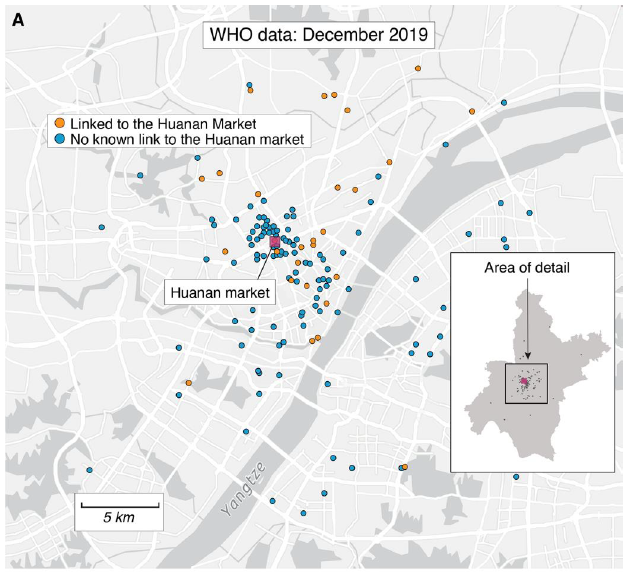
This remains true whether these cases were epidemiologically linked to the market or not. This pattern is consistent with newly established chains of transmission flowing outward from a central point.
Like an earthquake, spread radiates out from the epicenter.
Like an earthquake, spread radiates out from the epicenter.
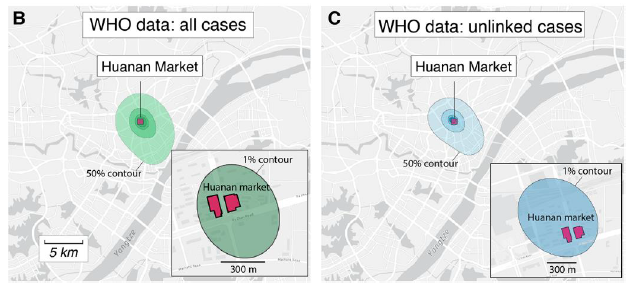
Later, the pattern becomes more diffuse as the virus spread throughout Wuhan. Again, this is consistent with emergence at the market in late November or early December 2019 followed by transmission throughout Wuhan (and eventually the rest of China and the world).
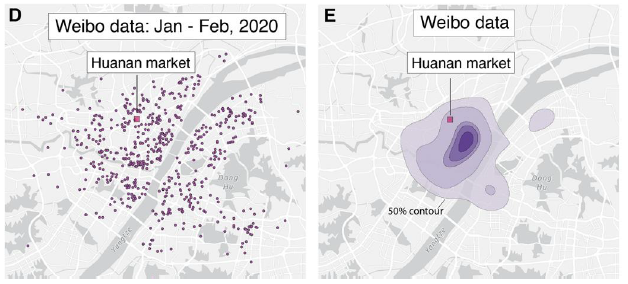
This shows the center points of Wuhan population density & Dec cases regardless of market association or not & virus lineage. The virus center points are all strongly linked to the market, while population is not.
If this were a dartboard, Huanan market would be the bullseye.
If this were a dartboard, Huanan market would be the bullseye.
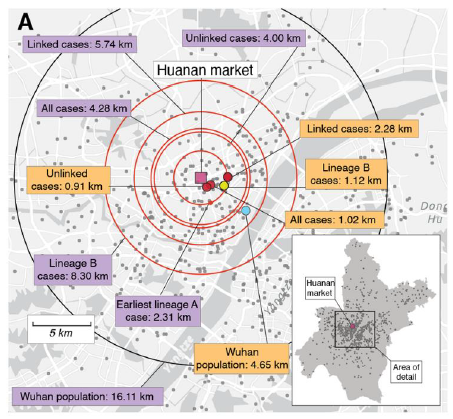
This schematic illustrates the significance of these center points. Early cases will not just be *near* the site where the pandemic started, they will be *centered* on it. That central place where this pandemic originated is the Huanan Seafood Market.
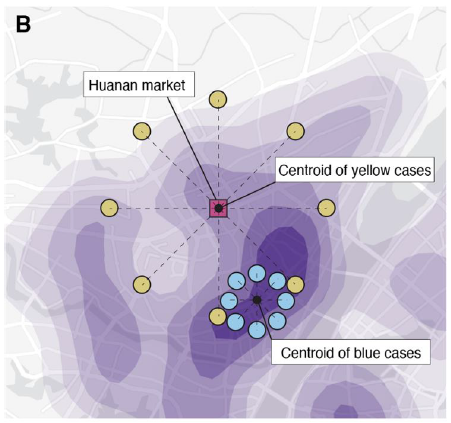
This shows the probability that you'd find cases from Dec within each contour if you used the distribution from Jan-Feb when spread was broader.
You'd expect to see this case density < 1/100,000 times if you sampled the Jan-Feb data.
Proximity to Huanan is not a coincidence.
You'd expect to see this case density < 1/100,000 times if you sampled the Jan-Feb data.
Proximity to Huanan is not a coincidence.
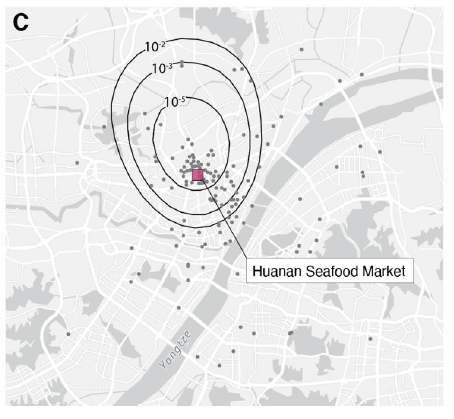
But how do we know that Huanan wasn't just a big superspreader event? Health officials knew early on that cases were associated with the market, so didn't they just look more there? Wuhan is a big city of 11 million people and there are other places the outbreak could start.
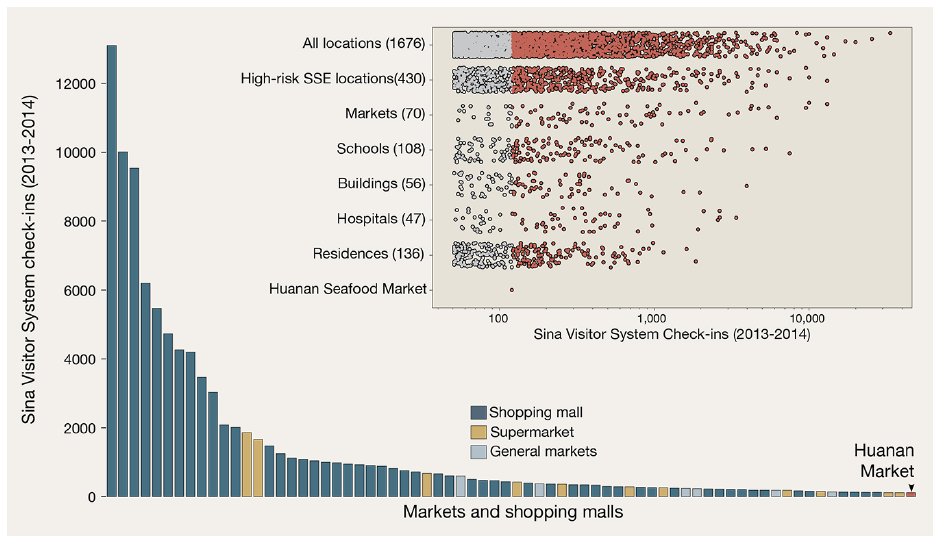
Looking at social media check-ins, we see that compared to other likely locations (including places considered high risk for superspreader events), Huanan got very little traffic and was much, much less likely to be the site of an early SSE than 100s of other places in Wuhan.
We also know there were multiple animal species that are known to be susceptible to SARS-CoV-2 being sold at Huanan in November and December 2019. That includes raccoon dogs & red foxes, as well as other animals likely to be susceptible like badgers, hares, hedgehogs, & muntjacs.
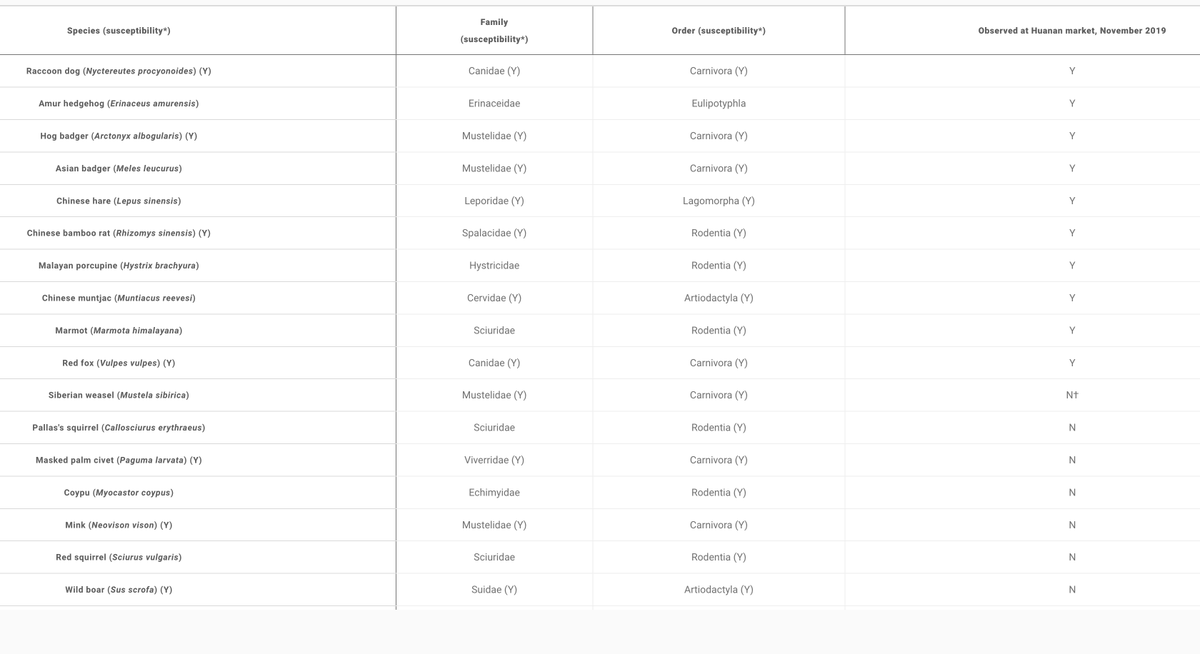
Don't believe me? Well, this paper from last summer proves it. Xiao et al documented live animal sales through December of 2019.
nature.com/articles/s4159…
nature.com/articles/s4159…
Sleuthing is very popular in origins research, so we did some of our own to identify the specific stalls where these photos were taken. We also got hold of a report from the China CDC that described environmental samples positive for SARS-CoV-2 & their location in the market.
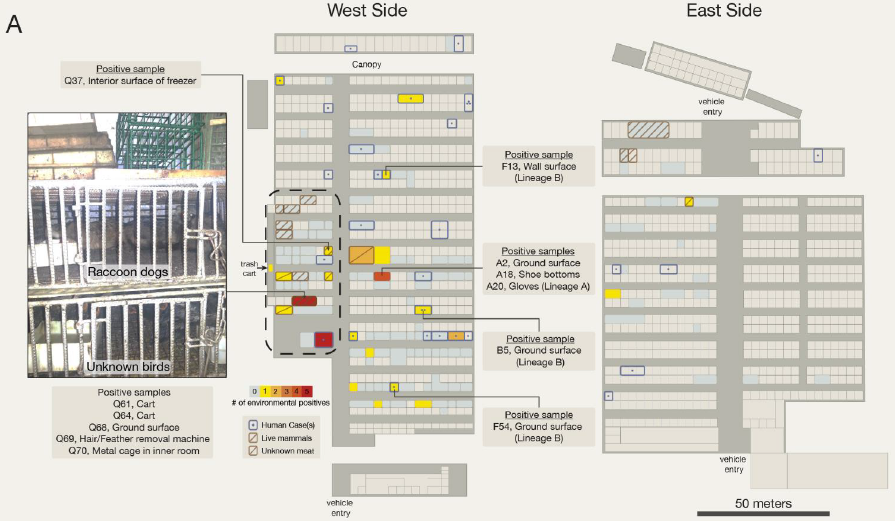
Guess what else? Those environmental samples were lifted from objects associated with live animal sales: cages, carts on which cages were stacked, and a hair and feather removal machine.
Now might be the time you ask "But Angie, why didn't they find any infected animals?"
Now might be the time you ask "But Angie, why didn't they find any infected animals?"
You can't find what you are intentionally not looking for. The market was closed Dec 31 without sampling any relevant species.
So we can't know which animal(s) were intermediate hosts. But the environmental samples point to the animals nonetheless.
So we can't know which animal(s) were intermediate hosts. But the environmental samples point to the animals nonetheless.
When we look at the distribution of positive samples in the market, we see that they are overwhelmingly associated with the west side where animals were sold, in the corner where the stalls sold animals.
This is a strong statistical association and it's not a coincidence.
This is a strong statistical association and it's not a coincidence.
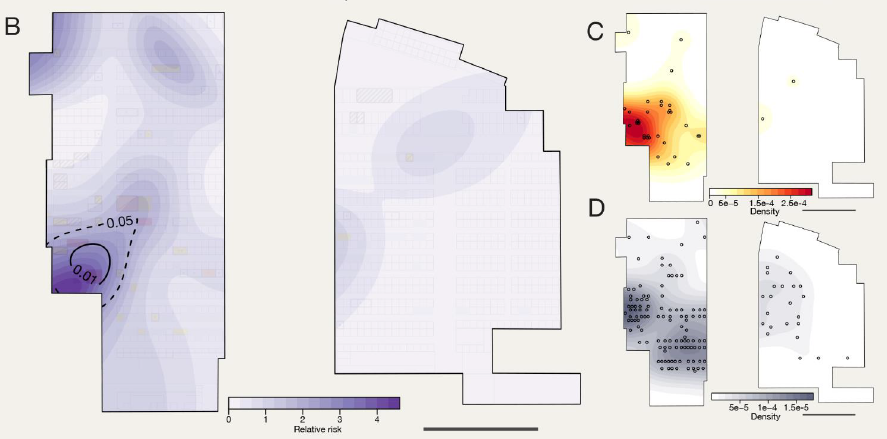
And back to the humans in the market, we see that the cases from prior to Dec 20th were all on the west side of the market where the animals were (albeit more diffuse, since humans can walk around unlike animals in cages).
This is also not a coincidence.
This is also not a coincidence.
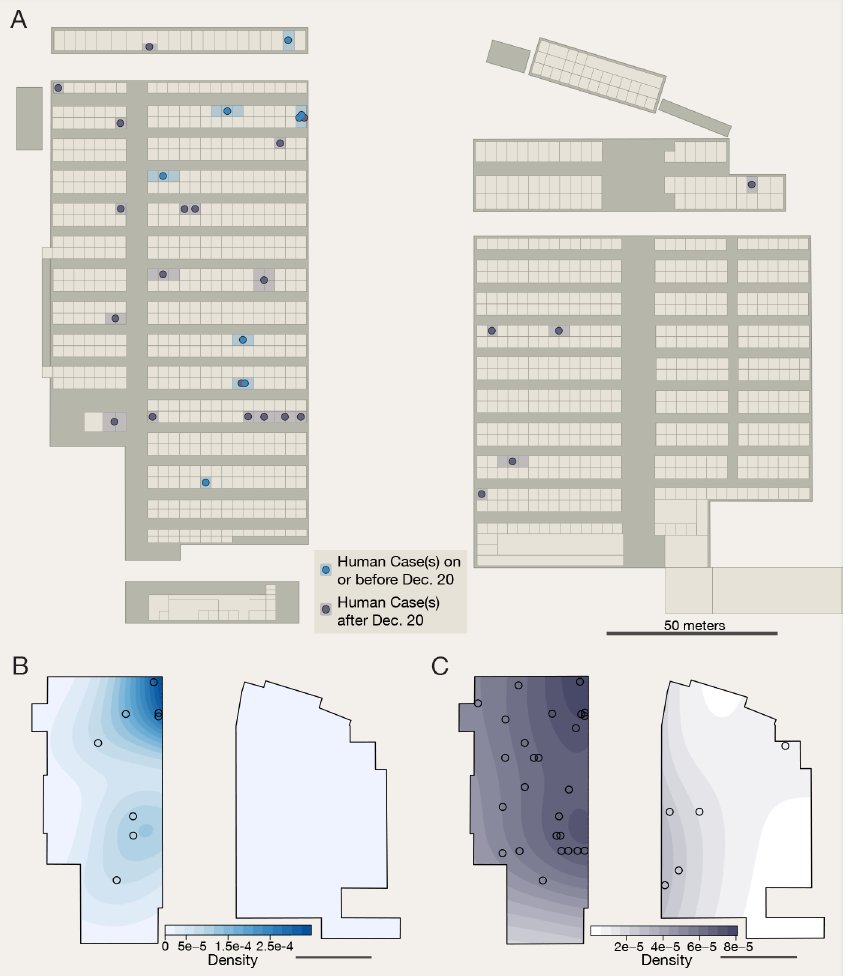
Finally, there's one finding that has been peppered throughout all these figures and that's the presence of lineage A at the market, shown by this preprint published 5 months and a day ago by Gao et al.
researchsquare.com/article/rs-137…
researchsquare.com/article/rs-137…
Early on in the pandemic, there were two lineages of SARS-CoV-2, lineage A and lineage B.
We knew that lineage A cases were geographically associated with the market in Wuhan, but we thought all the known market cases were lineage B.
Until this preprint put lineage A there too.
We knew that lineage A cases were geographically associated with the market in Wuhan, but we thought all the known market cases were lineage B.
Until this preprint put lineage A there too.
That means that Huanan could not have been a human to human amplification event.
The market didn't get much traffic relative to many other locations throughout Wuhan and it is vanishingly unlikely that both lineages would be present.
The market didn't get much traffic relative to many other locations throughout Wuhan and it is vanishingly unlikely that both lineages would be present.
Try fitting this into a lab leak scenario:
Worker 1 gets infected with lineage B at WIV and immediately goes straight to the market, only infecting other people once there.
A week later, worker 2 gets infected with lineage A at WIV & also immediately goes straight to Huanan.
Worker 1 gets infected with lineage B at WIV and immediately goes straight to the market, only infecting other people once there.
A week later, worker 2 gets infected with lineage A at WIV & also immediately goes straight to Huanan.
There's a much simpler explanation:
Human at market 1 gets infected with lineage B from a live animal sold at the market.
A week later, human at market 2 gets infected with lineage A from another live animal sold at the market.
Human at market 1 gets infected with lineage B from a live animal sold at the market.
A week later, human at market 2 gets infected with lineage A from another live animal sold at the market.
This is very plausible, because the animals were kept in such close quarters and were part of a common supply chain. One infected animal would spread virus to others, allowing for the divergence of the two lineages prior to zoonotic transmission to humans.
And I don't care how many questions you just ask or how much hand waving you do about deleted data, unfunded grant applications, or other speculative what-if scenarios.
Zoonotic spillover at Huanan is the only emergence scenario that accounts for all these threads of evidence.
Zoonotic spillover at Huanan is the only emergence scenario that accounts for all these threads of evidence.
And I'm not even done with this thread and already the bad faith takes are rolling in from people with a vested interest in a lab origin, like this below.
Our article makes it 100% clear the pandemic originated at Huanan market. We present the evidence & it passed peer-review.
Our article makes it 100% clear the pandemic originated at Huanan market. We present the evidence & it passed peer-review.
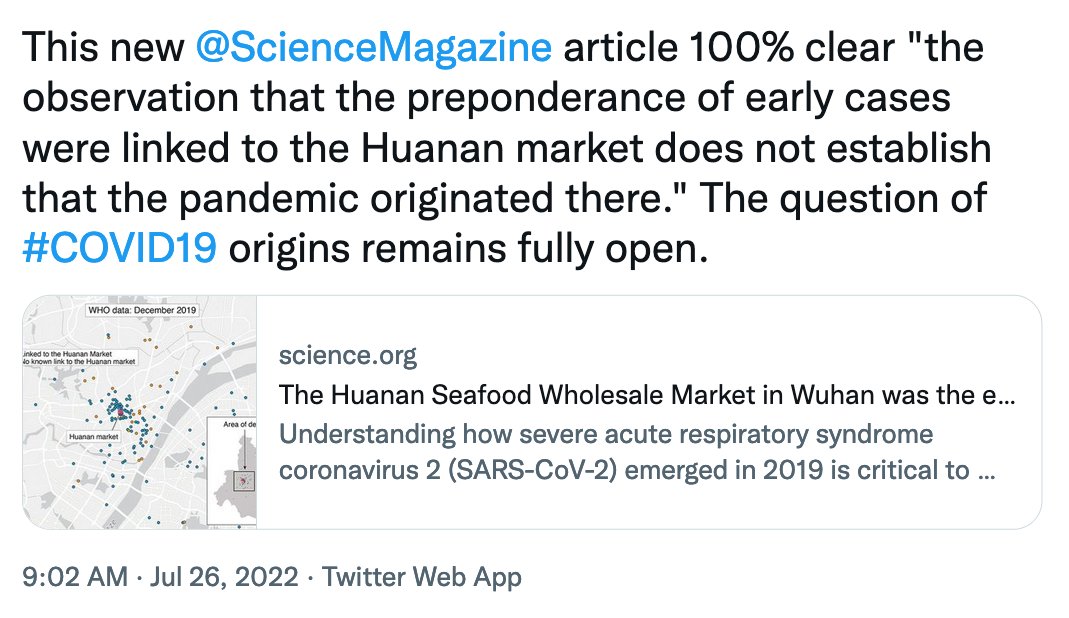
Beware those who demand an independent, data-driven investigation as if that isn't what we've done. Our article is precisely that: an original, scientific, evidence-based analysis that has undergone a rigorous review from 5 of our expert peers.
This is the standard for our field
This is the standard for our field
Like any study, this has limitations. The data is imperfect and incomplete. However, it was adequate to support our conclusions.
We have demonstrated that the pandemic started via zoonotic transmission at Huanan Market.
We have demonstrated that the pandemic started via zoonotic transmission at Huanan Market.

Origins investigations can take years. Evidence for origins is usually sparse and incomplete. There was actually much more evidence available for analysis regarding SARS-CoV-2's origin than other viruses.
For example, nearly 50 years later, we still don't know how Ebola emerged.
For example, nearly 50 years later, we still don't know how Ebola emerged.
But don't just take my word for it. My fantastic co-author @MichaelWorobey explains this in great detail in his wonderful thread on our work.
https://twitter.com/MichaelWorobey/status/1551949557205938176?s=20&t=UP_YAV_VmO9x8Sdh5RRuyg
There are many knowledge gaps left to fill. What animals were infected? Where did they come from? Are there other SARS-related CoVs circulating in them?
These questions are crucial to understanding the risk of a SARS-CoV-3 emerging. Some may remain unanswered.
These questions are crucial to understanding the risk of a SARS-CoV-3 emerging. Some may remain unanswered.
But we've answered a big one here: the pandemic began via at least 2 zoonotic spillovers from animals sold at the Huanan market. Not a lab, not a cave, not a dentist's office.
This is not our opinion. This is original evidence-based research that withstood a tough peer review.
This is not our opinion. This is original evidence-based research that withstood a tough peer review.
My great hope is that this work will put the origin debate to rest so we can start to investigate the open questions with the same rigorous scientific principles and methods we used here without distracting speculative bullshit about a lab leak.
And with that, I'll thank my wonderful co-authors for the privilege of working with them on this: @MichaelWorobey, @josh__levy, @LrnM9, @acritschristoph, @jepekar, @stgoldst, @MOUGK, @WildCRU_Ox, @MarionKoopmans, @suchard_group, Joel Wertheim, @LemeyLab, @robertson_lab...
...Bob Garry, @edwardcholmes, @arambaut, & @K_G_Andersen. Also the authors of the companion paper led by @jepekar: @afmagee42, @EdythParker, @niemasd, @KatherineIz, @gkay92, @akaEscapePlan, @TanyaVasylyeva, and other great colleagues who aren't on Twitter.
I'd also very much like to thank my institution @VIDOInterVac @usask for their continued support, as well as @CoVaRR_Net, a @CIHR_IRSC-supported network, for supporting my work. I'm proud to represent some of the best scientific institutions in Canada and the world.
Finally, I'd like to thank both the five peer reviewers and team of editors whose thoughtful criticism and guidance significantly improved this work.
• • •
Missing some Tweet in this thread? You can try to
force a refresh