The current increase in tensions btw KOS & SRB is the result of several wrong policies which are directed at symbolic victories rather than to anything substantial.
KOS govt that is unable to solve domestic issues is focused on getting SRB recognition.
But that improbable recognition makes no difference to KOS domestic and foreign policies which are fully free. If KOS were to be recognized tomorrow, nothing would change except that KOS would have an ambassadorial post at the UN.
Similarly, SRB govt intransigence on not accepting reciprocity in treatment of IDs and car license plates is dealing w symbols only. It makes no difference in the life of anyone, nor does it have any juridical importance. SRB govt sees it as a creeping recognition, but it is not.
Since both govts deal in symbols and rituals and not in reality, such tensions will continue b/c it is easier to increase tensions than to increase incomes.
Ignorant or ill-intentional commentators just add fuel to the fire.
• • •
Missing some Tweet in this thread? You can try to
force a refresh

IMO, Rawls' great contribution in "The law of peoples" is to have opened up the discussion of how govt's whose sources of legitimacy are different can live together and cooperate.
The book however is based on the situation in the 1990s where seemingly the only alternative to Western liberal democracy was Islam. Things have evolved since.
Secondly, the book proposes sharply different policies for the world compared to ToJ that applies to a single country.
As @spe07 writes, it is biased by the assumption of methodological nationalism. It is obviously a legitimate assumption, but it is also true that other assumptions are legitimate too--in which case Rawls' points of view from LoP may be found wanting.
(Long thread)
I always felt that the silly season is a great season for reading history and biographies. So much so that different summer vacations have forever remained in my mind linked with certain summer readings.
I remember exactly in what cities or canopied cafes I read AJP Taylor "Struggle for the mastery of Europe", Chateaubriand's memoires (that took three summers), Mazower's Nazi Germany, Kershaw's two volumes of Hitler, Richard Pipes' "The Russian revolution" etc.
Reading the news on the war in Ukraine is like Exhibit No 1 on what we always knew but do not observe often: wartime propaganda.
In Russian news, the only civilians killed are those shelled by UKR forces in Donbas. If RUS forces kill civilians, this is because they were used as a human shield.
In Western news, the only civilians killed are those shelled by RUS forces in Ukraine. The UKR shelling is never mentioned.
A few days ago, I finished Ian Kumekawa's biography of Pigou, "The first serious optimist". If you are intrigued by the title, it comes from Joan Robinson's praise (when she was on good terms with Pigou). amazon.com/First-Serious-…
Kumekawa is an excellent writer. The book is very well sourced; Kumekawa did serious archival work, reading 00s of letters Pigou exchanged. K does an excellent job in presenting the disagreements between the Keynesians & Pigou. (Full disclosure, Ian is nephew of a close friend).
As "everybody knows", P was appointed to be Marshall's successor at a fairly young age (31). In the long-run, it proved a mixed blessing: it made him an ex officio guardian of the Marshallian orthodoxy.
(long thread on global inequality).
Selected slides from my yesterday's presentation at Luxembourg Income Study (LIS) 30th Summer School.
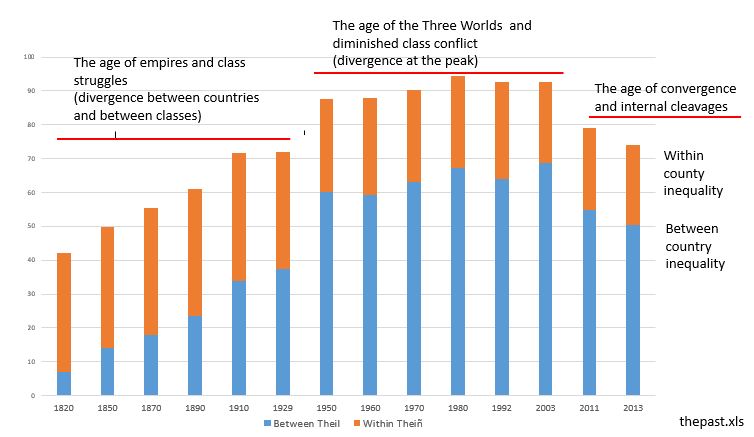
Background: global inequality btw 1820 and 2020.
We can distinguish three periods: 1820-1910 when global inequality increased thanks to both greater differences in countries' mean incomes (blue) and greater within-national inequalities (orange).
The second period is 1910-1990 with a very high, but rather constant, level of global inequality. This is the epoch of the Three Worlds.
The third period begins around 1990 w/ the rise of Asia that reduces global inequality thanks to the (population-weighted) income convergence.
I totally agree with @MartinRavallion. it really makes no sense that we have to rely to such scant evidence re China's income distribution when the underlying large HH survey data exist. They should be available to researchers & the public.
But the fact that the bias of which @MartinRavallion writes is present in all years displayed in the Yearbook means that at least we can argue that that particular bias is constant, and that the conclusions about the changes in rural and urban Ginis (as below) are meaningful.