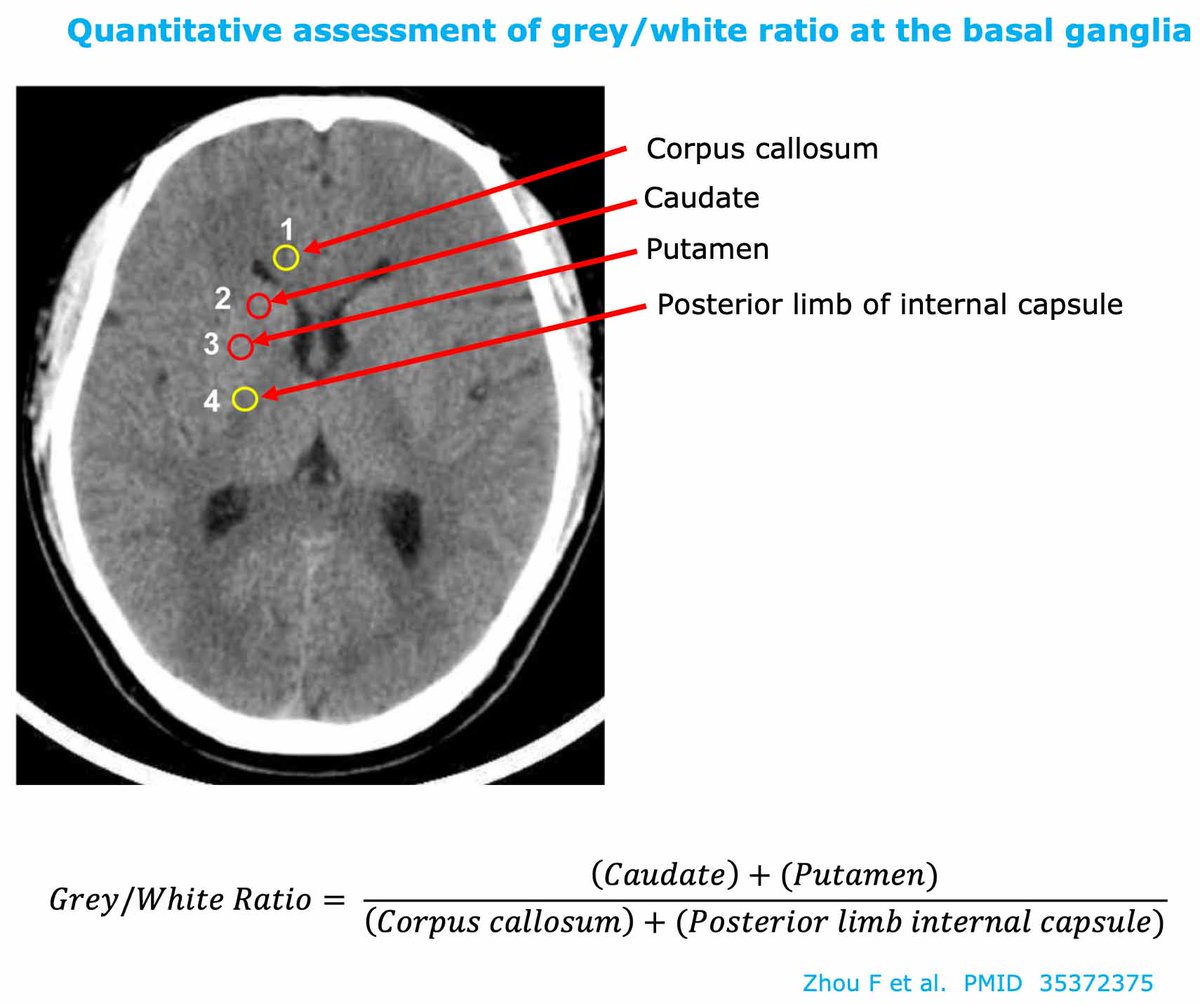
I think this paper by the Nielsen group on the use of CT scans to neuroprognosticate after cardiac arrest may be a game-changer.

But it will take a few tweets to explain why... ๐Ÿงต

pubmed.ncbi.nlm.nih.gov/35931271/
prognostication after cardiac arrest involves a structured series of tests performed over time.

this may vary a bit between patients and institutions.

most often, decisions center around the trifecta:
๐Ÿ”บserial clinical examination
๐Ÿ”บcontinuous EEG
๐Ÿ”บMRI
MRI is the weak link:

๐Ÿ–‡๏ธ least robust evidence
๐Ÿ–‡๏ธ interpretation is subjective
๐Ÿ–‡๏ธ logistically challenging (eg pacemaker)

MRI can help if there is *no* anoxia, or if there is an unexpected *alternative* dx.

MRI isn't great at sorting out bad anoxia from moderate anoxia.
CT has advantages over MRI:
๐Ÿ’ช measurement of Houndsfield units allows it to be objective
๐Ÿ’ช expanding evidentiary base
๐Ÿ’ช high specificity for poor outcome
๐Ÿ’ช can be applied to all pts

the problem with CT has been that it's done immediately post-arrest, before edema develops
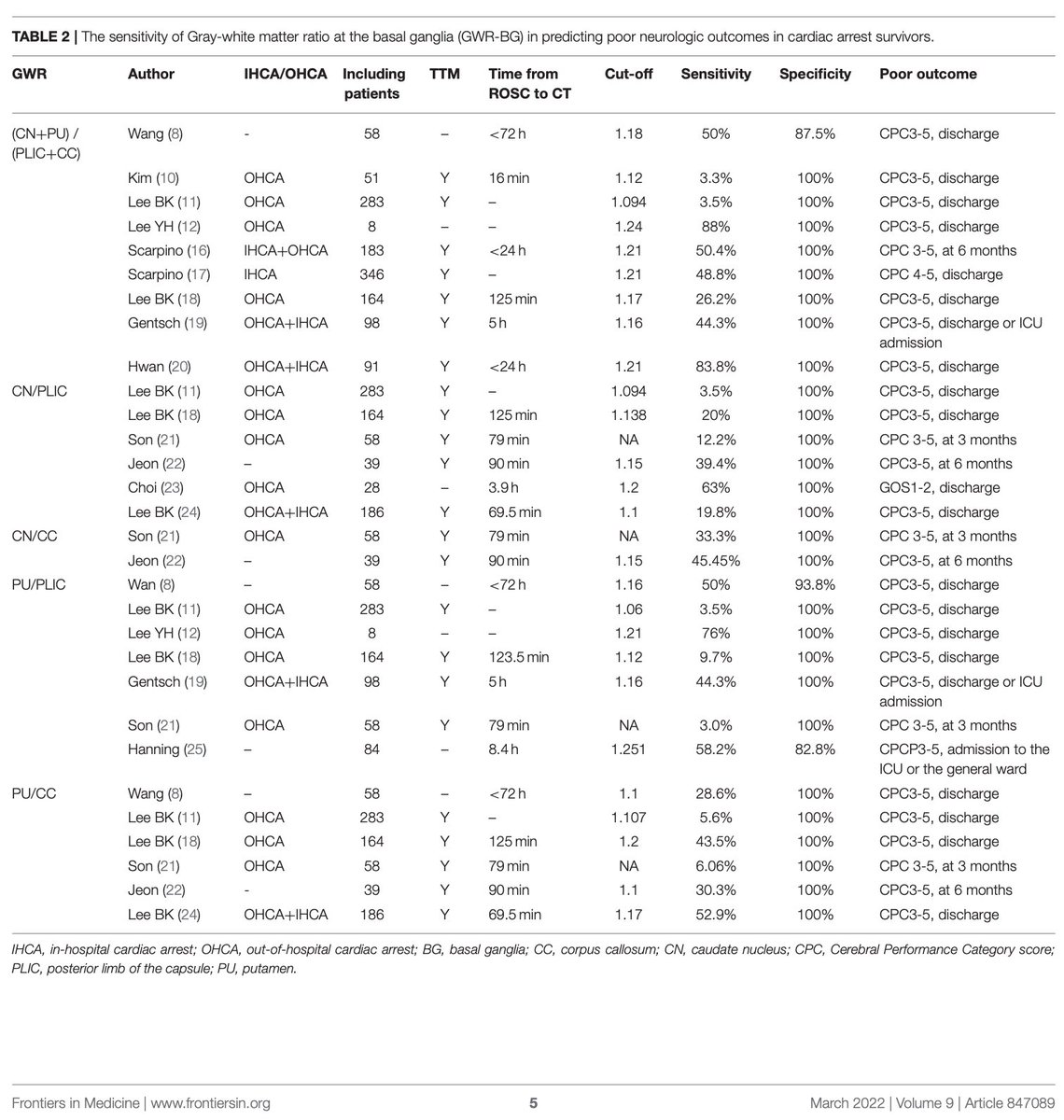
the immediate post-arrest CT has poor sensitivity.

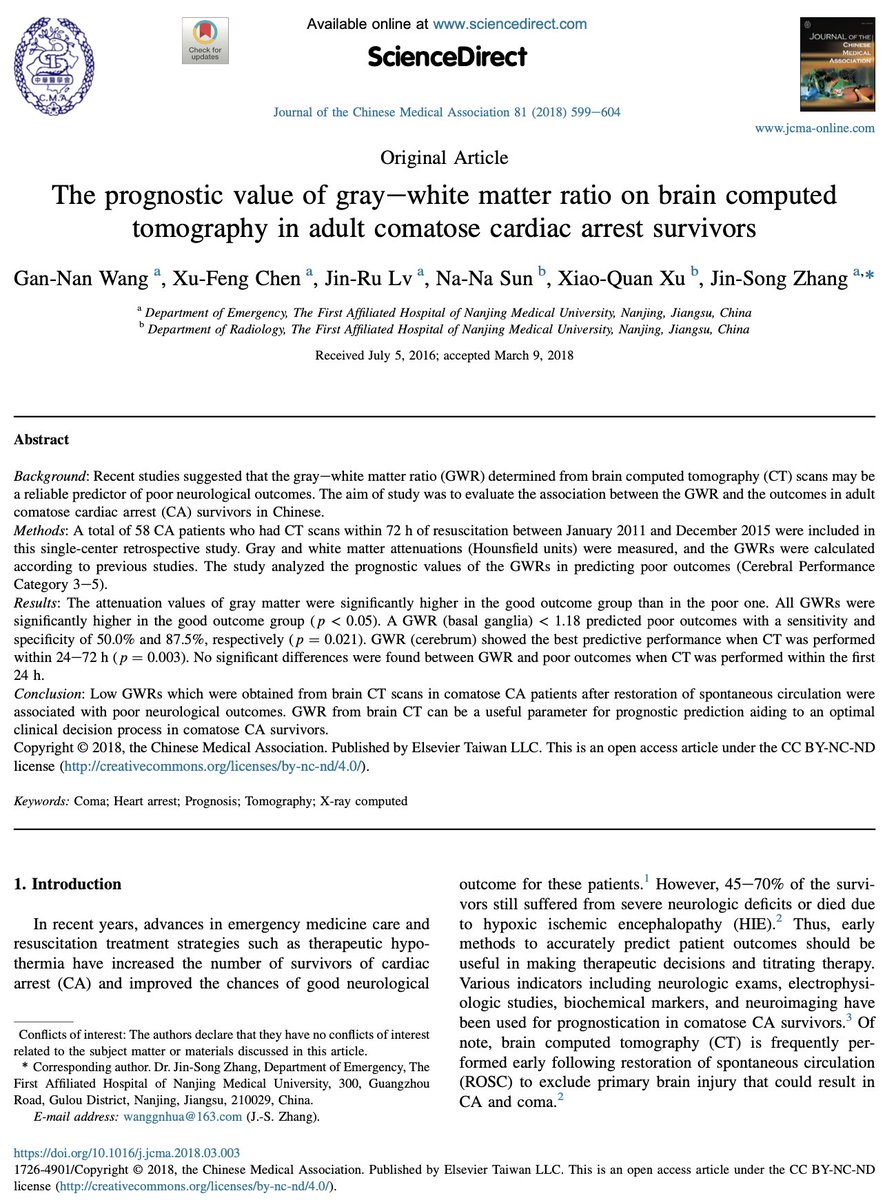
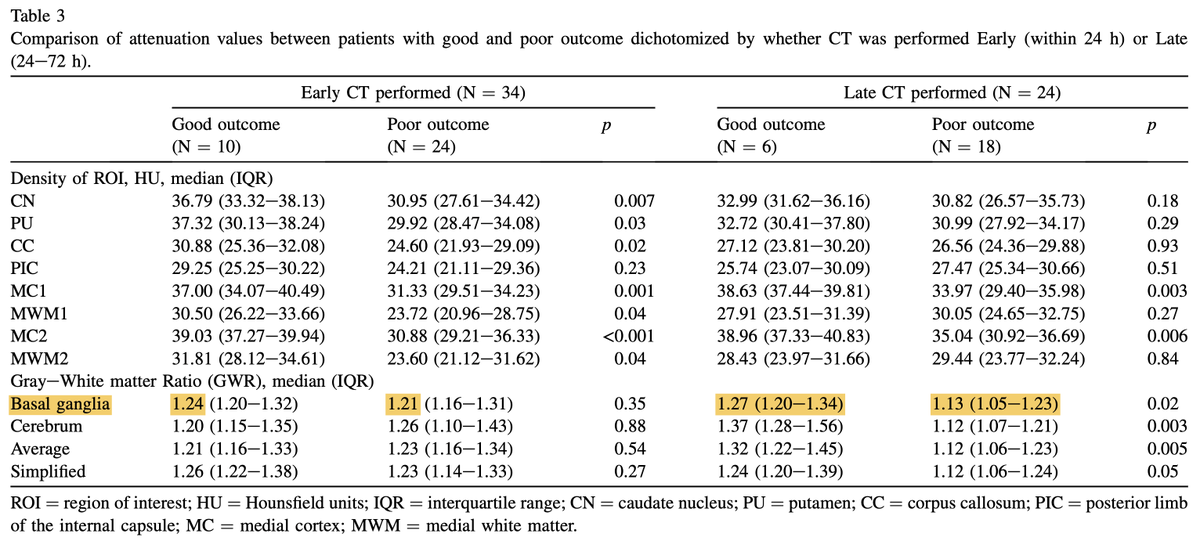
but *delaying* the CT >24 hours improves sensitivity, as found in this study from 2018:
the new study by Nielsen's group extends these findings, by showing that delayed CT scan >24 hr
๐Ÿˆ โฌ†๏ธ sensitivity for severe anoxic injury (~70%)
๐Ÿˆ retains high specificity for prognosticating a poor outcome

so CT seems to perform very well when evaluated at the right timepoint
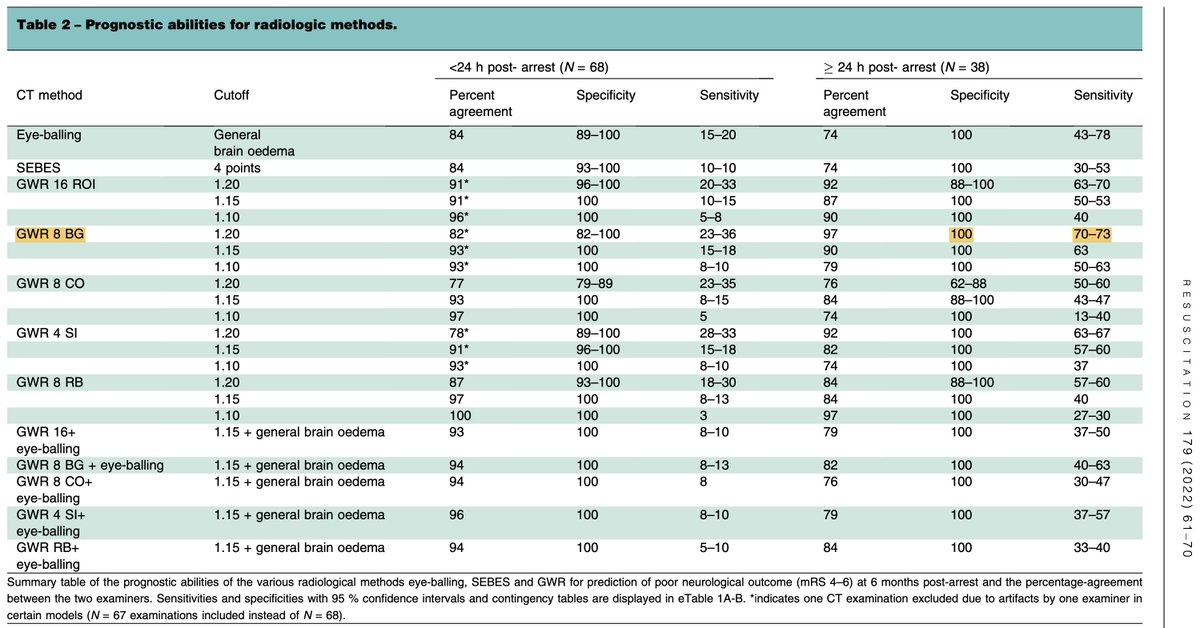
overall, CT scan may be poised to *replace* MRI for post-arrest neuroprognostication in many patients.

of course, each patient must be approached individually

if data isn't lining up (e.g., inconsistencies between exam / EEG / imaging) - wait & get more data!
what do folks think about CT-vs-MRI?

the evidence base for CT isn't gigantic, but I think it's better than the data for MRI.

MRI requires subjective interpretation which introduces a source of bias ๐Ÿ˜ค

more on quantitative CT for prognostication IBNCC: emcrit.org/ibcc/np/#CT_scโ€ฆ

โ€ข โ€ข โ€ข

Missing some Tweet in this thread? You can try to force a refresh

ใ€€

Keep Current with ๐™Ÿ๐™ค๐™จ๐™ ๐™›๐™–๐™ง๐™ ๐™–๐™จ ๐Ÿ’Š

๐™Ÿ๐™ค๐™จ๐™ ๐™›๐™–๐™ง๐™ ๐™–๐™จ ๐Ÿ’Š Profile picture

Stay in touch and get notified when new unrolls are available from this author!

Read all threads

This Thread may be Removed Anytime!

PDF

Twitter may remove this content at anytime! Save it as PDF for later use!

Try unrolling a thread yourself!

how to unroll video
  1. Follow @ThreadReaderApp to mention us!

  2. From a Twitter thread mention us with a keyword "unroll"
@threadreaderapp unroll

Practice here first or read more on our help page!

More from @PulmCrit

Aug 15
I think it's time for a difficult discussion, folks.

Let's talk about CSF lactate ๐Ÿซฃ

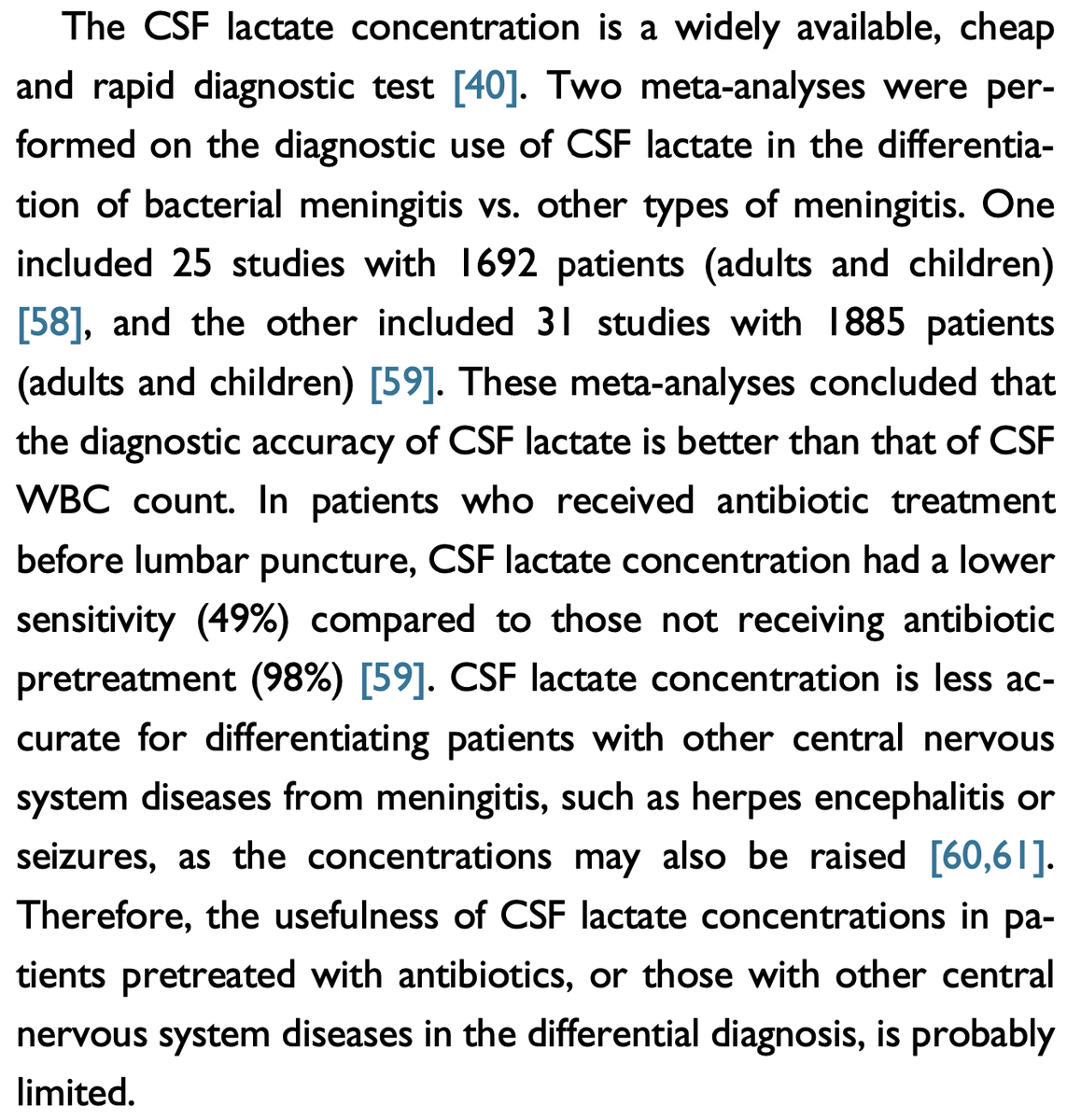
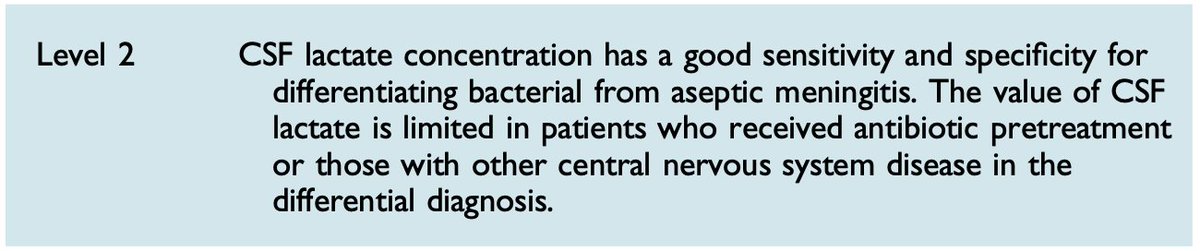
CSF lactate has been shown to be *superior* to traditional CSF studies in sorting out viral vs. bacterial meningitis in several studies & meta-analyses...
a subset of patients with viral meningitis will initially have a *neutrophilic* pleocytosis.

this can lead to unnecessary admissions & antibiotics

some patients are subjected to repeat LPs ๐Ÿ˜ฉ

a low CSF lactate could avoid all of this, allowing patients to go home from the ED
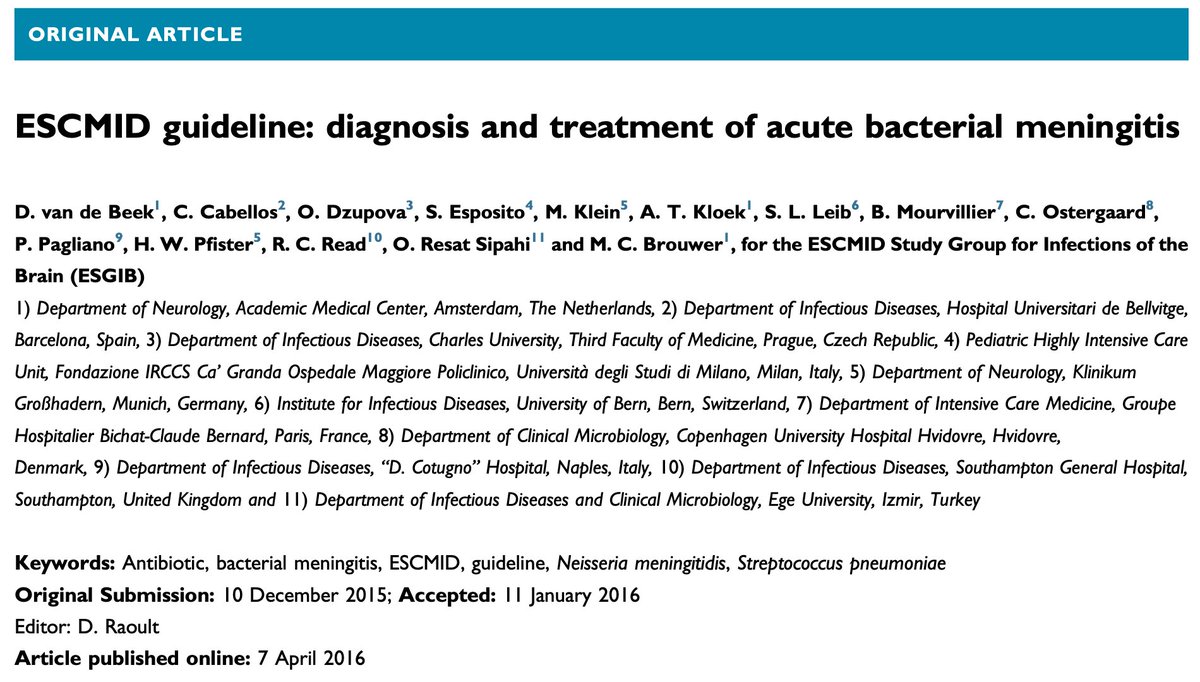
CSF lactate measurement is recommended in guidelines from the United Kingdom, Europe, and France.

(it's not recommended in the ID society of America guidelines, but they're from *2004* and require revisions)
Read 6 tweets
Jul 24
A 75YO human is transferred to your ICU from an outlying hospital 2/2 concerns regarding septic shock.

Generally healthy. History notable for fevers and neck stiffness.

Exam shows mild hypotension, nuchal rigidity, and nonfocal neuro exam (w/ apologies to The Neurologist)....
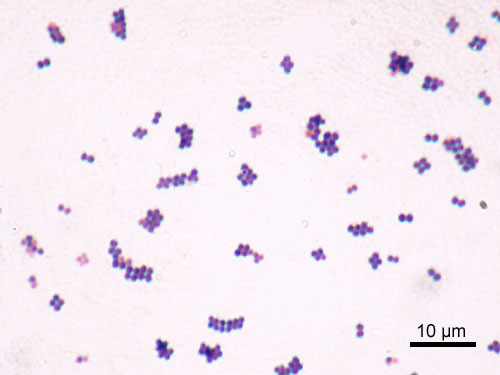
Due to the time delay in transfer, blood cultures have *already* turned positive in 2/2 sets with gram pos cocci in clusters.

**Teaching interlude**:

Each blood draw generates 1 SET = 2 BOTTLES.

1/2 SETS with GPC is often contamination.

2/2 SETS implies true positive...
So if two *bottles* turn positive but they're from the a *single* SET, this could be a contaminated blood draw.

Common contamination pattern: two bottles in one set grow tons of wierd stuff & the other set is negative.

๐Ÿ”‘ Focus on the number of SETS.

OK, back to the case...
Read 8 tweets
Jun 15
hot take on the LOVIT trial of vitamin C... I'm probably going to regret this but I can't resist...
as a preface, it seems that Marik's initial paper might have been fabricated - which may have pushed the field in the wrong direction for years. the VITAMINS trial largely halted the use of vitamin C... and surely nobody is going to use it now for sepsis.
medpagetoday.com/special-reportโ€ฆ
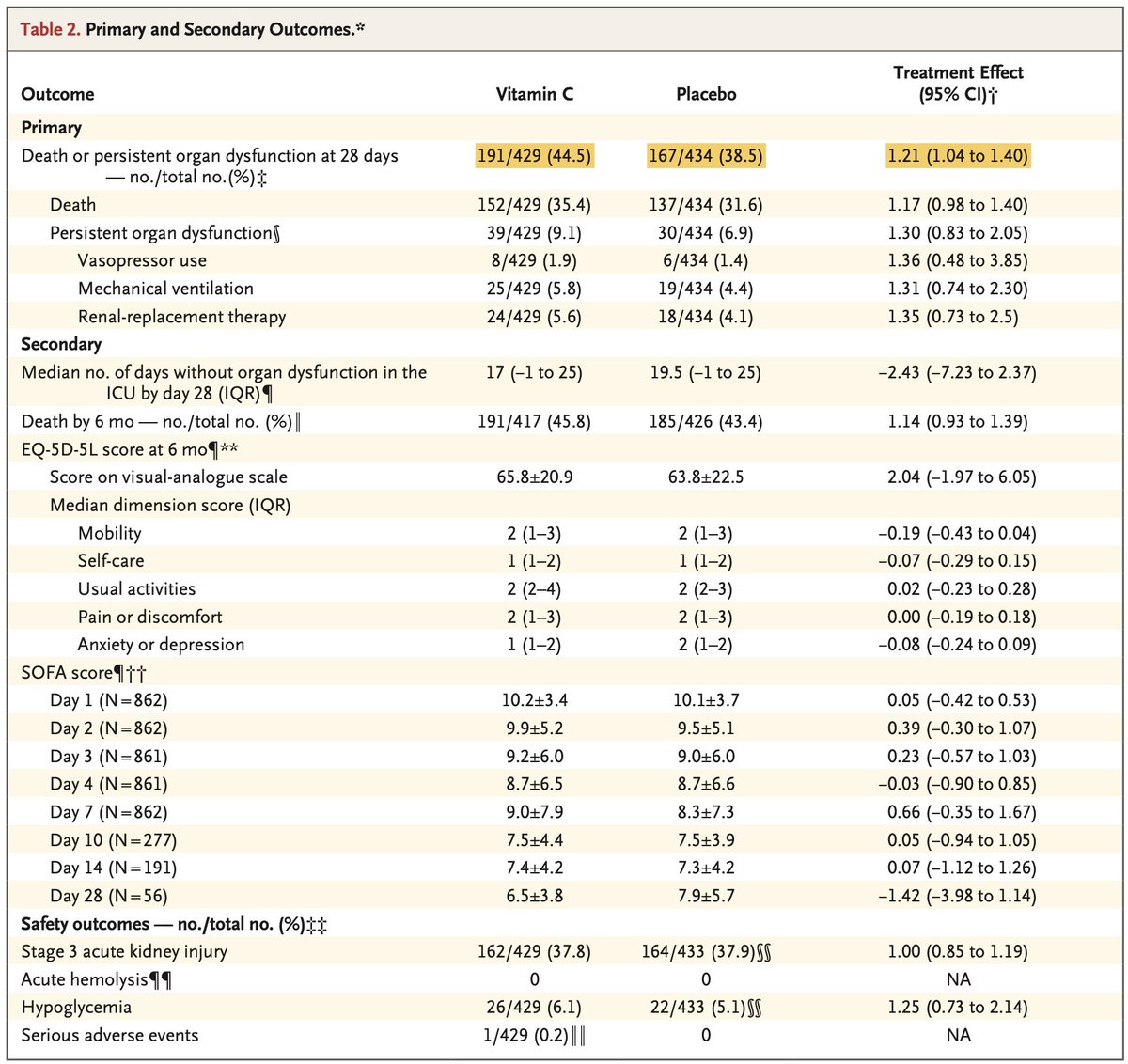
back to LOVIT: the primary endpoint was a composite of mortality or organ dysfunction at 28 days. the paper states that vitamin C caused statistically significant harm (p = 0.01)... ImageImage
Read 7 tweets
Apr 28
time for a fluid & electrolyte tweetorial ๐Ÿ˜

an asymptomatic adult human presents with these findings... ImageImage
should you institute therapy or repeat lytes?
EKG shows classic findings of hypoK (ST depression & pronounced U-wave that produce a "wavy baseline" pattern). so the hypokalemia is real - treatment should start immediately.
(more on EKG findings of hypoK:hqmeded-ecg.blogspot.com/search?q=hypokโ€ฆ )
Read 14 tweets
Oct 7, 2021
Waveform capnography! I've been meaning to cover this for years. Finally posted an IBCC chapter on it. The chapter is pretty long (filled with subversion, physiology, and zentensivism), so here is a thread with some key points.๐Ÿงต
emcrit.org/ibcc/co2/
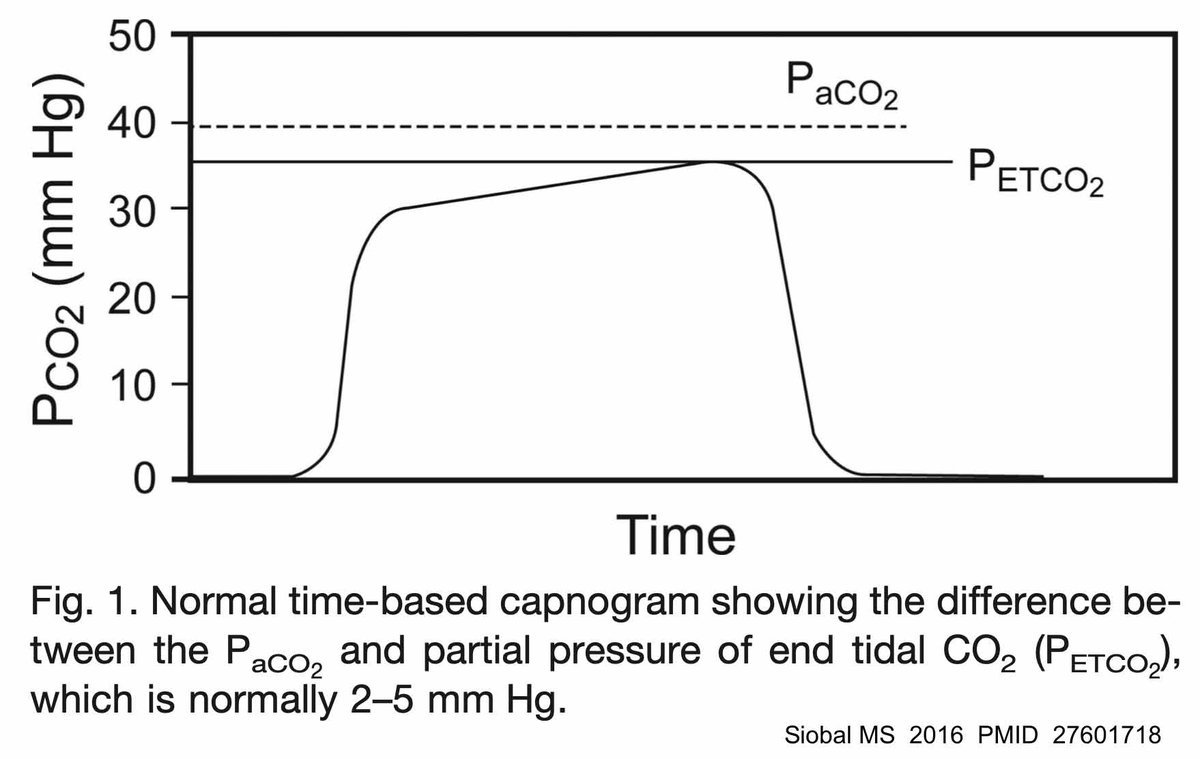
end tidal CO2 (etCO2) will ~always be lower than the arterial CO2 (b/c dead space dilutes CO2 as the patient exhales). the gap between the etCO2 and the arterial CO2 varies depending on lung function. in normal lungs, the CO2 gap is usually ~2-5 with an upper limit of ~10-15
Imagine that we intubate a healthy patient for airway protection 2/2 intoxication. A safe pH for this patient might be ~7.2-7.5 (no good data!). To achieve this, we need an arterial pCO2 to be ~32-64 mm. So all we need to do is target an etCO2 of ~30-35 and we should be good.
Read 11 tweets
Sep 20, 2021
oh, the life & times of remdesivir! - let's review the bizarre trajectory we've taken with this medication! with emoji's to represent each study ๐Ÿคฃ
we start with a retrospective series of patients treated with remdesivir under the banner of "compassionate use." most patients didn't die. this paper has so many flaws, at this point it's merely a case study in horrific research design ๐Ÿคฎ (commentary: bit.ly/2XBwnx1)
next: the 1st placebo-controlled trial. the primary endpoint (time to clinical improvement) was negative, as were most 2nd endpoints (including viral load). the only glimmer of benefit was faster clinical improvement in one slicing of the data ๐Ÿฅด (bit.ly/3lIxnXZ)
Read 12 tweets

Did Thread Reader help you today?

Support us! We are indie developers!


This site is made by just two indie developers on a laptop doing marketing, support and development! Read more about the story.

Become a Premium Member ($3/month or $30/year) and get exclusive features!

Become Premium

Don't want to be a Premium member but still want to support us?

Make a small donation by buying us coffee ($5) or help with server cost ($10)

Donate via Paypal

Or Donate anonymously using crypto!

Ethereum

0xfe58350B80634f60Fa6Dc149a72b4DFbc17D341E copy

Bitcoin

3ATGMxNzCUFzxpMCHL5sWSt4DVtS8UqXpi copy

Thank you for your support!

Follow Us on Twitter!

:(