

When I started to read more, I realized that everything I thought I knew about the history of Christianity and slavery was wrong. I had internalized the popular origin stories of Christianity and "western" freedom, which are based on 3 myths. A thread 🧵...
Myth #1: Slavery in the Roman Empire wasn't that bad.
Myth #2: Early Christians improved conditions for slaves and contributed to the decline of slavery as an institution.
Myth #3: Early Christians were radical/egalitarian but became politically coopted by Emperor Constantine.
Myth #2: Early Christians improved conditions for slaves and contributed to the decline of slavery as an institution.
Myth #3: Early Christians were radical/egalitarian but became politically coopted by Emperor Constantine.
These 3 myths have been used to tell a triumphant story about the ethical superiority of Christianity and "the West." They've been used to present slavery in modern Christianity and U.S. as momentary glitches or aberrations. But the historical facts tell a very different story.
Many have emphasized that Roman slavery wasn’t bad b/c it wasn’t based on race; slaves could sometimes “purchase” their freedom and free people sometimes willingly sold themselves.
While not the same as U.S. slavery, slavery in the Roman Empire was still brutal!
While not the same as U.S. slavery, slavery in the Roman Empire was still brutal!
In the Roman Empire, enslaved people were reduced to things, to bodily appendages or tools of the master. They had no personal rights, owned no property and weren’t allowed to legally marry other slaves.
They were regarded as objects who served the desires and needs of their superiors: masters could buy them, sell them, inflict corporal punishment and sexually exploit them at will.
As Pliny the Elder put it: “We use other people’s feet when we go out, we use other people’s eyes to recognize things, we use another person’s memory to greet people, we use someone else’s help to stay alive…”
It’s pointless to attempt a comparison of Roman and American slavery as if a hierarchy of oppression could be established by quantifying the average rate of whip lashings.
The reality is that the Romans violently dominated and dishonored enslaved people.
So that's for Myth #1.
The reality is that the Romans violently dominated and dishonored enslaved people.
So that's for Myth #1.
Now for Myth #2 that Christianity made everything better for enslaved people in Roman Empire.
The voices of enslaved people are largely absent from the documentary evidence available from this period, which means we’re left with the perspectives of the masters...
The voices of enslaved people are largely absent from the documentary evidence available from this period, which means we’re left with the perspectives of the masters...
But if artifacts could speak, they'd tell other stories about ppl who disagreed with their masters & resisted dehumanizing conditions. Otherwise, thick metal collars inscribed with words “Retain me, lest I flee,” wouldn’t be found around the necks of enslaved people’s skeletons.
This collar says, "Hold me, lest I flee, and return me to my master Viventius on the estate of Callistus' " britishmuseum.org/exhibitions/ne… 

Most of these surviving collars are from the 4th century CE and most actually appear to have been made by Christian owners, as evidenced by the Christian symbols—crosses and the alpha/omega or Chi-Rho figure—on them...
One infamous collar reads: “I am the slave of Felix the archdeacon. Retain me, lest I flee.”
Yes, there were plenty of early Christian church leaders trying to capture runway slaves in Roman Empire!
Yes, there were plenty of early Christian church leaders trying to capture runway slaves in Roman Empire!
The New Testament scholar Jennifer Glancy writes, “So discomforting are these objects that nineteenth-century scholars described them as dog collars rather than acknowledge that ancient Christians regularly bound other persons in such a crude manner.”
It's true that some early Christian leaders encouraged masters to be *merciful* toward their slaves. But there’s no evidence to support the claim that most Christians fundamentally opposed or altered the institution itself.
From the very beginning, every generation of Christians contained slave masters, and this class added the likes of bishops, deacons, and monastics to its ranks.
St. Augustine was acquainted with a wealthy Christian woman who tried to grow the size of the faithful by buying numerous slaves and arranging their baptisms.
Lactantius, a Christian adviser to Constantine, publicly defended the fact that masters rewarded docile slaves with privileges within their households and punished rebellious slaves “with cursing, lashes, nudity, hunger, thirst, chains.”
Myth #2 may claim that Christians were subtly corroding the foundations of slavery, but the evidence demonstrates that they were also busy capturing people trying to escape its horrors.
“Ecclesiastical networks were useful in the detection and recovery of fugitives,” writes scholar Kyle Harper. “One saint’s shrine even specialized in the production of talismans that were thought to help in the discovery of runaway slaves!”
When enslaved people threatened Roman custom, Christians came to the defense of masters’ rights. Some of the most disturbing examples expose the sexual double-standards of early Christians as it relates to enslaved women. I'll bring up one particular case...
Basil of Caesarea, a bishop, could say that “a slave-woman who gives herself in marriage against the will of her master is guilty of fornication. But if he approves, it is a marriage. So the one is a sexual sin, the other a marriage.”
Myth #2 doesn't stack up well against the facts. But that hasn't stopped Christians from narrating history as if early Xians were essentially proto-abolitionists.
As counter-arguments, folks like to cite St. Paul, Onesimus, & Gregory of Nyssa. But these also don't hold up...
As counter-arguments, folks like to cite St. Paul, Onesimus, & Gregory of Nyssa. But these also don't hold up...
In the New Testament, Paul writes to the slave-owner of Onesiums. While Paul humanizes Onesiumus to a certain extent, it's unclear if he was actually asking for manumission.
AND even if he was, this doesn't mean Paul/NT fundamentally opposed slavery itself.
AND even if he was, this doesn't mean Paul/NT fundamentally opposed slavery itself.
In Galatians, Paul says: “...there is no longer slave or free...for all of you are one in Christ Jesus.”
Christians have frequently cited this text to argue that Christianity, in its true essence, broke down every societal distinction including that of actual slavery.
Christians have frequently cited this text to argue that Christianity, in its true essence, broke down every societal distinction including that of actual slavery.
Within the ancient world, however, the New Testament’s emphasis on Christians extending brotherly love to enslaved people was neither unique nor the grounds for abolitionism.
Many people used metaphors of shared humanity.
Many people used metaphors of shared humanity.
Stoic philosophers like Seneca who could rhapsodize about the human dignity of slaves and then, in the next breath, declare that masters who voluntarily enslaved themselves to ambition experienced the meanest slavery of all.
Christians like Paul used very similar language.
Christians like Paul used very similar language.
This metaphorical slippage around slavery language is found in Paul, in the very same letter to the Galatians that folks cite!
“For freedom,” Paul writes, “Christ has set us free. Stand firm, therefore, and do not submit again to a yoke of slavery.”
“For freedom,” Paul writes, “Christ has set us free. Stand firm, therefore, and do not submit again to a yoke of slavery.”
In Galatians, Paul turns to the enslaved character of Hagar found in the Hebrew Bible, and contrasts Hagar with her owner Sarah as he charts the course of Christians’ spiritual freedom.
As is typical of so many intellectuals from this time, slaves become springboards and props for free people narrating their own problems, aspirations, and idealizations of self-mastery!
Paul's language of "no longer slave or free" needs to be read critically.
Paul's language of "no longer slave or free" needs to be read critically.
Now, finally, for Myth #3. Some folks will admit that Christians in late Roman Empire were complicit w/ slavery. But they'll argue that this happened AFTER Constantine.
In other words, the *earliest* Christians and Jesus were fine, but later generations caved to imperial vibe..
In other words, the *earliest* Christians and Jesus were fine, but later generations caved to imperial vibe..
Yet, as I said, the problem of slavery extends to Paul, who liked to call himself a slave of Christ, and to Jesus himself, whose parables in the Gospels are full not of “servants,” as many translations have it, but of slaves who get violently disciplined.
The New Testament’s language uses the slave auction as a central image for the Gospel when it states, “you are not your own, for you were bought with a price.”
Myth #3 wrongly asserts that there's some early "Golden Age" of Christianity that's untainted by slavery, as if there was some pristine origin that mirrors contemporary brands of social justice.
I've even heard some present Jesus/biblical Hebrews as woke abolitionist figures ..
I've even heard some present Jesus/biblical Hebrews as woke abolitionist figures ..
Some resuscitate Myth #3 by pretending there's an escape hatch from slavery problem through Jesus & Exodus narrative. This is wrong on so many levels!! (Hello there Canaanites and Parable of the Talents). For brevity, I'll drop this quote.
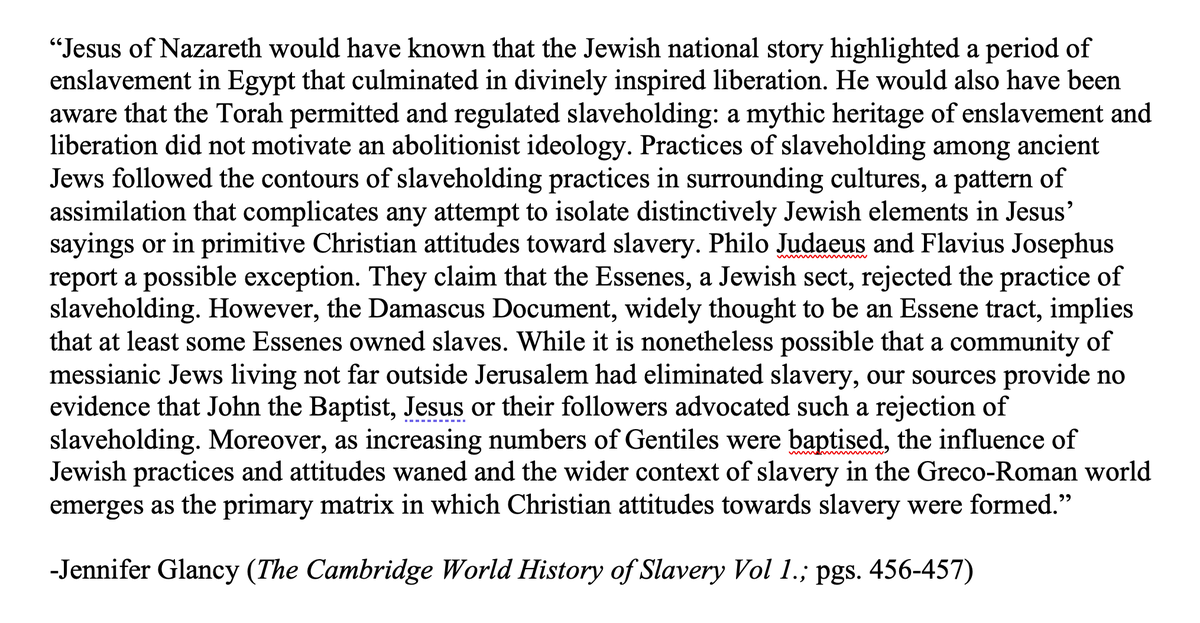
So that's it for Myth #3.
To summarize, I think the evidence doesn't support the following myths: 1. Roman slavery wasn't bad; 2. early Christians undid slavery as an institution; or 3. early Christians were radical egalitarians before Constantine corrupted the justice-y vibes.
To summarize, I think the evidence doesn't support the following myths: 1. Roman slavery wasn't bad; 2. early Christians undid slavery as an institution; or 3. early Christians were radical egalitarians before Constantine corrupted the justice-y vibes.
I want to conclude this thread with a point about how these 3 myths have functioned together to tell a certain story about early Christianity—and consequently "western civilization"...
This is why I felt I had to relearn all this history...
This is why I felt I had to relearn all this history...
These 3 Myths have functioned like a multiple-option play for a Christianity--and later secularized "West"-- presented as triumphantly marching down the field of human history.
Christianity’s origin remains unstained by slavery because Roman slavery wasn’t that bad. And if it was bad, then Christianity made things better. If Christianity didn’t make things better, well, its founders and core teachings were sold out by imperialist Christians.
Conservative and progressive Christians, and scholars of all stripes, have appealed to different aspects of this overarching framework. It’s almost entirely wrong.
End of thread 🧵
Thanks for reading!
For more, including sources, please read my essay "Saint Augustine's Slave Play" over at
@the_point_mag thepointmag.com/examined-life/…
I also have an occasional newsletter and hope to write more in the future nerdflow.substack.com
Thanks for reading!
For more, including sources, please read my essay "Saint Augustine's Slave Play" over at
@the_point_mag thepointmag.com/examined-life/…
I also have an occasional newsletter and hope to write more in the future nerdflow.substack.com
• • •
Missing some Tweet in this thread? You can try to
force a refresh



