@benkesslen (@techreview) is the latest journalist to jump on the bandwagon of misinformation surrounding pediatric gender medicine.
🧵
technologyreview.com/2022/08/18/105…
🧵
technologyreview.com/2022/08/18/105…
Considering how easy it is to fact-check these articles into the ground, you have to wonder how much editorial oversight is being exercised here.
Kesslen claims that ROGD is a fiction and that @LisaLittman1 2018 paper in PLOS One is responsible for a spread of misinformation.
Kesslen claims that ROGD is a fiction and that @LisaLittman1 2018 paper in PLOS One is responsible for a spread of misinformation.
First, Littman has always recognized the limitations of her study. Her goal was to describe what appeared at the time to be a newly emerging clinical cohort of transition-seekers. She called for more research to corroborate the ROGD hypothesis.
PLOS One's decision to temporarily take down Littman's paper was driven by pressure from activists. The real story here is not that the paper was taken down, but that it was republished after a second round of peer review (and not, as Kesslen writes, with a "large correction")!
Since 2018, three types of evidence have made Littman's findings more credible. (1) Data from gender clinics around the world, most notably the U.K., showed that the underlying demographic characteristics of ROGD were very much behind the huge surge in referrals. (Cass Review)
(2) Clinicians working in this specific field noted in peer-reviewed articles that Littman's descriptions align with what they were seeing in their day-to-day work and called for more research on ROGD.
link.springer.com/article/10.100…
See also @ZUCKERKJ on this: link.springer.com/article/10.100…
link.springer.com/article/10.100…
See also @ZUCKERKJ on this: link.springer.com/article/10.100…
Even the Dutch experts who developed pediatric transition have said the same.
publications.aap.org/pediatrics/art…
Thomas Steensma has said that other countries are "blindly adopting" the Dutch approach (2021)--"blindly," b/c it was not developed for the predominant presentation (ROGD).
publications.aap.org/pediatrics/art…
Thomas Steensma has said that other countries are "blindly adopting" the Dutch approach (2021)--"blindly," b/c it was not developed for the predominant presentation (ROGD).
(3) A study by Littman in 2021 on detransitioners revealed that some had come to their trans identity through social influences.
pubmed.ncbi.nlm.nih.gov/34665380/
pubmed.ncbi.nlm.nih.gov/34665380/
How to account for the upsurge in the number of teens showing up for transition, the flip in sex and age ratios since the Dutch studies of the 1990's, increasing regret/detransition, and the high degree of psych co-morbidities? Social contagion is the most plausible hypothesis.
There's a difference between saying "we've proven ROGD" and saying "ROGD is very likely, and given the risks of medicalizing we should refrain from doing so pending further research." Few are saying the former, and so Kesslen is essentially setting up a straw man.
Second, Kesslen's own citations are deeply misleading.
Kesslen, e.g., cites this collection of studies. But some of the studies explicitly warned that no conclusions about causal links could be drawn from their findings.
whatweknow.inequality.cornell.edu/topics/lgbt-eq…
Kesslen, e.g., cites this collection of studies. But some of the studies explicitly warned that no conclusions about causal links could be drawn from their findings.
whatweknow.inequality.cornell.edu/topics/lgbt-eq…
More importantly, I looked at 15 at random, and not one was actually about minors. Further, virtually all were done before 2016, when ROGD emerged as a clinical category of concern.
Seems like a problem for an article on CONTEMPORARY PEDIATRIC gender medicine, no?
Seems like a problem for an article on CONTEMPORARY PEDIATRIC gender medicine, no?
Another example: Kesslen cites a study by Kristina Olson from this year showing that 94% children who were "affirmed" in the gender identity persisted in that identity five years later.
But as I've explained, the best and maybe only way to square Olson's findings with all past research on persistence/desistence rates in children is by assuming that social transition is iatrogenic. Olson's paper is evidence AGAINST "affirming" care.
city-journal.org/new-study-cast…
city-journal.org/new-study-cast…
In short, Kesslen cherry-picks studies that (he thinks) help his case and ignores those that weaken it.
Third, Kesslen never once mentions developments in Sweden, Finland, and the U.K., where health authorities have drastically scaled down "affirming" care.
Third, Kesslen never once mentions developments in Sweden, Finland, and the U.K., where health authorities have drastically scaled down "affirming" care.
Health authorities in these countries have observed sharp changes in the composition of patient cohorts and expressed worries about ROGD. By now, there is simply no excuse for any journalist writing on this issue to ignore these developments.
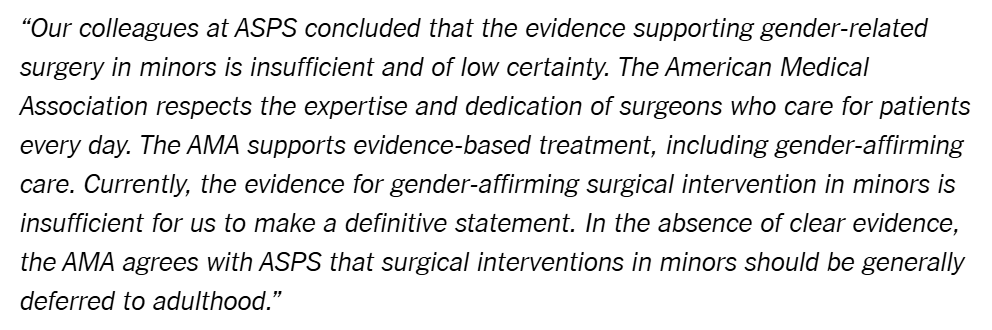
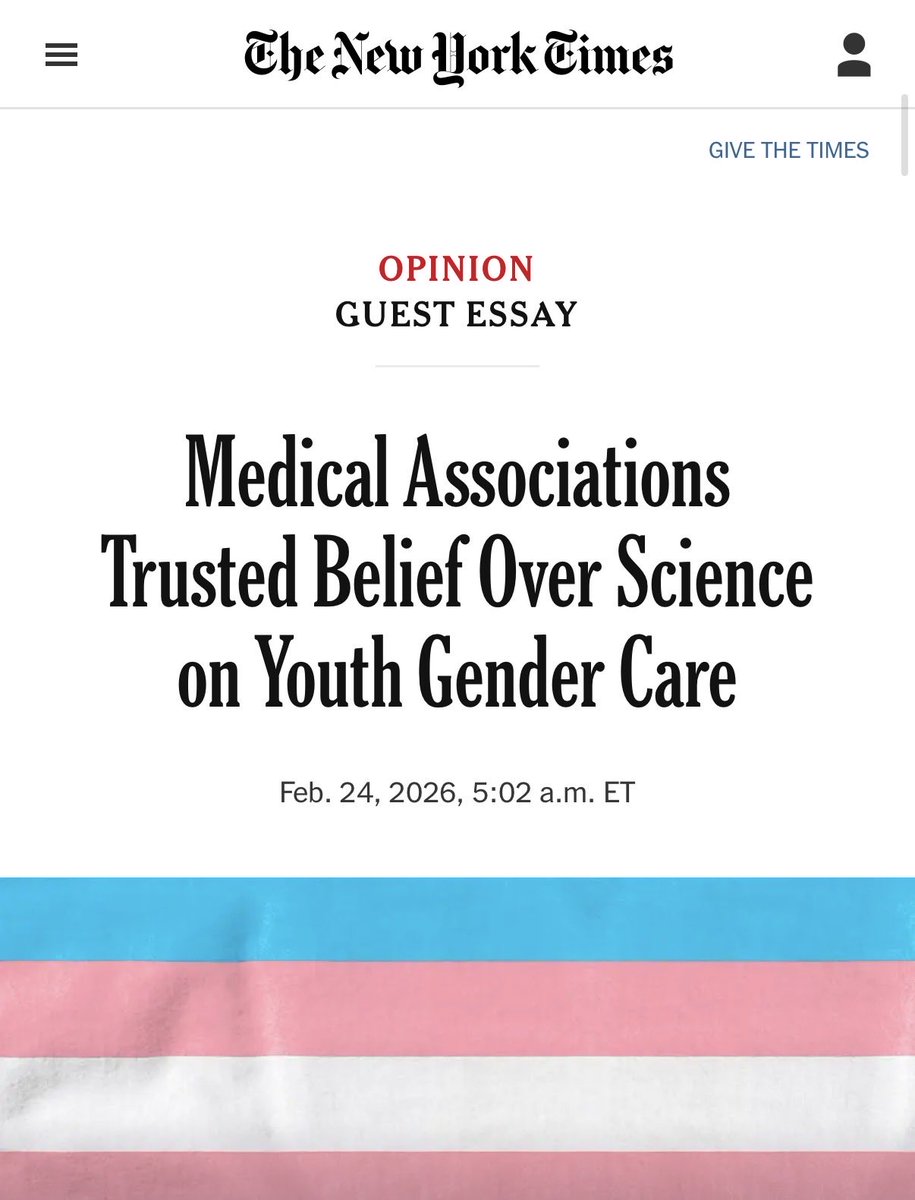
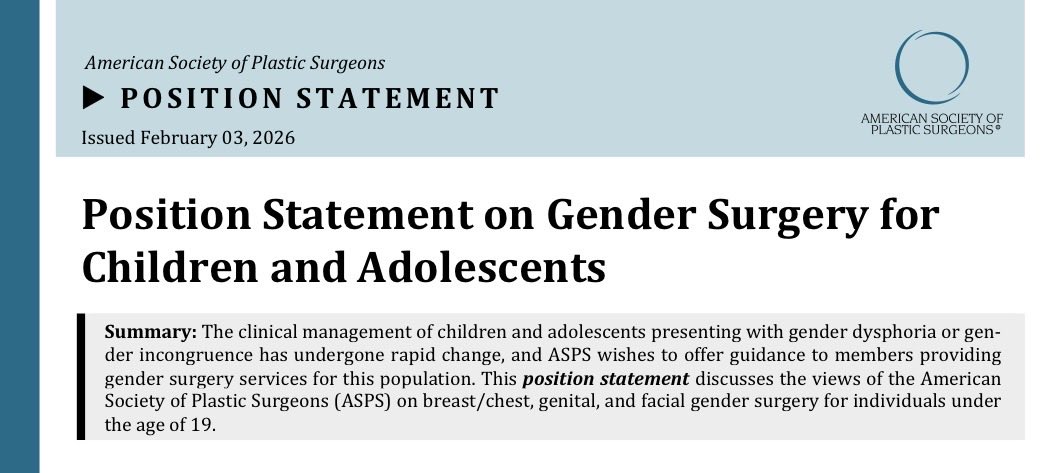
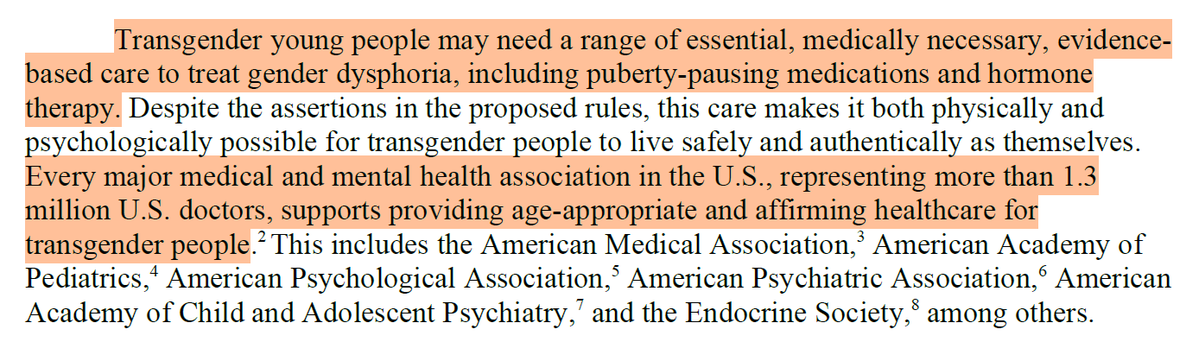
Finally, Kesslen resorts to lazy appeals to authority, telling us about how most major US medical organizations support affirming care. He ignores the mounting evidence that these groups have been captured by activists and led astray.
wsj.com/articles/the-a…
wsj.com/articles/the-a…
WPATH's entire model of care is premised on a single body of low-n, sample-biased Dutch studies that are of very low quality and have never been replicated.
The Endocrine Society's 2017 guidelines were rated, by itself, as resting on "low" or "very low" quality of evidence.
The Endocrine Society's 2017 guidelines were rated, by itself, as resting on "low" or "very low" quality of evidence.
A subsequent peer review of these guidelines gave WPATH a score of 0/6 and ES 1/6.
bmjopen.bmj.com/content/11/4/e…
bmjopen.bmj.com/content/11/4/e…
• • •
Missing some Tweet in this thread? You can try to
force a refresh