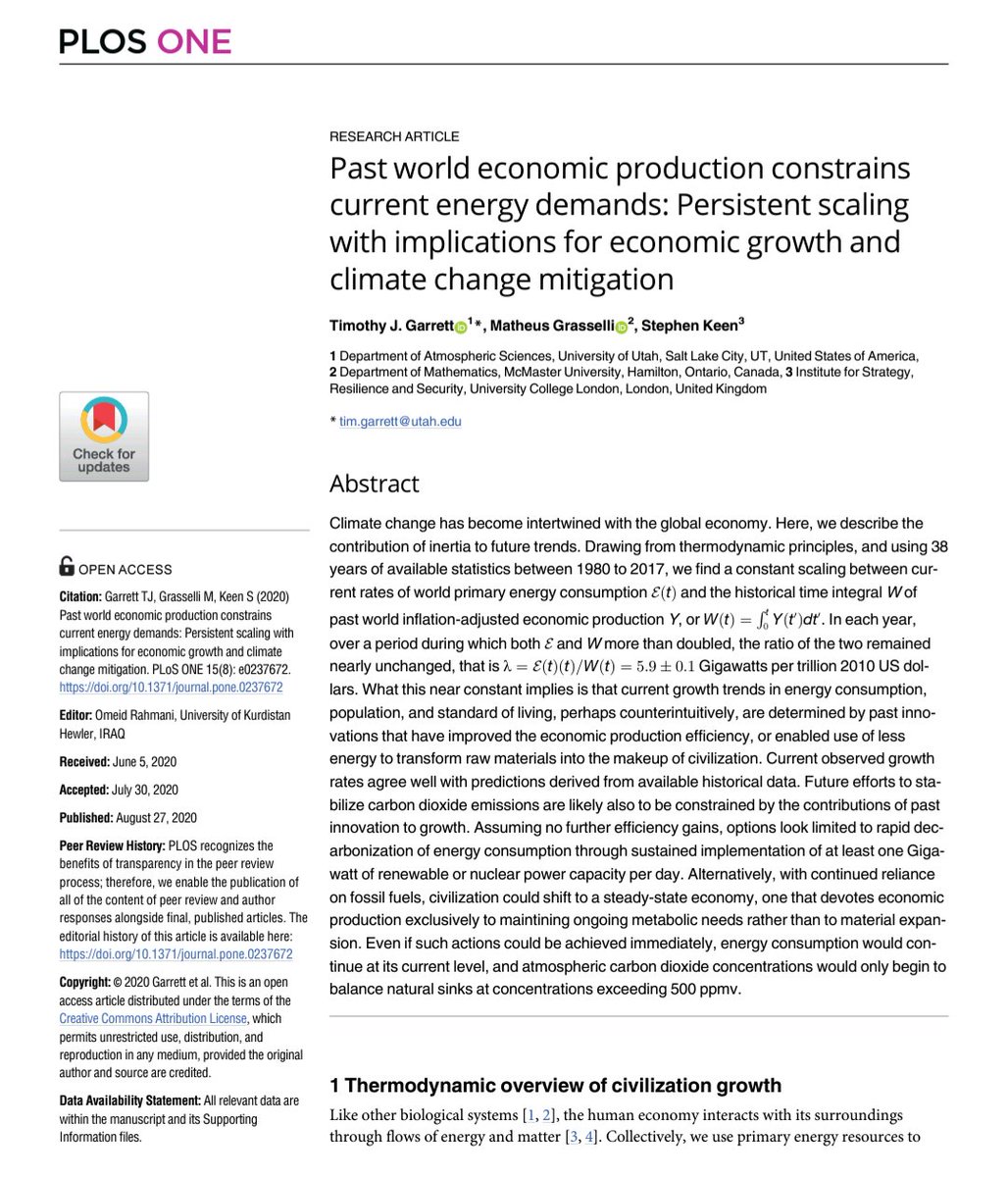
(long) 🧵:
• Noted climate physicist personally dives into cost-benefit Integrated Assessment Models (IAM's) - DICE and others.
•Writes own simplified version! Derives *intriguing* results!
A 🧵tour exploring his investigation and - slightly provocative? - conclusions!
• Noted climate physicist personally dives into cost-benefit Integrated Assessment Models (IAM's) - DICE and others.
•Writes own simplified version! Derives *intriguing* results!
A 🧵tour exploring his investigation and - slightly provocative? - conclusions!

The physicist is Myles Allen - of 2009's "Trillionth Tonne"⬋(and *much* other!) note.
Links to his 2015 lecture on IAM's and a 4-page 2016 paper are in this tweet.
Several elements of his investigation make it worthy of a thread:
podcasts.ox.ac.uk/how-hot-will-i…
nature.com/articles/nclim…
Links to his 2015 lecture on IAM's and a 4-page 2016 paper are in this tweet.
Several elements of his investigation make it worthy of a thread:
podcasts.ox.ac.uk/how-hot-will-i…
nature.com/articles/nclim…


• what originally draws Myles' attention and motivates his investigation of IAM's (a physical climate question about emissions→temperature modules)
• seeing how he grapples with spinning up his CBA-IAM knowledge base in order to test a question/hunch
• seeing a light bulb...
• seeing how he grapples with spinning up his CBA-IAM knowledge base in order to test a question/hunch
• seeing a light bulb...
... turn on as he realizes how he can use the framework further to isolate on impacts of specific policy and climate variables
• how he uses his new understanding to write his own, simplified/reduced model (which, usefully, allows him to effectively drop "time" from certain...
• how he uses his new understanding to write his own, simplified/reduced model (which, usefully, allows him to effectively drop "time" from certain...
... key calculations)
• *very* interesting results from this simple model/assumptions, regarding peak warming and two particular policy-relevant variables: the ultimate "backstop mitigation technology" price, and rate of economic growth. Results which may perplex/upset *some*?
• *very* interesting results from this simple model/assumptions, regarding peak warming and two particular policy-relevant variables: the ultimate "backstop mitigation technology" price, and rate of economic growth. Results which may perplex/upset *some*?
Specifically - and jumping ahead to my "provocative" reference (& partly to entice full reading through my thread!😛) - his results⬇ show peak warming varying *directly* with the backstop technology price, but varying *inversely* with the *rate* of economic growth.
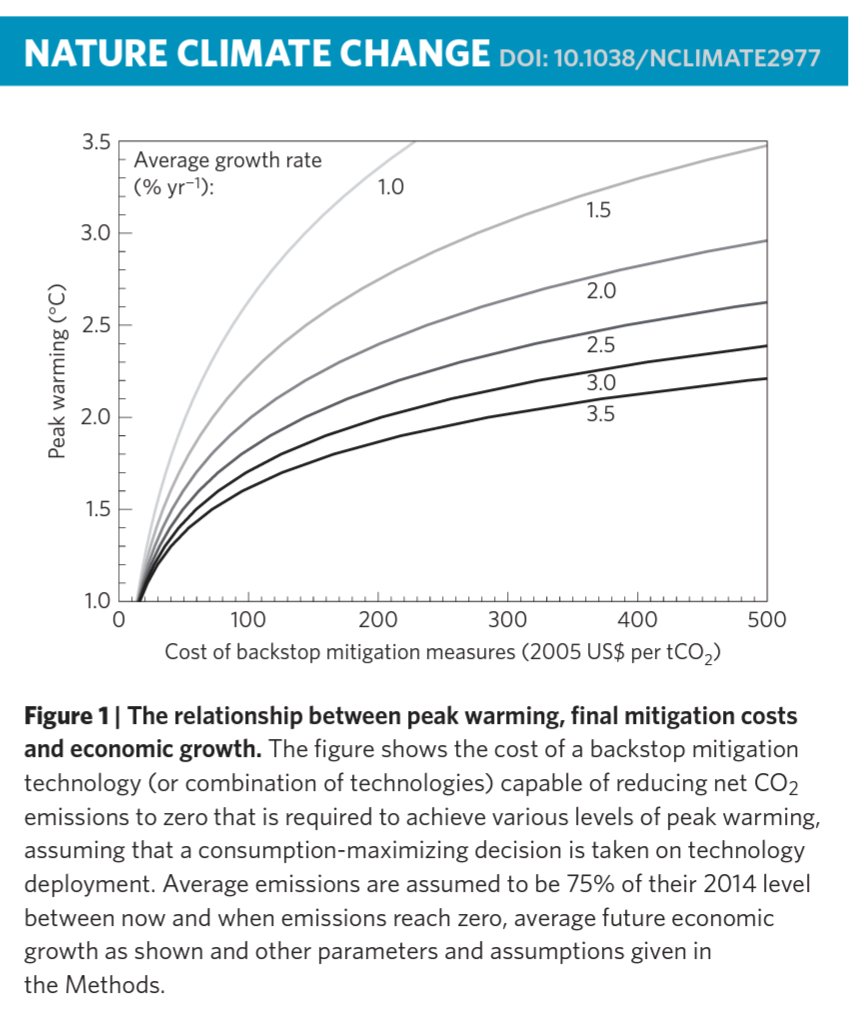
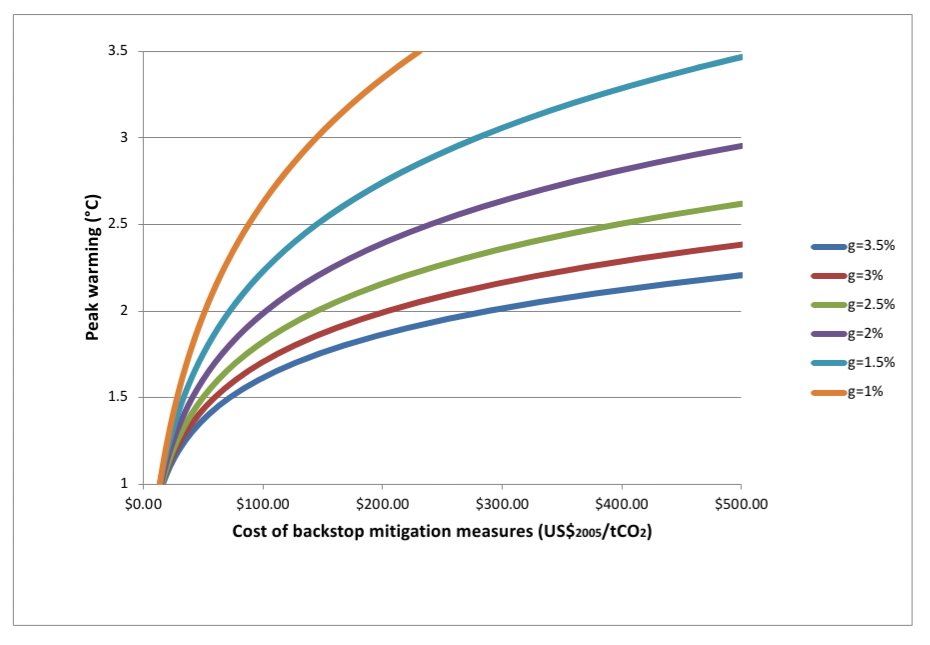
i.e., ceteris paribus, peaks of both warming and cumulative emissions occur at lower points if the ultimate cost of the "backstop" CO₂ mitigation technology is lower (intuitive!), but *also*, cet. par., for *higher* avg. rates of economic growth (likely *not* intuitive to many!)
We'll circle back to how/why those results interestingly emerge, but first...
Returning to the Myles Allen's motivations...
His initial interest in CBA-IAM's stemmed from noting their temperature response to emissions struck him as "sluggish". Model temps *eventually*...
Returning to the Myles Allen's motivations...
His initial interest in CBA-IAM's stemmed from noting their temperature response to emissions struck him as "sluggish". Model temps *eventually*...
... responded roughly correctly but slower than estimated by climate models. (Discussed at 6:19 - 9:52 in the lecture.)
So, his intuition was: if the representation of the *timing* of the physical temperature response 𝗧 to emissions in IAM's was sluggish, it would imply...
So, his intuition was: if the representation of the *timing* of the physical temperature response 𝗧 to emissions in IAM's was sluggish, it would imply...
... their damage functions (a function 𝒇 (T) at time t) would consequentially *also* be underspecified.
Further, he sensed they *should* have been using an 𝒇 (emissions) for T which would more closely resemble the TCRE (Transient Climate Response to Emissions👇).
Further, he sensed they *should* have been using an 𝒇 (emissions) for T which would more closely resemble the TCRE (Transient Climate Response to Emissions👇).
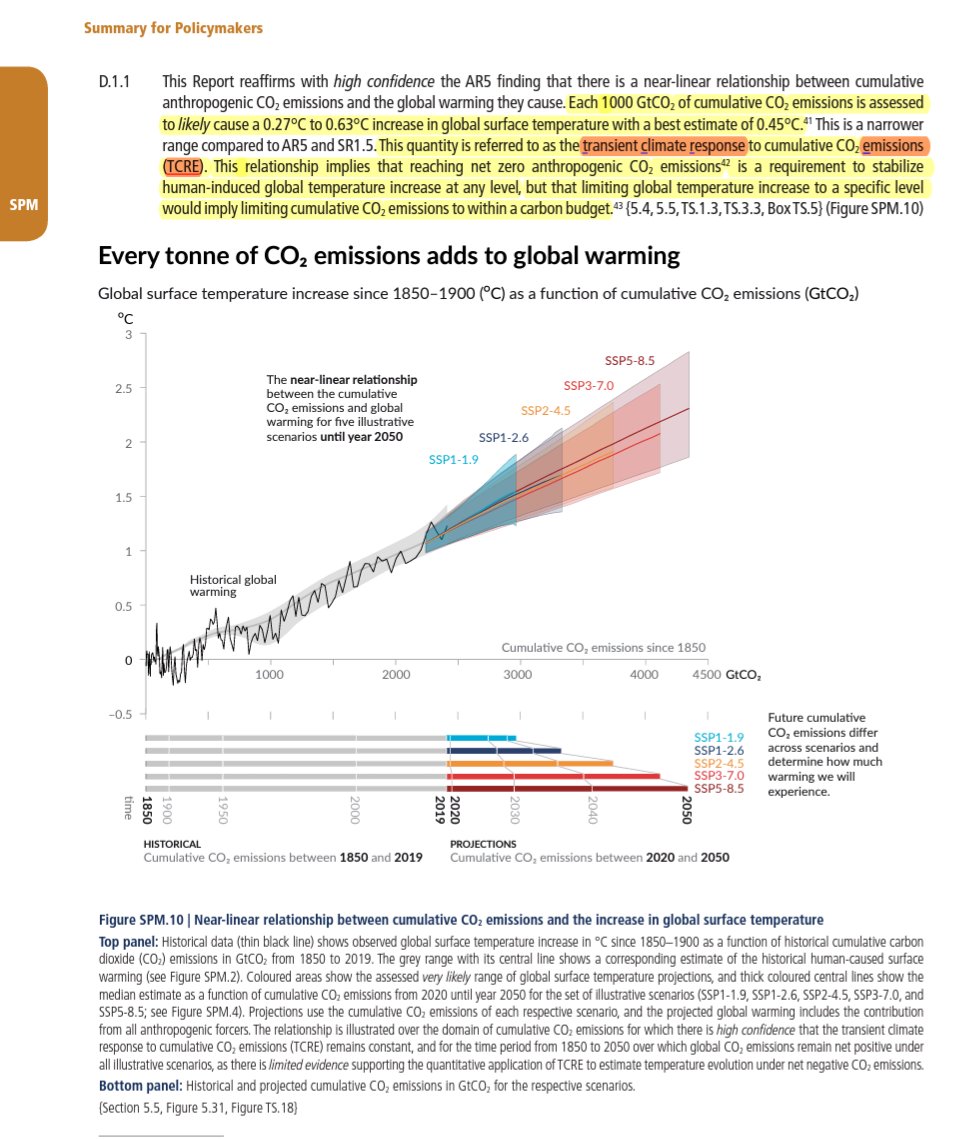
This was, itself, an interesting insight¹ - it's the top reason the subsequent 2016 paper gets cited, and significant further work has extended this since, e.g.,⬋and⬊
But it's something clever Myles does *next* I find intriguing.
sciencedirect.com/science/articl…
papers.ssrn.com/sol3/papers.cf…
But it's something clever Myles does *next* I find intriguing.
sciencedirect.com/science/articl…
papers.ssrn.com/sol3/papers.cf…
¹(minor aside: *Much* later to the party - but still pretty impressive to ex-beer-league-hockey-player-me! - one of the first things👇I *independently* noticed when initially diving deeper into CBA-IAM's was *exactly* this same TCRE point. (what, *me*?😲))
https://twitter.com/rustneversleepz/status/1422995117988777986?t=dnScFotkmfi0BO0sYAbWwg&s=19
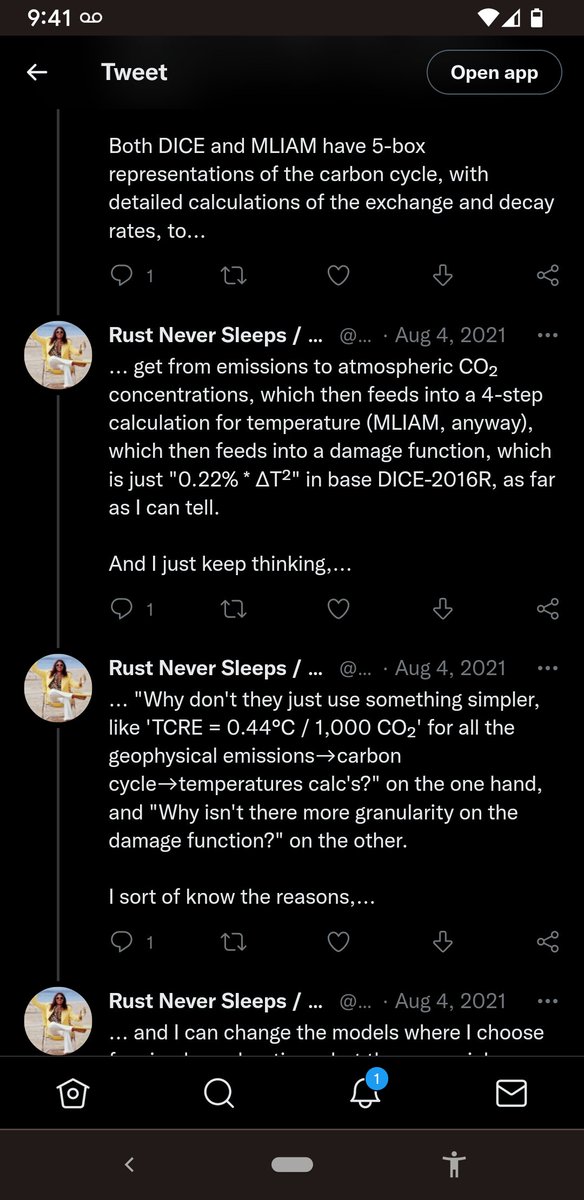
I really recommend watching the lecture, where Myles recounts his initial foray into exploring CBA-IAM's.
In any event, his hypothesis was that using the (correct) TCRE approach for translating emissions to temp's, ①, would in turn accelerate the impacts in the...
In any event, his hypothesis was that using the (correct) TCRE approach for translating emissions to temp's, ①, would in turn accelerate the impacts in the...
... damages function ②👇*. Which would then propogate through to GDP③, consumption④ and reflexively back into the (future) emissions module ⑤. (hence, e.g., the acronym "DICE"!🤷).
And likely lead to higher estimates of damages, and presumably earlier/larger mitigation...
And likely lead to higher estimates of damages, and presumably earlier/larger mitigation...
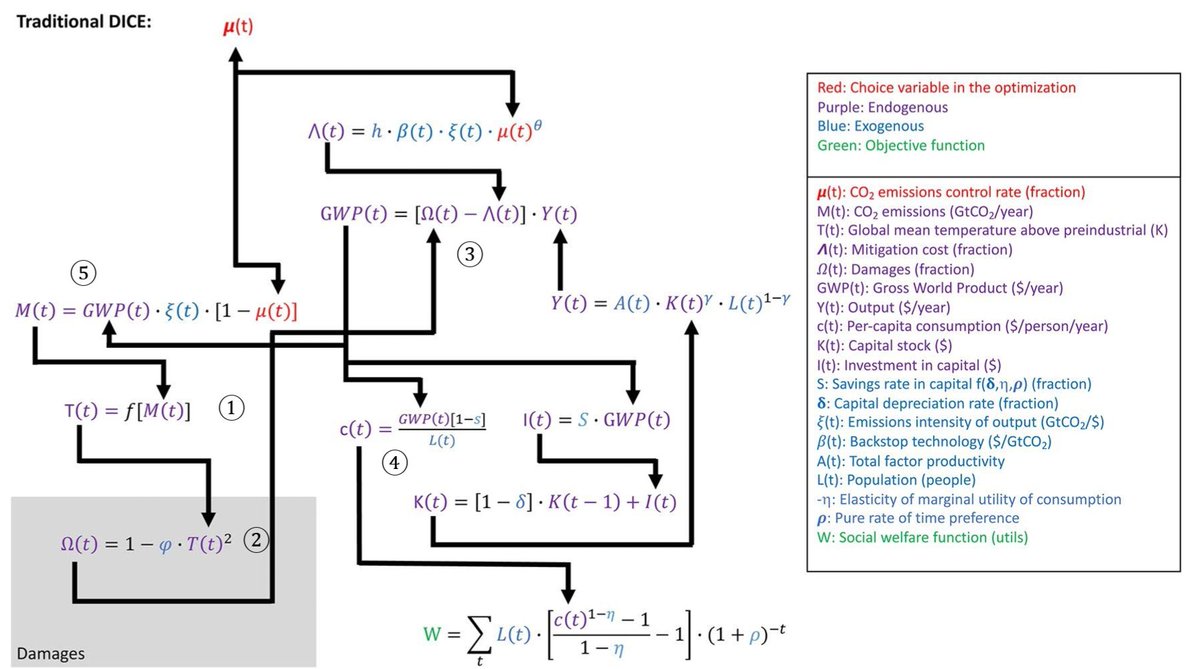
(* the simplified - and very useful! - top-level schematic of the vanilla DICE-2016R model happens to be courtesy of *another* climate scientist, @PatrickTBrown31 (with @hsaunders6) who took the time to dive into the CBA-IAM's and experiment... 🤷)
journals.plos.org/plosone/articl…
journals.plos.org/plosone/articl…
To test this hypothesis - and to essentially see how sensitive key CBA-IAM outputs would be to this new emissions→temperature function - Myles Allen decides to dive into how the models actually work... and *construct his own simplified version of an IAM*.👍😲
He studies Nordhaus' "Climate Casino"; consults* with Martin Weitzman, @camjhep, @cwhope, and several others on the IAM's/economics, and gets further input/help from @ClimateFramo, @NichollsZeb and other earth scientists, and plunges in...
(* rather a nice rolodex to consult!)
(* rather a nice rolodex to consult!)
In the lecture, before going on to describe his mini-model, Myles briefly describes a subtle concept he encounters that makes "solving" the economics for a stock pollutant like CO₂ that requires *ZERO* emissions deceptively more complex than for more familiar pollution dilemmas.
This wrinkle deserves it's own thread - which I may do as follow-up - but a *brief* digression (w/o graphs) on this key concept now...
There are *three* competing considerations any time we're faced with creating - or avoiding!- the next tonne of CO₂ emissions:
There are *three* competing considerations any time we're faced with creating - or avoiding!- the next tonne of CO₂ emissions:
1• the marginal additional *benefits* derived from the emissions (MB);
2• the marginal "abatement" cost (if any) of avoiding that emission (MAC) - e.g., any additional net cost involved in using a non-CO₂-emitting substitute;
3• the marginal additional damages (MD) due to ...
2• the marginal "abatement" cost (if any) of avoiding that emission (MAC) - e.g., any additional net cost involved in using a non-CO₂-emitting substitute;
3• the marginal additional damages (MD) due to ...
... an extra tonne of emissions.
If the benefit of creating and/or the cost of avoiding a specific tonne of emission is *less than* the damages created by that tonne, then, rationally, to better our outcome "we" shouldn't add *that* tonne of CO₂ to the atmospheric stock!
If the benefit of creating and/or the cost of avoiding a specific tonne of emission is *less than* the damages created by that tonne, then, rationally, to better our outcome "we" shouldn't add *that* tonne of CO₂ to the atmospheric stock!
The complicating factor is, largely, that although each of these marginal functions is generally characterized as non-linear with respect to CO₂ emissions, MB and MAC vary *inversely* with the *flow* of emissions, while MD varies *directly* with *cumulative stock* of emissions.
This can give rise to the awkward situation that as we reduce the annual *flow* of CO₂ emissions, we increasingly encounter use cases with progressively higher marginal benefits and/or harder-to-abate costs.
Because essentially all the MB and/or MAC is attached - *now* - to...
Because essentially all the MB and/or MAC is attached - *now* - to...
... the next flow-tonne of emissions, those values can rise at rates *much* faster than the *marginal* damages associated with that tonne, which - although also non-linear with emissions - still only increases *cumulative* emissions by about 1/2.5 trillionᵗʰ of historical stock.
This is problematic if the *goal* - as in the case of a long-lived climate forcing (CO₂) - physically requires not just significantly reducing but eliminating *entirely* marginal emissions. We'd potentially long be faced with some persistent emissions where MB &/or MAC is ≥ MD.
This complication presents a quandary for traditional pollution economics, but generally receives little attention in broader public discussion about the economics of climate/carbon mitigation. That's partly because so much mitigation at cheaper cost also needs to be done,...
... which seemingly makes the cost of the tail end of emissions reduction appear less salient.
Nevertheless, because we require *ZERO* (or less!) CO₂ emissions to stabilize temperatures, the implication is that we must reach the situation where potentially large and...
Nevertheless, because we require *ZERO* (or less!) CO₂ emissions to stabilize temperatures, the implication is that we must reach the situation where potentially large and...
... fast-rising MAC (or MB) must be *≤* marginal damages.
*Fortunately*, there is a way out of this dilemma if there exists an abatement technology (or technologies) that can serve as a "backstop" for the elimination of the the residual emissions as we approach zero emissions.
*Fortunately*, there is a way out of this dilemma if there exists an abatement technology (or technologies) that can serve as a "backstop" for the elimination of the the residual emissions as we approach zero emissions.
Technologies which, ideally, ① could be deployed at large scale, ② used for *multiple* difficult to abate sectors/applications, and ③ critically, whose *marginal cost per tonne would stop (or dramatically slow) rising* at some point.
Then, at the point where the...
Then, at the point where the...
... marginal damages exceeded *this* "backstop" abatement cost, emissions would/should - in theory - cease.
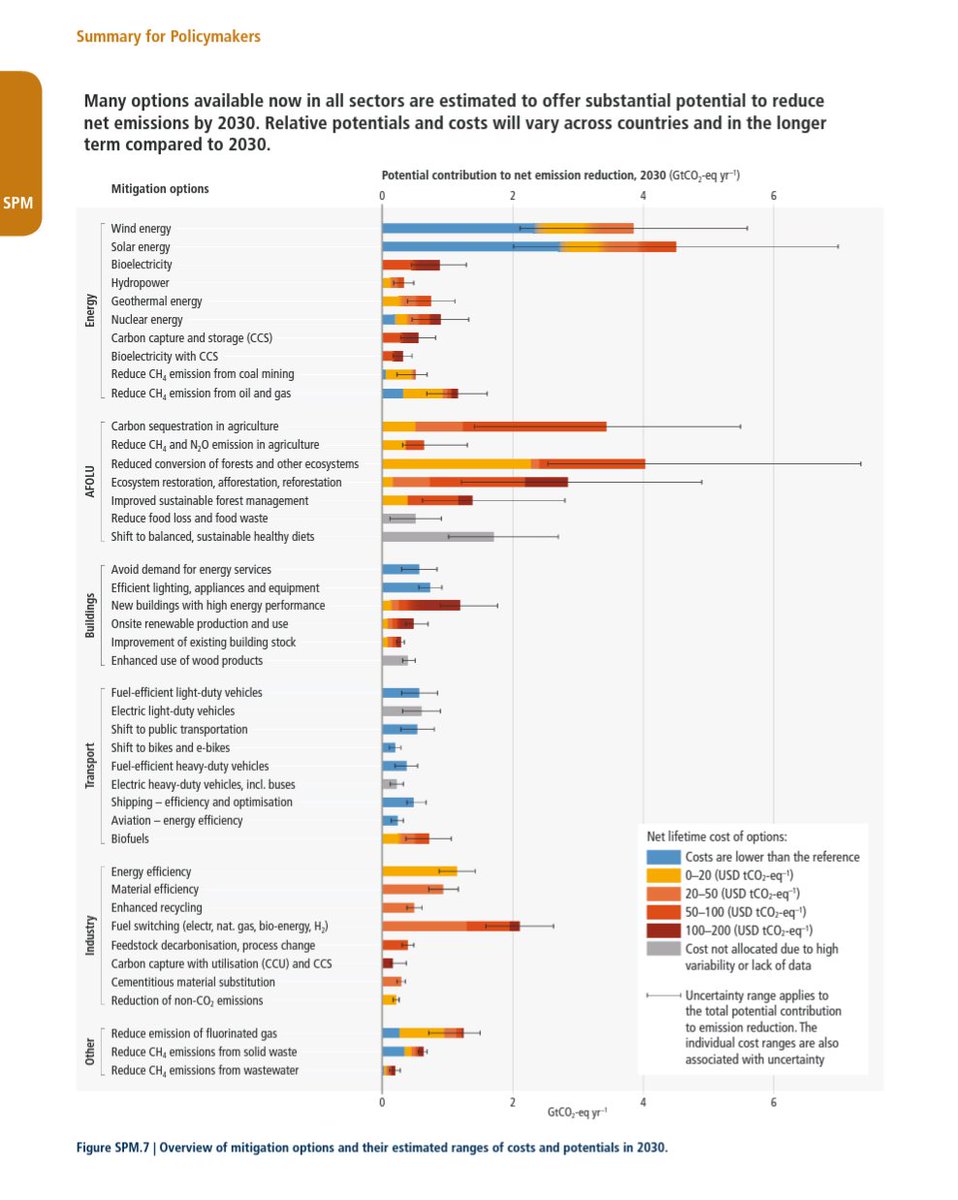
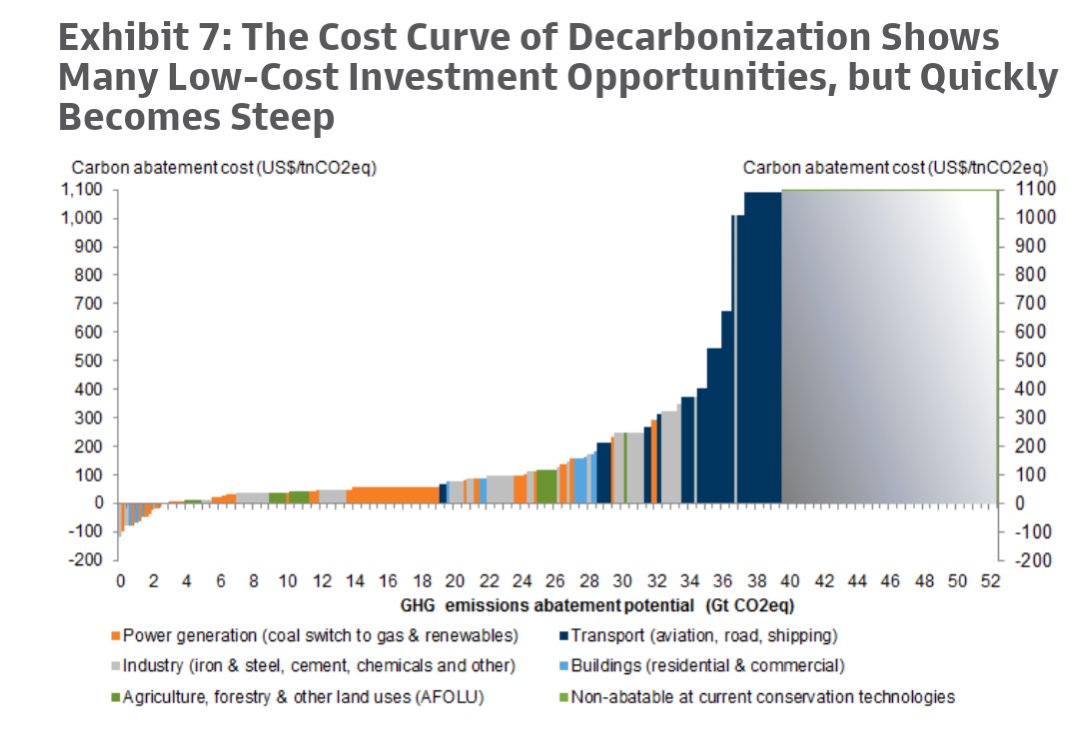
As a brief detour on how the cost curve for abatement technologies in general might map out over time, and the role a "backstop" might play in cutting off the high end,...
As a brief detour on how the cost curve for abatement technologies in general might map out over time, and the role a "backstop" might play in cutting off the high end,...
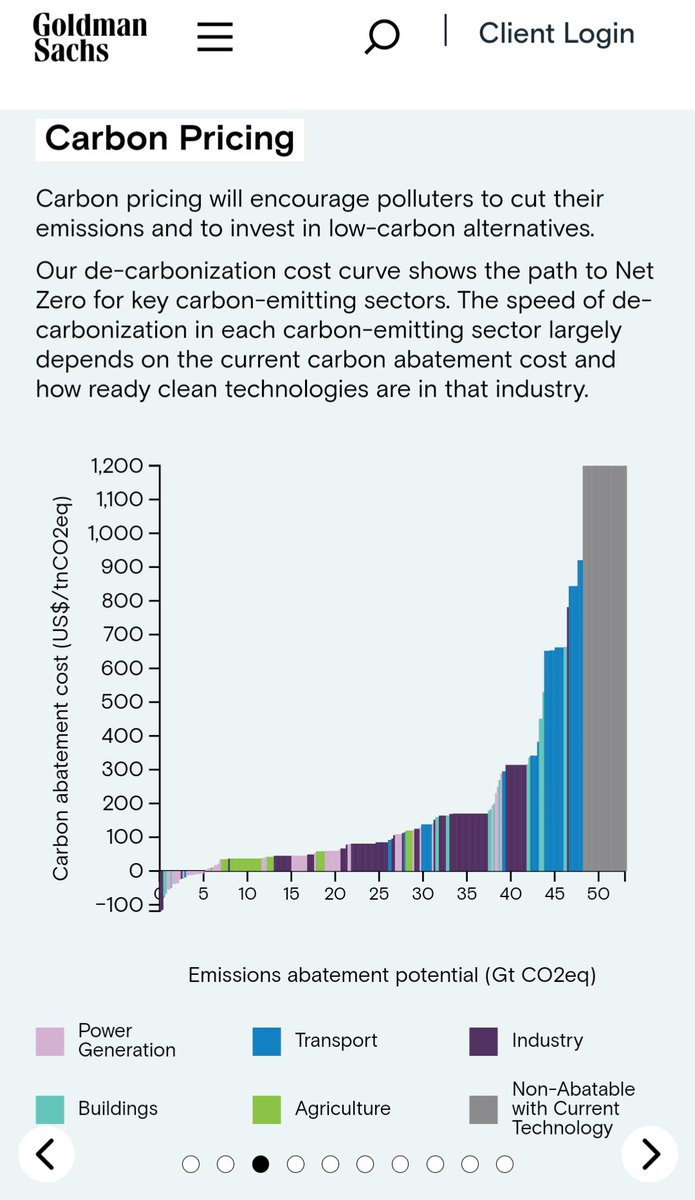
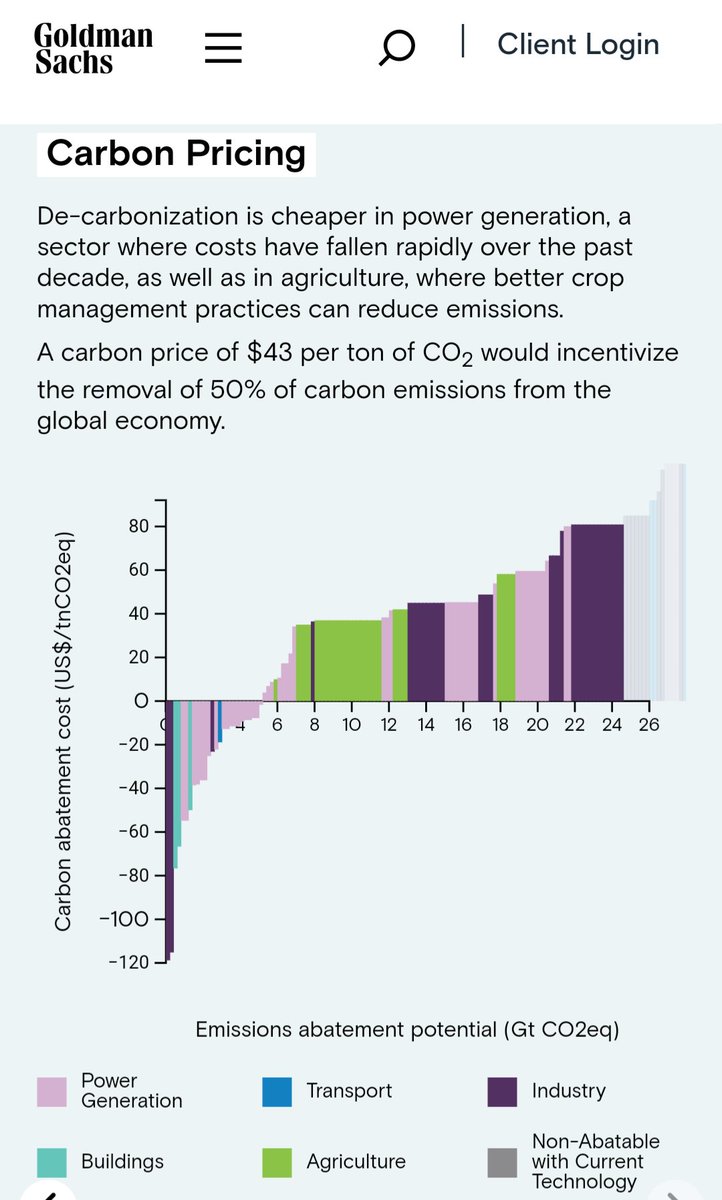
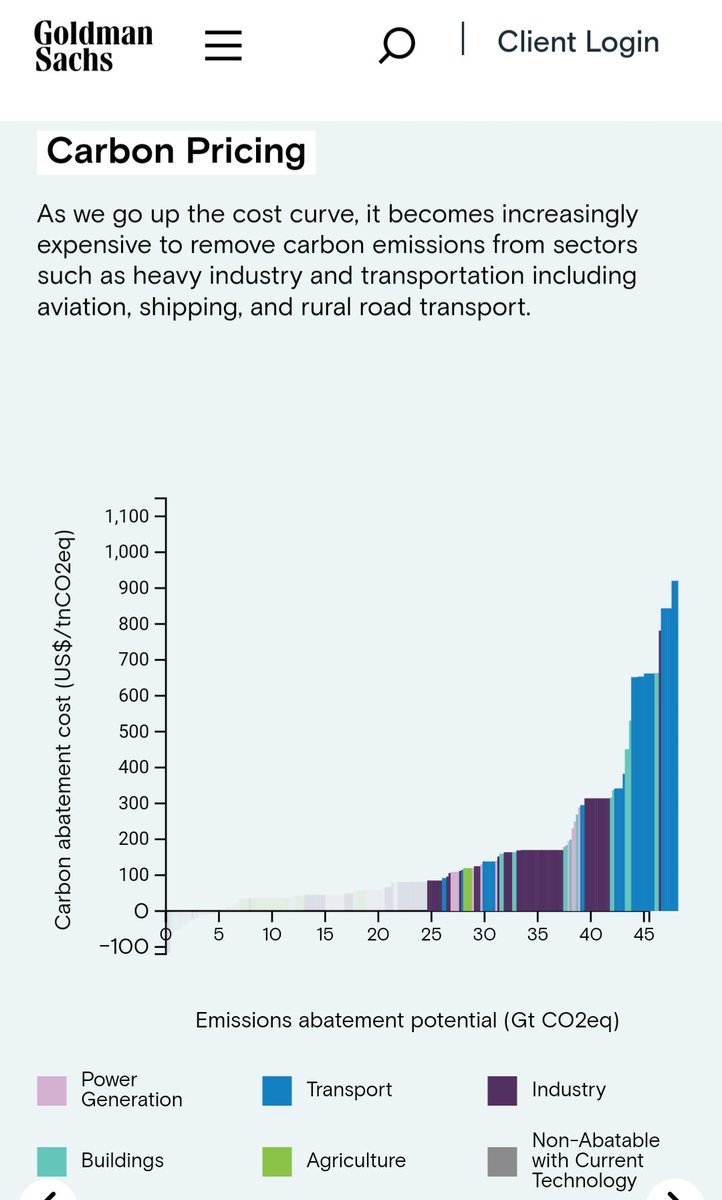
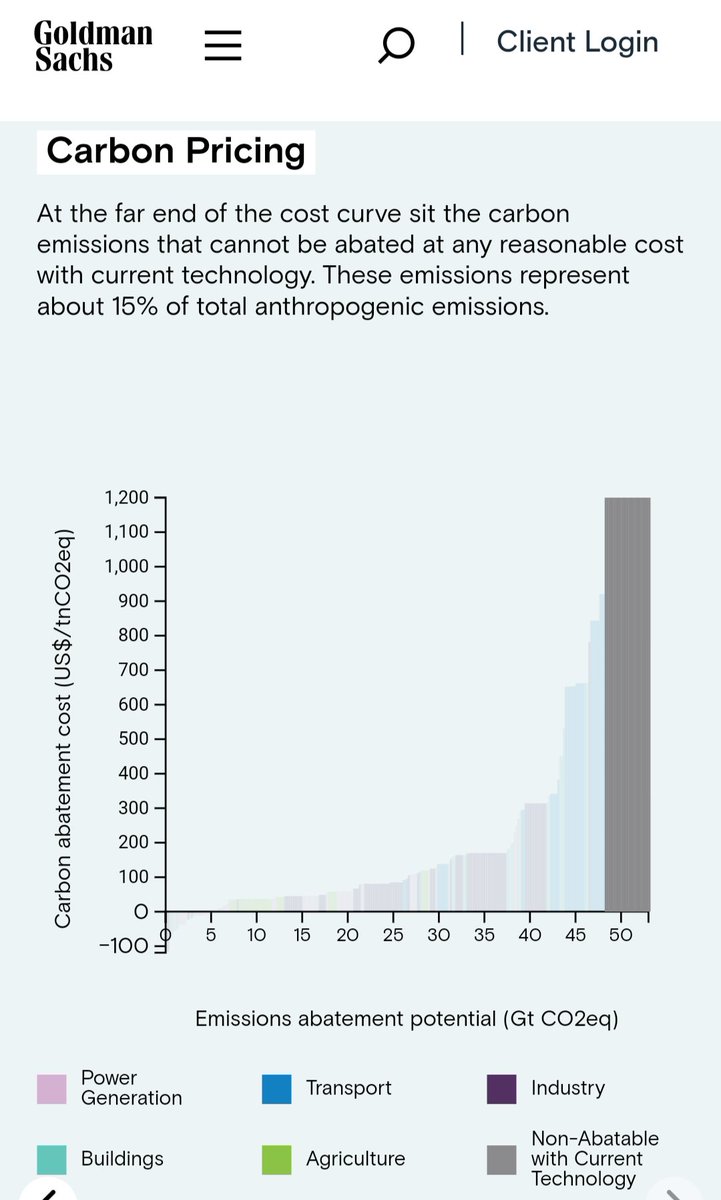
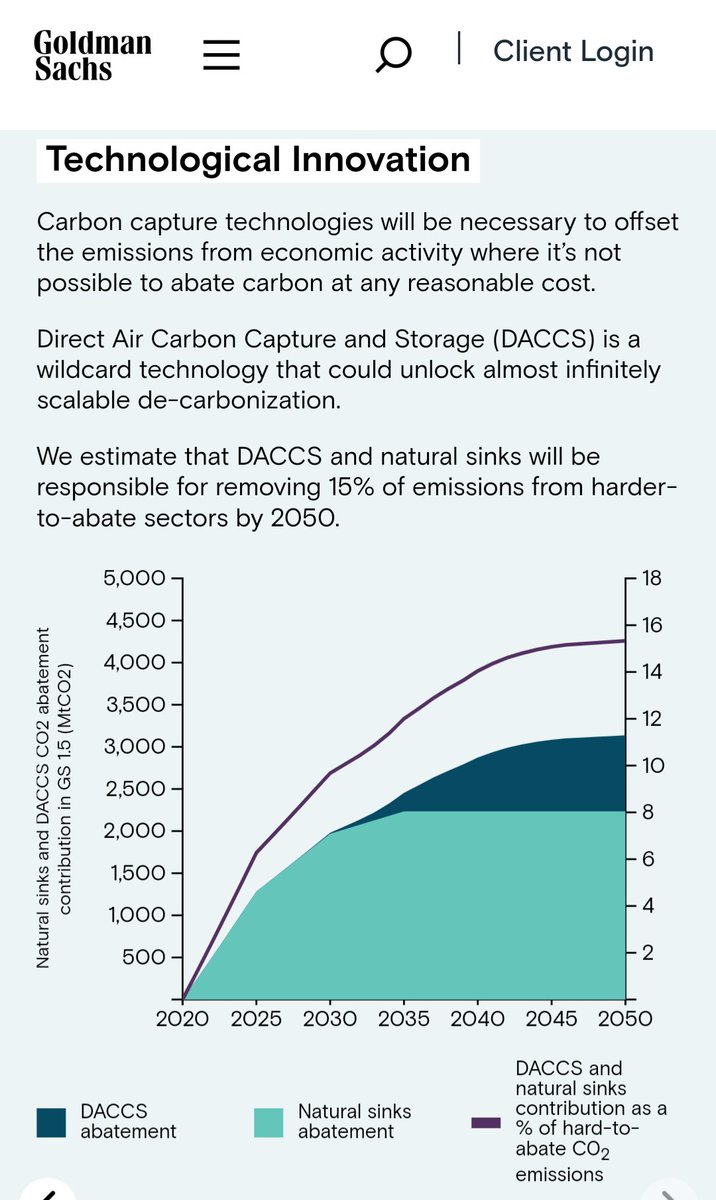
Or these roadmaps for 2050 by the Environmental Defense Fund⬋, and the IPCC AR6 WGIII SPM⬊.
edf.org/revamped-cost-…
edf.org/revamped-cost-…
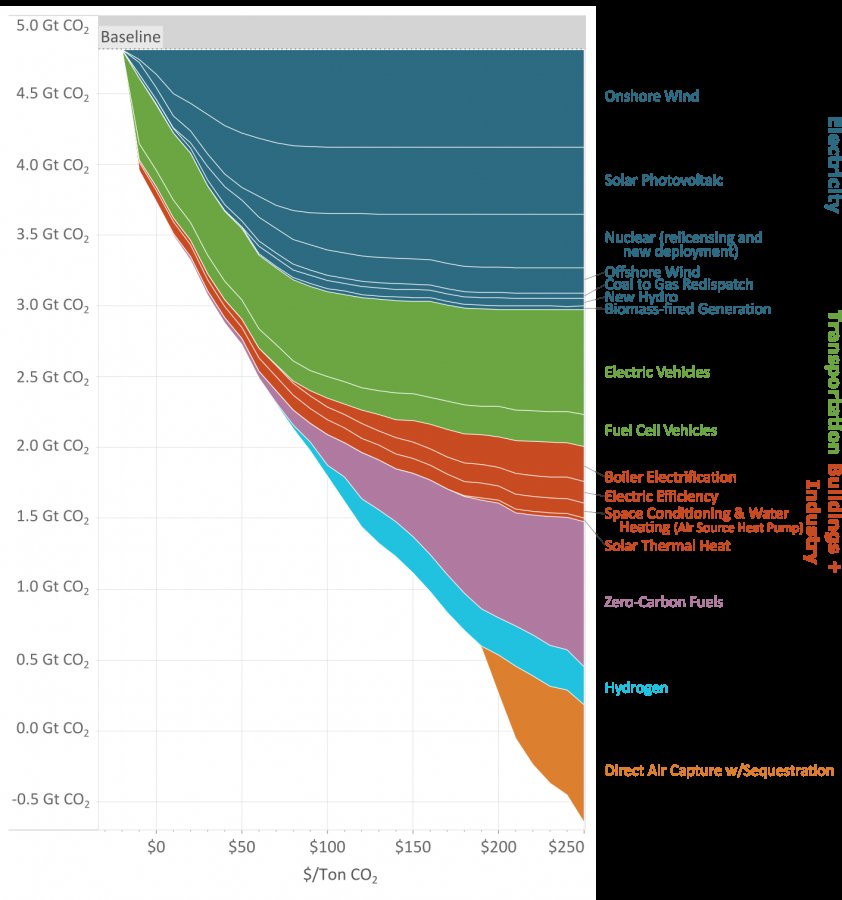
Well, at ~15 tweets, that was a somewhat longer digression than I'd hoped, but it was worth planting a flag as to what the concept of a "backstop technology" represents, because the concept will prove to be useful/important later.
But we'll now return to Myles Allen's...
But we'll now return to Myles Allen's...
... development of a mini- CBA-IAM, and his investigation of the "murder mystery" (his words) of what variables it is and isn't sensitive to.
Myles is using his IAM to explore alternatives and sensitivities to key variables - CBA-IAM's were primarily...
nature.com/articles/nclim…
Myles is using his IAM to explore alternatives and sensitivities to key variables - CBA-IAM's were primarily...
nature.com/articles/nclim…
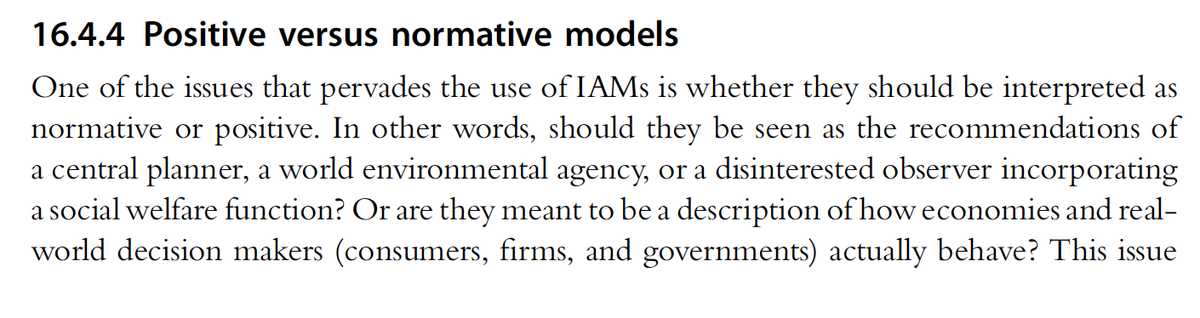
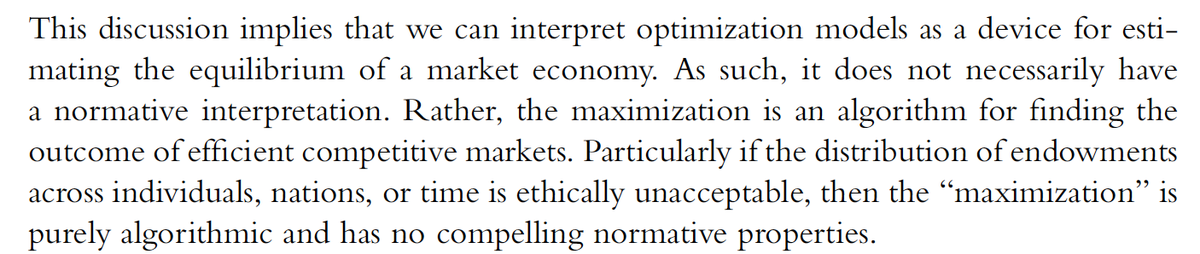
... developed as tools for exploration or descriptive analysis, less so for prescriptive purposes, (e.g. Nordhaus on the topic👇).
This allows Allen to make some simplifying assumptions (e.g. ideal participation/cooperation rates, perfect rationality, no specified production...
This allows Allen to make some simplifying assumptions (e.g. ideal participation/cooperation rates, perfect rationality, no specified production...
... function, etc.) which aren't "real-life", but they'll be held constant as other variables are examined, so he can still test sensitivities, make general inferences. This then also allows him to really streamline his mini-model to just a few key components:
1• An emissions→temperature module for time 𝘵, which is essentially simply just the cumulative emissions to time 𝘵 multiplied by a constant representing the TCRE.
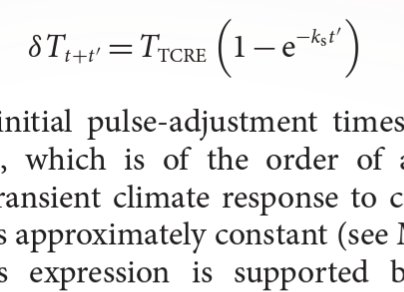
2• A function for *marginal* temperature change due to the emission of one extra tonne of CO₂, of the form:👇
2• A function for *marginal* temperature change due to the emission of one extra tonne of CO₂, of the form:👇

(don't get too hung up on his "initial pulse adjustment timescale"... just my advice if you are...)
3• A damages function for the overall economy *at time 𝘵* expressed as a function of temperature of the generalized form:👇
(again, one could specify a different damages...
3• A damages function for the overall economy *at time 𝘵* expressed as a function of temperature of the generalized form:👇
(again, one could specify a different damages...

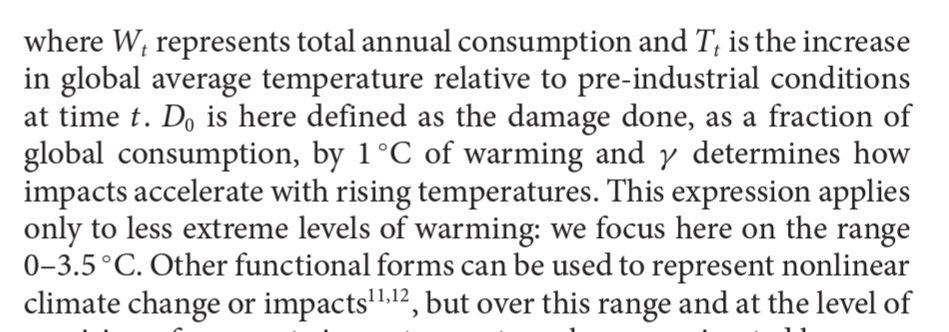
... function, but as we'll see, it may not change some of his *relative* sensitivities and results)
4• A *marginal* damages function (MD), representing the current and all discounted future damages attributable to the *next tonne of CO₂ emissions* (also known as...
4• A *marginal* damages function (MD), representing the current and all discounted future damages attributable to the *next tonne of CO₂ emissions* (also known as...
... the "Social Cost of Carbon" (SCC)), of the form:👇
(same caveats as above)
👆These four components are all modules anyone considering modeling the problem would need to include, and his functional choices are mostly conventional. (But remember, he's primarily exploring...
(same caveats as above)
👆These four components are all modules anyone considering modeling the problem would need to include, and his functional choices are mostly conventional. (But remember, he's primarily exploring...
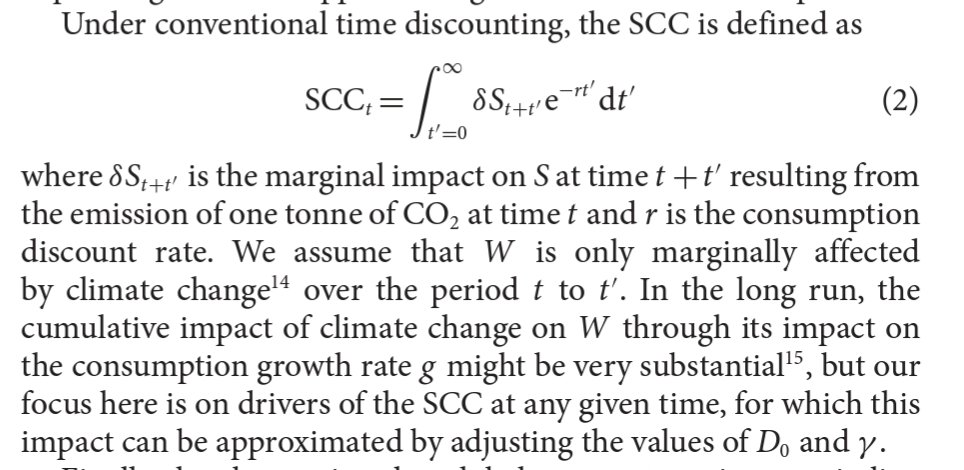
... sensitivities, so even radically different choices *may* not much change his generalized results!)
He also makes a functional choice for:
5• The *marginal* abatement cost (MAC) for the next tonne of CO₂ at time 𝘵, of the form:👇
He also makes a functional choice for:
5• The *marginal* abatement cost (MAC) for the next tonne of CO₂ at time 𝘵, of the form:👇

(Not sure how many people are going to get down to this level, so I am mostly going to defer discussion of this - clever - functional choice. There are several subtle implications, but note particularly that MACₜ ∝ Wₜ/Eₜ, so varies directly with global prosperity,...
... but *inversely* with emissions (which must decline towards zero).
Also worth noting that Allen's IAM-MAC function is *not* an attempt to represent the cost evolution of the mitigation technologies THEMSELVES, such as in this EDF version for the US economy we saw earlier.
Also worth noting that Allen's IAM-MAC function is *not* an attempt to represent the cost evolution of the mitigation technologies THEMSELVES, such as in this EDF version for the US economy we saw earlier.
INSTEAD, it's an attempt to represent an estimate of the marginal willingness/ability to pay for abatement when traded off against the rising "carbon productivity" of the economy's declining/residual emissions. Further, it's assumed that if abatement technologies become...
... available at this cost and are ≤ MD, they would, rationally, be deployed.
Armed with these 5 economical (😉) components, and abstracting away from some other common IAM modules by assuming perfect cooperation, etc., Myles Allen now has a *very* simple cost-benefit
Armed with these 5 economical (😉) components, and abstracting away from some other common IAM modules by assuming perfect cooperation, etc., Myles Allen now has a *very* simple cost-benefit
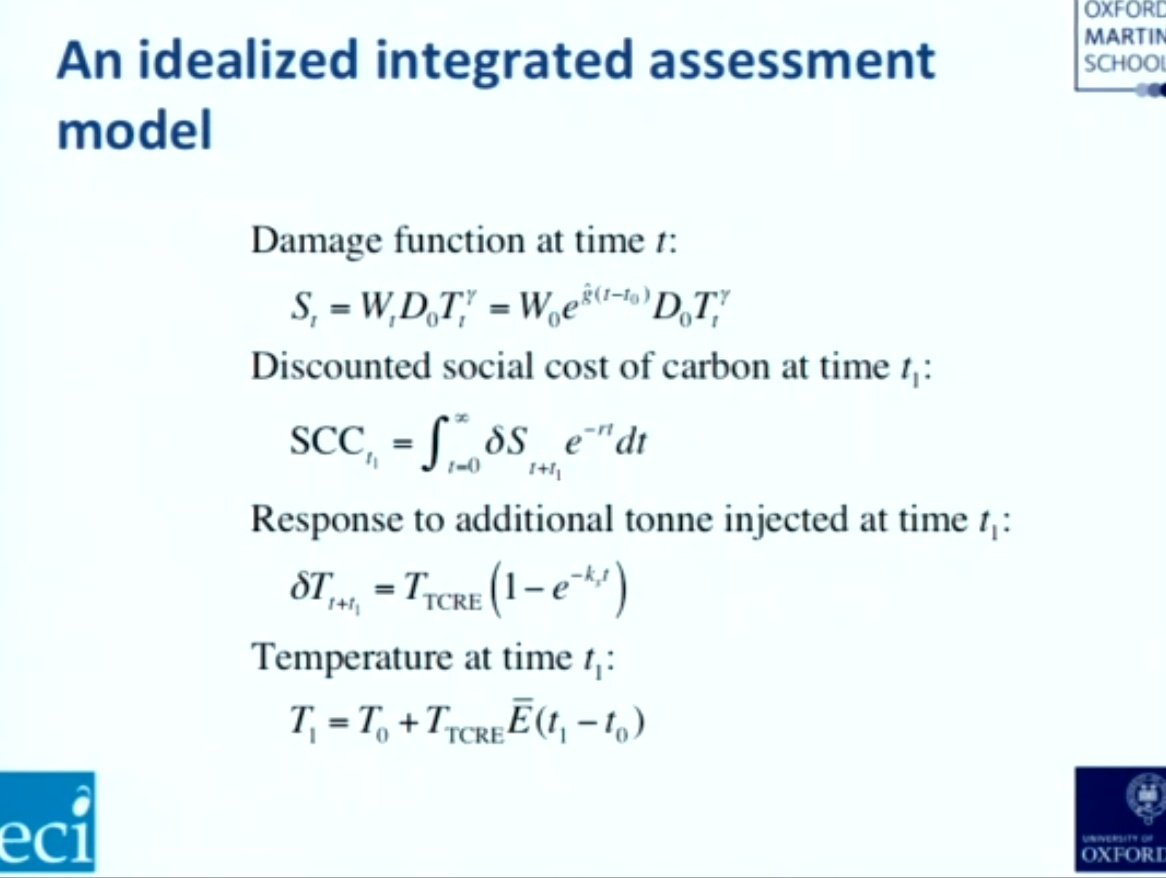
... integrated assessment model, defined by a few key variables and assumptions, which is also fully "analytically tractable".
Specifically, and as discussed in the less than one-page "Methods" section of his four-page paper - it's brief, but you want to *carefully* follow...
Specifically, and as discussed in the less than one-page "Methods" section of his four-page paper - it's brief, but you want to *carefully* follow...
... the derivative he takes, and substitutions and assumptions he makes there! - 𝙝𝙚 𝙘𝙖𝙣 𝙨𝙤𝙡𝙫𝙚👇𝙛𝙤𝙧 𝙩𝙝𝙚 𝙘𝙤𝙣𝙙𝙞𝙩𝙞𝙤𝙣𝙨 𝙩𝙝𝙖𝙩 𝙢𝙪𝙨𝙩 𝙚𝙭𝙞𝙨𝙩 𝙖𝙩 𝙩𝙝𝙚 𝙩𝙞𝙢𝙚 𝙣𝙚𝙩-𝙯𝙚𝙧𝙤 𝙘𝙖𝙧𝙗𝙤𝙣 𝙚𝙢𝙞𝙨𝙨𝙞𝙤𝙣𝙨 𝙞𝙨 𝙖𝙘𝙝𝙞𝙚𝙫𝙚𝙙...

... (𝙖𝙣𝙙 𝙩𝙚𝙢𝙥𝙚𝙧𝙖𝙩𝙪𝙧𝙚𝙨 𝙨𝙩𝙤𝙥 𝙧𝙞𝙨𝙞𝙣𝙜).
(if anyone is reading carefully along at this👆depth, I'll be genuinely quite happy/interested in discussing the steps he takes to arrive at this point... surprisingly simple, actually - but not "easy"👇... But for...
(if anyone is reading carefully along at this👆depth, I'll be genuinely quite happy/interested in discussing the steps he takes to arrive at this point... surprisingly simple, actually - but not "easy"👇... But for...

... purposes of this tweet-🧵right now, I am just moving the discussion forward to this balance condition.)
Note carefully: Myles Allen is *not* making a *prescriptive* case - i.e., what "should" we do to get to net-zero emissions. Rather, he's simply looking at what...
Note carefully: Myles Allen is *not* making a *prescriptive* case - i.e., what "should" we do to get to net-zero emissions. Rather, he's simply looking at what...
... the model estimates the values for certain variables would *be* 𝙖𝙩 𝙩𝙝𝙚 *𝙥𝙤𝙞𝙣𝙩* 𝙤𝙛 𝙯𝙚𝙧𝙤 𝙚𝙢𝙞𝙨𝙨𝙞𝙤𝙣𝙨 (𝙖𝙣𝙙 𝙨𝙩𝙖𝙗𝙞𝙡𝙞𝙯𝙚𝙙 𝙩𝙚𝙢𝙥𝙚𝙧𝙖𝙩𝙪𝙧𝙚𝙨), and how sensitive those values are to certain specified model assumptions, constants, etc.
Pretty elegant, frankly.😎 (also worth noting that "time" (in years) doesn't appear in this👇equation - although it is sort of "stood in for" by the implied cumulative emissions to that point and the average annual emissions during mitigation to zero-emissions).
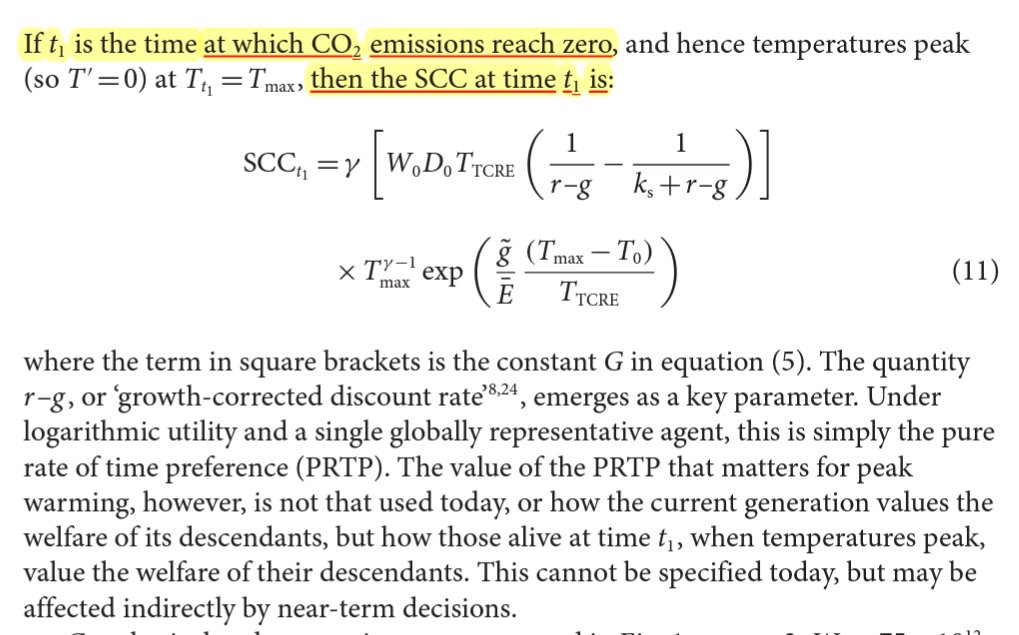
Ok, so now Myles Allen can implement this equation in a spreadsheet (Supplementary Information link and snapshot👇).
static-content.springer.com/esm/art%3A10.1…
static-content.springer.com/esm/art%3A10.1…

(Which *you* can also play with! Tip: if you're updating variables, constants to 2022-ish values, be sure to also adjust temperature labels in cells A7:A32.)
And, with that, Myles Allen (and us!) can then begin using his model to explore various sensitivities associated with...
And, with that, Myles Allen (and us!) can then begin using his model to explore various sensitivities associated with...
... this zero-emissions condition.
Recall, Myles Allen's original curiousity/skepticism of the CBA-IAM's was prompted by a hunch they were under-representing the timing of the temperature response to emissions. Which would have knock-on effects for damage functions, SCC, etc.
Recall, Myles Allen's original curiousity/skepticism of the CBA-IAM's was prompted by a hunch they were under-representing the timing of the temperature response to emissions. Which would have knock-on effects for damage functions, SCC, etc.
So, the first sensitivity he examines in his model is, in turn, its sensitivity to climate sensitivity! - represented in his model by the value for TCRE.
In his base case, he uses a *TCRE* value of 2.0°C per 1,000 GtC (0.54°C per 1,000 GtCO₂). This is somewhat higher than...
In his base case, he uses a *TCRE* value of 2.0°C per 1,000 GtC (0.54°C per 1,000 GtCO₂). This is somewhat higher than...
... the IPCC AR6 WG1 TCRE central estimate 0.45°C per 1,000 GtCO₂, but he is deliberately allowing for upside uncertainty for other climate forcings.
Then he varies that TCRE assumption upwards 50% to 3.0°C/GtC (roughly equivalent to an equilibrium climate sensitivity (ECS)...
Then he varies that TCRE assumption upwards 50% to 3.0°C/GtC (roughly equivalent to an equilibrium climate sensitivity (ECS)...
... closer to 4.5°C) and downwards 25% to 1.5°C/GtC.
Holding other values constant, here👇 are those results (via slides from his lecture).
Holding other values constant, here👇 are those results (via slides from his lecture).
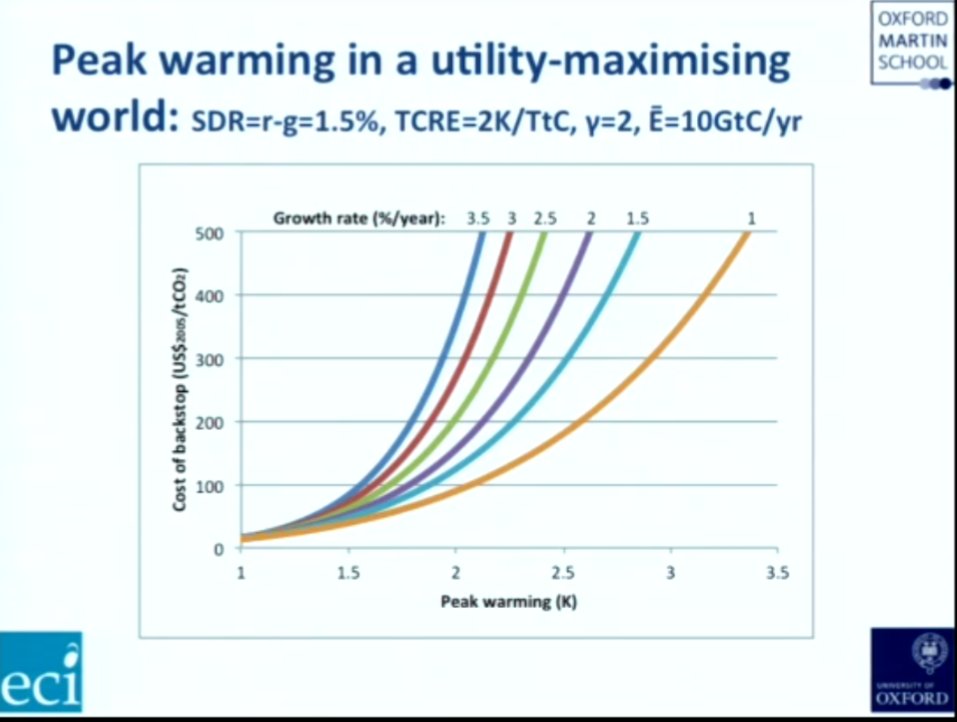
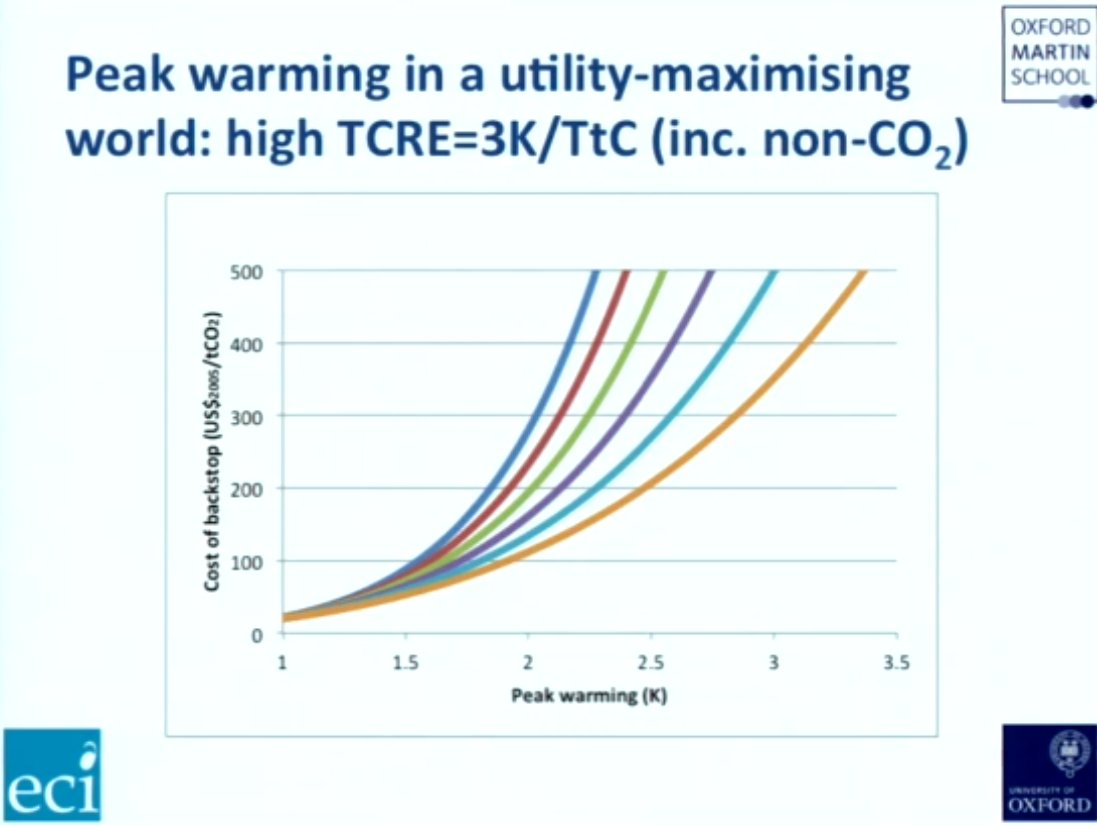
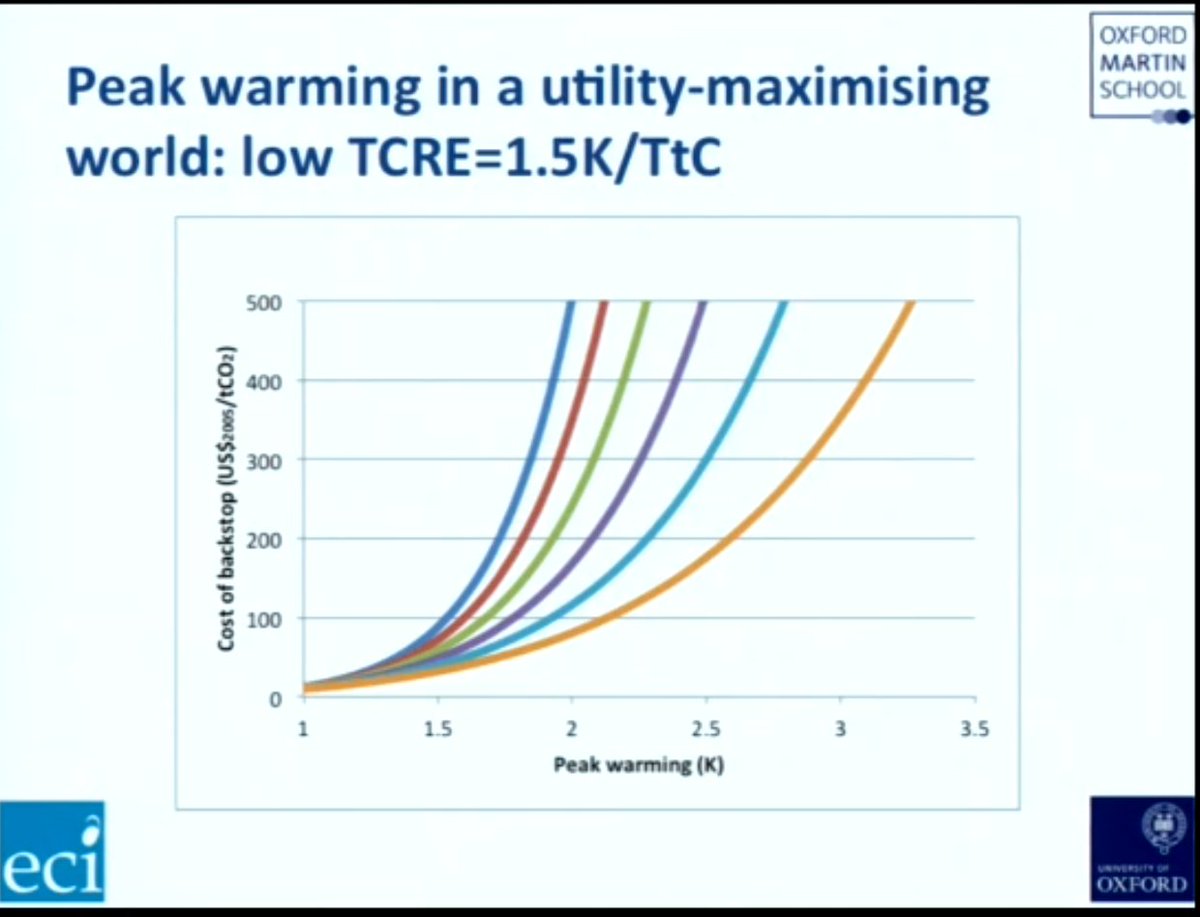
As he remarks in the lecture, although increases to the assumed TCRE value *do* have the expected directional effect of increasing the calculated SCC at the point of zero-emissions, it doesn't change it by *as much* as he expected before examining the IAM logic in more detail.
The *reason* for this is that the TCRE term occurs twice in the balance equation we saw above, with somewhat offsetting effects👇.
A higher TCRE by itself increases the relative marginal future damages due a tonne of emissions, thereby increasing the SCC, but the implied...
A higher TCRE by itself increases the relative marginal future damages due a tonne of emissions, thereby increasing the SCC, but the implied...
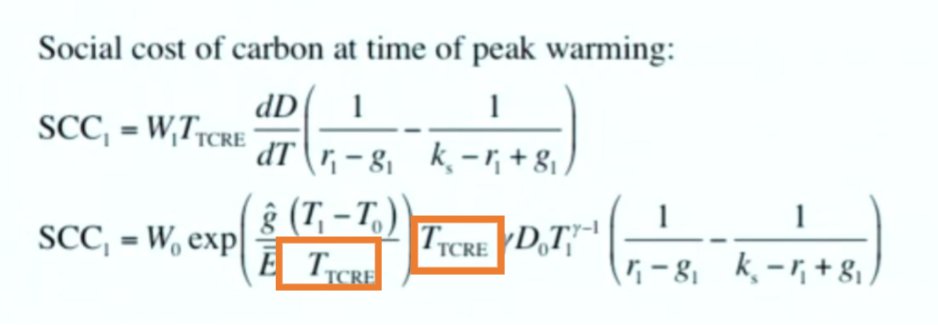
... higher experienced damages to that point have *also* acted to reduce global consumption, thereby somewhat counteracting and reducing the SCC.
So, his original suspicion on this count - that a higher TCRE would lead to a decisively higher SCC and, if we're acting rationally, faster pursuit of net-zero emissions - is already *partially* accounted for in the internal IAM logic.
But his model allows him to explore *other* sensitivities as well and he continues, examining, separately the sensitivity with respect to:
• discount rates: ✅, very sensitive - a long-understood attribute of most IAM's. (Notably, though, Myles Allen uses (effectively) a...
• discount rates: ✅, very sensitive - a long-understood attribute of most IAM's. (Notably, though, Myles Allen uses (effectively) a...
... quite low pure rate of time preference discount rate of 1.5% as his base case when analyzing the other variable sensitivities.)
• damage function: ✅, very sensitive to the parameterization of D and γ in the functional form he uses (and, presumably to other forms as well)...
• damage function: ✅, very sensitive to the parameterization of D and γ in the functional form he uses (and, presumably to other forms as well)...
Again, unsurprising. (And more on the damage function towards the end of the 🧵.)
But now - finally!
The part of the thread anyone still reading along has been *𝙥𝙖𝙩𝙞𝙚𝙣𝙩𝙡𝙮* waiting for!
But now - finally!
The part of the thread anyone still reading along has been *𝙥𝙖𝙩𝙞𝙚𝙣𝙩𝙡𝙮* waiting for!
Myles Allen then turns his attention to the zero-emissions condition sensitivity of the two key variables in his model we can actually target to directly influence through policy:
• economic growth rates *until* net-zero emissions are achieved;
and...
• economic growth rates *until* net-zero emissions are achieved;
and...
• the cost of the backstop abatement technology
Allen elects to fix the following parameters in his model thus:
•Current real GDP: $75 trillion (in 2015)
•Current temperature anomaly : 0.9°C (2015)
•"Growth-corrected" discount rate: 1.5%
Allen elects to fix the following parameters in his model thus:
•Current real GDP: $75 trillion (in 2015)
•Current temperature anomaly : 0.9°C (2015)
•"Growth-corrected" discount rate: 1.5%
•Damage coefficient "D" on ΔT: 0.00267
•Damage exponent "γ" on ΔT: 2
•k - which reflects any brief adjustment time to transient temperature peak after zero-emissions
•a TCRE value of 2.0°C/1,000 GtC (0.55°C/1,000 GtCO₂) - somewhat higher than the IPCC AR6 WGI value...
•Damage exponent "γ" on ΔT: 2
•k - which reflects any brief adjustment time to transient temperature peak after zero-emissions
•a TCRE value of 2.0°C/1,000 GtC (0.55°C/1,000 GtCO₂) - somewhat higher than the IPCC AR6 WGI value...
... of 0.45°C/1,000 GtCO₂, but deliberately assumes slightly higher contributions from non-CO₂ forcings
•a constant to represent the approximate "average" *annual* emissions after the initial date (here, 2015) during mitigation to net-zero, expressed as a fraction...
•a constant to represent the approximate "average" *annual* emissions after the initial date (here, 2015) during mitigation to net-zero, expressed as a fraction...
of initial emissions: 0.75*
(* this essentially reflects the general *shape* of various assumed emissions mitigation curves (e.g. below) - though not the "slope" or duration! A linear decline would be represented by 0.50, more convex paths by >0.50, etc. (perhaps @NichollsZeb...
(* this essentially reflects the general *shape* of various assumed emissions mitigation curves (e.g. below) - though not the "slope" or duration! A linear decline would be represented by 0.50, more convex paths by >0.50, etc. (perhaps @NichollsZeb...
might drop by with the precise translation))
Two other *very* noteworthy conditions I want to highlight:
•the different values for the GDP growth rates *only matter for the period from present to the point of net-zero emissions* - not afterwards!
Two other *very* noteworthy conditions I want to highlight:
•the different values for the GDP growth rates *only matter for the period from present to the point of net-zero emissions* - not afterwards!
•*NO* temperature declines are assumed after peak temperatures/zero-emissions - which means no net-negative emissions are assumed after zero-emissions are achieved.
Myles Allen can then vary assumed rates of GDP growth, and see what value is derived for...
Myles Allen can then vary assumed rates of GDP growth, and see what value is derived for...
the backstop technology price at 0.10°C increments for peak warming.
I think these are reasonable assumptions for this sensitivity analysis, but almost all can be questioned (and adjusted in his spreadsheet).
But remember, all the assumptions are being applied equally to...
I think these are reasonable assumptions for this sensitivity analysis, but almost all can be questioned (and adjusted in his spreadsheet).
But remember, all the assumptions are being applied equally to...
all the varied growth rates!
Running the model yields several isoquants representing the relationship between peak warming, final mitigation costs and economic growth.
So, let's (finally!) look at the model output👇.
Running the model yields several isoquants representing the relationship between peak warming, final mitigation costs and economic growth.
So, let's (finally!) look at the model output👇.
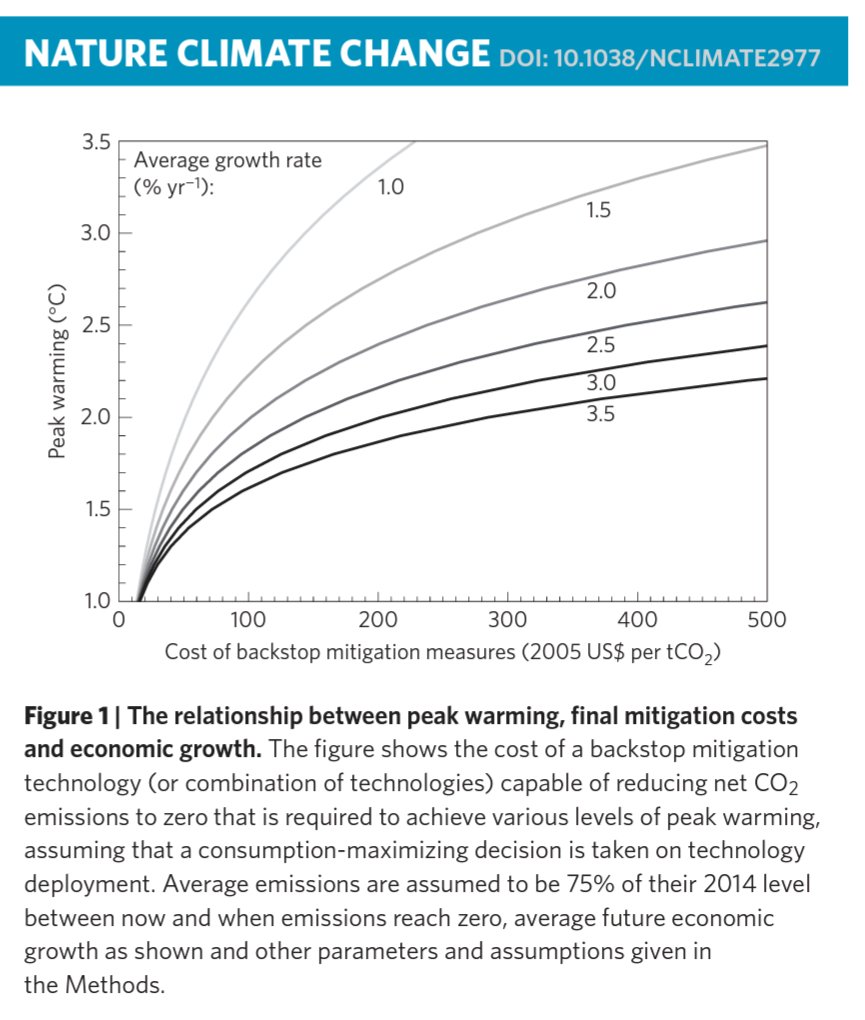
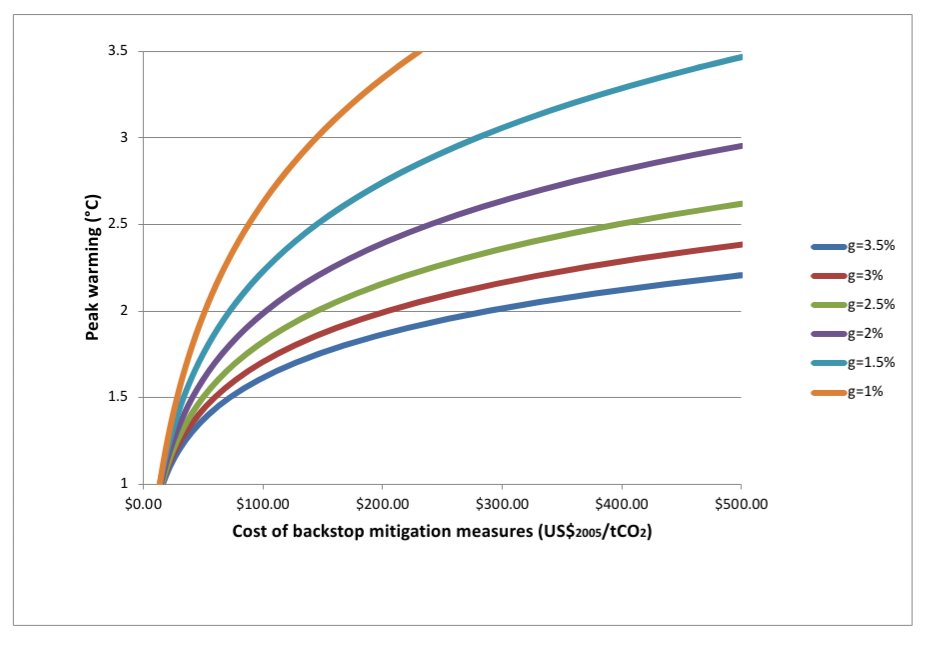
(And, as we do, recall that *climate physicist* Myles Allen *initially* undertook his investigation to see how sensitive the CBA-IAM's might be to variations in the emissions→temp module, *not* to economic growth and the backstop technology cost!)
I find this a *very* illuminating, clarifying result.
So, what are these results suggesting?
First, unsurprisingly, all else equal, lower levels of peak warming are associated with lower costs for the backstop technology.
Secondly, however, assuming backstop mitigation...
So, what are these results suggesting?
First, unsurprisingly, all else equal, lower levels of peak warming are associated with lower costs for the backstop technology.
Secondly, however, assuming backstop mitigation...
... measures are available and deployed when socially cost-effective, lower levels of peak warming are associated with 𝙝𝙞𝙜𝙝𝙚𝙧 levels of economic growth.
The implication, by this account, is - since peak temps are a function of *cumulative* emissions at the point of...
The implication, by this account, is - since peak temps are a function of *cumulative* emissions at the point of...
... of annual *flow* of zero-emissions - is that higher rates of economic growth yield lower cumulative emissions.
*Some* readers will also find this second part of the result unsurprising, but I suspect that *many* twitterati will balk at it.
So what is driving this outcome?
*Some* readers will also find this second part of the result unsurprising, but I suspect that *many* twitterati will balk at it.
So what is driving this outcome?
1• Recall that a term in the *damage* function at time 𝘵 is the *consumption* at time 𝘵. And, in turn, the marginal damages (SCC) is an integral of all future annual damages. Hence, to the extent that future consumption is higher, the marginal damages...
... are higher - e.g. more bridges, hospitals, well-being at risk of damage. And, assuming we act rationally to maximize our collective long-run welfare, rational, higher growth therefore should make us *more* willing - and *able* - to incur mitigation costs (and avoid these...
... damages) to cut emissions while we progress to net-zero.
And note!: this is not referring to higher *experienced* damages, but the higher assumed value of *avoiding* future damages.
2• Recall that the marginal abatement curve (MAC) also in part describes our willingness...
And note!: this is not referring to higher *experienced* damages, but the higher assumed value of *avoiding* future damages.
2• Recall that the marginal abatement curve (MAC) also in part describes our willingness...
... and ability to fund and adopt mitigation technologies at given prices up to (and including) intersection with the backstop technology price. Again, all else equal, at higher levels of growth and wealth, we will adopt the backstop technology sooner.
Again, to some people,...
Again, to some people,...
... these two points are going to seem self-evident.
But to those who may be even further balking, I'll just invite you to consider what the opposite cases would imply:
a• *lower* growth would somehow (🤔?) need to imply *even higher* perceived future damages...
But to those who may be even further balking, I'll just invite you to consider what the opposite cases would imply:
a• *lower* growth would somehow (🤔?) need to imply *even higher* perceived future damages...
... at *given temp level* even though consumption was *lower*;
b• our willingness and ability to fund and deploy the more expensive solutions to eliminate hard-to-abate emissions would somehow (🤔?) be *higher* if we were *poorer*.
It's not 𝘪𝘮𝘱𝘰𝘴𝘴𝘪𝘣𝘭𝘦 to make such...
b• our willingness and ability to fund and deploy the more expensive solutions to eliminate hard-to-abate emissions would somehow (🤔?) be *higher* if we were *poorer*.
It's not 𝘪𝘮𝘱𝘰𝘴𝘴𝘪𝘣𝘭𝘦 to make such...
... cases, but it's certainly not easy either (especially if not invoking special conditions just for one's favoured outcomes), and the onus should be on the ones making these claims counter to historically observed behaviours. But recognize that they also run...
... *diametrically opposite* to other arguments many of the same people regularly make: that future damages will (somehow) be *perceived* as *less* with lower consumption, and that richer nations should contribute technology transfer and deployment to poorer nations because of...
... their (observed) greater ability to develop and afford such technologies.
Anyway, that last bit is some added editorializing by me, but Myles Allen touches on some similar in the lecture.
We're both saying it's not impossible to argue the opposite, but it's a heavy lift...
Anyway, that last bit is some added editorializing by me, but Myles Allen touches on some similar in the lecture.
We're both saying it's not impossible to argue the opposite, but it's a heavy lift...
... if your argument doesn't simply start and end with "it's the other way just because."
So, that's *some* of what's driving these results under the covers.
What are some key implications?
For this, I'll simply directly take some excerpts from the last ~2/3ʳᵈ's page of...
So, that's *some* of what's driving these results under the covers.
What are some key implications?
For this, I'll simply directly take some excerpts from the last ~2/3ʳᵈ's page of...
... Myles Allen's article:
① "Growth matters, provided mitigation measures are available and deployed when socially cost-effective... for any (backstop technology price), the faster we can grow the world economy while not allowing average emissions to rise, the faster the...
① "Growth matters, provided mitigation measures are available and deployed when socially cost-effective... for any (backstop technology price), the faster we can grow the world economy while not allowing average emissions to rise, the faster the...
monetary value of the SCC rises and sooner (we'll) find it cost effective to reduce emissions to zero."
② "what matters for peak warming is the *total* emissions used to achieve a given rate of economic growth, *not* the *marginal change in emissions* associated with new...
② "what matters for peak warming is the *total* emissions used to achieve a given rate of economic growth, *not* the *marginal change in emissions* associated with new...
... production... Emission reduction measures that reduce the long-term rate of economic growth could be environmentally counterproductive if they impair the ability of future generations to reduce emissions to zero..."
③ "(T)he existence of at least one technology capable...
③ "(T)he existence of at least one technology capable...
... of reducing net CO₂ emissions to *𝙯𝙚𝙧𝙤* is crucial... (N)ot simply a substitute for fossil energy in a particular application, such as power generation:...a completely effective substitute in every application, including those for which fossil energy is most attractive..
"(W)e still do not know what this technology is, never mind what it will cost to deploy at the necessary scale... (but) the simplest hypothesis is that the backstop represents the cost of atmospheric CO₂ removal.
"(E)ven if *𝙤𝙩𝙝𝙚𝙧* measures are responsible...
"(E)ven if *𝙤𝙩𝙝𝙚𝙧* measures are responsible...
... for the *𝙗𝙪𝙡𝙠* of emission reductions... the cost of CO₂ removal and disposal is likely to determine the *𝙢𝙖𝙧𝙜𝙞𝙣𝙖𝙡* cost of reducing net CO2 emissions to *𝙯𝙚𝙧𝙤*...
"The cost of the backstop technology becomes much 𝙢𝙤𝙧𝙚 important in a low-growth world...
"The cost of the backstop technology becomes much 𝙢𝙤𝙧𝙚 important in a low-growth world...
... or for lower levels of peak warming. This is particularly germane to discussion of limiting warming to ‘‘well below 2°C’’. Achieving this, under the conditions shown in Fig. 1, would seem to require either very optimistic assumptions about future rates of economic growth,...
... or for the cost of backstop mitigation options such as large-scale CO₂ removal to be reduced to US$100/tCO₂ or less.
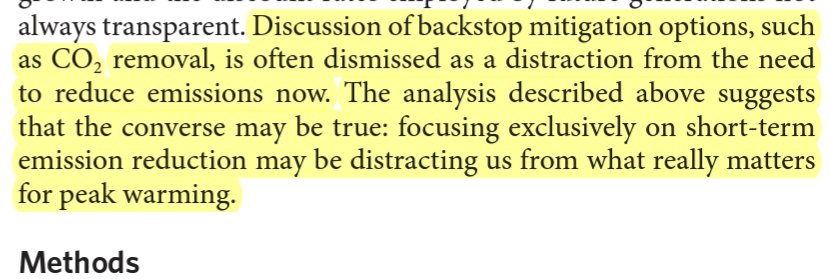
"Discussion of backstop mitigation options, such as CO₂ removal, is often dismissed as a distraction from the need to reduce emissions now. The analysis...
"Discussion of backstop mitigation options, such as CO₂ removal, is often dismissed as a distraction from the need to reduce emissions now. The analysis...
... described above suggests that *the converse may be true*: focusing exclusively on short-term emission reduction may be distracting us from what really matters for *peak* warming."
Note carefully!: this👆👇is in no ways advocating the use of the backstop...
Note carefully!: this👆👇is in no ways advocating the use of the backstop...
... technology - whatever it is - *in lieu of* "substitution" decarbonization technologies - e.g. clean power, etc. Rather, it suggests that the marginal cost of the backstop technology plays a surprisingly crucial role in when our net emissions reach 𝙯𝙚𝙧𝙤 (and temps peak)...
... Even if we're ultimately using relatively little of the backstop technology, *this remains the case*!
Before making some concluding tweets, for completeness I'll briefly touch on some caveats Myles Allen makes in his paper and or lecture:
Before making some concluding tweets, for completeness I'll briefly touch on some caveats Myles Allen makes in his paper and or lecture:
• "We do not address whether consumption maximization *should* be a policy objective or the assumption of sustained exponential consumption growth: the aim is simply to make their implications clear."
And, yes, obviously, one *can* solve for optimizing some different metric...
And, yes, obviously, one *can* solve for optimizing some different metric...
... of human welfare using a different setup - or even solving for some environmental objective first (go right ahead!). But the transparent sensitivity analysis here for backstop price and growth vs peak temperatures remains quite insightful.
• "Alternatively, future...
• "Alternatively, future...
... decision makers might assign a higher value to climate damages, by adopting a lower growth-corrected discount rate or higher values of D₀ or γ (perhaps motivated by welfare and equity considerations), or to reduce emissions below the level indicated by benefit–cost...
... maximization (on precautionary grounds, for example)."
Another way to get to a higher SCC earlier - and therefore, if we're rational, faster adoption of mitigation at higher MAC's - is to adopt higher damage function calibrations. *Unsurprisingly*!
Myles Allen - who...
Another way to get to a higher SCC earlier - and therefore, if we're rational, faster adoption of mitigation at higher MAC's - is to adopt higher damage function calibrations. *Unsurprisingly*!
Myles Allen - who...
... began his investigation thinking his most substantive physicist's contribution to the IAM outputs might be improvements to the emissions→temp modules, concludes in his lecture that helping improve the damage function - especially at lower temps - may be where physicists can
... help economic modelling best.
He cites Nordhaus' plea for the same👇. 🤷
He cites Nordhaus' plea for the same👇. 🤷
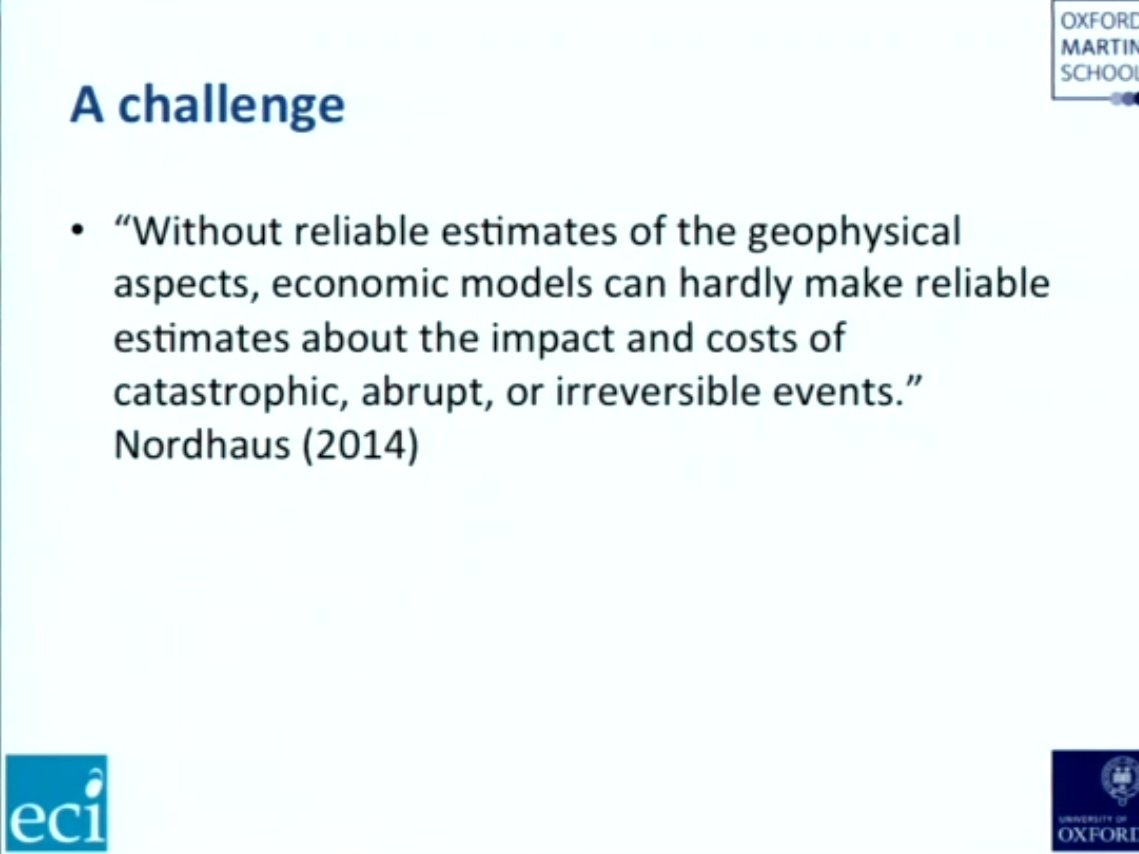
(obviously, since 2015, considerable effort has been made in this direction. e.g., via @GernotWagner, et al.👇, many other examples)
pnas.org/doi/10.1073/pn…
In any event, these caveats by Allen are well understood in the IAM literature and active debate.
pnas.org/doi/10.1073/pn…
In any event, these caveats by Allen are well understood in the IAM literature and active debate.
The sensitivity analysis - given the limitations of his model setup - stands.
I'm going to leave off here - for now anyway. I'm exhausted, and it may be that this thread gets very limited engagement. Anyway, wanted to write this much up. I'm going to tweet a *much* shorter...
I'm going to leave off here - for now anyway. I'm exhausted, and it may be that this thread gets very limited engagement. Anyway, wanted to write this much up. I'm going to tweet a *much* shorter...
... tl;dr sister thread. Probably will return to this main thread later.
• • •
Missing some Tweet in this thread? You can try to
force a refresh